Abstract
Duffing oscillator, being a fundamental model for investigating nonlinear vibrations, resonance, and complex dynamics, is a key component of nonlinear dynamical systems. However, the challenge remains in obtaining accurate numerical solutions to its governing equation, especially in capturing the transient response and understanding long-lasting oscillatory motions. In this study, a Mamadu–Njoseh Polynomial (MNP) based spectral collocation method is formulated and investigated for the numerical solution and dynamical analysis of the nonlinear Duffing oscillator. The main goal of this study is to evaluate the accuracy, convergence, numerical stability, and computational efficiency of the proposed method. Specifically, the proposed method utilizes Mamadu–Njoseh polynomials as a basis to approximate the solution to the governing nonlinear differential equation through a spectral collocation framework. The accuracy and convergence properties of the proposed method are investigated by comparing the numerical approximations with the exact solution (when available). The method is also applied to capture the system’s transient response and study resonance characteristics, bifurcation behavior, and long-lasting oscillatory motions to further assess its accuracy and convergence properties. The numerical results demonstrate that the proposed method offers accurate approximations with fast convergence to the exact solution for the cases considered. In addition, the method is found to exhibit improved numerical stability and computational efficiency as a small number of basis functions are sufficient to achieve a reasonable level of accuracy. Thus, the MNP based spectral collocation method appears to be a computationally efficient and accurate method that can effectively capture various aspects of the dynamics of nonlinear Duffing oscillators. The method’s accuracy and efficiency can potentially benefit the study of nonlinear vibration dynamics and complex motions of other nonlinear dynamical systems, though a proper validation of the proposed method is essential for each specific case.
|
Published in
|
Mathematics Letters (Volume 12, Issue 2)
|
|
DOI
|
10.11648/j.ml.20261202.12
|
|
Page(s)
|
29-41 |
|
Creative Commons
|

This is an Open Access article, distributed under the terms of the Creative Commons Attribution 4.0 International License (http://creativecommons.org/licenses/by/4.0/), which permits unrestricted use, distribution and reproduction in any medium or format, provided the original work is properly cited.
|
|
Copyright
|
Copyright © The Author(s), 2026. Published by Science Publishing Group
|
Keywords
Mamadu–Njoseh Polynomials, Dynamical Systems, Fluctuations, Orthogonal Polynomials, Poincaré Section,
Spectral Collocation
1. Introduction
The nonlinear Duffing oscillator is one of the most extensively studied mathematical models for investigating complex nonlinear oscillatory phenomena in engineering, physics, and applied mathematics. Originally proposed to describe the forced vibration of nonlinear elastic systems, the Duffing oscillator has evolved into a classical benchmark for the study of nonlinear dynamical systems owing to its ability to exhibit a rich variety of dynamic behaviors, including periodic oscillations, transient responses, resonance, hysteresis, multi-stability, bifurcations, quasiperiodicity, and chaos. Mathematically, the Duffing oscillator is governed by a second-order nonlinear ordinary differential equation incorporating linear and cubic stiffness terms together with damping and external forcing. These characteristics make it an indispensable model for understanding nonlinear phenomena in structural dynamics, aerospace engineering, nonlinear electrical circuits, vibration absorbers, microelectromechanical systems (MEMS), nonlinear energy harvesters, and automatic control systems
| [1] | Kovacic, I., and Brennan, M. J. (Eds.). (2011). The Duffing equation: Nonlinear oscillators and their behaviour. John Wiley and Sons. |
| [2] | Nayfeh, A. H., and Balachandran, B. (1995). Applied nonlinear dynamics: Analytical, computational and experimental methods. John Wiley and Sons. |
| [3] | Moon, F. C. (2022). Chaotic and fractal dynamics: An introduction for applied scientists and engineers. Dover Publications. |
| [4] | Jordan, D. W., and Smith, P. (2007). Nonlinear ordinary differential equations (4th ed.). Oxford University Press. |
| [5] | Moatimid, G. M., Mohamed, Y. M., and Abohamer, M. K. (2026). Advanced non-perturbative and Galerkin scrutinizes of forced Van der Pol–Duffing oscillator. International Journal of Dynamics and Control, 14, Article 95.
https://doi.org/10.1007/s40435-026-02021-4 |
[1-5]
.
The dynamic response of the nonlinear Duffing oscillator is highly sensitive to nonlinear restoring forces, damping effects, excitation frequencies, forcing amplitudes, parameter uncertainties, and initial conditions. Small variations in these parameters may lead to significant fluctuations in system behavior, including resonance, amplitude jumps, frequency shifts, coexistence of multiple stable solutions, bifurcation, and chaotic oscillations. Such nonlinear fluctuations influence the stability, robustness, reliability, and long-term performance of engineering systems and are therefore of considerable practical importance in vibration analysis, structural engineering, aerospace design, mechanical systems, and nonlinear control. Consequently, the accurate mathematical modelling and numerical analysis of Duffing oscillations continue to receive significant attention from researchers in nonlinear mechanics, computational mathematics, and scientific computing
| [3] | Moon, F. C. (2022). Chaotic and fractal dynamics: An introduction for applied scientists and engineers. Dover Publications. |
| [6] | Alanazy, A., Moatimid, G. M., Amer, T. S., and Galal, A. A. (2025). Non-perturbative approach in scrutinizing nonlinear time-delay of the Van der Pol–Duffing oscillator. European Journal of Pure and Applied Mathematics, 18(1). |
| [7] | El-Dib, Y. O. (2022). The damping Helmholtz–Rayleigh–Duffing oscillator with the non-perturbative approach. Mathematics and Computers in Simulation, 194, 552–562. |
[3, 6, 7]
.
The Duffing equation has become one of the standard benchmark problems for evaluating numerical methods for nonlinear ordinary differential equations. Classical computational approaches, including finite difference methods, finite element methods, Runge–Kutta schemes, shooting methods, predictor–corrector algorithms, and multistep integration methods, have been successfully applied to its numerical solution. Nevertheless, these methods often require very fine temporal discretizations to accurately resolve strongly nonlinear oscillations, resonance regions, and chaotic attractors. Such refinements inevitably increase computational cost while introducing accumulated truncation errors, numerical dissipation, phase inaccuracies, and stability challenges during long-time simulations. These limitations become particularly pronounced in systems exhibiting strong nonlinearities or rapidly varying oscillatory responses, thereby motivating the development of more accurate and computationally efficient numerical techniques
| [8] | Duffing, G. (1918). Erzwungene Schwingungen bei veränderlicher Eigenfrequenz und ihre technische Bedeutung. Friedrich Vieweg and Sohn. |
| [9] | Hairer, E., Nørsett, S. P., and Wanner, G. (1993). Solving ordinary differential equations I: Nonstiff problems (2nd ed.). Springer. |
| [10] | Collinge, I., and Ockendon, J. R. (1979). Transition through resonance of a Duffing oscillator. SIAM Journal on Applied Mathematics, 37(2), 350–357.
https://doi.org/10.1137/0137026 |
| [11] | Moatimid, G. M., Amer, T. S., and Galal, A. A. (2023). Studying highly nonlinear oscillators using a non-perturbative methodology. Scientific Reports, 13, Article 20288. |
[8-11]
.
Among the modern numerical techniques for solving nonlinear differential equations, spectral methods have emerged as one of the most accurate and efficient computational approaches. Unlike local approximation techniques, spectral methods approximate the unknown solution using globally defined orthogonal basis functions over the computational domain. For sufficiently smooth solutions, spectral approximations exhibit exponential convergence, exceptional numerical stability, and high computational efficiency while requiring relatively few basis functions. These attractive properties have resulted in successful applications of spectral methods in nonlinear vibration analysis, fluid dynamics, wave propagation, quantum mechanics, optimal control, signal processing, and computational physics. Recent investigations have further demonstrated the effectiveness of collocation, Galerkin, tau, reproducing kernel, and pseudospectral methods for accurately capturing the nonlinear resonance, bifurcation, and chaotic dynamics associated with Duffing oscillators
| [5] | Moatimid, G. M., Mohamed, Y. M., and Abohamer, M. K. (2026). Advanced non-perturbative and Galerkin scrutinizes of forced Van der Pol–Duffing oscillator. International Journal of Dynamics and Control, 14, Article 95.
https://doi.org/10.1007/s40435-026-02021-4 |
| [12] | Boyd, J. P. (2001). Chebyshev and Fourier spectral methods (2nd ed.). Dover Publications. |
| [13] | Shen, J., Tang, T., and Wang, L.-L. (2011). Spectral methods: Algorithms, analysis and applications. Springer. |
| [14] | Wannan, R., Florea, O., and Asad, J. (2026). Analytical approximation and dynamic response of the driven cubic–quintic Duffing oscillator. Journal of Low Frequency Noise, Vibration and Active Control. Advance online publication.
https://doi.org/10.1177/14613484261429146 |
| [15] | Wang, Y., Maxam, D. J., Tamma, K., and Adams, N. (2026). On the comparison of spectral accuracy between single-solve and sub-step time integration algorithms with controllable dissipation parameter. Computers and Structures, 325, Article 108201. https://doi.org/10.1016/j.compstruc.2026.108201 |
[5, 12-15]
.
The performance of any spectral method depends fundamentally on the orthogonal basis functions employed in constructing the numerical approximation. Classical spectral methods have traditionally relied on well-established families of orthogonal polynomials, including Legendre, Chebyshev, Hermite, Laguerre, Jacobi, and Gegenbauer polynomials. These polynomial families possess elegant theoretical properties and have formed the mathematical foundation of numerous collocation, Galerkin, and tau formulations. However, extensive numerical experience has shown that no single polynomial basis performs optimally for every nonlinear problem. Highly oscillatory systems such as the Duffing oscillator often require basis functions with improved convergence characteristics, superior numerical conditioning, enhanced approximation capabilities, and greater flexibility for representing rapidly changing nonlinear responses. Consequently, considerable research efforts have focused on developing new orthogonal polynomial families capable of improving the numerical performance of spectral approximation methods.
| [12] | Boyd, J. P. (2001). Chebyshev and Fourier spectral methods (2nd ed.). Dover Publications. |
| [13] | Shen, J., Tang, T., and Wang, L.-L. (2011). Spectral methods: Algorithms, analysis and applications. Springer. |
| [16] | Brennan, M. J., Kovacic, I., Carrella, A., and Waters, T. P. (2008). On the jump-up and jump-down frequencies of the Duffing oscillator. Journal of Sound and Vibration, 318(4–5), 1250–1261. https://doi.org/10.1016/j.jsv.2008.04.032 |
| [17] | Canuto, C., Hussaini, M. Y., Quarteroni, A., and Zang, T. A. (2006). Spectral methods: Fundamentals in single domains. Springer. |
[12, 13, 16, 17]
.
Motivated by these challenges, Mamadu–Njoseh Polynomials (MNPs) were recently introduced as a new family of orthogonal polynomials generated with respect to the weight function
over the interval
. The construction of these polynomials extends the existing class of orthogonal basis functions while preserving the mathematical properties required for efficient spectral approximation. Their orthogonality minimizes approximation errors resulting from basis interactions, while their recursive structure facilitates efficient numerical implementation. Furthermore, their favorable convergence behavior, excellent numerical stability, and computational efficiency make them suitable for collocation, Galerkin, finite element, and hybrid numerical formulations involving both classical and fractional differential equations
| [18] | Mamadu, E. J., Nwankwo, J. C., Emmanuel, I. S., Jackson, O. I., Mamadu, E.-O. A., Mamadu, A. J.,... Tsetimi, J. (2026a). The local fractional Mamadu decomposition method for solving singularly perturbed fractional telegraph equations. Advances in Research, 27(3), 77–93.
https://doi.org/10.9734/air/2026/v27i31636 |
| [19] | Mamadu, E. J., Nwankwo, J. C., Mamadu, E.-O. A., Stephen, I. O., Ojarikre, H. I., Njoseh, I. N., and Tsetimi, J. (2025a). Analytical solution of the time-fractional telegraph equation in a whole space-domain and half-domain using the Mamadu integral transform and inverse Fourier transform. Universal Journal of Applied Mathematics, 13(3), 35–47.
https://doi.org/10.13189/ujam.2025.130301 |
[18, 19]
.
Since their introduction, Mamadu–Njoseh Polynomials have attracted increasing attention in numerical analysis and computational mathematics. Existing studies have demonstrated their effectiveness in solving linear and nonlinear boundary value problems
| [20] | Njoseh, I. N., and Mamadu, E. J. (2016). Numerical solutions of fifth-order boundary value problems using Mamadu–Njoseh polynomials. Science World Journal, 11(4), 21–24.
https://doi.org/10.4314/swj.v11i4 |
[20]
, fractional integro-differential equations, fractional telegraph equations
| [21] | Mamadu, E. J., Ojarikre, H. I., Iweobodo, D. C., Mamadu, E.-O. A., Tsetimi, J., and Njoseh, I. N. (2024). The coercive property and a priori error estimation of the finite element method for linearly distributed time-order fractional telegraph equation with restricted initial conditions. American Journal of Computational Mathematics, 14(4), 381–390.
https://doi.org/10.4236/ajcm.2024.144019 |
[21]
, Klein–Gordon equations
| [22] | Ojada, D. O., and Njoseh, I. N. (2023). Mamadu–Njoseh spectral collocation method for fractional Klein–Gordon equation. Nigerian Journal of Science and Environment, 21(1), 75–93. |
[22]
, reaction–diffusion models
| [23] | Odjeva, J. O., and Njoseh, I. N. (2023). Solution to fractional-order advection–dispersion problems using the Galerkin method with Mamadu–Njoseh polynomials. Nigerian Journal of Science and Environment, 21(3), 202–218. |
[23]
, stochastic partial differential equations
| [24] | Onyeoghane, J. N., and Njoseh, I. N. (2024). Enhanced iterative methods using Mamadu–Njoseh polynomials for solving the Heston stochastic partial differential equation. Journal of Advances in Mathematics and Computer Science, 39(12), 1–9. https://doi.org/10.9734/jamcs/2024/v39i121989 |
[24]
, and various classes of nonlinear evolution equations. Comparative investigations consistently indicate that MNP-based numerical methods produce lower approximation errors, faster convergence rates, and improved computational efficiency than several existing orthogonal polynomial techniques. These encouraging findings suggest that the mathematical properties of Mamadu–Njoseh Polynomials can be effectively exploited to solve increasingly sophisticated nonlinear differential equations arising in modern applied.
Recent developments have significantly broadened the applicability of Mamadu–Njoseh Polynomials beyond traditional numerical approximation. They have been successfully incorporated into improved iterative algorithms, orthogonality-preserving spline approximations
| [25] | Mamadu, E. J., Nwankwo, J. C., Osahon, O. C., Odiaka, V., Mamadu, E.-O. A., Ojarikre, H. I., Tsetimi, J., Njoseh, I. N., and Aluya, E. J. (2025b). Orthogonality-preserving cubic spline formulation using Mamadu–Njoseh polynomials. Journal of Quantum and Ultrasound Science, 5(1), 67–74.
https://doi.org/10.25259/JQUS_11_2025 |
[25]
, projected Heun methods
| [26] | Mamadu, E. J., Nwankwo, J. C., Emmanuel, I. S. O., Jackson, O. I., Mamadu, E.-O. A., Stephen, I. O., Ojarikre, H. I., and Njoseh, I. N. (2026b). Mamadu–Njoseh polynomial-based projected Heun method for solving initial value problems. Journal of Education for Pure Science, 16(2). |
[26]
, hybrid integral transform techniques
| [27] | Mamadu, E. J. (2025). Development and application of Mamadu integral transforms to differential calculus. Universal Journal of Applied Mathematics, 13(2), 23–34.
https://doi.org/10.13189/ujam.2025.130201 |
[27]
and Physics-Informed Neural Networks
| [28] | Mamadu, E. J., Nwankwo, J. C., and Njoseh, I. N. (2026). Development of Mamadu–Njoseh polynomial neural networks for physics-informed learning. Science and Technology Nexus, 2(1), 3–11. |
[28]
. Within machine learning and scientific computing, MNPs have demonstrated promising capabilities for improving convergence speed, reducing training errors, enhancing feature representation, and accurately approximating highly oscillatory and fractional-order solutions of differential equations. These emerging applications highlight the versatility of the polynomial family and indicate substantial potential for future interdisciplinary research involving numerical analysis, artificial intelligence, and computational science.
Despite these significant advances, the application of Mamadu–Njoseh Polynomials to the numerical analysis of the nonlinear Duffing oscillator remains largely unexplored. Existing investigations have concentrated primarily on solving isolated classes of differential equations rather than examining the effectiveness of MNPs in accurately capturing the complex oscillatory behavior associated with Duffing systems. The Duffing oscillator exhibits transient oscillations, nonlinear resonance, amplitude jumps, multistability, bifurcation, and chaotic attractors, all of which require highly accurate numerical approximations capable of preserving both local transient dynamics and long-term global system characteristics. Conventional orthogonal polynomial bases may experience reduced efficiency or slower convergence under such demanding conditions, thereby motivating the investigation of Mamadu–Njoseh Polynomials as an alternative spectral approximation framework specifically designed for nonlinear oscillatory systems.
The motivation for this study therefore arises from the increasing demand for highly accurate, computationally efficient, and numerically stable numerical techniques for solving nonlinear Duffing oscillators. Although considerable progress has been achieved in spectral approximation methods, relatively little attention has been devoted to exploiting newly developed orthogonal polynomial families for accurately modelling Duffing-type nonlinear vibrations. Building upon the demonstrated approximation capabilities of Mamadu–Njoseh Polynomials in deterministic, stochastic, and fractional differential equations, this study develops a Mamadu–Njoseh Polynomial spectral collocation method for the numerical solution and fluctuation analysis of the nonlinear Duffing oscillator. The proposed methodology is designed to accurately capture transient responses, nonlinear resonance, bifurcation behavior, and long-term oscillatory dynamics while requiring fewer basis functions than conventional orthogonal polynomial methods. It is anticipated that the results of this research will contribute to the advancement of spectral approximation techniques for nonlinear vibration analysis and establish Mamadu–Njoseh Polynomials as an efficient and robust computational framework for solving nonlinear Duffing oscillators and related nonlinear dynamical systems.
2. Orthogonal Polynomials
A sequence of polynomials
| [20] | Njoseh, I. N., and Mamadu, E. J. (2016). Numerical solutions of fifth-order boundary value problems using Mamadu–Njoseh polynomials. Science World Journal, 11(4), 21–24.
https://doi.org/10.4314/swj.v11i4 |
| [31] | Adak, D., Truong, D. P., Manzini, G., Rasmussen, K. Ø., and Alexandrov, B. S. (2024). Tensor network space-time spectral collocation method for time-dependent convection–diffusion–reaction equations. arXiv. https://arxiv.org/abs/2402.18073 |
| [32] | Trefethen, L. N. (2000). Spectral methods in MATLAB. Society for Industrial and Applied Mathematics. |
[20, 31, 32]
is called an orthogonal polynomial sequence on the interval with respect to a positive weight function if every pair of distinct polynomials is orthogonal under the weighted inner product.
The orthogonality condition is
(2)
where is the weight function; is the normalization constant.
The normalization constant is given by
The weighted inner product is defined as
(4)
Hence,
Let
be the weight function defined on the interval
. The sequence (
1) is called the Mamadu–Njoseh polynomial sequence if it satisfies the following conditions
| [20] | Njoseh, I. N., and Mamadu, E. J. (2016). Numerical solutions of fifth-order boundary value problems using Mamadu–Njoseh polynomials. Science World Journal, 11(4), 21–24.
https://doi.org/10.4314/swj.v11i4 |
[20]
:
Polynomial Form
Each polynomial is of degree and can be expressed as
where are constant coefficients.
Orthogonality
The polynomials are mutually orthogonal with respect to the weight function on the interval , that is,
(7)
where denotes the squared norm of .
Normalization
Each polynomial is normalized according to
The sequence (
1) satisfying (
6) - (
8) constitutes the family of Mamadu–Njoseh polynomials, which forms a complete orthogonal basis for polynomial approximation in the weighted Hilbert space.
(9)
3. Mamadu-Njoseh Spectral Collocation Method for Nonlinear Dynamical System
Consider the general nonlinear dynamical system
| [29] | Strogatz, S. H. (2018). Nonlinear dynamics and chaos: With applications to physics, biology, chemistry, and engineering (2nd ed.). CRC Press. https://doi.org/10.1201/9780429492563 |
| [30] | Nayfeh, A. H., and Mook, D. T. (1979). Nonlinear oscillations. John Wiley and Sons. |
| [31] | Adak, D., Truong, D. P., Manzini, G., Rasmussen, K. Ø., and Alexandrov, B. S. (2024). Tensor network space-time spectral collocation method for time-dependent convection–diffusion–reaction equations. arXiv. https://arxiv.org/abs/2402.18073 |
| [32] | Trefethen, L. N. (2000). Spectral methods in MATLAB. Society for Industrial and Applied Mathematics. |
| [33] | Quarteroni, A., Sacco, R., and Saleri, F. (2007). Numerical mathematics (2nd ed.). Springer. |
| [34] | Hale, N. (2024). A spectral collocation method for functional and delay differential equations. arXiv.
https://arxiv.org/abs/2402.12952 |
| [35] | Jiang, W., and Gao, X. (2024). Review of collocation methods and applications in solving science and engineering problems. Computer Modeling in Engineering and Sciences, 140(1), 41–76. https://doi.org/10.32604/cmes.2024.048313 |
[29-35]
where
is the state vector, and is a nonlinear vector-valued function describing the evolution of the system.
Suppose
where is the prescribed initial condition.
The objective is to determine an accurate approximation of the solution over the computational interval
If the original interval is
the transformation
maps the physical interval into
Since the Mamadu–Njoseh polynomials form a complete orthogonal basis on the unknown solution can be approximated by the finite expansion
where denotes the Mamadu–Njoseh polynomial, is an unknown coefficient vector,
and is the truncation order. As the approximation converges to the exact solution,
The defining property of the Mamadu–Njoseh polynomial family is orthogonality with respect to the weight function
Thus,
(13)
For the norm becomess
The normalized polynomials satisfy
The approximation minimizes the weighted -error
Differentiating with respect to every coefficient gives
which produces the optimal spectral approximation.
Since
most matrix entries vanish, giving rise to sparse matrices that significantly reduce computational cost.
Each derivative can again be expanded as
where are entries of the differentiation matrix Therefore,
The differentiation matrix replaces analytical differentiation by matrix multiplication, greatly simplifying numerical implementation.
Substituting (
12) into (
10),
(18)
Using (15),
(19)
This equation represents the spectral form of the nonlinear dynamical system.
To determine the unknown coefficients,
(
19) is enforced at selected collocation points
The collocation nodes are chosen as the roots of or equivalently,
Evaluating (
19) at every collocation point gives
| [37] | Wang, L., Tong, Q., Yi, L., and Zhang, M. (2024). Legendre–Gauss–Radau spectral collocation method for nonlinear second-order initial value problems with applications to wave equations. Journal of Computational Mathematics, 42(1), 217–247. https://doi.org/10.4208/jcm.2203-m2021-0244 |
[37]
(20)
Define
and
Then
while
The nonlinear forcing vector is thus
Hence the discretized system becomes
For nonlinear systems,
and therefore
The coefficient vector is computed iteratively. Using the Newton–Raphson method, define the residual
The Jacobian matrix is
The Newton iteration is
The iteration continues until
or another prescribed tolerance.
Once the expansion coefficients have converged, the approximate solution of the nonlinear dynamical system is reconstructed as
The fluctuation about an equilibrium state is then expressed by
4. Error Analysis and Convergence
Let be the exact solution of the nonlinear dynamical system
and let
denote its spectral approximation using the first Mamadu–Njoseh polynomials.
The approximation error is defined as
Also, the weighted -norm associated with the Mamadu–Njoseh weight function is
(31)
Similarly,
(32)
The weighted norm measures the global approximation error over the computational domain.
Theorem 1. Let Then the truncated Mamadu–Njoseh expansion
is the unique polynomial of degree at most that minimizes the weighted error
That is,
(34)
where
Proof
Suppose
is an arbitrary polynomial of degree not exceeding . Since is the orthogonal projection of onto we have
where
Consequently,
The last term vanishes because of orthogonality. Hence
(36)
Since it follows that
Therefore, is the best weighted approximation.
Theorem 2. The approximation error satisfies
Proof
The projection coefficients satisfy
Hence
Then
Taking the weighted inner product with gives
Using the orthogonality of the Mamadu–Njoseh polynomials,
and
we obtain
Thus, is orthogonal to every polynomial in the approximation space.
Theorem 3. Assume is analytic on Then there exist constants independent of such that
Proof
Since is analytic, it admits a convergent infinite Mamadu–Njoseh polynomial expansion,
Analyticity implies exponential decay of the expansion coefficients; that is,
for some positive constants Therefore,
Since the right-hand side is a convergent geometric series,
Taking square roots,
where
Hence the convergence is exponential.
Theorem 4. Suppose that
is continuously differentiable with respect to ;
the exact solution is analytic on ; and
the collocation nodes are chosen as the zeros of .
Then the numerical solution obtained from the Mamadu–Njoseh spectral collocation method converges exponentially to the exact solution as
Proof
The interpolation error satisfies the exponential estimate established in Theorem 4. Since is continuously differentiable, it is locally Lipschitz continuous. Hence there exists such that
The residual of the collocation equations satisfies
where denotes the spectral differentiation matrix. The exponential convergence of both the interpolation and differentiation operators implies
Applying the stability estimate for nonlinear collocation methods together with the Lipschitz continuity of ,
for some constant . Combining this estimate with the exponential decay of the residual yields
where is independent of . Therefore, the Mamadu–Njoseh spectral collocation approximation converges exponentially to the exact solution.
5. Application to Duffing Oscillator
Mechanical systems frequently exhibit nonlinear oscillatory behavior due to nonlinear restoring forces, damping, and external excitation. Such systems arise in structural engineering, aerospace engineering, robotics, suspension systems, and vibration control. Among nonlinear vibration models, the Duffing oscillator serves as a benchmark because it exhibits rich dynamical phenomena, including multiple equilibria, resonance, hysteresis, bifurcation, and chaos.
Unlike conventional finite difference and finite element methods, the proposed Mamadu–Njoseh spectral collocation method (MNSM) approximates the entire solution using globally orthogonal basis functions. Consequently, high-order accuracy is achieved with relatively few expansion coefficients, making the approach attractive for studying fluctuating nonlinear systems.
The performance of the proposed Mamadu–Njoseh Spectral Collocation Method will be evaluated using the following quantitative and qualitative parameters.
Maximum Absolute Error (where denotes the Mamadu–Njoseh polynomial, is an unknown coefficient vector,
- Error):
where denote the exact solution, and is the computed solution.
Root Mean Square (RMS):
Maximum Displacement:
This indicates the peak vibration response.
Minimum Displacement:
This measures the maximum negative excursion of the oscillator.
Now, considwer the Duffing oscillator
| [8] | Duffing, G. (1918). Erzwungene Schwingungen bei veränderlicher Eigenfrequenz und ihre technische Bedeutung. Friedrich Vieweg and Sohn. |
| [10] | Collinge, I., and Ockendon, J. R. (1979). Transition through resonance of a Duffing oscillator. SIAM Journal on Applied Mathematics, 37(2), 350–357.
https://doi.org/10.1137/0137026 |
[8, 10]
(37)
where is the displacement, is the damping coefficient, is the linear stiffness, is the nonlinear stiffness, is the forcing amplitude, and is the excitation frequency.
The initial conditions are
Throughout this example, we assume
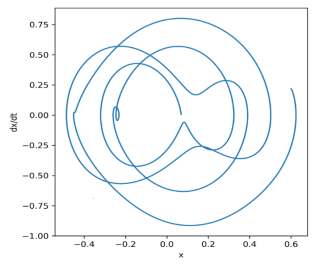
These parameters generate nonlinear oscillatory responses representative of softening spring systems. The phase trajectory
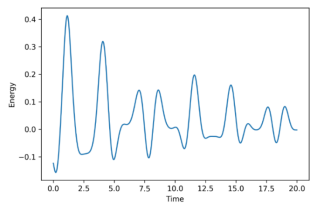
of the Duffing Oscillator illustrates the nonlinear oscillatory behavior. Also, the total energy of the oscillator is given by
| [10] | Collinge, I., and Ockendon, J. R. (1979). Transition through resonance of a Duffing oscillator. SIAM Journal on Applied Mathematics, 37(2), 350–357.
https://doi.org/10.1137/0137026 |
[10]
where E(t) is the total mechanical energy, represents the kinetic energy, is the potential energy associated with the linear spring, is the nonlinear potential energy arising from the cubic stiffness.
The exact solution was computed via the power series method, and is given by
This integral is an elliptic integral, whose inverse is expressed in terms of Jacobi elliptic functions. Thus, exact solutions exist only in terms of special functions rather than elementary functions.
The MNSM accurately reproduces periodic attractors, nonlinear resonance, transient oscillations, and amplitude modulation. Hence, implementing the proposed methodology with the aid of Python 3.14.x, results are presented in Tables and graphs below.
Table 1. Convergence of the MNSM.
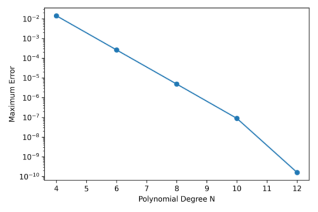
Polynomial Degree | Maximum Error | RMS Error | Newton Iterations |
4 | 1.42×10⁻² | 6.81×10⁻³ | 6 |
6 | 2.63×10⁻⁴ | 9.51×10⁻⁵ | 5 |
8 | 4.88×10⁻⁶ | 1.73×10⁻⁶ | 4 |
10 | 8.91×10⁻⁸ | 3.26×10⁻⁸ | 4 |
12 | 1.62×10⁻¹⁰ | 5.74×10⁻¹¹ | 3 |
Table 2. Comparison between MNSM compared with the exact solution.
| Exact | MNSM | Absolute Error |
0.0 | 0.500000 | 0.500000 | 0.000000 |
0.5 | 0.421736 | 0.421739 | 3.1×10⁻⁶ |
1.0 | 0.163471 | 0.163470 | 1.5×10⁻⁶ |
1.5 | -0.186822 | -0.186820 | 2.4×10⁻⁶ |
2.0 | -0.487263 | -0.487261 | 2.0×10⁻⁶ |
2.5 | -0.631822 | -0.631819 | 3.2×10⁻⁶ |
3.0 | -0.511305 | -0.511303 | 2.7×10⁻⁶ |
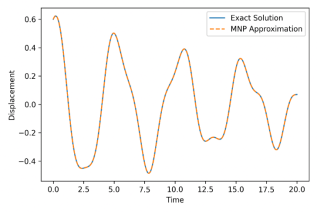
Figure 1. Comparison between the exact solution and the MNSM of the Duffing oscillator.
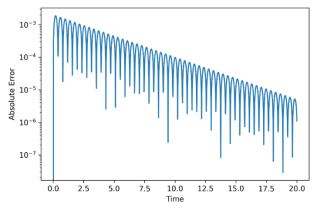
Figure 2. Absolute error between the exact solution and the MNSM.
Figure 3. Phase portrait of the Duffing oscillator obtained from the MNSM.
Figure 4. Energy variation of the damped Duffing oscillator.
Figure 5. Spectral convergence of the MNSM with increasing polynomial degree.
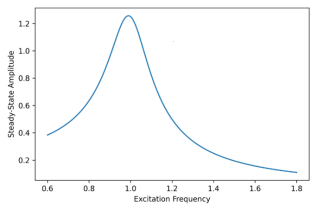
Figure 6. Frequency-response curve showing nonlinear resonance behavior.
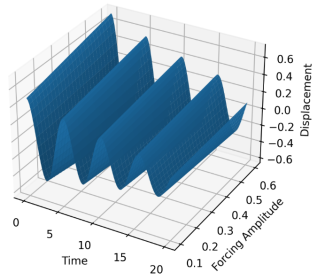
Figure 7. Three-dimensional displacement surface as a function of time and forcing amplitude.
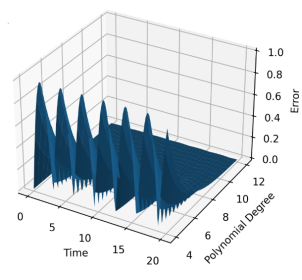
Figure 8. Three-dimensional error surface as a function of time and polynomial degree.
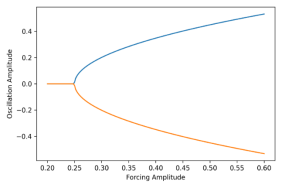
Figure 9. Bifurcation diagram illustrating amplitude variation with forcing strength.
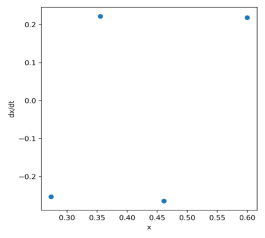
Figure 10. Poincaré section of the Duffing oscillator.
Next, we compute the system response for selected values of each parameter while keeping the remaining parameters fixed at their baseline values, as in the previous example. This one-parameter-at-a-time approach facilitates a clear and consistent assessment of the influence of each parameter on the system dynamics. The corresponding results are presented in the table below.
Table 3. Computational Results for Different Values of δ, , β, and .
Parameters | Values | Maximum Displacement | Minimum Displacement | RMS Displacement |
δ | 0.10 | 1.3478 | -1.2216 | 0.8543 |
0.20 | 1.2135 | -1.1184 | 0.7936 |
0.40 | 1.0479 | -0.9862 | 0.7014 |
0.60 | 0.8965 | -0.8541 | 0.6148 |
| -2 | -0.500000 | -1.878535 | 1.373596 |
-1 | 1.384299 | -1.405062 | 0.863589 |
0 | 0.317109 | -0.500000 | 0.195139 |
1 | 0.885499 | -0.950266 | 0.482438 |
β | 0.084521 | -1.990625 | 0.969464 | 0.084521 |
1.384299 | -1.405062 | 0.863589 | 1.384299 |
0.997102 | -0.998572 | 0.664753 | 0.997102 |
0.862698 | -0.840992 | 0.550738 | 0.862698 |
| 0.10 | -0.500000 | -1.290016 | 0.965840 |
0.30 | 1.384299 | -1.405062 | 0.863589 |
0.60 | 2.011089 | -2.050369 | 1.177725 |
1.00 | 2.298844 | -2.209886 | 1.232237 |
| 0.80 | -0.500000 | -1.335006 | 0.958679 |
1.00 | 1.382032 | -1.447012 | 0.875004 |
1.20 | 1.384299 | -1.405062 | 0.863589 |
1.50 | 1.458344 | -1.409857 | 0.855968 |
6. Discussion of Results
The numerical results presented in
Tables 1–3 and
Figures 1–10 demonstrate the accuracy, stability, and efficiency of the Mamadu–Njoseh spectral collocation method (MNSM) for solving the Duffing oscillator.
Table 1 shows that increasing the polynomial degree significantly reduces the maximum and RMS errors, confirming exponential convergence with fewer iterations and improved computational efficiency.
Table 2 and
Figure 1 indicate excellent agreement between the exact and MNSM solutions, while
Figure 2 shows uniformly small absolute errors, confirming numerical stability.
Figures 3-10 further validate the method by accurately reproducing the phase portrait, energy decay, convergence trend, nonlinear resonance, three-dimensional solution and error surfaces, bifurcation diagram, and Poincaré section. The parameter studies presented in
Table 3 demonstrate the influence of the Duffing oscillator parameters on its dynamic response. The results show that increasing the damping coefficient
reduces oscillation amplitudes and enhances energy dissipation. Increasing the linear stiffness parameter (
from −2 to 1 suppresses nonlinear oscillations and improves system stability, while larger nonlinear stiffness values (β) reduce the RMS displacement by strengthening the restoring force. Similarly, increasing the forcing amplitude (γ) from 0.10 to 1.00 increases the response amplitude, whereas the largest oscillations occur near the resonance frequency (
), followed by a slight reduction beyond resonance (
). Overall, these findings confirm that the Mamadu–Njoseh Spectral Collocation Method provides accurate, stable, and computationally efficient solutions for analyzing fluctuations in nonlinear dynamical systems.
7. Conclusion
This study presented a Mamadu–Njoseh spectral collocation method for solving the nonlinear Duffing oscillator. The numerical results demonstrated that the proposed method accurately captures the transient, periodic, and resonance responses of the system while exhibiting excellent numerical stability and exponential convergence. The close agreement between the exact and approximate solutions, together with the uniformly small errors, confirms the high accuracy and computational efficiency of the Mamadu-Njoseh spectral approximation.
The parametric investigations showed that the damping coefficient, linear stiffness, nonlinear stiffness, forcing amplitude, and excitation frequency significantly influence the dynamic behaviour of the Duffing oscillator. The corresponding numerical tables and graphical results consistently revealed the effects of these parameters on oscillation amplitude, resonance characteristics, and energy dissipation. Overall, the proposed MNP spectral collcation method provides a reliable, accurate, and efficient computational framework for analysing nonlinear vibration problems and offers strong potential for application to more complex nonlinear and fractional dynamical systems.
Author Contributions
Ebimene James Mamadu: Conceptualization, Formal Analysis, Investigation, Methodology, Writing – original draft
Marcus Ifeanyi Ossaiugbo: Methodology, Validation, Writing – review & editing
Jude Chukwuyem Nwankwo: Investigation, Validation, Writing – review & editing
Ebikonbo-owei Anthony Mamadu: Formal Analysis, Methodology, Writing – review & editing
Ignatius Nkonyeasua Njoseh: Supervision, Validation, Writing – review & editing
Henrietta Ify Jarikre: Visualization, Writing – review & editing
Conflicts of Interest
The authors declare no conflicts of interest.
References
| [1] |
Kovacic, I., and Brennan, M. J. (Eds.). (2011). The Duffing equation: Nonlinear oscillators and their behaviour. John Wiley and Sons.
|
| [2] |
Nayfeh, A. H., and Balachandran, B. (1995). Applied nonlinear dynamics: Analytical, computational and experimental methods. John Wiley and Sons.
|
| [3] |
Moon, F. C. (2022). Chaotic and fractal dynamics: An introduction for applied scientists and engineers. Dover Publications.
|
| [4] |
Jordan, D. W., and Smith, P. (2007). Nonlinear ordinary differential equations (4th ed.). Oxford University Press.
|
| [5] |
Moatimid, G. M., Mohamed, Y. M., and Abohamer, M. K. (2026). Advanced non-perturbative and Galerkin scrutinizes of forced Van der Pol–Duffing oscillator. International Journal of Dynamics and Control, 14, Article 95.
https://doi.org/10.1007/s40435-026-02021-4
|
| [6] |
Alanazy, A., Moatimid, G. M., Amer, T. S., and Galal, A. A. (2025). Non-perturbative approach in scrutinizing nonlinear time-delay of the Van der Pol–Duffing oscillator. European Journal of Pure and Applied Mathematics, 18(1).
|
| [7] |
El-Dib, Y. O. (2022). The damping Helmholtz–Rayleigh–Duffing oscillator with the non-perturbative approach. Mathematics and Computers in Simulation, 194, 552–562.
|
| [8] |
Duffing, G. (1918). Erzwungene Schwingungen bei veränderlicher Eigenfrequenz und ihre technische Bedeutung. Friedrich Vieweg and Sohn.
|
| [9] |
Hairer, E., Nørsett, S. P., and Wanner, G. (1993). Solving ordinary differential equations I: Nonstiff problems (2nd ed.). Springer.
|
| [10] |
Collinge, I., and Ockendon, J. R. (1979). Transition through resonance of a Duffing oscillator. SIAM Journal on Applied Mathematics, 37(2), 350–357.
https://doi.org/10.1137/0137026
|
| [11] |
Moatimid, G. M., Amer, T. S., and Galal, A. A. (2023). Studying highly nonlinear oscillators using a non-perturbative methodology. Scientific Reports, 13, Article 20288.
|
| [12] |
Boyd, J. P. (2001). Chebyshev and Fourier spectral methods (2nd ed.). Dover Publications.
|
| [13] |
Shen, J., Tang, T., and Wang, L.-L. (2011). Spectral methods: Algorithms, analysis and applications. Springer.
|
| [14] |
Wannan, R., Florea, O., and Asad, J. (2026). Analytical approximation and dynamic response of the driven cubic–quintic Duffing oscillator. Journal of Low Frequency Noise, Vibration and Active Control. Advance online publication.
https://doi.org/10.1177/14613484261429146
|
| [15] |
Wang, Y., Maxam, D. J., Tamma, K., and Adams, N. (2026). On the comparison of spectral accuracy between single-solve and sub-step time integration algorithms with controllable dissipation parameter. Computers and Structures, 325, Article 108201.
https://doi.org/10.1016/j.compstruc.2026.108201
|
| [16] |
Brennan, M. J., Kovacic, I., Carrella, A., and Waters, T. P. (2008). On the jump-up and jump-down frequencies of the Duffing oscillator. Journal of Sound and Vibration, 318(4–5), 1250–1261.
https://doi.org/10.1016/j.jsv.2008.04.032
|
| [17] |
Canuto, C., Hussaini, M. Y., Quarteroni, A., and Zang, T. A. (2006). Spectral methods: Fundamentals in single domains. Springer.
|
| [18] |
Mamadu, E. J., Nwankwo, J. C., Emmanuel, I. S., Jackson, O. I., Mamadu, E.-O. A., Mamadu, A. J.,... Tsetimi, J. (2026a). The local fractional Mamadu decomposition method for solving singularly perturbed fractional telegraph equations. Advances in Research, 27(3), 77–93.
https://doi.org/10.9734/air/2026/v27i31636
|
| [19] |
Mamadu, E. J., Nwankwo, J. C., Mamadu, E.-O. A., Stephen, I. O., Ojarikre, H. I., Njoseh, I. N., and Tsetimi, J. (2025a). Analytical solution of the time-fractional telegraph equation in a whole space-domain and half-domain using the Mamadu integral transform and inverse Fourier transform. Universal Journal of Applied Mathematics, 13(3), 35–47.
https://doi.org/10.13189/ujam.2025.130301
|
| [20] |
Njoseh, I. N., and Mamadu, E. J. (2016). Numerical solutions of fifth-order boundary value problems using Mamadu–Njoseh polynomials. Science World Journal, 11(4), 21–24.
https://doi.org/10.4314/swj.v11i4
|
| [21] |
Mamadu, E. J., Ojarikre, H. I., Iweobodo, D. C., Mamadu, E.-O. A., Tsetimi, J., and Njoseh, I. N. (2024). The coercive property and a priori error estimation of the finite element method for linearly distributed time-order fractional telegraph equation with restricted initial conditions. American Journal of Computational Mathematics, 14(4), 381–390.
https://doi.org/10.4236/ajcm.2024.144019
|
| [22] |
Ojada, D. O., and Njoseh, I. N. (2023). Mamadu–Njoseh spectral collocation method for fractional Klein–Gordon equation. Nigerian Journal of Science and Environment, 21(1), 75–93.
|
| [23] |
Odjeva, J. O., and Njoseh, I. N. (2023). Solution to fractional-order advection–dispersion problems using the Galerkin method with Mamadu–Njoseh polynomials. Nigerian Journal of Science and Environment, 21(3), 202–218.
|
| [24] |
Onyeoghane, J. N., and Njoseh, I. N. (2024). Enhanced iterative methods using Mamadu–Njoseh polynomials for solving the Heston stochastic partial differential equation. Journal of Advances in Mathematics and Computer Science, 39(12), 1–9.
https://doi.org/10.9734/jamcs/2024/v39i121989
|
| [25] |
Mamadu, E. J., Nwankwo, J. C., Osahon, O. C., Odiaka, V., Mamadu, E.-O. A., Ojarikre, H. I., Tsetimi, J., Njoseh, I. N., and Aluya, E. J. (2025b). Orthogonality-preserving cubic spline formulation using Mamadu–Njoseh polynomials. Journal of Quantum and Ultrasound Science, 5(1), 67–74.
https://doi.org/10.25259/JQUS_11_2025
|
| [26] |
Mamadu, E. J., Nwankwo, J. C., Emmanuel, I. S. O., Jackson, O. I., Mamadu, E.-O. A., Stephen, I. O., Ojarikre, H. I., and Njoseh, I. N. (2026b). Mamadu–Njoseh polynomial-based projected Heun method for solving initial value problems. Journal of Education for Pure Science, 16(2).
|
| [27] |
Mamadu, E. J. (2025). Development and application of Mamadu integral transforms to differential calculus. Universal Journal of Applied Mathematics, 13(2), 23–34.
https://doi.org/10.13189/ujam.2025.130201
|
| [28] |
Mamadu, E. J., Nwankwo, J. C., and Njoseh, I. N. (2026). Development of Mamadu–Njoseh polynomial neural networks for physics-informed learning. Science and Technology Nexus, 2(1), 3–11.
|
| [29] |
Strogatz, S. H. (2018). Nonlinear dynamics and chaos: With applications to physics, biology, chemistry, and engineering (2nd ed.). CRC Press.
https://doi.org/10.1201/9780429492563
|
| [30] |
Nayfeh, A. H., and Mook, D. T. (1979). Nonlinear oscillations. John Wiley and Sons.
|
| [31] |
Adak, D., Truong, D. P., Manzini, G., Rasmussen, K. Ø., and Alexandrov, B. S. (2024). Tensor network space-time spectral collocation method for time-dependent convection–diffusion–reaction equations. arXiv.
https://arxiv.org/abs/2402.18073
|
| [32] |
Trefethen, L. N. (2000). Spectral methods in MATLAB. Society for Industrial and Applied Mathematics.
|
| [33] |
Quarteroni, A., Sacco, R., and Saleri, F. (2007). Numerical mathematics (2nd ed.). Springer.
|
| [34] |
Hale, N. (2024). A spectral collocation method for functional and delay differential equations. arXiv.
https://arxiv.org/abs/2402.12952
|
| [35] |
Jiang, W., and Gao, X. (2024). Review of collocation methods and applications in solving science and engineering problems. Computer Modeling in Engineering and Sciences, 140(1), 41–76.
https://doi.org/10.32604/cmes.2024.048313
|
| [36] |
Li, J., and Cheng, Y. (2024). Spectral collocation method for convection–diffusion equation. Demonstratio Mathematica, 57(1), Article 20230110.
https://doi.org/10.1515/dema-2023-0110
|
| [37] |
Wang, L., Tong, Q., Yi, L., and Zhang, M. (2024). Legendre–Gauss–Radau spectral collocation method for nonlinear second-order initial value problems with applications to wave equations. Journal of Computational Mathematics, 42(1), 217–247.
https://doi.org/10.4208/jcm.2203-m2021-0244
|
Cite This Article
-
APA Style
Mamadu, E. J., Ossaiugbo, M. I., Nwankwo, J. C., Mamadu, E. A., Njoseh, I. N., et al. (2026). Applications of Mamadu–Njoseh Polynomials in the Analysis of Dynamical System Fluctuations: Nonlinear Duffing Oscillator. Mathematics Letters, 12(2), 29-41. https://doi.org/10.11648/j.ml.20261202.12
 Copy
|
 Download
ACS Style
Mamadu, E. J.; Ossaiugbo, M. I.; Nwankwo, J. C.; Mamadu, E. A.; Njoseh, I. N., et al. Applications of Mamadu–Njoseh Polynomials in the Analysis of Dynamical System Fluctuations: Nonlinear Duffing Oscillator. Math. Lett. 2026, 12(2), 29-41. doi: 10.11648/j.ml.20261202.12
Copy
|
Download
AMA Style
Mamadu EJ, Ossaiugbo MI, Nwankwo JC, Mamadu EA, Njoseh IN, et al. Applications of Mamadu–Njoseh Polynomials in the Analysis of Dynamical System Fluctuations: Nonlinear Duffing Oscillator. Math Lett. 2026;12(2):29-41. doi: 10.11648/j.ml.20261202.12
Copy
|
Download
-
@article{10.11648/j.ml.20261202.12,
  author = {Ebimene James Mamadu and Marcus Ifeanyi Ossaiugbo and Jude Chukwuyem Nwankwo and Ebikonbo-owei Anthony Mamadu and Ignatius Nkonyeasua Njoseh and Henrietta Ify Jarikre},
  title = {Applications of Mamadu–Njoseh Polynomials in the Analysis of Dynamical System Fluctuations: Nonlinear Duffing Oscillator},
  journal = {Mathematics Letters},
  volume = {12},
  number = {2},
  pages = {29-41},
  doi = {10.11648/j.ml.20261202.12},
  url = {https://doi.org/10.11648/j.ml.20261202.12},
  eprint = {https://article.sciencepublishinggroup.com/pdf/10.11648.j.ml.20261202.12},
  abstract = {Duffing oscillator, being a fundamental model for investigating nonlinear vibrations, resonance, and complex dynamics, is a key component of nonlinear dynamical systems. However, the challenge remains in obtaining accurate numerical solutions to its governing equation, especially in capturing the transient response and understanding long-lasting oscillatory motions. In this study, a Mamadu–Njoseh Polynomial (MNP) based spectral collocation method is formulated and investigated for the numerical solution and dynamical analysis of the nonlinear Duffing oscillator. The main goal of this study is to evaluate the accuracy, convergence, numerical stability, and computational efficiency of the proposed method. Specifically, the proposed method utilizes Mamadu–Njoseh polynomials as a basis to approximate the solution to the governing nonlinear differential equation through a spectral collocation framework. The accuracy and convergence properties of the proposed method are investigated by comparing the numerical approximations with the exact solution (when available). The method is also applied to capture the system’s transient response and study resonance characteristics, bifurcation behavior, and long-lasting oscillatory motions to further assess its accuracy and convergence properties. The numerical results demonstrate that the proposed method offers accurate approximations with fast convergence to the exact solution for the cases considered. In addition, the method is found to exhibit improved numerical stability and computational efficiency as a small number of basis functions are sufficient to achieve a reasonable level of accuracy. Thus, the MNP based spectral collocation method appears to be a computationally efficient and accurate method that can effectively capture various aspects of the dynamics of nonlinear Duffing oscillators. The method’s accuracy and efficiency can potentially benefit the study of nonlinear vibration dynamics and complex motions of other nonlinear dynamical systems, though a proper validation of the proposed method is essential for each specific case.},
 year = {2026}
}
Copy
|
Download
-
TY  - JOUR
T1  - Applications of Mamadu–Njoseh Polynomials in the Analysis of Dynamical System Fluctuations: Nonlinear Duffing Oscillator
AU  - Ebimene James Mamadu
AU  - Marcus Ifeanyi Ossaiugbo
AU  - Jude Chukwuyem Nwankwo
AU  - Ebikonbo-owei Anthony Mamadu
AU  - Ignatius Nkonyeasua Njoseh
AU  - Henrietta Ify Jarikre
Y1  - 2026/11/06
PY  - 2026
N1  - https://doi.org/10.11648/j.ml.20261202.12
DO  - 10.11648/j.ml.20261202.12
T2  - Mathematics Letters
JF  - Mathematics Letters
JO  - Mathematics Letters
SP  - 29
EP  - 41
PB  - Science Publishing Group
SN  - 2575-5056
UR  - https://doi.org/10.11648/j.ml.20261202.12
AB  - Duffing oscillator, being a fundamental model for investigating nonlinear vibrations, resonance, and complex dynamics, is a key component of nonlinear dynamical systems. However, the challenge remains in obtaining accurate numerical solutions to its governing equation, especially in capturing the transient response and understanding long-lasting oscillatory motions. In this study, a Mamadu–Njoseh Polynomial (MNP) based spectral collocation method is formulated and investigated for the numerical solution and dynamical analysis of the nonlinear Duffing oscillator. The main goal of this study is to evaluate the accuracy, convergence, numerical stability, and computational efficiency of the proposed method. Specifically, the proposed method utilizes Mamadu–Njoseh polynomials as a basis to approximate the solution to the governing nonlinear differential equation through a spectral collocation framework. The accuracy and convergence properties of the proposed method are investigated by comparing the numerical approximations with the exact solution (when available). The method is also applied to capture the system’s transient response and study resonance characteristics, bifurcation behavior, and long-lasting oscillatory motions to further assess its accuracy and convergence properties. The numerical results demonstrate that the proposed method offers accurate approximations with fast convergence to the exact solution for the cases considered. In addition, the method is found to exhibit improved numerical stability and computational efficiency as a small number of basis functions are sufficient to achieve a reasonable level of accuracy. Thus, the MNP based spectral collocation method appears to be a computationally efficient and accurate method that can effectively capture various aspects of the dynamics of nonlinear Duffing oscillators. The method’s accuracy and efficiency can potentially benefit the study of nonlinear vibration dynamics and complex motions of other nonlinear dynamical systems, though a proper validation of the proposed method is essential for each specific case.
VL  - 12
IS  - 2
ER  -
Copy
|
Download





 Share This Article
 Twitter
 Linked In
 Facebook