Abstract
This study quantitatively analyzes the influence of Foreign Direct Investment (FDI) on employment development in Cambodia’s manufacturing sector, focusing on garments (CG), food processing (CF), and electrical/electronic assembly (CE) industries. It addresses three primary objectives: evaluating the extent to which FDI generates employment opportunities for local Cambodians, identifying the specific employment benefits derived from these investments, and examining the required qualifications and mechanisms of skill transfer within FDI-invested industries. Building on Kokko’s FDI spillover theory in 1992, this study utilized firm-level survey data (n=101) collected via proportional stratified sampling. Firms were categorized into three regions such as capital, border, and sea-port, based on economic corridors. The findings reveal that FDI drove significant employment growth (grew by 315% for all job classifications: general workers, operators, supervisors, technicians, and higher management), with CE and CG sectors outperforming CF. Wages exceeded national minimums across all job classifications, and robust non-monetary benefits (healthcare, accommodation) were prevalent. However, knowledge transfer was uneven: higher-level roles (technicians, management) received industry-specific technical training, while general workers saw limited skill development. Notwithstanding FDI's demonstrable positive impact on employment generation, the analysis identifies structural constraints, notably skills shortages and wage-productivity divergence. Mitigating these requires prioritized investment in TVET systems and institutionalized tripartite coordination for sustainable industrial development.
|
Published in
|
Research & Development (Volume 7, Issue 1)
|
|
DOI
|
10.11648/j.rd.20260701.12
|
|
Page(s)
|
24-37 |
|
Creative Commons
|

This is an Open Access article, distributed under the terms of the Creative Commons Attribution 4.0 International License (http://creativecommons.org/licenses/by/4.0/), which permits unrestricted use, distribution and reproduction in any medium or format, provided the original work is properly cited.
|
|
Copyright
|
Copyright © The Author(s), 2026. Published by Science Publishing Group
|
Keywords
Foreign Direct Investment, Manufacturing Industry, Skill Development, Cambodia
1. Introduction
Foreign direct investment (FDI) is believed to correlate positively with manufacturing industries' expansion and employment development
| [15] | Kamara, A. K. (2026). The impact of Foreign Direct Investment and Trade on Economic Growth: Evidence from sub-Saharan Africa. Journal of Market Research, 2(1), 1-16. |
[15]
. FDI, known as the inflow of investment capital, fosters the development of economic activities in the country and aligns with United Nations Sustainable Development Goals (SDGs), particularly Goal 8 (Decent Work and Economic Growth) and Goal 1 (No Poverty).
The Royal Government of Cambodia (RGC) has acknowledged that FDI is essential for industrial development and human capital, as stated in the Industrial Development Policy 2015-2025
. Commonly, FDI brings capital investments, technologies, and knowledge transfer to the host country
| [3] | Akinci, G., & Crittle, J. (2008). Special economic zone: Performance, lessons learned, and implication for zone development. |
| [7] | Chen, J. (2020). Foreign Direct Investment (FDI). Investopedia. https://www.investopedia.com/terms/f/fdi.asp |
[3, 7]
. Moreover, FDI manufacturing firms create more employment opportunities and income improvement, export and diversify products and services, gain foreign exchange earnings, increase other inward FDI, generate movement income, improve skill upgrading, and create more female employment opportunities
| [1] | Adamu, U. I., Ozomata, B., Kasim, S. A., & Jibril, M. S. (2026). The Role of Foreign Direct Investment (FDI) in Promoting Sustainable Economic Development in Nigeria. Spanish Journal of Innovation and Integrity, 50, 9-15. |
| [3] | Akinci, G., & Crittle, J. (2008). Special economic zone: Performance, lessons learned, and implication for zone development. |
| [29] | Sotharith, C. (2011). Industrial development policy and intermediate goods trade in Cambodia. Intermediate Goods Trade in East Asia: Economic Deeping through FTAs/EPAs.
https://www.ide.go.jp/library/English/Publish/Reports/Brc/pdf/05_chapter9.pdf |
[1, 3, 29]
.
From existing studies, FDI investors were believed to improve the host country's economy, reduce unemployment pressure, and improve job conditions, both in finance and skills
| [2] | Aggarwal, A. (2007). Impact of special economic zones on employment, poverty and human development. |
| [3] | Akinci, G., & Crittle, J. (2008). Special economic zone: Performance, lessons learned, and implication for zone development. |
[2, 3]
. Aggarwal found that FDI helps female workers to develop their skills and livelihood and reduces gender inequality
| [2] | Aggarwal, A. (2007). Impact of special economic zones on employment, poverty and human development. |
[2]
. Evidence from another study also showed that growing FDI export production in a country with a poor economy or a high unemployment rate would significantly reduce unemployment conditions, especially in a country with a population of less than 5 million
| [3] | Akinci, G., & Crittle, J. (2008). Special economic zone: Performance, lessons learned, and implication for zone development. |
[3]
. In the same way, the study from
| [2] | Aggarwal, A. (2007). Impact of special economic zones on employment, poverty and human development. |
[2]
revealed that operating large-scale factories invested by FDI required other supporting services such as transportation, communication, banking, hospital, and shopping for their workers. These supportive services could create more job opportunities and increase income for skilled and unskilled people in the FDI hosting areas.
Vietnam and Thailand have significantly benefited from FDI in developing export zones. In the case of Thailand,
| [26] | Pakdeenurit, P., Suthikarnnarunai, N., & Rattanawong, W. (2017). Location and Key Success Factors of Special Economic Zone in Thailand (SSRN Scholarly Paper ID 3343302).
https://papers.ssrn.com/abstract=3343302 |
[26]
claim that the FDI in export processing zones, specialized zones, and freeport zones improved Thai workers' job opportunities and skill development. Similarly, building FDI special economic zones was an excellent method for increasing job opportunities and livelihood development in Vietnam
.
Learning from higher-experienced countries with FDI, such as India and China, is essential for the study. In India,
| [2] | Aggarwal, A. (2007). Impact of special economic zones on employment, poverty and human development. |
[2]
found that increasing export production factories were essential for Indian development. The factories have improved income generation, labour skills, knowledge, and technologies. Developing FDI special economic zones (multi-zones) for export in China provided many benefits
. Those export-producing factories created employment opportunities and income generation
| [25] | Pak, C., & Park, J.-D. (1997). The Special Economic Zones of China and Their Impact on Its Economic Development. Greenwood Publishing Group. |
[25]
. Pak and Park explained that the number of male employees in Shantou from 1984 to 1989 increased by around 1,320%, while the number of female workers increased by 1,570%. Female workers got almost 55.5% of all employment opportunities in those years. Thus, it indicated the importance of FDI in developing employment opportunities and livelihoods of workers in the two countries.
More than employment and livelihood, technology and knowledge transfers were also essential to inward FDI. It was confirmed that the Republic of Korea and Taiwan upgraded their industrial capacity due to increased FDI export production development
| [3] | Akinci, G., & Crittle, J. (2008). Special economic zone: Performance, lessons learned, and implication for zone development. |
[3]
. Similarly, the electronic sectors in the Philippines and Malaysia developed due to the development of FDI economic zones in these two countries
| [18] | Lall, S. (2000). Technological change and industrialization in the Asian newly industrializing economies: Achievements and challenges. Technology, Learning, & Innovation: Experiences of Newly Industrializing Economies, 13-68. |
[18]
. Finally, it also reported that the software and complexity coding operations had been upgraded in India due to increased inward FDI in this sector
| [3] | Akinci, G., & Crittle, J. (2008). Special economic zone: Performance, lessons learned, and implication for zone development. |
[3]
.
Given the importance of FDI in developing many countries, this study aimed to delve deeply into the influence of FDI on employment development in Cambodia's manufacturing industry, specifically garments (CG), food processing (CF), and electrical and electronic assembly (CE) industries. The study addressed three research questions:
1) To what extent does FDI offer employment opportunities to local Cambodians?
2) What are the employment benefits? And finally,
3) What are employment qualifications and skill transfers in the FDI-invested industries?
2. Conceptual Framework and Literature Review
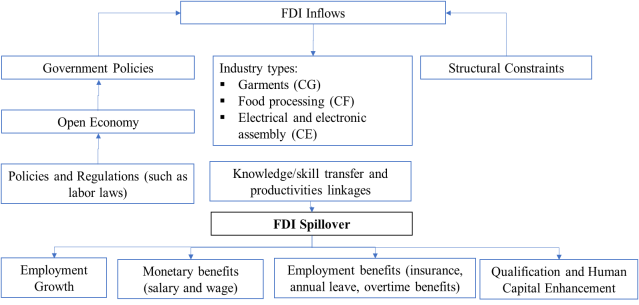
To examine the quantitative impacts of FDI on employment growth, wages, benefits, and knowledge transfer in Cambodia's manufacturing sectors (garments, food processing, and electrical/electronic assembly), the study adopted FDI Spillover Theory by
| [17] | Kokko, A. (1992). Foreign direct investment, host country characteristics and spillovers. Stockholm School of Economics. https://surl.li/gknhql |
[17]
as the underpinning theoretical foundation. The theorist indicated that FDI not only directly creates jobs and injects capital into the host economy but also generates indirect "spillover" effects. These include technology transfer, skill enhancement, productivity improvements, and backward/forward linkages with local suppliers and workers, which ultimately foster broader economic and employment development.
The Spillover Theory was used to examine firm-level in India by
| [30] | Subash, S. (2008). An Analysis of the Spillover Effects of Foreign Direct Investment in India (1994-2005) [PhD Thesis, Indian Institute of Technology, Bombay (India)].
https://surl.li/tnidce |
[30]
, who identified positive effects on the utilization of local resources, investment in training, higher education, and basic infrastructure, and focused on new firms. In recent studies,
| [24] | Ombuki, W. M., Kinuthia, B. K., & Abala, D. O. (2025). Productivity spillovers from foreign direct investment in Kenya’s manufacturing sector. Cogent Economics & Finance, 13(1), 2463275.
https://doi.org/10.1080/23322039.2025.2463275 |
[24]
examine the productivity spillovers from FDI in Kenya's manufacturing sector, and
| [4] | Barboza, G., Braga, A., Duchier, A., Chacon, A., Calderón, K., & Lang, G. (2025). Technology transfer, knowledge spillover and foreign direct investment. The Journal of Technology Transfer. https://doi.org/10.1007/s10961-025-10226-6 |
[4]
also look at technology transfer, knowledge spillover, and foreign direct investment. Spillover Theory explains these as horizontal spillovers (within the same industry, like skill upgrades in garment factories) and vertical spillovers (across supply chains, such as technology adoption in electrical assembly). Finally, the structural constraints underpinning the 'success' of foreign investment depend on the interaction between the type of industry being invested in and how ready the country is to handle it
| [28] | Pineli, A., Narula, R., & Belderbos, R. (2021). FDI, multinationals and structural change in developing countries. In N. Foster-McGregor, L. Alcorta, A. Szirmai, & B. Verspagen (Eds.), New Perspectives on Structural Change: (pp. 494-523). Oxford University Press.
https://doi.org/10.1093/oso/9780198850113.003.0022 |
[28]
.
Figure 1. Conceptual Framework of the study.
As a developing economy like Cambodia, reliant on FDI for manufacturing diversification (as per your references to the Industrial Development Policy 2015-2025 and UN SDGs like Goal 8), the theory emphasizes how host-country conditions (e.g., labor market institutions, education systems) moderate spillover benefits, aligning with your analysis of regional variations and female employment gains.
2.1. Review of Inward FDI in Cambodia
Cambodia has become a destination for inward FDI since the first general elections were held in 1993, moving from donor-driven to FDI-attractive. In 1995, the FDI investment approved by the Cambodia Development Council (CDC) reached USD 2.3 billion and increased cumulatively to USD 85.88 billion in 2019
.
From 1994 to 2019, three countries led inward FDI in Cambodia: China (21.81%), Korea (6.16%), and the United Kingdom (5.01%). Other countries were Malaysia (3.59%), Japan (3.13%), Hong Kong (3.05%), Taiwan (1.77%), Vietnam (2.31%), Singapore (1.64%), and Thailand (1.54%). The increasing inward FDI in Cambodia was contributed to by the preferential market that continuously attracts investors to produce and export to the international markets (EU and US). Furthermore, the open economy system and the improving business climate have also driven more foreign investors to Cambodia
.
It was noticed that inward FDI primarily focuses on manufacturing industries, including textiles, apparel and footwear, food, beverages and tobacco, rubber, wood, paper, publishing, and other sub-industry sectors. These sectors continued to increase from 18.3% to 23.2% of Cambodia's GDP in the last 16 years (2002-2018)
. Secondly, the textiles, apparel, and footwear FDI manufacturing industries played a significant role in exporting, which was about USD 13.1 billion, and contributed to GDP growth of approximately 18.2% in 2018
. Moreover, this sector creates plenty of employment opportunities for skilled and unskilled Cambodians. Finally, food, beverages, and tobacco are the second-highest manufacturing sectors contributing to exporting, employment, and GDP growth. It accounted for about USD 254 million in 2018, or about 1.9% of GDP
. It has also played a role in food security, local consumption, and economic diversification
, and the food processing industries are closely linked to agricultural development in the country.
Noticeably, among the sub-sectors in other manufacturing industries, electrical and electronic assembly is the fastest-growing sector with manufacturers, specifically inward FDI from Japan. In 2016, the industrial sector exported products from Cambodia to markets worth about USD 458 million, which massively increased to USD 6 million in 2012
. This emerging sector is potentially linked to heavy industry development, especially for promoting technology development and transformation and attracting more inward FDI, as the key strategies in the Cambodia Industrial Development Plan 201-2025
.
2.2. Review of Employment Classifications in FDI Firms in Cambodia
According to the International Labour Organization (ILO) International Standard Classification of Occupations (ISCO), workers are classified into five main categories: general workers, operators, supervisors, technicians, and higher management
. General workers typically perform simple and routine physical or manual tasks, often using basic handheld tools such as shovels or simple electrical equipment, with their duties including lifting, carrying, sorting, storing, and assembling goods. Operators, on the other hand, are responsible for operating machinery and electronic equipment, as well as maintaining and repairing electrical and mechanical systems, while also handling tasks related to manipulating, ordering, and storing data. Supervisors generally oversee groups of operators or general workers and require a substantial level of factual and procedural knowledge to manage these teams effectively. Technicians engage in more complex technical and practical activities that demand a broad foundation of specialized factual, technical, and procedural expertise within a particular field or sector. Finally, higher management consists of senior executives who play an active role in the day-to-day monitoring, planning, and administrative operations essential for an organization to achieve its objectives.
However, employment classifications can change over time due to business performance and human resource strategies in individual firms. For example, some firms have only higher management, technicians, and general workers, while others may have higher management, technicians, supervisors, and general workers. Therefore, this study used the ISCO as the analysis base.
2.3. Review of Employment Benefits in Cambodia
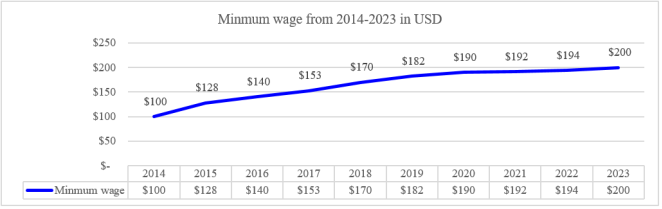
In Cambodia, wages and salaries are applied in a specific industry, for example, the Textile and Garment Sectors, specifically to general workers. Noticeably, the minimum wage increased from USD 100 monthly in 2014 to USD 200 in 2023
| [13] | ILO. (2023). Database of national labour, social security and related human rights legislation. Database of National Labour, Social Security and Related Human Rights Legislation.
https://surl.li/nigykk |
[13]
. Additionally, other benefits were indicated, such as a travel and accommodation allowance of USD 7 per month, an attendance bonus of USD 10 per month, a food allowance of USD 11 per month, and an overtime and seniority bonus of USD 2 to USD 11 per month for those between their second and eleventh year of work. Therefore, the basic salary of general workers was around USD 239 per month, considering the 2023 package.
More than the wage and salary, workers and employees also get working benefits such as accident insurance or National Social Security Fund (NSSF), annual leave of 18 days per annum, sick leave, public holidays, overtime benefits, and other benefits introduced by the MoLVT.
Figure 2. Cambodian minimum wage 2014-2023.
The benefits of other job classifications, such as operators, supervisors, technicians, and higher management, are known to be negotiated with employers based on their work experiences and qualifications.
3. Research Methodology
This study used quantitative research methodology by conducting firm surveys in Cambodia's Manufacturing industry, namely garments (CG), food processing (CF), and electronic and electrical assembly (CE). The significance of selecting these industries was due to the following empirical observations. The CG industries play a significant role in exports, with a value of about USD 13.1 billion, contributing to GDP growth of approximately 18.2% in 2018
. Moreover, this sector creates employment opportunities for skilled and unskilled local Cambodians. The CF is the second-highest manufacturing sector contributing to exports, employment, and GDP growth. It accounted for about USD 254 million in 2018, about 1.9% of the GDP
. Finally, CE is the fastest-growing manufacturing industry. In 2016, the CE exported from Cambodia to both international markets was about USD 458 million, a massive increase compared to USD 6 million in 2012
. Therefore, selecting these sectors provides a suitable representation of the manufacturing industry in the Kingdom.
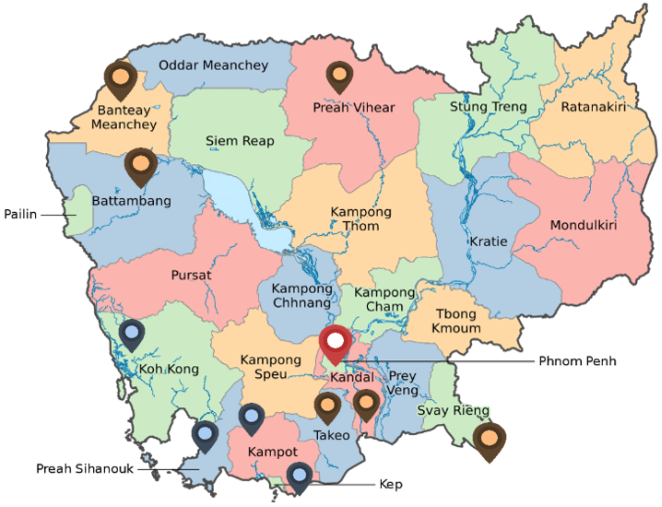
Sample firms were selected with proportional stratified sampling. Firstly, firms were divided into three regions: capital, border, and seaport due to the economic corridors. After stratification, 254 firms were identified to represent the total population of the survey. With
| [34] | Yamane, T. (1973). Statistics: An introductory analysis. |
[34]
formula, n=N/(1+Ne
2) (i.e., N=Population, n=Sample size, e= Tolerance error (7.7% =0.077), 101 firms were selected to participate in the study. Of the 101 firms, 65 were from the garment (CG), 20 firms were from the (CE), and 16 firms were from food processing (CF).
Source: Google Map
Note: Capital: Phnom Penh. Border: Banteay Meanchey, Battambang, Svay Rieng, Kandal, Takeo, and Preah Vihear. Sea: Kampot, Koh Kong, Preah Sihanouk, and Kep.
The study conducted a face-to-face survey with company representatives, including the management, director, production, or factory manager. The surveys were conducted in a standardized, structured format. All respondents were asked the same basic questions in the same order. Questions were worded in an entirely open-ended format. Its strength was that respondents answered the same questions, thus increasing the comparability of responses. Data were collected on the topic addressed in the survey, reducing effects and bias, and facilitating organization and analysis of the data. Finally, inferential statistics such as One-Way ANOVA and the Pearson correlation coefficient were conducted to address the research questions.
4. Results and Findings
4.1. The Influence of FDI Manufacturing Industries on Employment Creation
The study found positive employment opportunities created by FDI manufacturing industries. In the five years (2012-2017), employment grew by 315% for all worker classifications, half of whom were females. Even though there were high employment growth rates in CE and CG compared to CF, One-Way ANOVA revealed no statistically significant difference between CE, CG, and CF FDI firms (p=0.560). Thus, employment creation grew enormously in the three manufacturing industries regardless of the FDI industrial sectors.
Table 1. Employment creation by FDI firms from 2012-2017.
Industrial sector | Number of firms | Mean of Employment | Employment Growth |
Year_2012 | Year_2017 | Mean of growth rate |
CE | 19 | 210 | 597 | 495% |
CG | 56 | 612 | 988 | 313% |
CF | 14 | 210 | 308 | 76% |
Source: author calculated from survey data
Regarding job classifications, employment creation in the three FDI industries positively increased in all five classifications.
Table 2 indicates the strong employment creation from CE, CG, and CF firms for general workers, operators, supervisors, and technicians. Moreover, One-Way ANOVA showed no statistically significant differences between CE, CG, and CF firms (P>0.05) for job creation across the manufacturing firms. In this regard, employment creation was similarly increased for all classifications among the three FDI industrial sectors.
It was also noticed that higher management positions were increased more slowly than the other four. It reflects the high qualifications and work experience required for this position. To get this position, candidates need sufficient knowledge and skills to catch up with the hiring potential in these industries.
Table 2. Employment creation by job classifications from 2012-2017.
Employment growth by job classifications | CE (N=19) | CG (N=56) | CF (N=14) | p-value |
General workers | 1,131% | 321% | 64% | 0.26 |
Operators | 135% | 83% | 59% | .547 |
Supervisors | 188% | 131% | 50% | .442 |
Technicians | 170% | 105% | 136% | .778 |
Higher management | 56% | 59% | 57% | .997 |
Source: author calculated from survey data
A Pearson correlation coefficient was analyzed to assess the linear relationship between the year of firm operation and employment growth by job classifications (general workers, operators, supervisors, technicians, and higher management). The result showed no significant correlation between the two variables (P>0.05). The test indicated an increase in employment creation of FDI firms regardless of the year of establishment and operation.
The findings were well aligned with the current development trend.
| [11] | Iammarino, S., Muth, S., & Nith, K. (2024). 20 Years of FDI in Cambodia: Towards Upper Middle-Income Status and Beyond. https://surl.li/ikbgqk |
[11]
indicated that between 2023 and 2024, 315 new investment projects were registered, generating over 252,000 jobs across manufacturing, including agro-processing and electronics. The sector's labor allocation highlights FDI's influence, with large enterprises, 63% of which are FDI-backed, employing 63.3% of the manufacturing workforce and generating 76% of turnover
| [16] | Kenh, S., & Wei, Q. (2025). Industrial impact analysis of foreign direct investment on economic development in Cambodia. Journal of Business and Socio-Economic Development, 5(1), 20-36. https://doi.org/10.1108/JBSED-11-2022-0120 |
[16]
. Key subsectors such as garments, food processing, and electrical/electronic assembly illustrate varying degrees of FDI-driven employment expansion, supported by policies like the Industrial Development Policy 2015-2025
, aiming for manufacturing to reach 20% of GDP by 2025.
4.2. Employment Benefits: Monetary and Non-Monetary
The salaries and wages may be flexible due to individual working experience, qualification, productivity, and each firm's performance. So, the study captured the mean salary of FDI industrial sectors across the five job classifications. By considering the average wage and salary in 2017, general workers ranged from USD 228 to USD 277, operators got around USD 261 to USD 378, supervisors got approximately USD 319 to USD 351, technicians were around USD 443 to USD 452, and higher management got around USD 892 to USD 1,890, across the three industries. The analysis also indicated that the wage and salary of general work in the three FDI industrial sectors were comparatively higher than the standard wage of MoLTV 2017 of USD 192
| [13] | ILO. (2023). Database of national labour, social security and related human rights legislation. Database of National Labour, Social Security and Related Human Rights Legislation.
https://surl.li/nigykk |
[13]
, which USD 153 was the basic salary plus the travel and accommodation allowance of USD 7 per month, the attendance bonus of USD 10 per month, the food allowance of USD 11 per month, and the seniority bonus of USD 2 to USD11 per month.
Furthermore, growth calculation was applied to assess the salary growth in the last five years (2012-2017), and One-Way ANOVA was employed to compare growth across the industrial sectors.
Table 3 shows the positive growth of salary for all job classifications regardless of the industrial sector (P>0.05). It was also noticed that the salary of technicians grew more than the four classifications, reflecting the attractiveness of the high demand for skilled people working in this position.
Table 3. Salary growth by job classification from 2012-2017.
Salary growth | CE (N=19) | CG (N=56) | CF (N=14) | p-value |
General workers | 53% | 62% | 51% | .736 |
Operators | 53% | 53% | 52% | .998 |
Supervisors | 59% | 77% | 42% | .883 |
Technicians | - | 375% | 210% | .694 |
Higher management | 42% | 49% | 55% | .853 |
Source: author calculated from survey data
The study conducted a Pearson correlation coefficient to assess the linear relationship between the year of firm operation, employment growth, and the salary growth of the five job classifications in the FDI industries. The results showed that the salary growth of the general workers was positively correlated with the year of firm operation, r(77) =.290, p =.010. Moreover, the salary of technicians was significantly correlated to employment growth, r(12) =.935, p =.000. The rest of the variables were not significantly correlated. These results reflected that the older FDI operation firms tended to motivate workers and technicians to work in their firms for better operation and long-term growth.
Table 4. Correlation matrix of salary growth and firm operation.
Correlations | Year of firm operation | Employment growth |
Year of firm operation | Pearson Correlation | 1 | |
Sig. (2-tailed) | | |
N | 101 | |
Employment growth | Pearson Correlation | -.090 | 1 |
Sig. (2-tailed) | .400 | |
N | 89 | 89 |
Salary growth_ general workers | Pearson Correlation | .290** | .108 |
Sig. (2-tailed) | .010 | .349 |
N | 79 | 77 |
Salary growth_ operators | Pearson Correlation | .214 | .076 |
Sig. (2-tailed) | .082 | .546 |
N | 67 | 65 |
Salary growth_ supervisors | Pearson Correlation | -.020 | .119 |
Sig. (2-tailed) | .869 | .323 |
N | 73 | 71 |
Salary growth_ technicians | Pearson Correlation | .004 | .935** |
Sig. (2-tailed) | .990 | .000 |
N | 14 | 14 |
Salary growth _ higher management | Pearson Correlation | .222 | -.203 |
Sig. (2-tailed) | .061 | .092 |
N | 72 | 70 |
*. Correlation is significant at the 0.05 level (2-tailed).
Source: author calculated from survey data
More than the salary, workers and employees also got working benefits such as accident insurance or/and the National Social Security Fund (NSSF), annual leave of 18 days per annum, sick leave, public holidays, overtime benefits, and other benefits introduced by MoLVT.
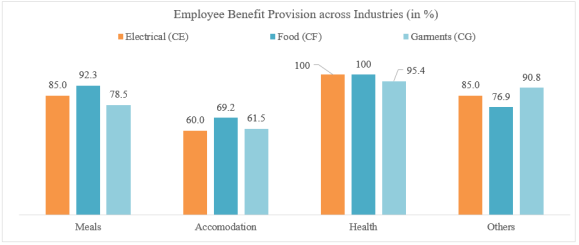
Figure 4 shows that most FDI firms provided health benefits to their workers and employees (almost 100%). Moreover, more than 78% of firms offered meals, both allowance and food. And more than 60% provide accommodation. Finally, more than 76% provided other benefits based on firm negotiation and competition in the labour market. These benefits were included as non-monetary compensation for the workers.
Figure 4. Working benefits.
However, salary and benefits were reported as obstacles for many firms. These included the increase in wages, but low productivity and low skills. The minimum wage was reported as increasing so fast, while the orders and sales were declining. The firm representatives complained that wages always increase, do not have a clear policy, and it affected business performance.
In general, monetary benefits include base wages, overtime pay, bonuses, and allowances, while non-monetary benefits encompass health insurance through the National Social Security Fund (NSSF), paid leave, training opportunities, and workplace safety measures, as mandated by Cambodia's Labor Law
| [9] | Cunningham, W., & Hollweg, C. H. (2019). Cambodia’s future jobs: Linking to the economy of tomorrow. World Bank Phnom Penh. https://surl.li/oomtzd |
[9]
. The garment sector leads in structured benefits due to international scrutiny and programs like Better Work Cambodia, offering higher average earnings and digital wage systems for financial inclusion
, whereas food processing and electronics sectors often provide more basic packages, with electronics showing potential for skill-based premiums amid diversification efforts. Challenges such as gender pay gaps, incomplete NSSF registration, and reliance on overtime persist across all sectors, impacting equitable benefit distribution
| [20] | McKay, F. H., & McKenzie, H. J. (2020). Life outside the garment factories: The lived experiences of Cambodian women garment factory workers. International Journal of Migration, Health and Social Care, 16(4), 415-427.
https://doi.org/10.1108/IJMHSC-02-2020-0013 |
[20]
. Recent shifts toward responsible digital wages have enhanced transparency and worker empowerment, particularly benefiting women who dominate these industries.
4.3. Employment Qualification Requirements and Knowledge Transfer
The study investigated employment qualification and the top 3 knowledge transfers in the FDI manufacturing industries. Employment qualification in the FDI firms was believed to be a key factor in encouraging local people to pursue higher education and skill development. Throughout the five job classifications, employment qualification and knowledge transfer were required and offered in the following skill transfer formations.
General workers: There were no specific requirements for general workers to have the skill set or qualifications to work in the CE, CG, and CF industrial sectors. General workers were recruited due to the industry's demand for the labour force. Regarding knowledge transfers, the general workers were trained with a few specific skills, such as operating sewing machines, ironing clothes, and other work skills. These skills were specifically trained in CG factories. However, the other sectors, such as CE and CF, did not mention knowledge transfers in their operations.
Operators: Operators were required for specific qualifications and knowledge in pre-employment. They were required to have machinery maintenance and repair knowledge and skills in CG firms. CE firms demanded degrees in Mechanical Engineering and Electrical Engineering diplomas. Finally, CF firms needed degrees in Animal Science and Industrial and Mechanical Engineering diplomas.
For knowledge transfers, operators were offered training programmes such as machine operations and techniques, gap analysis for CG, and technical improvement skills for the CE firms. However, it was not mentioned for the CF sector. It was noticed that these capacity-building activities were primarily conducted in the job-based training centre (factory training centre).
Table 5. Knowledge transfer for operators.
Operators | Knowledge transfers |
CG | Top 3 knowledge transfers | Machine operations and techniques, gap analysis |
CE | Top 3 knowledge transfers | Technical improvement skills |
CF | Top 3 knowledge transfers | NA |
Source: author calculated from survey data
Supervisors: Supervisors were required to have the knowledge and a specific skill set. For CE industries, supervisors were required to have degrees in Electrical Engineering, Electricity, Industrial and Mechanical Engineering, and Mechanical Engineering. In the same way, the CF sector also asked for a degree in Chemical Engineering and Food Technology, Chemical Engineering and Food Technology, Food Science and Technology, and Industrial and Mechanical Engineering. Besides, there was no specific degree required in the CG sector.
Regarding knowledge transfer, there were on-the-job training programmes such as supervisory skills, learning value, and stream mapping for the CG. Technical training was provided for the CE. And finally, food quality management and food safety were offered in CF.
Table 6. Knowledge transfer for supervisors.
Supervisors | Knowledge transfers |
CG | Top 3 knowledge transfers | Supervisory skills training, learning value, stream mapping |
CE | Top 3 knowledge transfers | Technical training |
CF | Top 3 knowledge transfers | Food quality management, food safety |
Source: author calculated from survey data
Technicians: technicians were required to have technical degrees that were officially recognized by the public. The CG technicians were asked for their electrical degrees. Similarly, the CE asked for Industrial and Mechanical Engineering and Electronic Engineering degrees. Lastly, the CF firms demanded degrees in Animal Science, Chemical Engineering, Food Technology, and Electricity.
Technicians were provided with knowledge transfers in electrical wiring and occupational safety, quality control, and electricity in the CG. Likewise, the CE factories also trained their technicians on SolidWorks, technical training, and sequence control Programmable Logic Controller (PLC) systems. Finally, the CF firms conducted knowledge transfer on food engineering, pre-and post-harvest, waste agriculture, and biotechnology. These training programmes were highly technical and practised with modern types of machinery.
Table 7. Knowledge transfer for technicians.
Technicians | Knowledge transfers |
CG | Top 3 knowledge transfers | Electrical wiring and occupational safety, quality control, and electricity |
CE | Top 3 knowledge transfers | Solid work, technical training, sequence control PLC system |
CF | Top 3 knowledge transfers | Training course on food engineering, training on pre-and post-harvest, waste agriculture, and biotechnology |
Source: author calculated from survey data
Higher management: this position required degrees in electrical engineering, mechanical engineering, and electronic engineering for CE firms. CG wanted degrees in electrical engineering and production control. Finally, CF wanted their candidates with degrees in chemical engineering and food processing, food technology, industrial and mechanical engineering, quality control and mechanics, and food science. More than qualifications, the higher management candidates also needed working experience, especially in managerial roles.
Regarding knowledge transfer, the analysis showed that higher management staff benefited the most from the three industrial sectors, especially the CG and CF sectors. Specifically, CG trained their higher management with various knowledge and skills, such as advisory skills training, supervisory skills, fit evaluation, and pattern alteration skills. These skills were essential for garment production and staff management. Similarly, CE provided their management staff with industrial management and system control. These skills were aimed at helping the operations team perform better in the business operation. Finally, CF provided additional training to management staff on quality control, factory and production management, food safety, and production management. These skills and knowledge were highly valuable and related to the business as usual.
Table 8. Knowledge transfer for higher management.
Higher management | Knowledge transfers |
CG | Top 3 knowledge transfers | Advisory skills training, supervisory skills training, fit evaluation, and pattern alteration |
CE | Top 3 knowledge transfers | Industrial management, system control |
CF | Top 3 knowledge transfers | Quality control, factory and production management, food safety, production management |
Source: author calculated from survey data
The knowledge transfer for all job classifications was provided as nonformal education and training, such as coaching and mentoring in the business operating system. It was industrial-specific and involved self-assessment of quality and practice. It would form in various ways, such as induction training, technology training, general information on the job position and operation, and work experience programmes.
5. Discussions
The study found a positive influence of inward FDI on employment development in Cambodia, aligned with
| [17] | Kokko, A. (1992). Foreign direct investment, host country characteristics and spillovers. Stockholm School of Economics. https://surl.li/gknhql |
[17]
, the FDI Spillover Theory, and similar to
| [27] | Penghuy, N. (2011). Triangular Relationship among Governance, Foreign Direct Investment, and Economic Growth: Cross Country Analysis and Cambodia’s Case Study [PhD Thesis]. NAGOYA UNIVERSITY. |
[27]
. The study found that inward FDI generated more employment opportunities for all job classifications as related to studies
| [2] | Aggarwal, A. (2007). Impact of special economic zones on employment, poverty and human development. |
| [3] | Akinci, G., & Crittle, J. (2008). Special economic zone: Performance, lessons learned, and implication for zone development. |
[2, 3]
, and the positive employment benefits gained, as found in neighbouring countries: Vietnam and Thailand, by
| [26] | Pakdeenurit, P., Suthikarnnarunai, N., & Rattanawong, W. (2017). Location and Key Success Factors of Special Economic Zone in Thailand (SSRN Scholarly Paper ID 3343302).
https://papers.ssrn.com/abstract=3343302 |
[26]
and
. Finally, the positives in education and knowledge transfer were gained from FDI, similar to the Republic of Korea, Taiwan, the Philippines, Malaysia, and India
| [3] | Akinci, G., & Crittle, J. (2008). Special economic zone: Performance, lessons learned, and implication for zone development. |
| [14] | Ing, K. (2022). The factors improving skill development and skill formation systems in industries: Firm-level analysis of Cambodia’s manufacturing industry. 4, 53-72.
https://surl.li/yaiqlp |
| [18] | Lall, S. (2000). Technological change and industrialization in the Asian newly industrializing economies: Achievements and challenges. Technology, Learning, & Innovation: Experiences of Newly Industrializing Economies, 13-68. |
[3, 14, 18]
. Though the study revealed a few concerns in the following.
The study highlights direct effects (e.g., 315% employment growth across job classifications) and indirect effects (e.g., knowledge transfer in technical skills for supervisors, technicians, and management, while noting limitations for general workers). Spillover Theory by
| [17] | Kokko, A. (1992). Foreign direct investment, host country characteristics and spillovers. Stockholm School of Economics. https://surl.li/gknhql |
[17]
explains these as horizontal spillovers (within the same industry, like skill upgrades in garment factories) and vertical spillovers (across supply chains, such as technology adoption in electrical assembly).
While employment grew, general workers did not seem to enjoy it much. There was a positive contribution of inward FDI in employment development in Cambodia, but general workers did not seem to enjoy it much. This study found that general workers received low-capacity development in knowledge transfer. They were trained in specific skills, such as operating a sewing machine, ironing clothes, and other specific garment work skills. It is indicated that there is limited skill-building in this particular job classification. Moreover, these general workers were recruited due to the companies' labour demand. The jobs were secure due to the company's performance and market situation. It brings concern because this job classification shares most of the Cambodian workforce. Thus, skill development, both upskilling in FDI firms and reskilling in TVET schools, should be broader and available to the general workers.
FDI investors were not satisfied with the quality of work produced by their employees, but pay increased annually. FDI investors complained about balancing the benefits given and the quality of work produced by employees in the three surveyed industrial sectors. For example, investors experienced low work productivity and skills while the minimum wage rose annually. These problems reported affected business performance. Given these research results, it would take into account the minimum wage policy and employment development offered by FDI investors. The three parties' understanding: FDI investors, employees, and policymakers should be on the same page, especially during the annual minimum wage negotiation. Doing so would improve employee benefits and encourage more inward FDI in the country.
Skills and knowledge transfer do occur, but they remain largely non-formal. Regarding knowledge transfer, a proper assessment mechanism should be considered. Most knowledge transfers were industrial-specific and involved self-assessment of quality and practice. These included induction training, technology training, general information on the job position and operation, and work experience programmes. These knowledge transfers were confirmed to be a high-value addition to skill gaps and skill shortages in the Cambodian labour market
| [14] | Ing, K. (2022). The factors improving skill development and skill formation systems in industries: Firm-level analysis of Cambodia’s manufacturing industry. 4, 53-72.
https://surl.li/yaiqlp |
[14]
. Thus, national recognition mechanisms should be developed within the industry to capture these essential skill transfers for better benefits to workers and standardize generic skills for the potential inward FDI.
Finally, it is essential to improve formal skill development to meet the needs of these industrial sectors. As found in this study, FDI investors still complained about the skills limitation. Thus, improving formal skill development should be the priority. Similarly,
| [19] | Makori Peter, B. (2018). An Evaluation of Strategies Influencing Performance of Technical Vocational and Education Training (TVET) Institutions in Nyamira County, Kenya [PhD Thesis]. Kisii University. |
[19]
suggests that the government should properly allocate a budget for formal training, enhance the training of trainers, update new technologies, and create innovative skills centres. Moreover, the government should coordinate to link skill providers to suitable firms in the job market. These ways may address worker quality and capacity development, improving labour competency to attract more inward FDI in Cambodia.
Limitations of the Study
This study, while providing valuable firm-level insights, has several limitations that should be acknowledged.
Temporal scope and data timeliness represent the most significant constraint. The survey data cover only the period 2012–2017 (five-year growth window). Cambodia’s manufacturing and FDI landscape evolved substantially after 2018–2019: the loss of Everything but Arms (EBA) preferences (2020), COVID-19 disruptions, rapid electronics/electrical assembly growth, heavy Chinese FDI dominance (often >50% of inflows post-2020), and recent wage negotiations/productivity pressures (2023–2025). Findings on wage-productivity divergence and knowledge transfer may understate or overstate current dynamics.
Reliance on manager-reported data (directors, production managers, factory managers) introduces potential biases. Self-reported employment figures, wages, benefits, and especially knowledge transfer/training activities are prone to social desirability bias and recall inaccuracies over a five-year retrospective window. The absence of employee-level surveys or payroll/HR records prevents triangulation of worker experiences, gender-specific outcomes, or actual skill absorption (a common critique in FDI spillover research).
Scope and generalizability are restricted. The sample focuses exclusively on three sub-sectors (garments, food processing, electrical/electronic assembly) out of a broader manufacturing base (footwear, wood, rubber, etc. are excluded). Although proportional stratified sampling yielded n=101 firms (≈40% response rate from 254 identified), 12 firms were dropped due to incomplete data, and results were not disaggregated by region (capital vs. border vs. seaport) or firm characteristics (size, ownership nationality, SEZ vs. non-SEZ, export intensity). No comparison with domestic firms was conducted, limiting spillover analysis.
Methodological constraints include reliance on basic inferential statistics (One-Way ANOVA, Pearson correlations) without advanced techniques (fixed effects, propensity score matching, instrumental variables, or difference-in-differences around foreign ownership changes). The open-ended yet structured questions, while improving comparability, required researcher interpretation/coding, introducing subjectivity. Finally, the study emphasizes direct employment effects more strongly than indirect spillovers (productivity, backward linkages, technology diffusion), despite framing via
| [17] | Kokko, A. (1992). Foreign direct investment, host country characteristics and spillovers. Stockholm School of Economics. https://surl.li/gknhql |
[17]
spillover theory.
Reflections and Implications
Despite these limitations, this research makes a meaningful contribution by presenting rare primary firm-level quantitative evidence from Cambodia on employment growth (315%), wage premiums, non-monetary benefits, and uneven knowledge transfer patterns. Such granular, sector-specific data remain scarce compared to aggregate or macro-level studies.
The findings reinforce that FDI generates jobs and basic income effectively but struggles to deliver broad-based human capital upgrading for the low-skilled majority (general workers). This structural mismatch, rising wages amid skills shortages and low productivity, is a classic "middle-income trap" warning signal and directly supports the paper’s policy recommendations (TVET investment, formalized tripartite wage/skill coordination, national recognition of in-firm training).
From a researcher’s perspective, conducting face-to-face firm surveys in Cambodia highlighted practical challenges: access difficulties, trust issues with foreign-owned factories, language barriers, and the sensitivity of wage/productivity data. These realities underscore why most Cambodia FDI studies remain secondary or macro-oriented.
Avenues for future research include:
Panel or matched employer-employee data (post-2018/2023)
Mixed-methods designs (manager + worker interviews)
Productivity-focused analysis
Comparison of Chinese vs. non-Chinese FDI
Causal identification strategies
More advanced econometric techniques, such as panel regression or propensity score matching, could yield stronger causal inferences in future research, specifically by addressing potential selection biases in firm-level FDI analysis.
Expanding to more sectors, incorporating SEZ-specific effects, and tracking long-term worker mobility would strengthen the evidence base for Cambodia’s Industrial Development Policy and SDG 8 ambitions. This study serves as an important baseline but must be updated and deepened to remain policy-relevant in Cambodia’s fast-changing FDI environment.
6. Conclusion
This study provides a comprehensive quantitative analysis of Foreign Direct Investment's (FDI) influence on employment development in Cambodia's manufacturing sector, drawing on firm-level survey data from 101 enterprises across the garments (CG), food processing (CF), and electrical/electronic assembly (CE) industries. The findings underscore FDI's substantial positive contributions, including a remarkable 315% employment growth across all job classifications, general workers, operators, supervisors, technicians, and higher management from 2012 to 2017, with CE and CG sectors leading over CF. This growth has particularly benefited female workers, who dominate the workforce in these industries. Wages consistently surpassed national minimums, supplemented by robust non-monetary benefits such as healthcare and accommodation, fostering improved livelihoods. Additionally, FDI facilitated critical knowledge transfers, enhancing skills in higher-level roles and aligning with spillover theory
| [17] | Kokko, A. (1992). Foreign direct investment, host country characteristics and spillovers. Stockholm School of Economics. https://surl.li/gknhql |
[17]
through horizontal (intra-industry) and vertical (supply chain) effects.
However, the analysis also exposes persistent structural challenges. Knowledge transfer remains uneven, favoring technicians, supervisors, and management with industry-specific training while offering limited upskilling for general workers, the bulk of Cambodia's labor force. This disparity perpetuates skills shortages and a wage-productivity gap, where annual wage increases outpace productivity gains, undermining long-term industrial competitiveness and risking entrapment in low-value activities.
These insights remain relevant amid Cambodia's evolving FDI landscape post-2017. Despite disruptions from the 2020 EBA tariff withdrawal and COVID-19, FDI inflows rebounded strongly, reaching $3.6 billion in 2020 and surging to $7.8 billion in approved projects in the first nine months of 2025, predominantly from China (75-90% of inflows) and focused on manufacturing and infrastructure. Manufacturing's GDP share grew to 16.3% by 2019 but stagnated around 15-16% thereafter due to pandemic effects, with employment creation averaging 17% annual growth pre-COVID but emphasizing low-wage roles. The Industrial Development Policy (IDP) 2015-2025 mid-term review (2022) notes partial achievement in shifting toward skill-driven industries, yet highlights the need for greater diversification beyond garments into high-tech sectors like electronics and renewables to sustain high-quality job growth and poverty reduction (below 10% by 2019).
By addressing these constraints through targeted reforms, Cambodia can enhance its FDI attractiveness, promote industrial upgrading, and align with Sustainable Development Goals (SDGs) 8 (Decent Work and Economic Growth) and 1 (No Poverty). This will foster equitable human capital development, reduce vulnerability to external shocks, and position the country for upper-middle-income status by 2030.
To maximize FDI's benefits for inclusive and sustainable employment development, this study proposes the following revised recommendations, updated to reflect post-2017 trends such as Chinese FDI dominance, COVID-19 recovery, and IDP progress:
Enhance Skill Development Accessibility and Relevance: Expand upskilling programs within FDI firms and reskilling via Technical and Vocational Education and Training (TVET) systems, prioritizing general workers with broader, transferable skills (e.g., digital literacy and basic automation). Collaborate with Chinese investors, who dominate inflows—to mandate technology transfer clauses in FDI approvals, building on the 2021 Law on Investment's focus on green energy and electronics. Allocate dedicated budgets for trainer development and innovative skills centers, aiming to bridge the wage-productivity gap and support IDP's skill-driven transition.
Strengthen Tripartite Stakeholder Coordination: Institutionalize regular dialogues among FDI investors, employees (via unions), and policymakers to align on wage negotiations, productivity incentives, and labor standards. Incorporate post-COVID lessons, such as remote training and supply chain resilience, to ensure mutual benefits. This could include incentives for firms demonstrating skills upgrading, targeting the 97% foreign-owned export factories to foster local management roles and reduce gender inequalities in advancement.
Develop National Recognition and Standardization Mechanisms: Partner with industry associations to formalize and certify in-firm knowledge transfers, creating portable credentials for workers. Standardize generic skills (e.g., quality control, safety) across sectors to attract diversified FDI beyond low-value manufacturing. Leverage recent FDI surges in renewables and automotive assembly to pilot these mechanisms in Special Economic Zones (SEZs), promoting backward linkages with domestic suppliers.
Align Formal Education with Market Demands and Promote Diversification: Bolster government coordination to match TVET graduates with FDI needs through data-driven labor market information systems. Update curricula with emerging technologies (e.g., AI in electronics) and provide fiscal incentives for FDI in high-value sectors like agro-processing and clean energy. Monitor Chinese FDI's impact on job quality, enforcing labor protections to ensure sustainable employment, and diversify investor sources to mitigate over-reliance.
Abbreviations
ANOVA | Analysis of Variance |
CDC | Council for the Development of Cambodia |
CE | Electrical/Electronic Assembly |
CF | Food Processing |
CG | Garments |
EBA | Everything but Arms |
EU | European Union |
FDI | Foreign Direct Investment |
GDP | Gross Domestic Product |
IDP | Industrial Development Policy |
ILO | International Labour Organization |
ISCO | International Standard Classification of Occupations |
MoLVT | Ministry of Labour and Vocational Training |
NSSF | National Social Security Fund |
PLC | Programmable Logic Controller |
R4D | Research for Development |
RGC | Royal Government of Cambodia |
SDGs | Sustainable Development Goals |
SEZ | Special Economic Zone |
TVET | Technical and Vocational Education and Training |
UN | United Nations |
USD | United States Dollar |
Author Contributions
Chhinh Sitha: Conceptualization
Mam Socheath: Supervision
Conflicts of Interest
The author declare that he has no competing interests.
References
| [1] |
Adamu, U. I., Ozomata, B., Kasim, S. A., & Jibril, M. S. (2026). The Role of Foreign Direct Investment (FDI) in Promoting Sustainable Economic Development in Nigeria. Spanish Journal of Innovation and Integrity, 50, 9-15.
|
| [2] |
Aggarwal, A. (2007). Impact of special economic zones on employment, poverty and human development.
|
| [3] |
Akinci, G., & Crittle, J. (2008). Special economic zone: Performance, lessons learned, and implication for zone development.
|
| [4] |
Barboza, G., Braga, A., Duchier, A., Chacon, A., Calderón, K., & Lang, G. (2025). Technology transfer, knowledge spillover and foreign direct investment. The Journal of Technology Transfer.
https://doi.org/10.1007/s10961-025-10226-6
|
| [5] |
CDC. (2018). Industrial Development Policy 2015-2025—Google Search.
https://surl.li/dfdtrx
|
| [6] |
CDC. (2020). The Council for the Development of Cambodia (CDC) » FDI trend.
http://www.cambodiainvestment.gov.kh/why-invest-in-cambodia/investment-enviroment/fdi-trend.html
|
| [7] |
Chen, J. (2020). Foreign Direct Investment (FDI). Investopedia.
https://www.investopedia.com/terms/f/fdi.asp
|
| [8] |
Sothan, S. (2017). Causality between foreign direct investment and economic growth for Cambodia. Cogent Economics & Finance, 5(1), 1277860.
https://shorturl.at/dnkxC
|
| [9] |
Cunningham, W., & Hollweg, C. H. (2019). Cambodia’s future jobs: Linking to the economy of tomorrow. World Bank Phnom Penh.
https://surl.li/oomtzd
|
| [10] |
Ecnmy. (2020). What is ‘foreign direct investment’? Economy.
https://www.ecnmy.org/learn/your-world/globalization/foreign-direct-investment/
|
| [11] |
Iammarino, S., Muth, S., & Nith, K. (2024). 20 Years of FDI in Cambodia: Towards Upper Middle-Income Status and Beyond.
https://surl.li/ikbgqk
|
| [12] |
ILO. (2017). ISCO - International Standard Classification of Occupations.
https://www.ilo.org/public/english/bureau/stat/isco/
|
| [13] |
ILO. (2023). Database of national labour, social security and related human rights legislation. Database of National Labour, Social Security and Related Human Rights Legislation.
https://surl.li/nigykk
|
| [14] |
Ing, K. (2022). The factors improving skill development and skill formation systems in industries: Firm-level analysis of Cambodia’s manufacturing industry. 4, 53-72.
https://surl.li/yaiqlp
|
| [15] |
Kamara, A. K. (2026). The impact of Foreign Direct Investment and Trade on Economic Growth: Evidence from sub-Saharan Africa. Journal of Market Research, 2(1), 1-16.
|
| [16] |
Kenh, S., & Wei, Q. (2025). Industrial impact analysis of foreign direct investment on economic development in Cambodia. Journal of Business and Socio-Economic Development, 5(1), 20-36.
https://doi.org/10.1108/JBSED-11-2022-0120
|
| [17] |
Kokko, A. (1992). Foreign direct investment, host country characteristics and spillovers. Stockholm School of Economics.
https://surl.li/gknhql
|
| [18] |
Lall, S. (2000). Technological change and industrialization in the Asian newly industrializing economies: Achievements and challenges. Technology, Learning, & Innovation: Experiences of Newly Industrializing Economies, 13-68.
|
| [19] |
Makori Peter, B. (2018). An Evaluation of Strategies Influencing Performance of Technical Vocational and Education Training (TVET) Institutions in Nyamira County, Kenya [PhD Thesis]. Kisii University.
|
| [20] |
McKay, F. H., & McKenzie, H. J. (2020). Life outside the garment factories: The lived experiences of Cambodian women garment factory workers. International Journal of Migration, Health and Social Care, 16(4), 415-427.
https://doi.org/10.1108/IJMHSC-02-2020-0013
|
| [21] |
Mejía-Mantilla, C., & Woldemichael, M. T. (2017). To sew or not to sew. Assessing the Welfare Effects of the Garment Industry in Cambodia.
https://openknowledge.worldbank.org/bitstreams/dbf0eca3-95ec-58af-88bd-3a95b9072da0/download
|
| [22] |
MISTI. (2015). Cambodia industrial development policy 2015-2025.
https://misti.gov.kh/public/file/202103031614763249.pdf
|
| [23] |
NIS. (2018). National Account 2018.
https://www.nis.gov.kh/index.php/en/21-na/81-national-account-table
|
| [24] |
Ombuki, W. M., Kinuthia, B. K., & Abala, D. O. (2025). Productivity spillovers from foreign direct investment in Kenya’s manufacturing sector. Cogent Economics & Finance, 13(1), 2463275.
https://doi.org/10.1080/23322039.2025.2463275
|
| [25] |
Pak, C., & Park, J.-D. (1997). The Special Economic Zones of China and Their Impact on Its Economic Development. Greenwood Publishing Group.
|
| [26] |
Pakdeenurit, P., Suthikarnnarunai, N., & Rattanawong, W. (2017). Location and Key Success Factors of Special Economic Zone in Thailand (SSRN Scholarly Paper ID 3343302).
https://papers.ssrn.com/abstract=3343302
|
| [27] |
Penghuy, N. (2011). Triangular Relationship among Governance, Foreign Direct Investment, and Economic Growth: Cross Country Analysis and Cambodia’s Case Study [PhD Thesis]. NAGOYA UNIVERSITY.
|
| [28] |
Pineli, A., Narula, R., & Belderbos, R. (2021). FDI, multinationals and structural change in developing countries. In N. Foster-McGregor, L. Alcorta, A. Szirmai, & B. Verspagen (Eds.), New Perspectives on Structural Change: (pp. 494-523). Oxford University Press.
https://doi.org/10.1093/oso/9780198850113.003.0022
|
| [29] |
Sotharith, C. (2011). Industrial development policy and intermediate goods trade in Cambodia. Intermediate Goods Trade in East Asia: Economic Deeping through FTAs/EPAs.
https://www.ide.go.jp/library/English/Publish/Reports/Brc/pdf/05_chapter9.pdf
|
| [30] |
Subash, S. (2008). An Analysis of the Spillover Effects of Foreign Direct Investment in India (1994-2005) [PhD Thesis, Indian Institute of Technology, Bombay (India)].
https://surl.li/tnidce
|
| [31] |
Ven, S., & Veung, N. (2020). The Contribution of Vocational Skills Development to Cambodia’s Economy.
https://doi.org/10.64202/wp.122.202007
|
| [32] |
Walsh, J. (2013). Social Policy and Special Economic Zones in the Greater Mekong Subregion. The International Journal of Social Quality, 3(1), 44-56.
https://doi.org/10.3167/IJSQ.2013.030104
|
| [33] |
Wang, J. (2013). The economic impact of special economic zones: Evidence from Chinese municipalities. Journal of Development Economics, 101, 133-147.
https://doi.org/10.1016/j.jdeveco.2012.10.006
|
| [34] |
Yamane, T. (1973). Statistics: An introductory analysis.
|
Cite This Article
-
APA Style
Kvanthai, I., Sitha, C., Socheath, M. (2026). The Influence of Foreign Direct Investment on Employment Development in Cambodia: A Lens on Manufacturing Industry. Research & Development, 7(1), 24-37. https://doi.org/10.11648/j.rd.20260701.12
 Copy
|
Copy
|
 Download
ACS Style
Kvanthai, I.; Sitha, C.; Socheath, M. The Influence of Foreign Direct Investment on Employment Development in Cambodia: A Lens on Manufacturing Industry. Res. Dev. 2026, 7(1), 24-37. doi: 10.11648/j.rd.20260701.12
Copy
|
Download
AMA Style
Kvanthai I, Sitha C, Socheath M. The Influence of Foreign Direct Investment on Employment Development in Cambodia: A Lens on Manufacturing Industry. Res Dev. 2026;7(1):24-37. doi: 10.11648/j.rd.20260701.12
Copy
|
Download
-
@article{10.11648/j.rd.20260701.12,
  author = {Ing Kvanthai and Chhinh Sitha and Mam Socheath},
  title = {The Influence of Foreign Direct Investment on Employment Development in Cambodia: A Lens on Manufacturing Industry},
  journal = {Research & Development},
  volume = {7},
  number = {1},
  pages = {24-37},
  doi = {10.11648/j.rd.20260701.12},
  url = {https://doi.org/10.11648/j.rd.20260701.12},
  eprint = {https://article.sciencepublishinggroup.com/pdf/10.11648.j.rd.20260701.12},
  abstract = {This study quantitatively analyzes the influence of Foreign Direct Investment (FDI) on employment development in Cambodia’s manufacturing sector, focusing on garments (CG), food processing (CF), and electrical/electronic assembly (CE) industries. It addresses three primary objectives: evaluating the extent to which FDI generates employment opportunities for local Cambodians, identifying the specific employment benefits derived from these investments, and examining the required qualifications and mechanisms of skill transfer within FDI-invested industries. Building on Kokko’s FDI spillover theory in 1992, this study utilized firm-level survey data (n=101) collected via proportional stratified sampling. Firms were categorized into three regions such as capital, border, and sea-port, based on economic corridors. The findings reveal that FDI drove significant employment growth (grew by 315% for all job classifications: general workers, operators, supervisors, technicians, and higher management), with CE and CG sectors outperforming CF. Wages exceeded national minimums across all job classifications, and robust non-monetary benefits (healthcare, accommodation) were prevalent. However, knowledge transfer was uneven: higher-level roles (technicians, management) received industry-specific technical training, while general workers saw limited skill development. Notwithstanding FDI's demonstrable positive impact on employment generation, the analysis identifies structural constraints, notably skills shortages and wage-productivity divergence. Mitigating these requires prioritized investment in TVET systems and institutionalized tripartite coordination for sustainable industrial development.},
 year = {2026}
}
Copy
|
Download
-
TY  - JOUR
T1  - The Influence of Foreign Direct Investment on Employment Development in Cambodia: A Lens on Manufacturing Industry
AU  - Ing Kvanthai
AU  - Chhinh Sitha
AU  - Mam Socheath
Y1  - 2026/03/14
PY  - 2026
N1  - https://doi.org/10.11648/j.rd.20260701.12
DO  - 10.11648/j.rd.20260701.12
T2  - Research & Development
JF  - Research & Development
JO  - Research & Development
SP  - 24
EP  - 37
PB  - Science Publishing Group
SN  - 2994-7057
UR  - https://doi.org/10.11648/j.rd.20260701.12
AB  - This study quantitatively analyzes the influence of Foreign Direct Investment (FDI) on employment development in Cambodia’s manufacturing sector, focusing on garments (CG), food processing (CF), and electrical/electronic assembly (CE) industries. It addresses three primary objectives: evaluating the extent to which FDI generates employment opportunities for local Cambodians, identifying the specific employment benefits derived from these investments, and examining the required qualifications and mechanisms of skill transfer within FDI-invested industries. Building on Kokko’s FDI spillover theory in 1992, this study utilized firm-level survey data (n=101) collected via proportional stratified sampling. Firms were categorized into three regions such as capital, border, and sea-port, based on economic corridors. The findings reveal that FDI drove significant employment growth (grew by 315% for all job classifications: general workers, operators, supervisors, technicians, and higher management), with CE and CG sectors outperforming CF. Wages exceeded national minimums across all job classifications, and robust non-monetary benefits (healthcare, accommodation) were prevalent. However, knowledge transfer was uneven: higher-level roles (technicians, management) received industry-specific technical training, while general workers saw limited skill development. Notwithstanding FDI's demonstrable positive impact on employment generation, the analysis identifies structural constraints, notably skills shortages and wage-productivity divergence. Mitigating these requires prioritized investment in TVET systems and institutionalized tripartite coordination for sustainable industrial development.
VL  - 7
IS  - 1
ER  -
Copy
|
Download





 Share This Article
 Twitter
 Linked In
 Facebook