Research Article | | Peer-Reviewed

Effectiveness of Modern BROCAP® and Locally Made Traps in Controlling Coffee Berry Borer (Hypothenemus hampei Ferrari) in Arabica Coffee

Received: 1 July 2025     Accepted: 16 August 2025     Published: 23 March 2026
Views:       Downloads:
Abstract

The Coffee berry borer (Hypothenemus hampei) is one of the most destructive pests affecting coffee production in Tanzania. As part of Integrated Pest Management (IPM) strategies, effective trapping methods are crucial for reducing pest populations and minimizing crop damage. This study evaluated the effectiveness of modern BROCAP® traps compared to traditional, locally-made traps in capturing adult CBBs in coffee farms at Uparo village, Moshi Rural District, Kilimanjaro region. A field experiment was conducted from January to December 2019 using a total of 60 traps, 30 BROCAP® traps and 30 modified local traps developed by the Tanzania Coffee Research Institute (TaCRI). Each trap was baited with a 1:1 mixture of methylated spirit and water. The experiment was laid out in a Randomized Complete Block Design (RCBD) to control for field variability, and data were collected every three days for twelve consecutive months. Statistical analysis was performed using GenStat software, with the Chi-square test used to determine the significance of differences in trap performance. Results showed that BROCAP® traps captured a total of 505.67 adult CBBs, while traditional traps captured 429.00. The greatest performance gaps were observed in May (O–E = –21.00) and July (O–E = –24.33), suggesting that modern traps are more effective during peak infestation periods. The cumulative Chi-square value of 32.38, corresponding to a p-value < 0.001, confirmed a statistically significant difference in trap effectiveness. The study revealed that while the BROCAP® trap was more effective in certain months, the locally-made trap performed comparably well throughout the year. This suggests that the modified local trap can be used as an alternative for managing CBB in coffee farms, a technology affordable to smallholder farmers.

Published in Science Discovery Agriculture (Volume 1, Issue 1)
DOI 10.11648/j.sda.20260101.16
Page(s) 56-61
Creative Commons

This is an Open Access article, distributed under the terms of the Creative Commons Attribution 4.0 International License (http://creativecommons.org/licenses/by/4.0/), which permits unrestricted use, distribution and reproduction in any medium or format, provided the original work is properly cited.

Copyright

Copyright © The Author(s), 2026. Published by Science Publishing Group

Keywords

Effectiveness, Coffee Berry Borer, BROCAP® Trap, Traditional Trap, Methylated Spirit Lure, Integrated Pest Management

1. Introduction
Coffee remains a vital export crop for many countries, significantly contributing to earnings and impacting the socio-economic lives of rural communities involved in its production . It serves as a crucial source of national export revenue and internal cash income for farmers in numerous developing countries across Africa, Asia, and Latin America, according to the International Coffee Organization . Economically, coffee is the second most exported commodity after crude oil and employs over 100 million people worldwide . The two most economically significant species of the genus Coffee are Coffea arabica L. and Coffea canephora Pierre ex Froehner . Over 90% of coffee production occurs in developing countries, while consumption predominantly happens in industrialized economies . In Tanzania coffee contributes about five percent to total exports, generating around United States Dollars (USD) 100 million annually, whereby, over 90% of its output is from smallholder farmers, employing 400,000 families, impacting 2.4 million citizens The country produces an average of 70,000 metric tons of coffee each year, with around 70% being Arabica and 30% Robusta . However, in recent years, coffee production has significantly declined due to phytosanitary issues, particularly from direct and indirect damage caused by various pest species .
Coffee pests and diseases are significant constraints to coffee production in Tanzania, reducing both crop yield and quality . Among these, the coffee berry borer (CBB), Hypothenemus hampei Ferrari, stands out as one of the most economically impactful and widespread insect pests, affecting coffee production across Africa, Asia, and Central and South America . A survey in the Kilimanjaro region by reported infestations in farms at medium altitudes (1200-1600 m.a.s.l.). The adult female borer causes damage by boring into green coffee berries to lay eggs, resulting in legless white larvae that feed on the beans . This pest leads to premature cherry drop, reduces bean weight, decreases quality, and affects coffee flavor . In severe infestations, up to 50-100% of berries can be attacked if no control measures are implemented . Therefore, effective management strategies are essential to mitigate the impact of this pest. Integrated Pest Management (IPM) programs, which focus on crop sanitation, biological control, and pesticides, have been developed in other regions to manage CBB . Many IPM examples emphasize cultural controls, such as frequent harvesting to eliminate CBB breeding habitats, although labor-intensive, efficiently collecting mature and older dried berries .
Control of this pest varies according to the cultivation system used, but it is hindered by two main factors; the cryptic nature of the insect, which remains protected inside the coffee berry, and the presence of unharvested or fallen coffee berries in the field, which allows the pest to survive from one season to the next . Traditionally, CBB control has relied heavily on synthetic insecticides . Management strategies have also included the use of African parasitoids (Cephalonomia stephanoderis, Prorops nasuta, and Phymastichus coffee), a fungal entomopathogen (Beauveria bassiana) , and insect traps . Trapping is one of the most effective methods for reducing the population of adult Coffee berry borer in the field . Modern traps (BROCAP® trap) have recently become a promising method for CBB Management. The BROCAP® trap, specifically designed and developed by the Centre International Research Agriculture Development (CIRAD) and Production de Café (PROCAFE) in El Salvador, is considered a useful addition to IPM for CBB control in El Salvador . Its validation in commercial coffee plantations resulted in infestation reductions of up to 80% . However, currently, due to demand in several countries, this trap is possibly the only patented one marketed under a trademark for borer control . Moreover, the Tanzania Coffee Research Institute (TaCRI) has also developed modifications of the Brocap trap that have proven effective, especially with methylated spirit and water (1:1) and local alcohol made from banana (Mbege) . However, a significant challenge for coffee farmers is the lack of adequate knowledge regarding the effectiveness of these traps, leading to confusion about which trap to use against CBB. Therefore, this study aims to evaluate the effectiveness of these modern and locally made traps for capturing the adult coffee berry borer in coffee fields, to provide insights into cost-effective pest control methods for coffee growers.
2. Materials and Methods
2.1. Description of the Study Site and Duration
The study was conducted in smallholder coffee farms at Uparo Village, Moshi rural district in Kilimanjaro Region. Uparo is located at latitude 3o 20’20.69729’S and 37o27’38.03104’E with 1238.47 m altitude above the sea level. The farmers found in this village are among the coffee producers. The site was also selected due Survey done by the Adaptation for Ecosystem Resilience in Africa (AFERIA) project, which identified a severe infestation of CBB.
2.2. Traps, Dispenser, and Attractant
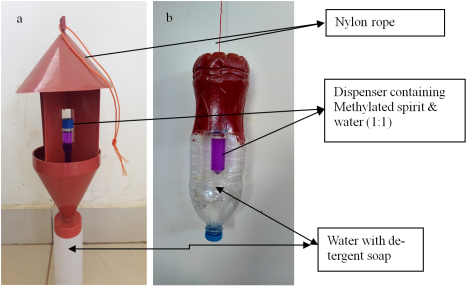
The traps used for the experiment were a modified locally trap and a BROCAP® trap. The BROCAP® trap, developed by CIRAD and PROCAFE in El Salvador, which is specifically designed for the coffee berry borer (CBB) and has been deemed useful for Integrated Pest Management (IPM) in Indonesia, with validation conducted by ICCRI and CIRAD under local conditions . Over a decade of experimentation by PROCAFE and CIRAD has refined its design and effectiveness, leveraging methanol and ethanol as attractants or lures, But for this experiment, methylated spirit and water were used as attractants (1:1). Similarly, the local CBB trap developed by the Tanzania Coffee Research Institute (TaCRI) is a modification of the BROCAP® trap, made from a painted red colour of 1.5-liter empty plastic bottle using methylated spirit and water as attractants.
Figure 1. (1a) Photo of BROCAP® (Modern) trap and (1b) photo of the modified traditional trap.
2.3. Placement of Traps and Experimental Design
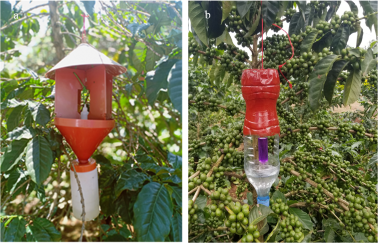
A Complete Randomized Block Design (CRBD) with three replications was used for the experiment. The treatments included modern traps (Brocap traps) and traditional traps. A total of 60 traps were placed in the field, with 30 modern traps and 30 traditional traps. The traps were baited with a mixture of methylated spirit and water in a 1:1 ratio by volume as a lure, which was refreshed every two weeks to maintain its effectiveness. The experiment was conducted over one year from January to December.
Figure 2. Photo of (2a) BROCAP® trap and (2b) traditional trap placed in the coffee field.
2.4. Data Collection
Data were collected over twelve months from January to December. Inspections of both traditional and modern traps were conducted every three days for twelve months. During each inspection, the total number of adult coffee berry borers (CBB) captured in each device was counted and identified using a magnifying lens.
2.5. Data Analysis
Data on adult Coffee Berry Borer (CBB) captures from the two trap types BROCAP® and modified local traps were collected every three days over a 12-month period and subjected to statistical analysis using GenStat software. The total number of CBBs captured per trap type was aggregated monthly and annually. The Chi-square test was used to determine whether differences in trap performance were statistically significant across the observation period. Observed versus expected values were compared monthly to identify periods of significant variation in trap efficacy.
3. Results
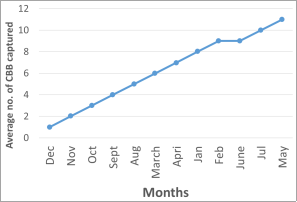
Figure 3. Monthly Performance of BROCAP® Traps in Capturing Coffee Berry Borer (CBB).
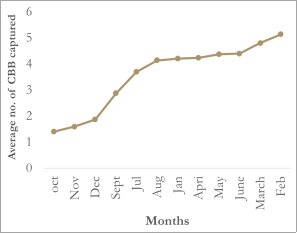
The number of coffee berry borer (CBB) captures varied significantly with trapping method and month (p < 0.05). Modern traps outperformed traditional traps during peak infestation (January–July), with the largest difference in May (65 ± 2.5 vs. 50 ± 2.2; p < 0.01). Traditional traps slightly exceeded modern traps in August–September, while no significant differences were observed in November–December (p > 0.05). Seasonal trends showed captures rising from January, peaking in May, and declining sharply thereafter. The findings highlight the superior efficiency of modern traps during high-infestation periods, with both methods performing similarly in low-infestation months.
Figure 4. Monthly Performance of Traditional traps in Capturing Coffee Berry Borer (CBB).
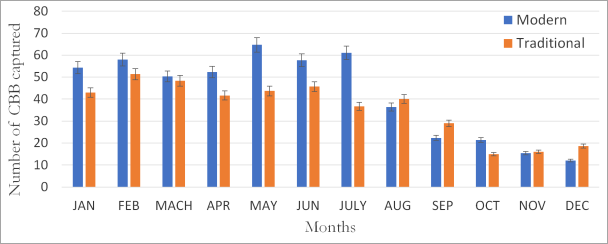
Figure 5. Monthly Comparison of CBB Captures by BROCAP® and Traditional Traps.

4. Discussion
The present study evaluated the comparative effectiveness of modern BROCAP® traps and traditional locally-fabricated traps in capturing adult Coffee Berry Borer (Hypothenemus hampei) over 12 months in coffee farms in Uparo village, Kilimanjaro, Tanzania. The monthly capture data, as illustrated in the bar graph, indicate a consistent and notable superiority of BROCAP® traps over traditional traps across all months of the year.
Peak CBB captures occurred between January and July, coinciding with key phonological stages of the coffee plant that are favorable to CBB infestation, particularly berry development and maturation. During these high-infestation periods, BROCAP® traps consistently recorded higher catch rates. For example, in May and July, BROCAP® traps captured approximately 20–25 more insects per month than the traditional traps. This notable difference during peak infestation months highlights the potential of BROCAP® traps as a more effective intervention tool in integrated pest management (IPM) programs, particularly when timely pest suppression is most critical to minimizing crop losses.
In the early months (January to March), the difference between trap performances was present but relatively modest. This may be attributed to more uniform environmental conditions and a more evenly distributed pest population at the beginning of the infestation season as revealed by . Nevertheless, BROCAP® traps maintained an edge, demonstrating their capacity to begin reducing pest populations before they reach economic threshold levels.
From August through December, a declining trend in CBB captures was observed for both trap types, likely reflecting the post-harvest period when fewer mature berries are available to sustain large pest populations. Although the overall number of insects captured declined, BROCAP® traps continued to outperform traditional traps, albeit with narrower margins. This suggests that while both trap types lose efficiency with reduced pest activity, the modern traps remain consistently more effective throughout the year.
The differences in trap efficiency were further supported by the cumulative Chi-square value of 32.38, with a corresponding p-value of < 0.001, confirming a statistically significant difference in trap performance. Notably, the error bars for the traditional traps in several months indicate greater variability, suggesting that locally-made traps may be more susceptible to performance inconsistencies. These could result from differences in construction quality, lure dispersion efficiency, or structural durability under varying environmental conditions.
The superior performance of BROCAP® traps is attributed to their optimized design, which facilitates better pest attraction and retention, as well as improved lure effectiveness. Their larger trap surface area and specialized configuration likely enhance interception and capture rates, especially during periods of intense CBB activity.
From a practical standpoint, these findings advocate for the integration of BROCAP® traps into coffee pest management strategies. Their proven effectiveness, especially during peak infestation periods, can contribute to a substantial reduction in pest pressure and potential crop damage. However, for successful large-scale adoption, considerations must be made regarding cost, availability, and accessibility for smallholder farmers. BROCAP® traps, while effective, may be more expensive and require external sourcing, unlike traditional traps that can be produced locally with minimal resources. Therefore, extension efforts should also include farmer training, demonstration plots, and potential subsidies or cost-sharing mechanisms to facilitate widespread use.
5. Conclusion and Recommendations
The study highlights the significant potential of using traps to reduce the number of adult coffee berry borers (CBB) and thereby increase coffee production. The BROCAP® B trap demonstrated superior trapping ability compared to traditional traps. However, since the number of CBBs captured by both traps was almost similar on most sampling dates, the traditional trap, which is a modification of the Brocap trap, could serve as a cost-effective alternative for integrated CBB management. To ensure effective validation of these technologies, it is recommended that the study be conducted over at least three years.
Abbreviations

IPM

Integrated pest management

CBB

Coffee Berry Borer

CIRAD

Centre International Research Agriculture Development

TaCRI

Tanzania Coffee Research Institute

Data Availability Statement
The datasets used and/or analysed during the current study are available from the corresponding author upon reasonable request.
Conflicts of Interest
The authors declare no conflicts of interest.
References
[1] Aristizábal, L. F., Johnson, M. A., Mariño, Y. A., Bayman, P., & Wright, M. G. (2023). Establishing an integrated pest management program for coffee berry borer (Hypothenemus hampei) in Hawaii and Puerto Rico coffee agroecosystems: achievements and challenges. Insects, 14(7), 603.
[2] Asegid, A. (2020). Impact of climate change on production and diversity of coffee (Coffea arabica L.) in Ethiopia. Int. J. Res. Stud. Sci. Eng. Technol, 7, 31-38.
[3] Benavides, P., Gil, Z. N., Escobar, L. E., Navarro-Escalante, L., Follett, P., & Diaz-Soltero, H. (2023). Pilot testing of an area-wide biological control strategy against the coffee berry borer in Colombia using African parasitoids. Insects, 14(11), 865.
[4] Carvalho, M., Lopes, A., Bento, A., Santos, L., Guedes, R. N. C., & Casquero, P. A. (2023). Effectiveness of different traps and lures for coffee berry borer, Hypothenemus hampei (Ferrari, 1867) in São Tomé Island. African Entomology, 31, 1-6. ance their effectiveness.
[5] Dogeje, F., Ngaruko, D., & Mpeta, D. (2024). Farmer’s literacy and contract farming participation in Tanzania’s cash crops agriculture: application of human capital theory. Discover Agriculture, 2(1), 86.
[6] Dufour, B. P., & Frérot, B. (2008). Optimization of coffee berry borer, Hypothenemus hampei Ferrari (Col., Scolytidae), mass trapping with an attractant mixture. Journal of Applied Entomology, 132(7), 591-600.
[7] Johnson, A., LeMay, G., & Hulcr, J. (2022). Identification of Coffee Berry Borer from Similar Bark Beetles in Southeast Asia and Oceania: FOR377/FR447, 02/2022. Edis, 2022(1).
[8] Johnson, M. A., Ruiz-Diaz, C. P., Manoukis, N. C., & Verle Rodrigues, J. C. (2020). Coffee berry borer (Hypothenemus hampei), a global pest of coffee: Perspectives from historical and recent invasions, and future priorities. Insects, 11(12), 882.
[9] Magina, F. L., Kilambo, D. L., Maerere, A. P., & Teri, J. M. (2016). Innovative strategies for control of coffee insect pests in Tanzania: A review. Huria: Journal of the Open University of Tanzania, 22(1), 63-72.
[10] Mbuba, A. R., & Shechambo, L. F. (2024). Positional Effects of Bottle-Baited Traps in Reducing Infestation Level of Coffee Berry Borer Hypothenemus Hampei Ferrari in Kilimanjaro Region, Tanzania. Journal of Agricultural Science, 16(5), 32-41.
[11] Mbuba, A., & Shechambo, L. (2023). Efficacy of Plastic Bottle-Baited Traps for Capturing Coffee Berry Borer and Other Coffee Insects Pests in Kilimanjaro Region-Tanzania. American Journal of Entomology, 7(3), 100-108.
[12] Myrie, A., Hall, T., Luke, D., Chinthapalli, B. R., Tennant, P., & Robinson, D. (2023). Coffee Berry Borer, Hypothenemus hampei (Ferrari) (Coleoptera: Curculionidae): Activity and Infestation in the High Mountain and Blue Mountain Regions of Jamaica. Insects, 14(8), 694.
[13] Rimbing, Jimmy, Reity Engka, Sherlij Dumalang, and Frangky Rorong. "Response of the coffee berry borer (Hypothenemus hampei) to attractant traps in Robusta coffee plantations." The Indian Journal of Agricultural Sciences 93, no. 5(2023): 544-548.
[14] Ruiz-Diaz, C. P., Rodrigues, J. C. V., Miro-Rivera, E., & Diaz-Vazquez, L. M. (2023). Impact of the coffee berry borer on the volatile and semi-volatile compounds; qualitative profile of Coffea arabica berries. Food Chemistry Advances, 2, 100154.
[15] Vega, F. E., Infante, F., & Johnson, A. J. (2015). The genus Hypothenemus, with emphasis on H. hampei, the coffee berry borer. In Bark beetles (pp. 427-494). Academic Press.
[16] Vega, F. E., Simpkins, A., Miranda, J., Harnly, J. M., Infante, F., Castillo, A., & Cossé, A. (2017). A potential repellent against the coffee berry borer (Coleoptera: Curculionidae: Scolytinae). Journal of Insect Science, 17(6), 122.
[17] Yousuf, F., Follett, P. A., Gillett, C. P., Honsberger, D., Chamorro, L., Johnson, M. T., & Wright, M. G. (2021). Limited host range in the idiobiont parasitoid Phymastichus coffea, a prospective biological control agent of the coffee pest Hypothenemus hampei in Hawaii. Journal of Pest Science, 94, 1183-1195.
[18] Zani, E., & Rwegasira, G. M. (2023). Pest Status of Antestia Bug, Antestiopsis spp. (Hemiptera: Pentatomidae) in Arabica Coffee Fields of Smallholder Farmers in Tanzania. Advances in Entomology, 11(4), 264-284.
Cite This Article
  • APA Style

    Mbuba, A., Maro, G. (2026). Effectiveness of Modern BROCAP® and Locally Made Traps in Controlling Coffee Berry Borer (Hypothenemus hampei Ferrari) in Arabica Coffee. Science Discovery Agriculture, 1(1), 56-61. https://doi.org/10.11648/j.sda.20260101.16

    Copy | Download

    ACS Style

    Mbuba, A.; Maro, G. Effectiveness of Modern BROCAP® and Locally Made Traps in Controlling Coffee Berry Borer (Hypothenemus hampei Ferrari) in Arabica Coffee. Sci. Discov. Agric. 2026, 1(1), 56-61. doi: 10.11648/j.sda.20260101.16

    Copy | Download

    AMA Style

    Mbuba A, Maro G. Effectiveness of Modern BROCAP® and Locally Made Traps in Controlling Coffee Berry Borer (Hypothenemus hampei Ferrari) in Arabica Coffee. Sci Discov Agric. 2026;1(1):56-61. doi: 10.11648/j.sda.20260101.16

    Copy | Download

  • @article{10.11648/j.sda.20260101.16,
      author = {Aden Mbuba and Gosteven Maro},
      title = {Effectiveness of Modern BROCAP® and Locally Made Traps in Controlling Coffee Berry Borer 
    (Hypothenemus hampei Ferrari) in Arabica Coffee},
      journal = {Science Discovery Agriculture},
      volume = {1},
      number = {1},
      pages = {56-61},
      doi = {10.11648/j.sda.20260101.16},
      url = {https://doi.org/10.11648/j.sda.20260101.16},
      eprint = {https://article.sciencepublishinggroup.com/pdf/10.11648.j.sda.20260101.16},
      abstract = {The Coffee berry borer (Hypothenemus hampei) is one of the most destructive pests affecting coffee production in Tanzania. As part of Integrated Pest Management (IPM) strategies, effective trapping methods are crucial for reducing pest populations and minimizing crop damage. This study evaluated the effectiveness of modern BROCAP® traps compared to traditional, locally-made traps in capturing adult CBBs in coffee farms at Uparo village, Moshi Rural District, Kilimanjaro region. A field experiment was conducted from January to December 2019 using a total of 60 traps, 30 BROCAP® traps and 30 modified local traps developed by the Tanzania Coffee Research Institute (TaCRI). Each trap was baited with a 1:1 mixture of methylated spirit and water. The experiment was laid out in a Randomized Complete Block Design (RCBD) to control for field variability, and data were collected every three days for twelve consecutive months. Statistical analysis was performed using GenStat software, with the Chi-square test used to determine the significance of differences in trap performance. Results showed that BROCAP® traps captured a total of 505.67 adult CBBs, while traditional traps captured 429.00. The greatest performance gaps were observed in May (O–E = –21.00) and July (O–E = –24.33), suggesting that modern traps are more effective during peak infestation periods. The cumulative Chi-square value of 32.38, corresponding to a p-value < 0.001, confirmed a statistically significant difference in trap effectiveness. The study revealed that while the BROCAP® trap was more effective in certain months, the locally-made trap performed comparably well throughout the year. This suggests that the modified local trap can be used as an alternative for managing CBB in coffee farms, a technology affordable to smallholder farmers.},
     year = {2026}
    }
    

    Copy | Download

  • TY  - JOUR
    T1  - Effectiveness of Modern BROCAP® and Locally Made Traps in Controlling Coffee Berry Borer 
    (Hypothenemus hampei Ferrari) in Arabica Coffee
    AU  - Aden Mbuba
    AU  - Gosteven Maro
    Y1  - 2026/03/23
    PY  - 2026
    N1  - https://doi.org/10.11648/j.sda.20260101.16
    DO  - 10.11648/j.sda.20260101.16
    T2  - Science Discovery Agriculture
    JF  - Science Discovery Agriculture
    JO  - Science Discovery Agriculture
    SP  - 56
    EP  - 61
    PB  - Science Publishing Group
    UR  - https://doi.org/10.11648/j.sda.20260101.16
    AB  - The Coffee berry borer (Hypothenemus hampei) is one of the most destructive pests affecting coffee production in Tanzania. As part of Integrated Pest Management (IPM) strategies, effective trapping methods are crucial for reducing pest populations and minimizing crop damage. This study evaluated the effectiveness of modern BROCAP® traps compared to traditional, locally-made traps in capturing adult CBBs in coffee farms at Uparo village, Moshi Rural District, Kilimanjaro region. A field experiment was conducted from January to December 2019 using a total of 60 traps, 30 BROCAP® traps and 30 modified local traps developed by the Tanzania Coffee Research Institute (TaCRI). Each trap was baited with a 1:1 mixture of methylated spirit and water. The experiment was laid out in a Randomized Complete Block Design (RCBD) to control for field variability, and data were collected every three days for twelve consecutive months. Statistical analysis was performed using GenStat software, with the Chi-square test used to determine the significance of differences in trap performance. Results showed that BROCAP® traps captured a total of 505.67 adult CBBs, while traditional traps captured 429.00. The greatest performance gaps were observed in May (O–E = –21.00) and July (O–E = –24.33), suggesting that modern traps are more effective during peak infestation periods. The cumulative Chi-square value of 32.38, corresponding to a p-value < 0.001, confirmed a statistically significant difference in trap effectiveness. The study revealed that while the BROCAP® trap was more effective in certain months, the locally-made trap performed comparably well throughout the year. This suggests that the modified local trap can be used as an alternative for managing CBB in coffee farms, a technology affordable to smallholder farmers.
    VL  - 1
    IS  - 1
    ER  - 

    Copy | Download

Author Information