Research Article | | Peer-Reviewed

Determinants of Improved Maize Variety Adoption and Its Impact on Smallholder Farm Productivity Evidence from Gesha Woreda, Southwest Ethiopia

Received: 19 January 2026     Accepted: 23 March 2026     Published: 13 April 2026
Views:       Downloads:
Abstract

Despite the availability of improved maize varieties in Ethiopia, adoption among smallholder farmers remains uneven, contributing to persistent yield gaps. This study investigates the determinants of improved maize variety adoption and its impact on smallholder farm productivity in Gesha Woreda, Southwest Ethiopia. Using cross-sectional household survey data, a binary logit model is employed to identify factors influencing farmers’ adoption decisions. To address potential selection bias arising from observable differences between adopters and non-adopters, Propensity Score Matching (PSM) were applied to estimate the causal effect of adoption on maize productivity. Multiple matching algorithms, including nearest neighbor, radius, and kernel matching, are used to assess the robustness of the estimated treatment effects. Descriptive results indicate significant differences between adopters and non-adopters in age, education, farm size, farming experience, and credit access. Logit model results show that the sex of the household head, education level, farm size, farming experience, access to credit, and distance to markets significantly affect adoption decisions. PSM results revealed that adopters produce significantly higher maize yields than non-adopters, confirming the positive effect of IMV adoption. The results underscore the need for policies that expand farmer access to extension services and rural credit, strengthen dissemination of improved seed technologies, and enhance farmers’ human capital through education and training programs to accelerate adoption and improve smallholder productivity.

Published in Science Discovery Agriculture (Volume 1, Issue 2)
DOI 10.11648/j.sda.20260102.13
Page(s) 83-95
Creative Commons

This is an Open Access article, distributed under the terms of the Creative Commons Attribution 4.0 International License (http://creativecommons.org/licenses/by/4.0/), which permits unrestricted use, distribution and reproduction in any medium or format, provided the original work is properly cited.

Copyright

Copyright © The Author(s), 2026. Published by Science Publishing Group

Keywords

Improved Maize Varieties, Adoption, Smallholder Farmers, Productivity, Propensity Score Matching, South West Ethiopia, Gesha Woreda

1. Introduction
Agriculture is known for its source of livelihood for much of the world’s population for many years (since 10,000 years ago), especially in least developed countries . It includes crop production, livestock, fisheries, forestry, and related activities, forming the backbone of rural livelihoods and a major determinant of living standards . In developing countries, agriculture provides above 35 percent of household income and employment, and its low productivity directly contributing to poverty, low education, and limited empowerment .
According to , sub-Saharan Africa economy including Ethiopia is highly dependent on agriculture, and it remains a key driver of economic growth, contributing about 25% of GDP and over 70% of export earnings. However, the sector is facing different challenges. identified limited access to finance, low technology adoption, inefficient markets, and vulnerability to rainfall variability as a serious challenges affecting the productivity of agriculture in Ethiopia.
Among types of crops produced in Ethiopia, Maize is the common crop growing in majority parts of Ethiopia. This crop plays a central role in ensuring food security and income generation of rural smallholder households, though its productivity is too low in Southwestern part of the country . According to the data from central statistical agency, the average productivity of Maize in Southwest Ethiopia averages only 4.6 tons/ha, which is below global standards .
The yield productivity of Maize crop is determined by a number of factors. Among the factors, the most cited one is adopting modern agricultural technology for its production. According to, adoption of improved maize variety (agricultural technology) significantly determined the productivity of Maize. However, the smallholder farming household’s decision toward adopting this technology is affected by number factors . The factors are socio-economic, institutional, and agro-ecological . But, these factors remained under-researched in many regions of Ethiopia, including the study area. To address this gap, this study examines the determinants of improved maize variety adoption and its impact on maize productivity among smallholder farmers in Gesha Woreda, Southwest Ethiopia. In line with this, the general objective of this study is to examined determinants of improved maize variety adoption and its impact on maize productivity in Gesha Woreda; and specifically to identify the factors influencing smallholder farmers’ decisions to adopt improved maize varieties in the study area, and to assess the impact of improved maize variety adoption on maize productivity in Gesha Woreda.
This study provides evidence-based insights into the factors that determine the adoption of improved maize varieties, helping smallholder farmers enhance maize productivity and household food security. The findings can inform targeted interventions to close the yield gap and improve agricultural outcomes. By identifying barriers to adoption and assessing impacts on household welfare including income, food consumption, and resilience the study offers guidance for policymakers and development practitioners. Additionally, the research contributes to the existing literature on agricultural technology adoption in Ethiopia and lays the groundwork for future studies in similar contexts. The study is limited to selected kebeles in Gesha Woreda and focuses on smallholder maize farmers. It examines the determinants of improved maize variety adoption and its impact on maize productivity during a specific farming season (2024/25). Both quantitative and qualitative analyses were employed to provide insights that can guide policy and agricultural development strategies in the region.
2. Literature Review
Agriculture, derived from the Latin words ager (soil) and cultura (cultivation), covers crop production, livestock, fisheries, forestry, and related activities . It is a biological process dependent on soil, water, air, seeds, land, and human labor. According to , agriculture as an economic activity has been practiced for over 10,000 years in core areas, providing livelihoods for more than 60% of the global population. Beyond production, agriculture interacts with environmental issues such as climate change and land degradation . Most of the time, the level of agricultural productivity remained unpredictable as it is determined by natural variability in soil, climate, and plant growth .
The topography of Ethiopia (highlands and lowlands) becomes favorable for the production of different agricultural outputs including livestock for many years . Agricultural economic activity becomes highest contributor to the economy with crops accounting for 60% and livestock 27% of sectoral outputs. However, the smallholder farmer’s agricultural productivity is highly dependent on rain-fed systems and low-input technologies, which constrains productivity . Accordingly, the low yield result from low input use, inefficient land management, limited irrigation, and recurrent droughts, among other challenges .
The practice of producing Maize as a staple crop was started during 17th C, and by now it becomes the second most widely cultivated crop in Ethiopia and a key source of calories and protein. It is grown across diverse agro-ecologies under rain-fed conditions, primarily by smallholders, and plays a critical role in ensuring food security . Despite the rapid expansion of maize cultivation and a developing seed industry, productivity remains limited due to inefficient production practices and low adoption of modern technologies like improved seeds .
Agricultural technology refers to methods, tools, and innovations that improve crop and livestock production efficiency and profitability . Hence, it contributes significantly for enhancement of agricultural productivity. According to , Africa lags behind in adopting modern agricultural technologies. The practice of adopting improved modern technologies like improved seeds, fertilizers, irrigation, and mechanization remains poor in Africa due to weak extension services, poor access to inputs, and low technology transfer .
The adoption of modern agricultural technology is influenced by factors including socio-economic, institutional, demographic, and agro-ecological factors . The effects of these factors on adoption decision are explained with the help of different models; such as Transtheoretical Model (TTM) in which change of farming households behavior is changed through stages; precontemplation, contemplation, preparation, action, and maintenance ; Theory of Reasoned Action (TRA) in which farming households hehavior is influenced by attitudes and subjective norms ; Theory of Interpersonal Behavior (TIB) which explains the change in behavior based on intention, habit, facilitating conditions, and social/affective factors; and Innovation–Decision Process (IDP) which explains the decision of adoption progresses through knowledge, persuasion, decision, implementation, and confirmation stages .
Evidences indicated that modern technologies improve productivity and increase income by improving efficiency and reducing labor intensity . Agricultural technologies such as improved seeds, fertilizers, irrigation, and mechanization significantly raise yields. However, low-technology adoption practices contribute to persistent yield gaps in Africa .
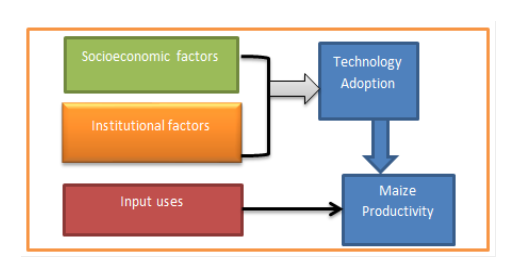
Based on the above theoretical evidences, this study integrates production theory and agricultural technology adoption theory. It conceptualized Maize output is a function of input use and technology under environmental constraints. Adoption of improved maize varieties depends on farmer characteristics, socioeconomic status, institutional factors, and environmental factors, which together influence productivity . The framework posits that improved maize variety adoption mediates the relationship between these determinants and maize yield (qt/ha).
Figure 1. Conceptual framework based on theoretical review.
Empirical evidences across Africa indicated that the technology adoption decision of smallholder farmer is influenced by socioeconomic, institutional, and farm-specific factors . For instance, study result from Uganda and Tunisia revealed that perceptions of climate, household size, and off-farm income shapes adoption behavior of smallholder farmers . Specifically in Ethiopia factors such as age, education, gender, farm size, income, credit access, livestock ownership, and extension services significantly affect adoption decisions .
Further, the existing evidences revealed that modern technology enhances crop productivity. According to , the adoption of improved maize variety adoption improves households income from Maize by about 35-50% in Ethiopia. Multiple technology adoption further increases productivity relative to single innovations . However, based on theoretical and empirical evidence, it is conceptualized that maize farmers’ adoption of improved varieties is influenced by socio-demographic, institutional, economic, and technological factors. Adoption, in turn, positively affects maize productivity, creating a chain linking farmer characteristics, technology use, and output. Recent study by concerning the determinants of modern agricultural technology adoption in Gimbo woreda of Kaffa zone revealed that farm size, age of household head, educational level, agricultural inputs access, access to agricultural extension, and credit service are the main determining factors of household adoption of modern agricultural technology.
3. Methodology
The study was conducted in Gesha Woreda, Kaffa Zone, Southwest Ethiopia, located 449 km from Addis Ababa. Agriculture is the primary economic activity, in which majority engaged. Farming in the woreda is predominantly mixed, combining crop production with livestock rearing. The woreda comprises 24 rural kebeles, with most farmers practicing small-scale subsistence agriculture. Despite the importance of maize as a staple crop, the adoption of modern agricultural technologies, particularly improved maize varieties remains low in the woreda.
A cross-sectional research design was employed to examine the determinants and impacts of agricultural technology adoption on maize productivity in this study. Further, this study employed both quantitative and qualitative approaches to capture comprehensive information from smallholder farmers and agricultural development agents. The analysis of this study relied primarily on primary cross-sectional data collected during the 2024/25 cropping season from maize-producing smallholder households. Also, secondary data from official reports and relevant literatures were also utilized to support and contextualize the findings.
Data were collected using structured household questionnaires designed to capture both qualitative and quantitative information. The structured questionnaire included demographic and socio-economic characteristics, agricultural practices and technology adoption, as well as institutional, economic, and environmental factors that influence maize productivity. Further, more qualitative insights were obtained from agricultural development agents to validate household-level information and supplement the analysis. The study population of this study covered all maize-producing households in Gesha Woreda, with particular focus on the eight kebeles (smallest administrative unit in Ethiopia) identified as potential maize producers. A three-stage sampling technique was employed. In the first stage, the study woreda is purposely selected based on its comparative potential relative to other woredas in Kaffa zone. In the second stage, the eight kebeles were purposively selected based on their maize production potential. In the third stage, the required sample size was determined, and distributed proportionally within each kebele.
The sample size was calculated using Yamane’s (1967) formula: n=N1+N(e2); where N=10,749 maize-producing households and e=0.05 (level of precision). This yielded a sample of 386 households. Table 1 presents the distribution of sampled households across the eight kebeles, differentiating adopters and non-adopters of improved maize varieties.
Table 1. Sample size distribution for respective Kebeles (the lowest administrative unit in Ethiopia).

Kebele

Number of Farmers

Adopter

Non- Adopter

Total Sample

Total

Sample

Total

Sample

1

Yerkichit

1258

898

32

360

13

45

2

Dirbedo

1421

906

32

515

19

51

3

Amero Ata

1123

754

27

369

13

40

4

Nechiti

1022

821

30

201

7

37

5

Mashami

1458

852

31

606

22

53

6

Batiganiti

1332

802

29

530

19

48

7

Abeta

1542

789

28

753

27

55

8

Yeshitoyeri

1,593

757

27

836

30

57

Total

10,749

6,579

236

4170

150

386

In this study, both descriptive and econometric techniques of analysis were employed to analyze the data collected from the sampled households. Descriptive statistics such as frequencies, percentages, and tabulations were used to summarize demographic, socio-economic, and institutional characteristics of the respondents. Econometric analysis was conducted in two stages. First, a Binary Logit Model was applied to identify the determinants of improved maize variety (IMV) adoption decision among smallholder farmers. And secondly, Propensity Score Matching (PSM) was used to estimate the causal impact of IMV adoption on maize productivity while controlling for potential selection bias.
This study based on Cobb Douglas production function for modeling the relationship between Maize output from a hectare of land and factors used for producing it. In this study, the analysis of the function relationship between output and input following the economic analysis conducted by . This analyses models that a smallholder farming household uses combination of N inputs such as labor, capital, seed, fertilizer and others for producing agricultural output (Maize in this case). The production function which connects the technological relationship between input and output by using the following production function.
Q=f(X,Z)
where Q represents output, X = (X1, X2... XN) is amount of inputs and Z = (Z1, Z2... ZM) is production shifter variables including household characteristics, environmental problem, farm practices and institutional services.
Different scholars employed Cobb-Douglas production function for analyzing the relationship presented above. For instance; used this Cobb Douglas production function to understand the major factors that affect the production of coffee in Darolabu woreda, West Hararghe Zone, and ; and also used it as specified below:
Q=F(x,z)
Y=Ax1a1x2a2+……………+xnaneβ1D1+β2D2+βnDn+Ui
This non-linear function can be converted to linear function through simple logarithmic transformation, and can be written as;
lnY=lnA+a1lnx1+a2lnx2+……….+anlnxn1D12D2+………βnDn+Ui
where Y represents maize output per hectare, Xi ​ denotes input factors such as labor, seed, and fertilizer, Di captures household, environmental, or institutional characteristics, and Ui is the error term. This functional form allows for estimating the elasticities of inputs while controlling for household, environmental, and institutional factors that may influence productivity.
Therefore, the transformed multiple linear models from the above function which can be used for this study is specified as;
Lnoutput=β01lnAge+β2lnSex+β3lneduc+β4lnexp+β5lnfsize+β6lndistr+β7lncred+β8lnexten+β9lndistm+β10lntrain+β11lnAES+Ui
Probability of household adopting improved maize varieties (AIMVs) was estimated using a binary logit model. The model is formulated as:
pi = E(AIMVi=1/Xi) = 11+e-Zi = 11+e-X'β
And, Households Not Adopting (1-pi) is expressed as;
1-pi = 1- eZi1+eZi
Where: X is a vector of explanatory variables determining the individual’s choice of whether adopting or not adopting the improved maize variety,
β is the set of parameters or coefficients of explanatory variables.
For simplicity, the equation above can rewrite as;
pi=eZi1+eZi = eX'β1+eX'β
Equation above is called cumulative distribution function, and represents the probability of household adopting the technology.
Since pi is non-linear in βs and Xi, it is impossible to apply the OLS procedures to estimate the parameters. So what is required is that linearizing equation above, because the problem is more apparent than the real case. Given the probability that household adopting and not adopting, we can write the odds ratio or relative risk, i.e. the ratio of households adopting to households not adopting can be derived as follows;
pi1-pi = 1+eZi1+e-Zi, by simplification it becomes eZi=eX'β.
Finally, by taking the natural log of the odds ratio (equation above) we can derive the logistic distribution. i.e.
Li =ln(adoptNot adopt)=Zi=X'β
For estimation purpose, equation above can be modified as
Zi=X'β+ui=α+βiXi+ui
Where X and β are as defined above.
Thus, the log-odds are a linear function of the explanatory variables.
Letting an individual’s true but completely unobservable technology adoption by AIMVi* (latent variable),
AIMVi*=X'β+ui= α+βiXi+ui
AIMVi*=α+β1age+β2sex+β3educ+β4exp+β5fsize+β6distr+β7cred+β8exten+β9distm+β10train+ui
Where; α-constant intercept and β1.. β10- coefficients of explanatory variable.
AIMVi*- is the ith households true but unobservable improved maize variety adoption and is binary choice dependent variable.
To estimate the causal effect of IMV adoption on maize productivity, Propensity Score Matching (PSM) was employed. PSM compares adopters (treatment group) and non-adopters (control group) who have similar observable characteristics, thereby controlling for selection bias. The Average Treatment Effect on the Treated (ATT) was calculated as:
ATT=E(YiT-YiC/Di=1)=E(YiT/Di=1)-E(YiT/Di=0)
where YiT and YiC are outcomes for treated and control farm households, respectively, and Di=1 indicates adoption.
In this study, various matching algorithms including nearest neighbor, radius, stratification, and kernel matching were used, and matching quality was evaluated using standardized bias and t-tests to ensure comparability between groups. In this study, diagnostic tests were performed to validate the reliability of both logistic regression and PSM models. The tests include assessing model fit using the likelihood ratio test, evaluating goodness-of-fit with the Hosmer-Lemeshow test, checking for multicollinearity among explanatory variables, and performing common support and covariate balance tests for PSM. These tests ensured that the models provided robust and unbiased estimates.
Table 2. Description of variables with their expected signs.

Variables

Type of Variable

Decision

Description

Expected Sign

Dependent and Outcome

Adoption of Improved Maize Variety (AIMV)

Dummy

1_ if “Adopt” and 0_ if “Not”

The maize farmers decision toward adopting technology is dependent on different factors

**

Maize productitvity (Prod)

Continuous

Measured in quintals of maize per hectare

The outcome variable of technology adoption

**

Independent Variables

Age (age)

Continuous

Measured in number of years

Aged farmers are experiences, hence adopt; or Older farmers may be more risk-averse

+/-

Sex (sex)

Dummy

1 if Male; and 0 otherwise

Being male-headed households are more willing to adopt

+

Education Level (educ)

Categorical

0-Never attend formal education

1-Primary (1-8)

2-Secondary (9-12)

3-College & above

Literate or years of schooling; influences awareness and ability to understand new practices.

+

Farm Experience (exp)

Continuous

Measured in years

More experienced farmers may be more likely to adopt, or less resistant to change

+

Farm Size (fsize)

Continuous

Measured in hectares

Larger farms sites may have more resources and willingness to adopt

+

Distance of farm from main road (distr)

Continuous

Measured in walking hours

Affects ease of supervision and application of technology.

-

Access to Credit (cred)

Dummy

1-if Yes; and 0-otherwise

Availability of loans or financial services for inputs or equipment

+

Access to extension services (exten)

Dummy

1-if Yes; and 0-otherwise

Regular visits or contact with agricultural officers increases information exposure

+

Distance of Market to the farm site (distm)

Continuous

Measured in walking hours

Proximity and affordability of seeds, fertilizers, and also opportunities to sell maize influence motivation to invest in productivity.

-

Access to training (train)

Dummy

1-if Yes; and 0-otherwise

Exposure to training increases likelihood of adoption.

+

The study incorporated dependent, outcome, and independent variables. The main dependent variables were the adoption of improved maize varieties (AIMV), coded as a binary variable (1 = adopt, 0 = not adopt), and the outcome variable was maize productivity (Prod/hectare), measured continuously in quintals per hectare; and independent variables were comprised of socio-economic, farm-related, environmental, and institutional factors hypothesized to influence adoption decision and productivity, with expected positive or negative signs based on prior literature and theory.
4. Results and Discussion
This study analyzed the factors of improved maize variety adoption decision and their impact of enhancing Maize productivity of smallholder farmers in Gesha Woreda, Kaffa Zone. The analysis were conducted both in descriptive and econometric analysis. The descriptive analysis highlights the demographic and socio-economic characteristics of respondents and institutional factors influencing maize productivity; while the econometric analysis identified the determinants of improved maize variety adoption decision of smallholder farm decision using Binary Logit model and its impact on Maize productivity through Score Matching (PSM). For analysis, necessary data was collected from 386 sample households while only 348 responses were used for analysis.
The descriptive statistics analysis result indicated that the age of sample farm households range from 20 to 78 years, with a mean of 45.2 years, indicating that most farmers were in the productive age group. This result aligns with human capital theory, which suggests that age and experience influence productivity and adoption of innovations. The sex composition shows that, male farmers dominated maize production in the study area (73.3%), while females represented 26.7%, consistent with empirical studies in Ethiopia showing male predominance in staple crop production . Concerning the level of education, 51.2% of farmers had completed primary education, 25.9% had no formal education, 17.2% had completed secondary education, and only 5.8% had attained college-level or higher education. Evidences indicated that level of education has been widely recognized as a key determinant of technology adoption decision, as it improves farmers’ capacity to access, understand, and utilize improved agricultural practices .
Regarding average income of sample farm households in the study area, the study area shows that the average annual income from maize production was ETB 21,331 ranging from minimum of ETB 1,250 and maximum of ETB 90,000, and 67.2% of households earned over ETB 20,000 annually from off-maize sources. The result further indicates that practicing mixed farming plays a vital role in ensuring farming households livelihood. Further the result is consistent with livelihood diversification theory presented by , who states that rural households combine multiple income sources to reduce risk and enhance welfare.
Concerning the average land owned by farm households, the study result revealed that the average landholding was 2.82 hectares ranging from a minimum of 0.75 hectare and maximum of 9 hectares. The average hour of walking from farm site to main road becomes 1 hour and 30 minutes, which may constrain access to markets, inputs, and extension services. The existing study results in Ethiopia tells us that proximity to infrastructure such as main feeder road significantly influences input use, market participation, and adoption of improved varieties .
Regarding the farm households access to agricultural extension services, the descriptive statistics of this study revealed that majority (67.2%) of sample participants had access to credit, 65.2% had used fertilizers, 63.0% had utilized improved maize seeds, and 57.2% had participated in extension services in general; while only 39.1% had received training during the last production season, highlighting gaps in capacity-building in the study area. The theoretical evidences highlight that access to credit service and extension services improves the adoption decision of farm households as well as their productivity . Further, a study finding from Ethiopia supports this theory. For instance, study by confirmed that access to credit and extension services enhances productivity. In conclusion, though majority had access to credit service and extension service in the study area, gaps particularly in training may limit the effective adoption of the technology and productivity of maize output in the study area.
Before directly using the results for discussions, basic diagnostic tests were conducted. Accordingly, the diagnostic tests indicate that the binary logit model is statistically robust. Multicollinearity was assessed using the Variance Inflation Factor (VIF), which produced a mean value of 1.20, suggesting no serious multicollinearity concerns. Heteroskedasticity was evaluated using the Breusch-Pagan/Cook-Weisberg test, confirming that the model exhibits constant variance. Finally, the Hosmer-Lemeshow goodness-of-fit test indicated that the model fits the data well, supporting the reliability of the estimated results .
Determinants of Improved Maize Variety (IMV) Adoption in Gesha Woreda
To analyze the determinants of improved maize variety adoption decision in the study area, binary logit model was applied. Accordingly, the result from the model revealed that different hypothesized factors were significant determinants of improved maize variety adoption in the study area. Table 3 below presented the binary logit regression result. The result shown that male-headed households were 78% more likely to adopt improve maize variety’s, with a marginal effect of 14.6 percentage points. The result for level of education revealed that higher education significantly raises the likelihood of improved maize variety adoption by 76% (marginal effect = 10.9 percentage points). The finding is in line with empirical findings that education improves farmers’ capacity to access, understand, and utilize agricultural technologies . Similarly, the farm households experience positively and significantly determined the decision of improved maize variety in the study area. The result for farm experience shows that, one additional year of farm experience increases the odds by 8% (marginal effect =1.8 percentage points), which supports the human capital theory, which emphasizes that accumulated experience enhances productivity and adoption decisions.
The other significant factor of improved maize variety adoption in the study area is the size of landholding. The finding presented below shows that each additional hectare of land increases the adoption odds by 17% (marginal effect = 3.7 percentage points). Likewise, access to credit strongly enhanced adoption decision, increasing the odds by 91% (marginal effect = 15.7 percentage points). The result is consistent with prior studies showing that financial access enables farmers to invest in improved inputs.
Being far from market center discourages farming household from adopting improved maize variety in the study area. Further, the result presented below shown that, greater distance to the nearest market reduced the likelihood of adoption by 39% (marginal effect = −11.3 percentage points), reflecting the importance of market accessibility in technology adoption . However, variables such as participation in extension services, training, and distance to the main road were not statistically significant in this study. Overall, the results indicate that factors such as socio-economic, environmental, institutional, and others play key roles in shaping farmers’ adoption decisions.
Table 3. Logit regression result for determinants of improved maize variety adoption in the study area.

Variables

Odd-ratio

dy/dx

Stand. Err

Z

p>|z|

_constant

0.2601125

-

0.7100

-2.00

0.045

Age

0. 9958821

-0.0008

0.0118

-.28

0.780

Sex

1.782809

0.1459

0.2811

2.14

0.033**

Education

1.757276

0.1091

0.1593

2.87

0.004***

Experience

1.079141

0.0179

0.0157

4.78

0.000***

Farm size

1.166733

0.0367

0.0702

2.19

0.028**

Distance_main road

0. 761835

-0.0645

0.2225

-1.22

0.224

Credit access

1.905072

0.1574

0.2736

2.50

0.012**

Extension service

1.302635

0.0614

0.2500

1.03

0.304

Distance of market

0. 6115543

-0.1131

0.1669

-2.84

0.004***

Training service

0. 8684482

-0.0391

0.2565

-0.64

0.524

*,**, &*** represents significant at 10%, 5%, & 1% respectively.

Number of Obs = 348
LR chi2(10) = 83.01
Prob >chi2 = 0.0000
Pseudo R2 = 0.1756
Log likelihood = -194.85433
Source: Own computation based on data, 2025
Impact of Improved Maize Variety Adoption on Maize Productivity in Gesha Woreda
For examining the impact of improved maize variety on maize productivity in the study area, Propensity Score Matching (PSM) was employed. PSM model was employed to control for selection bias arising from observable differences between adopters and non-adopters . The result of this study revealed that the adoption of improved maize variety significantly improved the maize productivity in the study area.
Table 4. Covariate Balance Test Before and After Matching.

Variable

Mean

%reduct

t-test

Treated

Control

%bias

Bias

t

p>t

Age

U

47.946

41.255

48.400

4.470

0.000

0.880

M

47.946

46.227

12.400

74.300

1.250

0.212

Sex

U

0.783

0.662

27.200

2.530

0.012

M

0.783

0.803

-4.400

83.700

-0.490

0.625

Educ

U

0.847

0.731

22.200

2.040

0.042

0.950

M

0.847

0.867

-3.800

83.100

-0.390

0.698

Exper

U

20.892

13.276

72.900

6.710

0.000

0.980

M

20.892

20.473

4

94.500

0.380

0.706

Farm size

U

3.027

2.520

27.100

2.470

0.014

1.300

M

3.027

3.231

-10.900

59.800

-0.940

0.345

Distance of road

U

1.244

1.327

-14.500

-1.330

0.184

1.010

M

1.244

1.257

-2.300

84.400

-0.230

0.819

Credit

U

0.355

0.290

13.900

1.270

0.204

M

0.355

0.350

1.1

92.400

0.100

0.918

Extension

U

0.596

0.538

11.700

1.080

0.281

M

0.596

0.611

-3.000

74.600

-0.300

0.762

Distance of market

U

1.151

1.575

-56.300

-5.190

0.000

0.950

M

1.151

1.202

-6.700

88.100

-0.680

0.495

Training

U

0.384

.4

-3.200

-0.300

0.767

M

0.384

0.374

2

37.500

0.200

0.838

Source: Own computation based on data, 2025
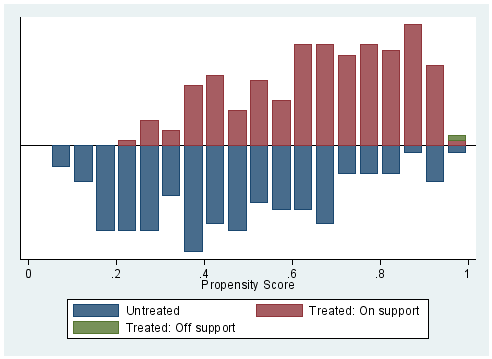
Figure 2. Common Support Region.
The figure above presents the distribution of propensity scores for treated and untreated households. The overlap in the propensity score distribution indicates the existence of common support region for both adopters and non-adopters. Except few treated observations, majority falls within the common support region; hence the estimation is based on comparable observations.
Moreover, the covariate balance test was conducted. The test result presented in table below shows that the covariate balance test results before and after matching. The test result revealed that significant difference exists between adopters and non-adopters before matching. After matching, the standardized bias for all covariates declined significantly. Thus indicates the common support and conditional independence assumptions are reasonably satisfied.
The Average Treatment Effect on the Treated (ATT) indicates that households adopting improved maize varieties achieved, on average, a 11-unit higher maize productivity outcome compared to comparable non-adopting households. Although the magnitude of the ATT appears modest, the associated t-statistic (4.94) confirms that the effect is statistically significant at conventional levels, implying that IMV adoption generates a measurable and positive productivity gain for adopting households. Similarly, the Average Treatment Effect (ATE) shows that, on average, adoption improves maize productivity for a randomly selected household from the population, suggesting that the productivity benefits of improved maize varieties extend beyond current adopters.
Furthermore, the sincerity of the estimated impact result is confirmed by post-matching diagnostic tests. The result of pseudo R2 decreased from 0.167 before matching to 0.007 after matching, indicating that observable differences between adopters and non-adopters were largely eliminated following matching . In addition, post-matching covariate balance tests revealed no statistically significant differences in key household and farm characteristics between the matched groups, confirming satisfaction of the common support condition and the Conditional Independence Assumption (CIA). Hence, these post diagnostic tests indicated that the results are strongly confirmed for the causal interpretation of the estimated treatment effects, indicating that the observed productivity differences can be convincingly attributed to improved maize variety adoption rather than pre-existing household characteristics.
Generally, the adoption of improved maize variety enhances productivity of maize output in the study area. The statistically significant and consistent result of ATT had shown us the importance agricultural technology adoption in the study area. Moreover, the study result is consistent with prior studies across Ethiopia and sub-saharan Africa . And also, from the perspective of policy, the finding highlights the need for intervention in provision of improved seeds to the smallholder farmers in the study area specifically, and to the region in general.
Table 5. Estimated the average treatment effect on the treated group (ATT) in the study area.

Variable

Sample

Treated

Controls

Difference

S. E

T-stat

ATT

22.20248

11.1087

11.0094

0.2215

4.94*

ATE

22.0016

10.998106

11.003494

0.1547

3.25*

Source: Own computation based on data, 2025
Insights from Agricultural Development Agents
This study obtained additional insights from agricultural development agents in the study woreda. Accordingly, interviews were conducted with ten local agricultural development agents, and the interview highlights that revealed that the promotion of improved maize varieties (IMVs) is supported by different mechanisms though the initiation from the side of households is low. Moreover, the agents identified several challenges, such as seed shortages, limited budgets, inadequate infrastructure, pest outbreaks, and climate variability, which constrain effective adoption of the modern agricultural technologies in the study area. Further, the participants emphasized the importance of improving seed supply, strengthening extension follow-up, establishing better market linkages, and providing targeted farmer training to boost adoption rates. These qualitative insights from interview with officials complement the survey findings and offer valuable context for formulating policy recommendations.
5. Conclusion
Agriculture is the main livelihood activity in sub-Saharan Africa including Ethiopia, and maize is the known crop among others. The productivity of agriculture in general and maize in particular remained low due to different factors including limited adoption of improved modern agricultural technologies. This study assessed the determinants of adoption of improved maize varieties (IMVs) and their impact on maize productivity among smallholder farmers in Gesha Woreda, Kaffa Zone. The analysis was conducted both in descriptive and econometric analysis.
The results from descriptive analysis revealed that majority of households are male headed, attended primary education, generated average yearly maize income up to ETB 90,000, and owned maximum of 9 hectare of farm land. Moreover, the farm household’s decision of adopting improved maize variety is significantly determined by sex, education, farm experience, farm size, access to credit, and distance to markets; while age, distance to main roads, extension services, and training were not significant factors. Regarding the impact, before addressing selection bias, adopters produced an average of 22.20 quintals per hectare compared to 11.11 quintals for non-adopters. Using Propensity Score Matching (PSM) to control for selection bias, the Average Treatment Effect on the Treated (ATT) indicated that adopters gained an additional 11.01 quintals per hectare, while the Average Treatment Effect (ATE) suggested a potential increase of 11.00 quintals if all households adopted IMVs. These findings confirm that IMV adoption significantly enhances maize productivity and household income, highlighting the importance of supporting adoption through targeted extension services, credit access, and improved market infrastructure to boost rural livelihoods.
6. Recommendations
Based on the study findings, the following recommendations are proposed to enhance the adoption of improved maize varieties and increase maize productivity in Gesha Woreda and the broader Kaffa Zone, Southwest Ethiopia.
First, credit access plays a vital role in enhancing the adoption of improved maize variety; hence improving the credit access to credit is important point of consideration. To achieve the impact through credit, strengthening rural microfinance institutions and cooperative-based schemes, reducing collateral requirements, providing seasonal input-specific credit packages, and piloting innovative delivery models such as mobile-based microloans or blockchain-backed digital credit to ensure timely, transparent, and tailored financial support for smallholder farmers is recommended as a way out. Second, organizing different market hubs can improve the adoption of modern agricultural technologies including improved maize variety, since distance to market center negatively influence the farming households adoption decision. Encouraging females participation through different mechanisms like gender-sensitive training programs, targeted seed and credit support for women-headed households, strengthening farmer education and training is also recommended, since education strongly influences adoption; expanding farmer field schools, radio programs, and interactive digital learning tools can improve awareness of the benefits, management, and profitability of improved maize varieties. Finally, supporting farmers with small landholdings is necessary, as farm size positively affects adoption. Generally, implementing the remedies stated above can substantially increase adoption rates, increase maize productivity, and enhance rural household income and food security.
Abbreviations

GDP

Gross Domestic Product

IMV

Improved Maize Variety

AIMV

Adoption of Improved Maize Varieties

PSM

Propensity Score Matching

ETB

Ethiopian Birr

ATT

Average Treatment Effect on Treated

ATE

Average Treatment Effect

CIA

Conditional Independence Assumption

VIF

Variance Inflation Factor

TTM

Trans-theoretical Model

TRA

Theory of Reasoned Action

TIB

Theory of Interpersonal Behavior

IDP

Innovation Decision Making

OLS

Ordinary Least Square

Author Contributions
Netsanet Gizaw: Conceptualization, Supervision, Methodology, Writing – review & editing, Investigation, Data Curation, Validation, Project Administration, Resources, Funding acquisition
Mathiwos Kifle: Conceptualization, Methodology, Formal Analysis, Writing – original draft, Visualization, Investigation, Data Curation, Validation, Software, Formal analysis
Conflicts of Interest
The authors declare no conflicts of interest.
References
[1] Abate, T. (2024). Agricultural technology adoption and productivity in Ethiopia: A synthesis of empirical evidence. Journal of Development Studies, 60(3), 410–430.
[2] Abate, T., et al. (2017). Factors that transformed maize productivity in Ethiopia. Food Security, 9(5), 965–981.
[3] Abate, T., Shiferaw, B., Menkir, A., et al. (2015). Factors that influence adoption of improved maize varieties in Africa: A review. Food Security, 7(2), 307–327.
[4] Abate, T., Shiferaw, B., Yesuf, M., et al. (2017). Impact of improved maize varieties on smallholder farmers’ food security in Ethiopia: Evidence from panel data. Food Policy, 67, 55–68.
[5] Ahmed, S., Amare, H., & Suri, T. (2017). Agricultural technology adoption and productivity in sub-Saharan Africa. World Development, 95, 161–175.
[6] Alemu, D., Simane, B., & Teklewold, H. (2014). Maize production in Southwest Ethiopia: Challenges and opportunities. Ethiopian Journal of Agricultural Sciences, 24(1), 45–60.
[7] Anteneh, B., & Aman, A. (2017). Factors affecting coffee production in Darolabu Woreda, West Hararghe Zone: A Cobb-Douglas approach. Ethiopian Journal of Agricultural Economics, 6(2), 1–15.
[8] Ayalew, T., & Abebe, T. (2018). Determinants of agricultural technology adoption in Ethiopia: Evidence from maize farmers. Journal of Development and Agricultural Economics, 10(5), 134–145.
[9] Ayele, G., Admassie, A., & Tadele, G. (2003). Adoption of improved maize varieties in Ethiopia: Patterns, determinants, and impacts. Ethiopian Journal of Agricultural Economics, 2(1), 25–41.
[10] Banda, K. (2020). Agriculture and economic growth in sub-Saharan Africa: Opportunities and challenges. African Development Review, 32(2), 105–118.
[11] Banda, K. (2022). Climate variability and agricultural productivity in Africa. Journal of Environmental Economics, 15(1), 21–40.
[12] Bekabil, F. (2014). Constraints to maize production in Ethiopia: A review. Ethiopian Journal of Agricultural Research, 7(1), 12–27.
[13] Berhanu, T. (2022). Determinants of improved seed adoption among smallholder farmers in Ethiopia. Journal of Agricultural Extension and Development, 14(2), 55–70.
[14] Berhanu, Y. Y. (2022). DETERMINANTS OF AGRICULTURAL MODERN TECHNOLOGY ADOPTION BY SMALLHOLDER FARMERS: THE CASE OF GIMBO DISTRICT, KEFFA ZONE, SOUTHWESTERN REGIONAL STATE, ETHIOPIA (Doctoral dissertation, Haramaya University).
[15] Caliendo, M., & Kopeinig, S. (2008). Some practical guidance for the implementation of propensity score matching. Journal of Economic Surveys, 22(1), 31–72.
[16] Challa, F., & Tilahun, A. (2014). Impact of improved maize varieties on household income and food security in Ethiopia. Journal of Development and Agricultural Economics, 6(6), 242–250.
[17] Chowdhury, M. A. H., & Hassan, M. S. (2013). Hand book of agricultural technology. Bangladesh Agricultural Research Council, Farmgate, Dhaka, 230.
[18] Coelli, T., Rao, D. S. P., O’Donnell, C. J., & Battese, G. E. (2005). An introduction to efficiency and productivity analysis (2nd ed.). Springer.
[19] CSA (Central Statistical Agency). (2017). Agricultural sample survey 2016/17: Report on area and production of major crops (private peasant holdings). Addis Ababa, Ethiopia.
[20] Dhraief, M., Khlif, N., & Amri, M. (2019). Determinants of improved maize seed adoption in Tunisia. African Journal of Agricultural Research, 14(4), 188–198.
[21] Dissanayake, C. A. K., Jayathilake, W., Wickramasuriya, H. V., Dissanayake, U., Kopiyawattage, K. P., & Wasala, W. M. C. B. (2022). Theories and models of technology adoption in agricultural sector. Human Behavior and Emerging Technologies, 2022(1), 9258317.
[22] Ellis, F. (2000). Rural livelihoods and diversity in developing countries. Oxford University Press.
[23] Emeru, M. (2022). Socioeconomic determinants of agricultural technology adoption in Ethiopia: Evidence from maize and wheat farmers. Ethiopian Journal of Agricultural Economics, 11(1), 15–33.
[24] Erenstein, O., Jaleta, M., Sonder, K., Mottaleb, K., & Prasanna, B. M. (2022). Global maize production, consumption and trade: trends and R&D implications. Food security, 14(5), 1295-1319.
[25] Feder, G., Just, R. E., & Zilberman, D. (1985). Adoption of agricultural innovations in developing countries: A survey. Economic Development and Cultural Change, 33(2), 255–298.
[26] Fishbein, M., & Ajzen, I. (1975). Belief, attitude, intention, and behavior: An introduction to theory and research. Addison-Wesley.
[27] Fuglie, K. (2008). Is agricultural productivity slowing? Global Food Security, 1(1), 1–9.
[28] Gebre-Selassie, S., & Bekele, D. (2012). Agricultural productivity and technology adoption in Ethiopia. Journal of Development and Agricultural Economics, 4(9), 243–254.
[29] Geta, E., Alemayehu, M., & Tadesse, T. (2013). Maize production constraints and adoption of improved varieties in Ethiopia. Ethiopian Journal of Agricultural Research, 6(2), 34–47.
[30] Haggblad, S., Nyberg, G., & Fagerberg, B. (2010). Agriculture, productivity, and economic development. Journal of Economic Perspectives, 24(4), 45–68.
[31] Hailu, A., Zeleke, T., & Tsegaye, D. (2014). Determinants of improved maize adoption in Southwest Ethiopia. Ethiopian Journal of Development Research, 36(1), 21–42.
[32] Hamathilake, S., & Gunathilake, D. (2022). Technological innovation and agricultural productivity in developing countries. Sustainability, 14(3), 1452.
[33] Harris, D., & Fuller, D. (2013). Agriculture: definition and overview. Springer.
[34] Hosmer, D. W., & Lemeshow, S. (2000). Applied logistic regression (2nd ed.). Wiley.
[35] Kansiime, M., Tumuhimbise, R., & Mugisha, J. (2014). Socioeconomic factors influencing adoption of improved maize varieties in Uganda. African Journal of Agricultural Research, 9(25), 1927–1936.
[36] Kassie, M., Jaleta, M., Shiferaw, B., Mmbando, F., & Mekuria, M. (2018). Adoption of interrelated sustainable agricultural practices in smallholder systems. Agricultural Economics, 49(3), 1–13.
[37] Marenya, P., Barrett, C., & Moser, C. (2022). Maize production and food security in sub-Saharan Africa. Food Policy, 111, 102–123.
[38] McCann, J. (2017). The African goods revolution: Agricultural change and rural livelihoods. Cambridge University Press.
[39] Mgendi, R., Mrema, M., & Kessy, P. (2019). Agricultural technology adoption and productivity: Evidence from Tanzania. African Journal of Agricultural Research, 14(3), 150–162.
[40] Mwangi, W., & Kariuki, S. (2015). Factors determining adoption of new agricultural technologies in Africa. Journal of Economics and Sustainable Development, 6(5), 208–216.
[41] NECATTC (National Educational and Community Training Center). (2021). Behavior change and technology adoption frameworks. Addis Ababa: NECATTC Press.
[42] Paul, R., Smith, J., & Harrison, K. (2020). Origins of agriculture and human civilization. Journal of Historical Biology, 32(2), 115–133.
[43] Rogers, E. M. (2003). Diffusion of innovations (5th ed.). Free Press.
[44] Rosenbaum, P. R., & Rubin, D. B. (1983). The central role of the propensity score in observational studies for causal effects. Biometrika, 70(1), 41–55.
[45] Saliem, A., Kothari, V., & Singh, R. (2020). Determinants of technology adoption among smallholder farmers in Africa. Agricultural Systems, 177, 102–118.
[46] Self, J., & Grabowski, R. (2007). Technological adoption and labor productivity in agriculture. American Journal of Agricultural Economics, 89(2), 346–360.
[47] Semreab, E. (2018). The determinants of agricultural technology adoption and its’ impact on teff productivity in the case of Amhara and Oromia national Regional state (Doctoral dissertation, Doctoral Dissertation).
[48] Shiferaw, B., Kassie, M., Jaleta, M., & Yirga, C. (2014). Adoption of improved wheat varieties and impacts on household food security in Ethiopia. Food Policy, 44, 272–284.
[49] Solomon, S., Worku, H., & Zewdie, S. (2021). Adoption of improved maize varieties in Ethiopia: Socioeconomic and institutional factors. Ethiopian Journal of Agricultural Economics, 10(2), 45–63.
[50] Solomon Yokamo. (2020) Adoption of Improved Agricultural Technologies in Developing Countries: Literature Review. International Journal of the Science of Food and Agriculture, 4(2), 183-190.
[51] Suri, T., & Udry, C. (2022). Agricultural technology in Africa. Journal of Economic Perspectives, 36(1), 33-56.
[52] Taru, H., Desalegn, M., & Kebede, D. (2008). Estimating input-output relationships in smallholder agriculture using Cobb-Douglas production functions. Ethiopian Journal of Agricultural Research, 2(1), 45–58.
[53] Tauger, M. (2010). Agriculture and economic development: Historical perspectives. Agricultural History Review, 58(1), 5–28.
[54] Tesfaye, K., Kassa, B., & Alemayehu, M. (2016). Effects of improved seed adoption on maize productivity in Ethiopia. Journal of Development Studies, 52(10), 1452–1467.
[55] Todaro, M. P., & Smith, S. C. (2009). Economic development (11th ed.). Pearson.
[56] Tru, N. (2009). Application of Cobb-Douglas function in agricultural productivity analysis. Journal of Economics and Agricultural Development, 1(1), 33–40.
[57] Wordofa, M., Chala, M., & Gebre, M. (2021). Impact of improved maize and wheat varieties on smallholder productivity in Ethiopia. Journal of Development and Agricultural Economics, 13(4), 100–112.
[58] Wossen, T., et al. (2017). Impacts of improved maize varieties on food security in Ethiopia. Agricultural Economics, 48(3), 1–13.
[59] Yadav, S. (2023). Agriculture, livelihoods, and development in low-income countries. Global Food Security, 33, 100–115.
[60] Yadete, W. (2024). Maize productivity and technology adoption in Southwest Ethiopia. Ethiopian Journal of Agricultural Economics, 12(1), 1–18.
[61] Yigezu, T. (2021). Constraints and opportunities for maize production in Ethiopia. Ethiopian Journal of Agricultural Research, 14(2), 25–42.
[62] Zegeye, T., Abebe, T., & Solomon, H. (2022). Multiple technology adoption and its effect on smallholder productivity in Ethiopia. Agricultural Economics, 53(2), 245–258.
[63] Zvelebil, M., & Pluciennik, M. (2011). The origins and spread of agriculture. Current Anthropology, 52(1), 1–20.
Cite This Article
  • APA Style

    Gizaw, N., Kifle, M. (2026). Determinants of Improved Maize Variety Adoption and Its Impact on Smallholder Farm Productivity Evidence from Gesha Woreda, Southwest Ethiopia. Science Discovery Agriculture, 1(2), 83-95. https://doi.org/10.11648/j.sda.20260102.13

    Copy | Download

    ACS Style

    Gizaw, N.; Kifle, M. Determinants of Improved Maize Variety Adoption and Its Impact on Smallholder Farm Productivity Evidence from Gesha Woreda, Southwest Ethiopia. Sci. Discov. Agric. 2026, 1(2), 83-95. doi: 10.11648/j.sda.20260102.13

    Copy | Download

    AMA Style

    Gizaw N, Kifle M. Determinants of Improved Maize Variety Adoption and Its Impact on Smallholder Farm Productivity Evidence from Gesha Woreda, Southwest Ethiopia. Sci Discov Agric. 2026;1(2):83-95. doi: 10.11648/j.sda.20260102.13

    Copy | Download

  • @article{10.11648/j.sda.20260102.13,
      author = {Netsanet Gizaw and Mathiwos Kifle},
      title = {Determinants of Improved Maize Variety Adoption and Its Impact on Smallholder Farm Productivity Evidence from Gesha Woreda, Southwest Ethiopia},
      journal = {Science Discovery Agriculture},
      volume = {1},
      number = {2},
      pages = {83-95},
      doi = {10.11648/j.sda.20260102.13},
      url = {https://doi.org/10.11648/j.sda.20260102.13},
      eprint = {https://article.sciencepublishinggroup.com/pdf/10.11648.j.sda.20260102.13},
      abstract = {Despite the availability of improved maize varieties in Ethiopia, adoption among smallholder farmers remains uneven, contributing to persistent yield gaps. This study investigates the determinants of improved maize variety adoption and its impact on smallholder farm productivity in Gesha Woreda, Southwest Ethiopia. Using cross-sectional household survey data, a binary logit model is employed to identify factors influencing farmers’ adoption decisions. To address potential selection bias arising from observable differences between adopters and non-adopters, Propensity Score Matching (PSM) were applied to estimate the causal effect of adoption on maize productivity. Multiple matching algorithms, including nearest neighbor, radius, and kernel matching, are used to assess the robustness of the estimated treatment effects. Descriptive results indicate significant differences between adopters and non-adopters in age, education, farm size, farming experience, and credit access. Logit model results show that the sex of the household head, education level, farm size, farming experience, access to credit, and distance to markets significantly affect adoption decisions. PSM results revealed that adopters produce significantly higher maize yields than non-adopters, confirming the positive effect of IMV adoption. The results underscore the need for policies that expand farmer access to extension services and rural credit, strengthen dissemination of improved seed technologies, and enhance farmers’ human capital through education and training programs to accelerate adoption and improve smallholder productivity.},
     year = {2026}
    }
    

    Copy | Download

  • TY  - JOUR
    T1  - Determinants of Improved Maize Variety Adoption and Its Impact on Smallholder Farm Productivity Evidence from Gesha Woreda, Southwest Ethiopia
    AU  - Netsanet Gizaw
    AU  - Mathiwos Kifle
    Y1  - 2026/04/13
    PY  - 2026
    N1  - https://doi.org/10.11648/j.sda.20260102.13
    DO  - 10.11648/j.sda.20260102.13
    T2  - Science Discovery Agriculture
    JF  - Science Discovery Agriculture
    JO  - Science Discovery Agriculture
    SP  - 83
    EP  - 95
    PB  - Science Publishing Group
    UR  - https://doi.org/10.11648/j.sda.20260102.13
    AB  - Despite the availability of improved maize varieties in Ethiopia, adoption among smallholder farmers remains uneven, contributing to persistent yield gaps. This study investigates the determinants of improved maize variety adoption and its impact on smallholder farm productivity in Gesha Woreda, Southwest Ethiopia. Using cross-sectional household survey data, a binary logit model is employed to identify factors influencing farmers’ adoption decisions. To address potential selection bias arising from observable differences between adopters and non-adopters, Propensity Score Matching (PSM) were applied to estimate the causal effect of adoption on maize productivity. Multiple matching algorithms, including nearest neighbor, radius, and kernel matching, are used to assess the robustness of the estimated treatment effects. Descriptive results indicate significant differences between adopters and non-adopters in age, education, farm size, farming experience, and credit access. Logit model results show that the sex of the household head, education level, farm size, farming experience, access to credit, and distance to markets significantly affect adoption decisions. PSM results revealed that adopters produce significantly higher maize yields than non-adopters, confirming the positive effect of IMV adoption. The results underscore the need for policies that expand farmer access to extension services and rural credit, strengthen dissemination of improved seed technologies, and enhance farmers’ human capital through education and training programs to accelerate adoption and improve smallholder productivity.
    VL  - 1
    IS  - 2
    ER  - 

    Copy | Download

Author Information
  • Economics Department, Mizan-Tepi University, Tepi, Ethiopia

  • Economics Department, Bonga University, Bonga, Ethiopia