
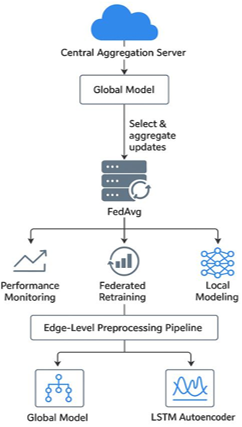
The increasing deployment of Internet of Things (IoT) devices in smart city infrastructures has significantly expanded the cyberattack surface, creating new opportunities for sophisticated cyber threats. Among these threats, Advanced Persistent Threats (APTs) pose a major security challenge because they operate stealthily, remain active over extended periods, and often evade traditional signature-based intrusion detection systems. At the same time, privacy concerns and the decentralized nature of smart city environments limit the effectiveness of conventional centralized security solutions. To address these challenges, this study proposes a privacy preserving federated learning framework for detecting APTs within smart city IoT networks. The proposed system combines distributed federated learning with a dual model detection architecture consisting of a federated XGBoost classifier and a locally trained Long Short Term Memory (LSTM) autoencoder. The federated model enables collaborative learning across multiple edge nodes without transferring raw data to a central server, thereby preserving user privacy and reducing communication overhead. Meanwhile, the LSTM autoencoder learns local behavioral patterns and identifies previously unseen anomalies. The Edge IIoTset dataset, containing approximately 2.2 million network flow records and fourteen attack categories, is employed to evaluate the proposed framework under realistic non-independent and identically distributed (non-IID) conditions. Experimental evaluation demonstrates that the integrated federated learning approach achieves high detection performance while maintaining low inference latency suitable for edge environments. The LSTM autoencoder achieves an F1-score of 0.93, while the federated XGBoost classifier effectively identifies known attack categories with minimal computational overhead. The layered detection strategy improves the identification of both known and unknown threats and maintains response times below 200 milliseconds on edge class devices. These findings indicate that privacy preserving federated learning can provide a scalable, efficient, and practical solution for securing smart city IoT infrastructures against sophisticated APT attacks.
| Published in | Science Discovery Computers (Volume 1, Issue 2) |
| DOI | 10.11648/j.sdcomput.20260102.14 |
| Page(s) | 102-109 |
| Creative Commons |
This is an Open Access article, distributed under the terms of the Creative Commons Attribution 4.0 International License (http://creativecommons.org/licenses/by/4.0/), which permits unrestricted use, distribution and reproduction in any medium or format, provided the original work is properly cited. |
| Copyright |
Copyright © The Author(s), 2026. Published by Science Publishing Group |
Advanced Persistent Threats, Cybersecurity, Edge Computing, Federated Learning, Internet of Things
Dataset | Strengths | Limitations | Relevance to This Study |
|---|---|---|---|
CICAPT-IoT [15] | Realistic APT attack chains, provenance based logging | Limited scale, centralized setup | Useful for APT analysis, but unsuitable for edge level learning |
N-BaIoT [16] | High quality botnet traces, real IoT devices | Focused solely on botnets | Suitable for anomaly detection baselines |
Bot-IoT [17] | High volume traffic, diverse attack types | Highly imbalanced, synthetic benign traffic | Appropriate for ML benchmarking but lacks realism |
TON_IoT [18] | Distributed telemetry sources | No multi stage APT scenarios | Relevant for distributed detection |
Edge-IoTSet [19] | Large scale (2.2M flows), 14 attack types, suitable for edge and federated learning | No explicit APT chains | Best fit for heterogeneous and distributed smart city environments |
AI | Artificial Intelligence |
APT | Advanced Persistent Threat |
CNN | Convolutional Neural Network |
DDoS | Distributed Denial of Service |
DL | Deep Learning |
FedAvg | Federated Averaging |
FL | Federated Learning |
FPR | False Positive Rate |
IIoT | Industrial Internet of Things |
IoT | Internet of Things |
LSTM | Long Short-Term Memory |
ML | Machine Learning |
MQTT | Message Queuing Telemetry Transport |
SQL | Structured Query Language |
XGBoost | Extreme Gradient Boosting |
| [1] | R. Ahmad and I. Alsmadi, “Machine learning approaches to IoT security: A sys tematic literature review,” Internet of Things, vol. 14, p. 100365, Jan. 2021, |
| [2] | X. Liang and Y. Kim, “A survey on security attacks and solutions in the IoT network,” IEEE Access, Jan. 2021, [Online]. Available: |
| [3] | C. Gan, J. Lin, D.-W. Huang, Q. Zhu, and L. Tian, “Advanced persistent threats and their defense methods in industrial Internet of Things: A survey,” Mathematics, vol. 11, no. 14, p. 3115, 2023, |
| [4] | A. S. Al-Aamri, R. Abdulghafor, S. Turaev, I. Al-Shaikhli, A. Zeki, and S. Talib, “Machine learning for APT detection,” Sustainability, vol. 15, no. 18, p. 13820, 2023, |
| [5] | F. Farid, “A threat analysis framework for cyberattacks in smart cities,” Ad vances in the Internet of Things, pp. 101–124, Jun. 2025, |
| [6] | S. H. Javed, M. B. Ahmad, M. Asif, S. H. Almotiri, K. Masood, and M. A. A. Ghamdi, “An intelligent system to detect advanced persistent threats in industrial Inter net of Things,” Electronics, vol. 11, no. 5, p. 742, Feb. 2022, |
| [7] | W. Rajeh et al., “Improved smart city security using a deep maxout network based intrusion detection system with walrus optimization,” PeerJ Computer Science, vol. 11, p. e2743, Mar. 2025, |
| [8] | M. Alauthman, A. Aldweesh, and A. Al-Qerem, “IoT security challenges in mod ern smart cities,” in Proc. Int. Conf. Comput. Commun. Robotics (ICCR)*, Feb. 2024, pp. 1–6, |
| [9] | F. Alzyoud, R. Al-Falah, M. Tarawneh, and O. Tarawneh, “Security challenges and solutions in smart cities,” in Lecture Notes in Networks and Systems*, vol. 790, pp. 256–267, Jan. 2024, |
| [10] | R. Sharma and R. Arya, “Security threats and measures in the Internet of Things for smart city infrastructure: A state-of-the-art,” Trans. Emerg. Telecommun. Technol., vol. 34, no. 11, 2022, |
| [11] | Y. Chen et al., “Real-time inference with sub-35 ms latency processing over 1200 network flows using CNN–LSTM architecture for intrusion detection,” IEEE Trans. Ind. Informatics, vol. 19, no. 3, pp. 2894–2903, Mar. 2023. |
| [12] | H. Neuschmied, M. Winter, B. Stojanović, K. Hofer-Schmitz, J. Božić, and U. Kleb, “APT-attack detection based on multi-stage autoencoders,” Applied Sciences, vol. 12, no. 13, p. 6816, Jul. 2022, |
| [13] | E. Daisy, “Effectiveness of hybrid AI models (e.g., CNN–LSTM) in detecting advanced persistent threats,” Jan. 2025, [Online]. Available: |
| [14] | N. Saini, V. B. Kasaragod, K. Prakash, and A. K. Das, “A hybrid ensemble machine learning model for detecting APT attacks based on network behavior anomaly detection,” Concurrency Computat.: Pract. Exper., 2023, |
| [15] | E. Ghiasvand, S. Ray, S. Iqbal, S. Dadkhah, and A. A. Ghorbani, “CICAPT IIoT: A provenance-based APT attack dataset for IIoT environments,” arXiv: 2407.11278, Jul. 2024, |
| [16] | Y. Meidan et al., “N-BaIoT: Network-based detection of IoT botnet attacks using deep autoencoders,” IEEE Perv. Comput., vol. 17, no. 3, pp. 12–22, Jul. 2018, |
| [17] | E. Özer, M. İskefiyeli, and J. Azimjonov, “Toward lightweight intrusion detec tion systems using optimal feature pairs from the Bot-IoT dataset,” Int. J. Distrib. Sens. Netw., vol. 17, no. 10, Oct. 2021, |
| [18] | N. Moustafa, “TON_IoT datasets: A distributed architecture for evaluating AI based security systems in IoT networks,” Sustainable Cities and Society, vol. 72, p. 102994, May 2021, |
| [19] | M. A. Ferrag, O. Friha, D. Hamouda, L. Maglaras, and H. Janicke, “Edge-IIoTset: A New Comprehensive Realistic Cyber Security Dataset of IoT and IIoT Applications for Centralized and Federated Learning,” IEEE Access, vol. 10, pp. 40281–40306, 2022. |
| [20] | A. Kumar et al., “Smart framework for industrial IoT and cloud computing intrusion detection using CNN–LSTM GPU architecture,” Journal of Sensors, 2023. |
| [21] | P. K. Sharma and R. Kumar, “Network anomaly detection using LSTM-based autoencoder for IoT and IIoT networks,” in *Proc. IEEE Int. Conf. Computing, Com munication and Networking Technologies (ICCCNT)*, 2021, pp. 1–6. |
APA Style
Sakalasooriya, S. (2026). Privacy Preserving Federated Learning for Advanced Persistent Threat Detection in Smart City IoT Networks. Science Discovery Computers, 1(2), 102-109. https://doi.org/10.11648/j.sdcomput.20260102.14
ACS Style
Sakalasooriya, S. Privacy Preserving Federated Learning for Advanced Persistent Threat Detection in Smart City IoT Networks. Sci. Discov. Comput. 2026, 1(2), 102-109. doi: 10.11648/j.sdcomput.20260102.14
AMA Style
Sakalasooriya S. Privacy Preserving Federated Learning for Advanced Persistent Threat Detection in Smart City IoT Networks. Sci Discov Comput. 2026;1(2):102-109. doi: 10.11648/j.sdcomput.20260102.14
@article{10.11648/j.sdcomput.20260102.14,
  author = {Sachira Sakalasooriya},
  title = {Privacy Preserving Federated Learning for Advanced Persistent Threat Detection in Smart City IoT Networks},
  journal = {Science Discovery Computers},
  volume = {1},
  number = {2},
  pages = {102-109},
  doi = {10.11648/j.sdcomput.20260102.14},
  url = {https://doi.org/10.11648/j.sdcomput.20260102.14},
  eprint = {https://article.sciencepublishinggroup.com/pdf/10.11648.j.sdcomput.20260102.14},
  abstract = {The increasing deployment of Internet of Things (IoT) devices in smart city infrastructures has significantly expanded the cyberattack surface, creating new opportunities for sophisticated cyber threats. Among these threats, Advanced Persistent Threats (APTs) pose a major security challenge because they operate stealthily, remain active over extended periods, and often evade traditional signature-based intrusion detection systems. At the same time, privacy concerns and the decentralized nature of smart city environments limit the effectiveness of conventional centralized security solutions. To address these challenges, this study proposes a privacy preserving federated learning framework for detecting APTs within smart city IoT networks. The proposed system combines distributed federated learning with a dual model detection architecture consisting of a federated XGBoost classifier and a locally trained Long Short Term Memory (LSTM) autoencoder. The federated model enables collaborative learning across multiple edge nodes without transferring raw data to a central server, thereby preserving user privacy and reducing communication overhead. Meanwhile, the LSTM autoencoder learns local behavioral patterns and identifies previously unseen anomalies. The Edge IIoTset dataset, containing approximately 2.2 million network flow records and fourteen attack categories, is employed to evaluate the proposed framework under realistic non-independent and identically distributed (non-IID) conditions. Experimental evaluation demonstrates that the integrated federated learning approach achieves high detection performance while maintaining low inference latency suitable for edge environments. The LSTM autoencoder achieves an F1-score of 0.93, while the federated XGBoost classifier effectively identifies known attack categories with minimal computational overhead. The layered detection strategy improves the identification of both known and unknown threats and maintains response times below 200 milliseconds on edge class devices. These findings indicate that privacy preserving federated learning can provide a scalable, efficient, and practical solution for securing smart city IoT infrastructures against sophisticated APT attacks.},
 year = {2026}
}
TY  - JOUR
T1  - Privacy Preserving Federated Learning for Advanced Persistent Threat Detection in Smart City IoT Networks
AU  - Sachira Sakalasooriya
Y1  - 2026/11/26
PY  - 2026
N1  - https://doi.org/10.11648/j.sdcomput.20260102.14
DO  - 10.11648/j.sdcomput.20260102.14
T2  - Science Discovery Computers
JF  - Science Discovery Computers
JO  - Science Discovery Computers
SP  - 102
EP  - 109
PB  - Science Publishing Group
UR  - https://doi.org/10.11648/j.sdcomput.20260102.14
AB  - The increasing deployment of Internet of Things (IoT) devices in smart city infrastructures has significantly expanded the cyberattack surface, creating new opportunities for sophisticated cyber threats. Among these threats, Advanced Persistent Threats (APTs) pose a major security challenge because they operate stealthily, remain active over extended periods, and often evade traditional signature-based intrusion detection systems. At the same time, privacy concerns and the decentralized nature of smart city environments limit the effectiveness of conventional centralized security solutions. To address these challenges, this study proposes a privacy preserving federated learning framework for detecting APTs within smart city IoT networks. The proposed system combines distributed federated learning with a dual model detection architecture consisting of a federated XGBoost classifier and a locally trained Long Short Term Memory (LSTM) autoencoder. The federated model enables collaborative learning across multiple edge nodes without transferring raw data to a central server, thereby preserving user privacy and reducing communication overhead. Meanwhile, the LSTM autoencoder learns local behavioral patterns and identifies previously unseen anomalies. The Edge IIoTset dataset, containing approximately 2.2 million network flow records and fourteen attack categories, is employed to evaluate the proposed framework under realistic non-independent and identically distributed (non-IID) conditions. Experimental evaluation demonstrates that the integrated federated learning approach achieves high detection performance while maintaining low inference latency suitable for edge environments. The LSTM autoencoder achieves an F1-score of 0.93, while the federated XGBoost classifier effectively identifies known attack categories with minimal computational overhead. The layered detection strategy improves the identification of both known and unknown threats and maintains response times below 200 milliseconds on edge class devices. These findings indicate that privacy preserving federated learning can provide a scalable, efficient, and practical solution for securing smart city IoT infrastructures against sophisticated APT attacks.
VL  - 1
IS  - 2
ER  -
School of Computing, Sliit City Uni, Colombo, Sri Lanka

Information



 Share This Article
 Twitter
 Linked In
 Facebook

 Copy
 Download