
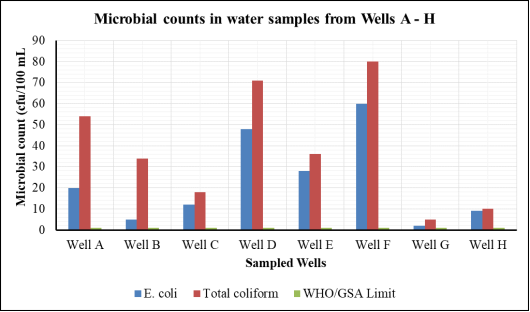
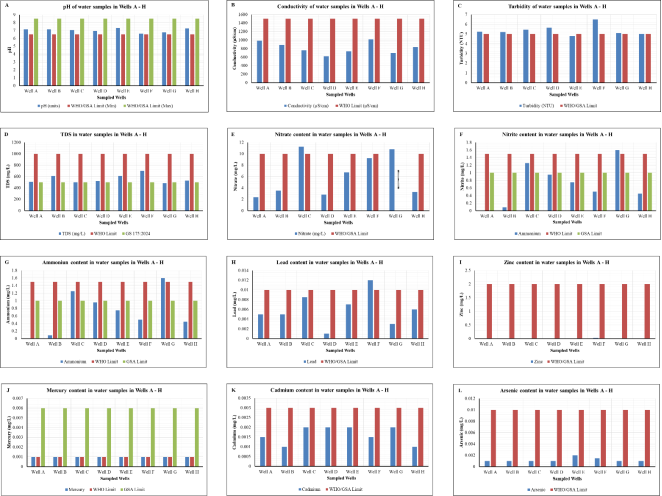
Background: Many residents in the Sagnarigu Municipality in Northern Ghana rely on open wells for their daily water needs. However, these water sources remain unregulated, unprotected and there is rarely any study that has assessed the water quality and safety of the open wells in the Municipality. The aim of the study was to assess the microbial and physicochemical water quality and safety of open wells in the Sagnarigu Municipality, Northern Ghana by analyzing the microbial and physicochemical water quality parameters. Method: Eight open wells were purposively sampled and analyzed for their microbial (i.e. total coliforms and E. coli) and physicochemical (e.g. pH, turbidity, anions, trace metals, etc.) parameters using standard analytical protocols. The water quality parameters analyzed were compared with Ghana Standard Authority (GSA) and WHO standard measures. Results: The results showed that the microbial quality of the studied open wells were highly compromised as the total coliforms and E. coli were detected. The microbial loads exceeded the WHO and GSA acceptable limit of 0 cfu/100 mL, with values ranging from 5-60 cfu/100 mL for total coliforms and 2.5-80 cfu/100 mL for E. coli. The assessment of the physicochemical parameters revealed that turbidity, TDS, nitrate, nitrite, ammonium and lead exceeded the WHO and GSA standards in some wells, while pH, zinc, mercury, cadmium, arsenic and conductivity were all within the standard measures. Conclusions: The study assessed the microbial and physicochemical quality of water from eight public open wells in the Sagnarigu Municipality, Northern Region, Ghana. The findings showed that none of the studied open wells met the WHO and GSA safety standards. The overall implication of these findings is that the examined open wells present serious public health risks and highlight the urgent need for interventions.
| Published in | Journal of Water Resources and Ocean Science (Volume 15, Issue 2) |
| DOI | 10.11648/j.wros.20261502.11 |
| Page(s) | 29-39 |
| Creative Commons |
This is an Open Access article, distributed under the terms of the Creative Commons Attribution 4.0 International License (http://creativecommons.org/licenses/by/4.0/), which permits unrestricted use, distribution and reproduction in any medium or format, provided the original work is properly cited. |
| Copyright |
Copyright © The Author(s), 2026. Published by Science Publishing Group |
Microbial Quality, Open Wells, Physicochemical Parameters, Northern Ghana, E. coli, Total Coliforms, Water Quality
Sampled Wells | E. coli (cfu/100 mL) | Total Coliform (cfu /100 mL) | GSA (DGS 175: 2021) cfu/100 mL | WHO Guideline cfu/100 mL |
|---|---|---|---|---|
Well A | 20 | 54 | <1 | <1 |
Well B | 5 | 34 | <1 | <1 |
Well C | 12 | 18 | <1 | <1 |
Well D | 48 | 71 | <1 | <1 |
Well E | 28 | 36 | <1 | <1 |
Well F | 60 | 80 | <1 | <1 |
Well G | 2 | 5 | <1 | <1 |
Well H | 9 | 10 | <1 | <1 |
Parameter | Unit | WHO Limit | GSA Limit | Well A | Well B | Well C | Well D | Well E | Well F | Well G | Well H |
|---|---|---|---|---|---|---|---|---|---|---|---|
Conductivity | µS/cm | 1500 | 1500 | 985 | 885 | 762.5 | 622.5 | 740 | 1020 | 695 | 835 |
Turbidity | NTU | 5.0 | 5.0 | 5.25 | 5.20 | 5.45 | 5.65 | 4.8 | 6.5 | 5.1 | 5.0 |
pH | units | 6.5–8.5 | 6.5–8.5 | 7.15 | 7.145 | 7.06 | 6.95 | 7.30 | 6.60 | 6.75 | 7.25 |
TDS | mg/L | 1000 | 500 | 507.5 | 607.5 | 499.5 | 521 | 612 | 700 | 485 | 530 |
Nitrate | mg/L | 50.0 | 50.0 | 2.35 | 3.55 | 11.25 | 2.85 | 6.75 | 9.25 | 10.8 | 3.3 |
Nitrite | mg/L | 3.0 | 3.0 | 0.0065 | 1.55 | 0.0095 | 1.25 | 0.8 | 0.5 | 1.1 | 0.3 |
Ammonium | mg/L | 0.2 | 0.5 | <0.001 | <0.089 | 1.255 | 0.955 | 0.75 | 0.5 | 1.6 | 0.45 |
Lead | mg/L | 0.01 | 0.01 | <0.005 | <0.005 | 0.0085 | <0.001 | 0.007 | 0.012 | 0.003 | 0.006 |
Zinc | mg/L | 3.00 | 3.00 | 0.006 | 0.0085 | 0.015 | 0.007 | 0.010 | 0.025 | 0.018 | 0.005 |
Mercury | mg/L | 0.006 | 0.001 | <0.001 | <0.001 | <0.001 | <0.001 | <0.001 | <0.001 | <0.001 | <0.001 |
Cadmium | mg/L | 0.003 | 0.003 | 0.0015 | 0.001 | <0.002 | <0.002 | 0.002 | 0.0015 | <0.002 | 0.001 |
Arsenic | mg/L | 0.01 | 0.01 | 0.001 | 0.001 | <0.001 | <0.001 | 0.002 | 0.0015 | <0.001 | 0.001 |
Parameter | Min | Max | Mean | SD | WHO/GSA Limit |
|---|---|---|---|---|---|
Conductivity (µS/cm) | 622.5 | 1020 | 818.75 | ±121.2 | 1500 |
Turbidity (NTU) | 4.8 | 6.5 | 5.37 | ±0.49 | 5.0 |
pH | 6.60 | 7.30 | 7.04 | ±0.23 | 6.5–8.5 |
TDS (mg/L) | 485 | 700 | 570.56 | ±73.7 | 1000/500 |
Nitrate (mg/L) | 2.35 | 11.25 | 6.65 | ±3.10 | 50.0 |
Nitrite (mg/L) | 0.0065 | 1.55 | 0.777 | ±0.61 | 3.0 |
Ammonium (mg/L) | 0.001 | 1.6 | 0.626 | ±0.52 | 0.2/0.5 |
Lead (mg/L) | 0.001 | 0.012 | 0.0059 | ±0.0043 | 0.01 |
Zinc (mg/L) | 0.005 | 0.025 | 0.011 | ±0.0067 | 3.00 |
Mercury (mg/L) | 0.001 | 0.001 | 0.001 | 0 | 0.006/0.001 |
Cadmium (mg/L) | 0.002 | 0.002 | 0.0012 | ±0.00058 | 0.003 |
Arsenic (mg/L) | 0.001 | 0.002 | 0.0010 | ±0.00063 | 0.01 |
APHA | American Public Health Association |
DGS | Draft Ghana Standards |
GSA | Ghana Standard Authority |
NTU | Nephelometric Turbidity Unit |
TDS | Total Dissolved Solids |
WHO | World Health Organization |
| [1] | Bessah E., Raji A. O., Taiwo O. J., et al. (2021) Assessment of surface waters and pollution impacts in Southern Ghana. Hydrology Research, 52(6). 1423-1435. |
| [2] | Progress on household drinking water, sanitation and hygiene 2000–2024: special focus on inequalities. Geneva: World Health Organization (WHO) and the United Nations Children’s Fund (UNICEF), (2025). Licence: CC BY-NC-SA 3.0 IGO. |
| [3] | Mohammad, A., Asgedom, A. G., Mokenen, K. N., Tesfay, A. H., Gebretsadik, T. T., Bruggen, V. d. B. (2024) Evaluation of groundwater quality for drinking water using a quality index in Abyi Adi, Tigrai, Northern Ethiopia. Heliyon, 10(16): e36173. |
| [4] | Dekker D. M., Krumkamp R., Sarpong N., Frickmann H., et al. Drinking water from dug wells in rural Ghana—Salmonella contamination, environmental factors, and genotypes. Int J Environ Res Public Health. 2015; 12(4): 3535-46. |
| [5] | Abanyie S. K., Ampadu B., Frimpong N. A., Amuah E. E. Y. (2023) Impact of improved water supply on livelihood and health: Emphasis on Doba and Nayagnia, Ghana. Innov Green Dev. 2: 100033. |
| [6] | World Health Organization. Guidelines for drinking-water quality [electronic resource] : incorporating 1st and 2nd addenda, vol. 1, Recommendations. 3rd ed. Geneva: World Health Organization, (2008). |
| [7] | Fayomi G. U., Onyari E. K., Jaiyeola A. T., Ode G. O. (2024) Unveiling the outcome of multispectral indices in evaluating total suspended solid of water quality. Remote Sensing Applications: Society and Environment. 36: 101381. |
| [8] | Rajeswari C. V., Saraswathi B. (2009) Assessment of water quality of rivers Tungabhadra and Hundri, India. Nature Environment and Pollution Technology. 28: 499–505. |
| [9] | Jomova, K., Alomar, S. Y., Nepovimova, E., Kuca, K., & Valko, M. (2025). Heavy metals: Toxicity and human health effects. Archives of Toxicology. Springer Nature. |
| [10] | Sell, I., & Kask, I. (2021). An overview of the biological impacts of heavy metals. International Journal of Molecular Biology and Biochemistry, 3(2), 01–05. |
| [11] | S. Arora, P. Saha, A. D. Shende. (2025). Assessment of heavy metal pollution of surface water through multivariate analysis, HPI and GIS techniques. Water Practice & Technology, 20(1), 148. |
| [12] | M. Latif, I. Nasim, M. Ahmad, R. Nawaz, et al. (2025) Human health risk assessment of drinking water using heavy metal pollution index: a GIS‑based investigation in mega city. Applied Water Science 15: 12. |
| [13] | Kumar D., Kumar R., Sharma M., Awasthi A., Kumar M. (2024) Global water quality indices: Development, implications, and limitations. Total Environment Advances. 9: 200095. |
| [14] | Abdul S., Dwumfour-Asare B., Mensah G. T., Owusu-Mensah I. (2025) Journal of Water, Sanitation and Hygiene for Development 15(6), 507. |
| [15] | U. F. Iddrisu, E. K. Tetteh, B. S. Amedorme, V. C. Mbatchou. (2024) Assessing the groundwater quality in Ghana’s Nanton District: comprehensive evaluation and implications for sustainable management. AQUA-Water Infrastructure, Ecosystems and Society 73(1), 34. |
| [16] | U. F. Iddrisu, E. K. Armah, E. K. Tetteh, B. S. Amedorme. (2023). Assessing groundwater quality: a case study in Ghana Talensi district. Water Practice & Technology 18(9), 2096 |
| [17] | Ghana Population and Housing Census, (2021). |
| [18] | Amuah E. E. Y., Amanin-Ennin, P., Antwi, K. (2022) Irrigation water quality in Ghana and associated implications on vegetables and public health. A Systematic Review. Journal of Hydrology, 604, Article 127211. |
| [19] | Baird, R. B., Eaton, A. D., & Rice, E. W. (Eds.). (2017). Standard methods for the examination of water and wastewater (23rd ed.). Washington, D.C.: American Public Health Association, American Water Works Association, Water Environment Federation. |
| [20] | World Health Organization. (2022). Guidelines for drinking-water quality: Fourth edition incorporating the first and second addenda. Geneva: World Health Organization. Licence: CC BY-NC-SA 3.0 IGO. |
| [21] | Ghana Standard Authority, DGS 175: 2021 Guidelines. |
| [22] | Adamou H., Ibrahim B., Salack S., Adamou R., Sanfo S., Liersch S. (2020) Drinking water quality in a rural area of Western Niger: a case study of Bonkoukou. Journal of Water and Health, 18(1). 77-90. |
| [23] | Addisie M. B. (2022) Evaluating drinking water quality using water quality parameters and esthetic attributes, Air, Soil and Water Research, 15. 1-8. |
| [24] | Anang E., Tei M., Antwi A. B., Aduboffour V. K., Anang B. (2023) Assessment of groundwater and surface water quality in a typical mining community: application of water quality indices and hierarchical cluster analyses. Journal of Water and Health. 21(7). 925-938. |
| [25] | U.S. Environmental Protection Agency, Technical Support Center. (2017). Analytical methods approved for drinking water compliance monitoring under the revised total coliform rule. Washington, DC: U.S. Environmental Protection Agency. |
| [26] | Yeboah S. I. I. K., Antwi-Agyei P., Domfeh M. K. (2022) Drinking water quality and health risk assessment of intake and point-of-use water sources in Tano North Municipality, Ghana. Journal of Water, Sanitation and Hygiene for Development, 12(2). 157. |
| [27] | Aryal J., Gautam B., Sapkota N. (2012) Drinking water quality assessment. J Nepal Health Res Counc. 10(3). 192-6. |
| [28] | Omar A. I., Mohamed M. A., Jalei A. A., et al. (2025) Assessing drinking water quality in compliance with WHO standards: Analysis of physicochemical and bacteriological parameters in Mogadishu, Somalia. Sustainable Environment, 11(1). 1-11. |
| [29] | World Health Organization. (2003). Total dissolved solids in drinking-water: Background document for development of WHO guidelines for drinking-water quality (WHO/SDE/WSH/03.04/16). Geneva: World Health Organization. |
| [30] | LeChevallier, M. W., Evans, T. M., Seidler, R. J. (1981) Effect of turbidity on chlorination efficiency and bacterial persistence in drinking water. Applied and Environmental Microbiology, 42(1). 159–167. |
| [31] | Lee, T. S. (Ed.) (2015) Research and practices in water quality. IntechOpen. |
| [32] | Knobeloch, L., Salna, B., Hogan, A., Postle, J., Anderson, H. A. (2000) Blue babies and nitrate-contaminated well water. Environmental Health Perspectives, 108(7). 675–678. |
| [33] | Ward, M. H., Jones, R. R., Brender, J. D., de Kok, T. M., Weyer, P. J., Nolan, B. T., Villanueva, C. M., van Breda, S. G. (2018) Drinking water nitrate and human health: An updated review. International Journal of Environmental Research and Public Health, 15(7). 1557. |
| [34] | Fewtrell, L. (2004) Drinking-water nitrate, methemoglobinemia, and global burden of disease: A discussion. Environmental Health Perspectives, 112(14). 1371–1374. |
| [35] | Granger, J., Wankel, S. D. (2016) Isotopic overprinting of nitrification on denitrification as a ubiquitous and unifying feature of environmental nitrogen cycling. Proceedings of the National Academy of Sciences of the United States of America, 113(42). E6391–E6400. |
| [36] | Collin, S., Baskar, A., Geevarghese, D. M., et al. (2022) Bioaccumulation of Lead (Pb) and Its Effects in Plants: A Review. Journal of Hazardous Materials Letters, 3. Article 100064. |
| [37] | World Health Organization. (2003) Ammonia in drinking-water: background document for development of WHO guidelines for drinking-water quality. Geneva: World Health Organization. |
| [38] | Waleed M. B., Al Qahtani, S. J., Alwagdani, N. A., et al. (2022) Role of health awareness campaigns in improving public health: A systematic review. International Journal of Life Science and Pharma Research, 12(6). 29–35. |
APA Style
Yakubu, A., Banaamwine, Z. D., Abdulai, B. (2026). Assessment of the Microbial and Physicochemical Quality of Water from Open Wells in the Sagnarigu Municipality in Northern Ghana. Journal of Water Resources and Ocean Science, 15(2), 29-39. https://doi.org/10.11648/j.wros.20261502.11
ACS Style
Yakubu, A.; Banaamwine, Z. D.; Abdulai, B. Assessment of the Microbial and Physicochemical Quality of Water from Open Wells in the Sagnarigu Municipality in Northern Ghana. J. Water Resour. Ocean Sci. 2026, 15(2), 29-39. doi: 10.11648/j.wros.20261502.11
AMA Style
Yakubu A, Banaamwine ZD, Abdulai B. Assessment of the Microbial and Physicochemical Quality of Water from Open Wells in the Sagnarigu Municipality in Northern Ghana. J Water Resour Ocean Sci. 2026;15(2):29-39. doi: 10.11648/j.wros.20261502.11
@article{10.11648/j.wros.20261502.11,
  author = {Abdallah Yakubu and Zangu Daniel Banaamwine and Banuha Abdulai},
  title = {Assessment of the Microbial and Physicochemical Quality of Water from Open Wells in the Sagnarigu Municipality in Northern Ghana},
  journal = {Journal of Water Resources and Ocean Science},
  volume = {15},
  number = {2},
  pages = {29-39},
  doi = {10.11648/j.wros.20261502.11},
  url = {https://doi.org/10.11648/j.wros.20261502.11},
  eprint = {https://article.sciencepublishinggroup.com/pdf/10.11648.j.wros.20261502.11},
  abstract = {Background: Many residents in the Sagnarigu Municipality in Northern Ghana rely on open wells for their daily water needs. However, these water sources remain unregulated, unprotected and there is rarely any study that has assessed the water quality and safety of the open wells in the Municipality. The aim of the study was to assess the microbial and physicochemical water quality and safety of open wells in the Sagnarigu Municipality, Northern Ghana by analyzing the microbial and physicochemical water quality parameters. Method: Eight open wells were purposively sampled and analyzed for their microbial (i.e. total coliforms and E. coli) and physicochemical (e.g. pH, turbidity, anions, trace metals, etc.) parameters using standard analytical protocols. The water quality parameters analyzed were compared with Ghana Standard Authority (GSA) and WHO standard measures. Results: The results showed that the microbial quality of the studied open wells were highly compromised as the total coliforms and E. coli were detected. The microbial loads exceeded the WHO and GSA acceptable limit of 0 cfu/100 mL, with values ranging from 5-60 cfu/100 mL for total coliforms and 2.5-80 cfu/100 mL for E. coli. The assessment of the physicochemical parameters revealed that turbidity, TDS, nitrate, nitrite, ammonium and lead exceeded the WHO and GSA standards in some wells, while pH, zinc, mercury, cadmium, arsenic and conductivity were all within the standard measures. Conclusions: The study assessed the microbial and physicochemical quality of water from eight public open wells in the Sagnarigu Municipality, Northern Region, Ghana. The findings showed that none of the studied open wells met the WHO and GSA safety standards. The overall implication of these findings is that the examined open wells present serious public health risks and highlight the urgent need for interventions.},
 year = {2026}
}
TY  - JOUR
T1  - Assessment of the Microbial and Physicochemical Quality of Water from Open Wells in the Sagnarigu Municipality in Northern Ghana
AU  - Abdallah Yakubu
AU  - Zangu Daniel Banaamwine
AU  - Banuha Abdulai
Y1  - 2026/05/18
PY  - 2026
N1  - https://doi.org/10.11648/j.wros.20261502.11
DO  - 10.11648/j.wros.20261502.11
T2  - Journal of Water Resources and Ocean Science
JF  - Journal of Water Resources and Ocean Science
JO  - Journal of Water Resources and Ocean Science
SP  - 29
EP  - 39
PB  - Science Publishing Group
SN  - 2328-7993
UR  - https://doi.org/10.11648/j.wros.20261502.11
AB  - Background: Many residents in the Sagnarigu Municipality in Northern Ghana rely on open wells for their daily water needs. However, these water sources remain unregulated, unprotected and there is rarely any study that has assessed the water quality and safety of the open wells in the Municipality. The aim of the study was to assess the microbial and physicochemical water quality and safety of open wells in the Sagnarigu Municipality, Northern Ghana by analyzing the microbial and physicochemical water quality parameters. Method: Eight open wells were purposively sampled and analyzed for their microbial (i.e. total coliforms and E. coli) and physicochemical (e.g. pH, turbidity, anions, trace metals, etc.) parameters using standard analytical protocols. The water quality parameters analyzed were compared with Ghana Standard Authority (GSA) and WHO standard measures. Results: The results showed that the microbial quality of the studied open wells were highly compromised as the total coliforms and E. coli were detected. The microbial loads exceeded the WHO and GSA acceptable limit of 0 cfu/100 mL, with values ranging from 5-60 cfu/100 mL for total coliforms and 2.5-80 cfu/100 mL for E. coli. The assessment of the physicochemical parameters revealed that turbidity, TDS, nitrate, nitrite, ammonium and lead exceeded the WHO and GSA standards in some wells, while pH, zinc, mercury, cadmium, arsenic and conductivity were all within the standard measures. Conclusions: The study assessed the microbial and physicochemical quality of water from eight public open wells in the Sagnarigu Municipality, Northern Region, Ghana. The findings showed that none of the studied open wells met the WHO and GSA safety standards. The overall implication of these findings is that the examined open wells present serious public health risks and highlight the urgent need for interventions.
VL  - 15
IS  - 2
ER  -
Department of Pharmaceutical Chemistry, University for Development Studies, Tamale, Ghana
Department of Pharmaceutical Chemistry, University for Development Studies, Tamale, Ghana
Department of Pharmaceutical Chemistry, University for Development Studies, Tamale, Ghana

Information



 Share This Article
 Twitter
 Linked In
 Facebook
 Copy
Copy Download