Recently, electronic wallets have emerged as a primary catalyst in driving the growth of cashless and electronic payment systems. Electronic wallets contribute to financial inclusion by providing banking services to unbanked populations and enabling easier access to financial tools without the need for physical bank branches, thereby enhancing the global shift toward cashless societies. This work designed, implemented, and evaluated a Unstructured Supplementary Service Data (USSD) based electronic wallet system aimed at promoting financial inclusion in Nigeria. The system was designed using Unified Modeling Language (UML) tools and implemented with Python, Django, PostgreSQL, and Africa’s talking. A user-centered approach was adopted, emphasizing simplicity, easy navigation, and language accessibility, with support for English and Yoruba to ensure inclusivity. Key usability testing metrics, including task completion rates, error rates, and user satisfaction, were employed to evaluate the system's effectiveness. Results indicated an 80% task completion rate, a 20% error rate, and a high user satisfaction score of 4.7 out of 5. These findings highlight the system’s capability to bridge the digital divide by providing essential financial services with no or less internet access. The USSD-based electronic wallet facilitates account creation, fund transfers, receiving payments, multilingual support and airtime purchases, making it accessible via feature phones. This study underscores the potential of USSD technology to support underserved populations, advancing financial inclusion for individuals who may lack access to smartphones or stable internet connectivity. The implementation of such a system represents a crucial step towards achieving seamless, secure financial transactions in Nigeria, ultimately fostering greater economic empowerment among marginalized communities.
This is an Open Access article, distributed under the terms of the Creative Commons Attribution 4.0 International License (http://creativecommons.org/licenses/by/4.0/), which permits unrestricted use, distribution and reproduction in any medium or format, provided the original work is properly cited.
The rise of mobile wallets, facilitated by increased smartphone adoption and internet connectivity, has the potential to advance cashless transactions and promote financial inclusion. However, a significant portion of Nigeria's population, particularly in rural areas, remains financially excluded, with approximately 40.1 million individuals lacking access to basic financial services
[1]
Enhancing Financial Innovation & Access (EFInA). (2023). Access to Financial Services in Nigeria Survey 2023 (A2F): Unlocking Insights to Accelerate Financial and Economic Inclusion. Lagos, Nigeria.
This exclusion is exacerbated by limited internet access, low digital literacy, and the necessity of pre-existing bank accounts for many electronic wallet services
[2]
Adewusi, O., Msagusa, W. S., Imanirumva, J. P., Obadofin, O., & Ndibwile, J. D. (2025). Hybrid USSD-based authentication for inclusive e-government mobile money services.
. The majority of these financially excluded populations are rural dwellers. As such, financial inclusion has been seen as key to reducing poverty: bank accounts have an important role to play in establishing and expanding businesses while making transactions more efficient, secure, and transparent and managing savings
[3]
Mwale, M., & Banda, D. (2025). From disconnection to inclusion: Advancing financial services in Zambia through USSD technology. International Journal of Social Sciences, Humanities & Management Research, 4(1).
To address these barriers, the proposed USSD-based electronic wallet system aims to provide accessible financial services without the need for internet connectivity, leveraging Unstructured Supplementary Service Data (USSD) technology. USSD technology provides a simple and accessible platform that allows users to perform financial transactions through text-based menus on both smartphones and basic feature phones
[4]
Aker, J. C., & Wilson, K. (2023). Mobile money and financial inclusion: The role of mobile technology in expanding access to financial services in developing economies. Information Technologies & International Development, 19, 1–16.
[4]
. This capability makes USSD particularly valuable in developing countries where smartphone ownership and internet connectivity remain limited. The USSD-based e-wallet system enables users to perform essential financial services such as money transfers, bill payments, airtime purchases, and balance inquiries, thereby improving financial access for underserved populations while maintaining adequate security mechanisms
[5]
Ruslim, T. S., Herwindiati, D. E., & Cokki. (2024). Adoption of e-wallet in the post-pandemic era: A study on Generation X’s intention to use e-wallet. Innovative Marketing, 20(2), 267–280.
Ujjawal, N., & Sharma, S. (2024). Adoption of mobile wallets by tourists for digital payments in India: An investigation of behavioural intention and the moderating impact of digital innovativeness. International Journal of Global Management Perspectives, 1(1), 6–21. Retrieved from
. In the post-pandemic era, the adoption of digital payment technologies has increased significantly across different demographic groups, including Generation X. Studies also indicate that digital innovativeness plays a key role in shaping user behavior and willingness to adopt mobile wallet technologies, particularly among travelers and tourists who rely heavily on convenient digital payment solutions
[5]
Ruslim, T. S., Herwindiati, D. E., & Cokki. (2024). Adoption of e-wallet in the post-pandemic era: A study on Generation X’s intention to use e-wallet. Innovative Marketing, 20(2), 267–280.
Ujjawal, N., & Sharma, S. (2024). Adoption of mobile wallets by tourists for digital payments in India: An investigation of behavioural intention and the moderating impact of digital innovativeness. International Journal of Global Management Perspectives, 1(1), 6–21. Retrieved from
. These developments highlight the growing expansion of mobile wallet usage across emerging markets, driven by increasing user acceptance, improved technological infrastructure, and the need for inclusive financial systems.
The implementation of a bilingual interface supporting both English and Yoruba languages is critical for enhancing accessibility and usability among users with limited proficiency in English. This initiative aligns with the Central Bank of Nigeria’s (CBN) goal of achieving 95% financial inclusion by 2024 and represents a transformative approach to bridging the digital divide for rural dwellers
[7]
Tijjani, M., Besar, B. N., & Al-Shaghdari, F. M. O. (2022). Financial exclusion in Northern Nigeria: A lesson from developed countries. AFEBI Islamic Finance and Economic Review, 7(01), 45.
. Ultimately, this study contributes to advancing financial inclusion, fostering socioeconomic development, and providing scalable solutions for similar challenges faced in other regions
[8]
Amer, H., Anaan, G., Yousef, I., & Yousef, A. (2023). The efficiency and effectiveness of e-wallet systems in e-commerce platforms. Journal of Survey in Fisheries Sciences, 10(2S), pp. 2634–2644.
[8]
.
2. Literature Review
This section discusses previous research on electronic wallets and USSD-based electronic wallets. Anuobi emphasized the importance of extending financial services to underserved populations who have limited or no internet access
[9]
Anunobi S. (2024). Mitigating security vulnerabilities in offline USSD payments in non-smartphones: Enhancing user privacy. (Master’s thesis, Staffordshire University).
[9]
. The study recommended leveraging USSD technology, as it functions without requiring an internet connection or a smartphone—resources that may be inaccessible to individuals in these communities. The work of Haoyang et al. developed a blockchain-based digital wallet application using the HoneyBadger-BFT consensus algorithm, demonstrating innovative approaches to enhancing security and reliability in digital wallet systems
[10]
Haoyang, Z., Zhuoyi, H., Rui, L., & Yanfei, X. (2022). A blockchain-based digital wallet application with HoneyBadger-BFT consensus algorithm. pp. 3 - 8. Stanford Secure Computer Systems Group.
[10]
. The application was developed using Python and Google Remote Procedure Call (gRPC). The result indicated that the application did not scale well with an increase in transactions and batch sizes, with batch sizes of 40, 60, 80, 100, 300, 500, 700 used and 4 nodes. The result also showed that as the batch size remained constant and the node count increased, the time it took to run a transaction decreased. The limitation of this work was how unconventional and complex it was to use an electronic wallet to bridge the financial inclusion gap. The work of Bongani et al. addressed these limitations by conducting a study involving 22 Eswatini students in India to evaluate their perceptions of USSD-based mobile money services
[11]
Bongani, C., & Venkata, K. R. (2023). Implementation of a mobile application that runs on USSD codes for mobile payment in network-constrained environments. International Journal of Creative Research Thoughts, pp. 3–8.
. Questionnaire administering aided data collection on the functionality, usage, and potential adoption of USSD code-based services. Google Forms was used to gather responses from the respondents, and Statistical Package for the Social Sciences 27.0 (SPSS) was used for data analysis and interpretation. The mobile application was built using Java and Android Studio. Findings revealed that the majority of respondents believed that integrating a mobile application to execute USSD commands could enhance both the speed and user experience of financial transactions. Specifically, 95.5% of participants agreed that using a mobile application to process USSD transactions significantly improved transaction speed, while 95% believed that it enhanced the overall user experience. The study equally highlighted a key limitation that is the reliance on smartphones and internet connectivity for the mobile application. This dependence on smartphones restricts the solution’s ability to address the financial inclusion needs of rural populations, who often lack access to smartphones or reliable internet connections. Consequently, while integrating mobile app may enhance the user experience for some, it fails to fully address the broader issue of financial exclusion in underserved areas. The work of Patrick addressed the limitation of the of Bongani & Venkata by developing a USSD-based service-oriented wallet application aimed at helping rural dwellers in Congo to receive money more easily
[11]
Bongani, C., & Venkata, K. R. (2023). Implementation of a mobile application that runs on USSD codes for mobile payment in network-constrained environments. International Journal of Creative Research Thoughts, pp. 3–8.
Patrick, M. (2023). Implementation of a service-oriented architecture for an e-wallet system for cashless transactions in the Democratic Republic of Congo. Pp. 1 - 17.
. This work aimed at providing simple and cost-effective means of facilitating money transfers to and from rural areas in Congo without the need for an internet connection. The application was built using HTML, JavaScript, and PHP, it allowed users to access its features by dialing a USSD code, enabling them to send and receive money without internet access. The findings showed that the application helped users save up to 10% on transaction costs compared to other traditional methods of sending money. However, the system had notable limitations. First, users were unable to send money to customers of commercial banks in Congo, restricting its overall functionality. Additionally, the lack of multiple language support was a significant drawback, particularly given the application's rural target audience, where linguistic diversity is common.
The research of Ogbonlaiye et al focused on the relationship between financial inclusion and economic growth in Nigeria
[13]
Ogbonlaiye, J. B., Kwanashie, M., & Olushola, O. (2025). Effect of financial inclusion on economic growth in Nigeria. International Journal of Research and Innovation in Social Science, 8(12), 3238–3257.
. Using the Autoregressive Distributed Lag (ARDL) model, the work analyzed time series data from the Central Bank of Nigeria (CBN) Statistical Bulletin and the World Bank reports. The results indicated that the estimated ARDL model had an R-squared value of 92%, demonstrating that the model was a strong fit for evaluating the impact of financial inclusion on economic growth. However, a key limitation of this study was the lack of practical implementation. While the results highlighted the potential to bridge the financial inclusion gap, no actionable steps were taken to apply the findings towards improving financial inclusion in Nigeria.
The reviewed literature highlighted several gaps, one of which was the absence of multi-language support to improve accessibility. This study addresses this gap by developing an inclusive, USSD-based wallet system that supports both Yoruba and English, specifically designed for rural areas in Nigeria. Additionally, the system is accessible on both feature phones and smartphones, ensuring it reaches populations without access to smartphones or internet connectivity. This practical implementation moves beyond theoretical discussions and isolated improvements to deliver a solution that meets the fundamental requirements for financial inclusion: simplicity, broad compatibility, and cultural adaptability. By addressing these gaps, this work advanced the field by offering a comprehensive, practical application that facilitates financial transactions without the need of a bank account or internet access. This contribution not only validates the theoretical underpinnings highlighted by Adewusi et al.
[2]
Adewusi, O., Msagusa, W. S., Imanirumva, J. P., Obadofin, O., & Ndibwile, J. D. (2025). Hybrid USSD-based authentication for inclusive e-government mobile money services.
and others but also applies them in a tangible, impactful way that fosters economic empowerment in underserved communities.
3. Materials and Methods
This section involved the steps such as identifying the target rural location with no internet connection, which was Sekona, Ede-South local government, Osun State. The data collection phase involved the physical administration of a survey to 52 participants at the aforementioned location as shown in Table 1. The preprocessing phase carried out data cleaning and addressed missing values. The data analysis phase involved using Google spreadsheets to generate graphs based on the preprocessed data. The system design phase of the USSD-based electronic wallet system focuses on transforming the gathered requirements and data into a functional software solution.
Table 1. Survey Data.
Age
Gender
Occupation
Owns Smart Phone
Owns Feature Phone
Used E-wallet
Will Use USSD-based E-wallet
I am more likely to switch
15-30
Female
Trader
No
Yes
No
Yes
Strongly Agree
15-30
Female
Entrepreneur
No
Yes
No
Yes
Agree
31-45
Male
Farmer
Yes
No
No
Yes
Strongly Agree
31-45
Male
Farmer
No
Yes
No
Yes
Strongly Agree
45-60
Female
Trader
No
Yes
No
Yes
Strongly Agree
45-60
Male
Artisan
No
Yes
No
Yes
Agree
Prefer Not To Say
Female
Others
No
Yes
No
Yes
Agree
45-60
Female
Trader
No
Yes
No
Yes
Strongly Agree
15-30
Male
Artisan
No
Yes
No
Yes
Agree
31-45
Female
Farmer
No
Yes
No
Yes
Agree
45-60
Female
Farmer
No
Yes
No
Yes
Strongly Agree
15-30
Male
Farmer
No
Yes
No
Yes
Agree
45-60
Male
Artisan
No
Yes
No
Yes
Agree
45-60
Male
Trader
No
Yes
No
Yes
Strongly Agree
31-45
Male
Artisan
No
Yes
No
Yes
Agree
31-45
Female
Entrepreneur
No
Yes
No
Yes
Agree
45-60
Female
Trader
No
Yes
No
Yes
Strongly Agree
45-60
Female
Farmer
No
Yes
No
Yes
Agree
15-30
Male
Farmer
No
Yes
No
Yes
Agree
15-30
Female
Farmer
Yes
Yes
No
Yes
Strongly Agree
15-30
Male
Artisan
No
Yes
No
Yes
Agree
31-45
Female
Others
No
Yes
No
Yes
Agree
15-30
Male
Trader
No
Yes
No
Yes
Agree
31-45
Female
Trader
No
Yes
No
Yes
Strongly Agree
15-30
Male
Farmer
No
Yes
No
Yes
Agree
31-45
Female
Others
No
Yes
No
Yes
Agree
31-45
Male
Trader
No
Yes
No
Yes
Agree
31-45
Female
Entrepreneur
No
Yes
No
No
Agree
15-30
Female
Farmer
No
Yes
No
Yes
Strongly Agree
15-30
Female
Trader
No
Yes
No
Yes
Strongly Agree
15-30
Male
Artisan
No
Yes
No
Yes
Strongly Agree
15-30
Female
Farmer
No
Yes
No
Yes
Agree
45-60
Male
Trader
Yes
Yes
No
No
Agree
15-30
Female
Farmer
No
Yes
No
Yes
Agree
Greater than 60
Female
Farmer
No
Yes
No
Yes
Agree
15-30
Male
Artisan
No
Yes
No
Yes
Agree
31-45
Female
Others
No
Yes
No
No
Agree
45-60
Male
Farmer
No
Yes
No
Yes
Agree
31-45
Female
Others
No
Yes
No
Yes
Agree
15-30
Male
Artisan
No
Yes
No
Yes
Agree
15-30
Male
Farmer
No
Yes
No
Yes
Agree
31-45
Female
Others
No
Yes
No
Yes
Agree
45-60
Male
Farmer
No
Yes
No
No
Agree
31-45
Female
Others
No
Yes
No
Yes
Agree
45-60
Male
Artisan
No
Yes
No
Yes
Agree
45-60
Male
Farmer
No
Yes
No
Yes
Agree
31-45
Female
Farmer
No
Yes
No
Yes
Agree
45-60
Male
Farmer
No
Yes
No
Yes
Agree
31-45
Female
Others
No
Yes
No
Yes
Agree
15-30
Male
Artisan
No
Yes
No
Yes
Agree
15-30
Male
Trader
No
Yes
No
Yes
Agree
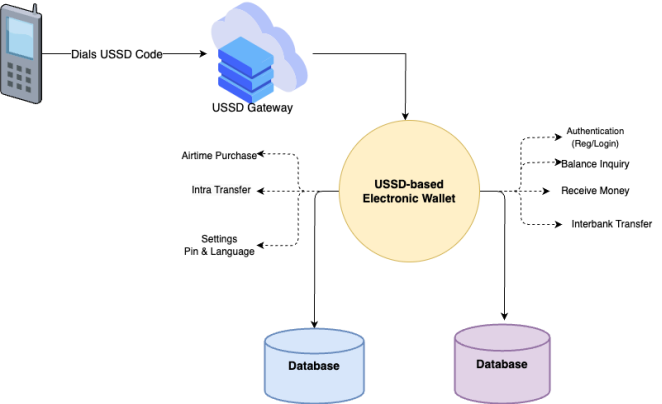
Figure 1 shows the USSD-based electronic wallet. The users initiate the process by dialing a USSD code, which the telecommunication provider forwards to the USSD gateway provider. The gateway then sends the USSD request to the application. In response, the application displays the main menu or a sub-menu both of which are part of the main menu interface. The user selects an option based on the action they wish to perform, and their selection is sent back to the USSD gateway provider through the telecommunication provider. The gateway forwards the request to the application, which processes the user's input and returns a response. This process continues in a loop until the user completes the desired action.
The support for Yoruba and English languages will enhance accessibility. Also, non-existent reliance on smartphone and internet means more people can have access to digital financial services, thereby bridging the financial gap in rural areas. The system architecture consists of three main components: a USSD gateway, a backend server, and a database. Africa’s talking was selected as the USSD gateway for its reliability in handling USSD requests across multiple mobile networks, making it an ideal choice for rural settings where internet access is limited or nonexistent. Africa’s Talking provides a reliable USSD and mobile payment platform, enabling financial services to reach users in areas with limited internet connectivity, thereby supporting financial inclusion across Africa
[14]
Africa’s Talking. (2025). USSD and payments APIs for mobile financial services (Product documentation). Retrieved from
. The USSD gateway acts as the communication bridge between users and the backend server, processing requests in real-time and enabling a seamless interaction with the system. The backend server, developed using Python and Django, handles the application logic and processes user requests efficiently. Django was chosen due to its scalability, security features, and rapid development framework, which makes it well-suited for building complex financial applications. Python’s versatility also allows for easy integration with other system components, making it ideal for developing a robust financial service platform. PostgreSQL was employed as the database engine, primarily due to its robust data security and integrity features. PostgreSQL is an open-source, enterprise-grade database known for its ability to handle complex queries, and large datasets, and ensure data integrity, making it an excellent choice for financial applications where transaction data must be stored securely. It is also the recommended database engine for building wallets and financial applications, as it supports ACID (Atomicity, Consistency, Isolation, Durability) properties essential for transaction management. This ensures that every transaction is properly recorded, providing a secure and reliable system for users. In this architecture, the combination of a USSD gateway, Python-Django backend, and PostgreSQL ensures that the system is highly efficient, secure, and scalable, providing rural users with a reliable platform for accessing digital financial services without the need for smartphones or internet access.
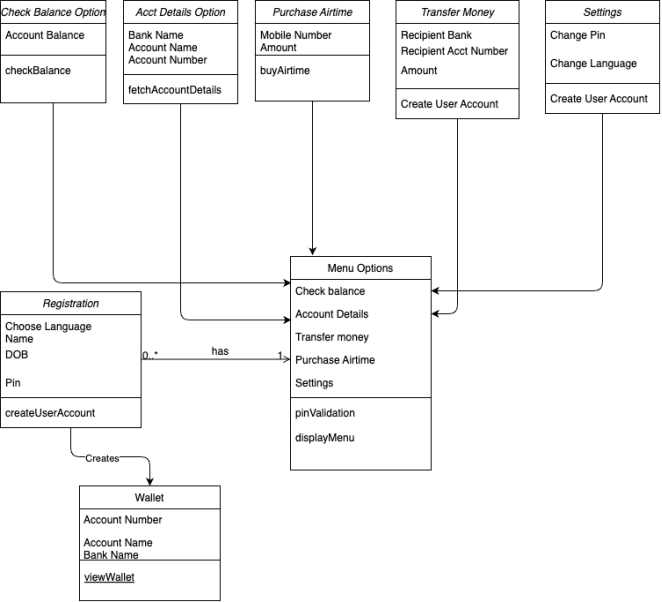
Figure 2 represents the class diagram for the proposed model. A class diagram was used to visually represent the structure of a system by showing its classes, their attributes, methods, and the relationships among them. The class diagram below represents a modular USSD-based electronic wallet system designed to provide services like multiple language support, balance inquiries, money transfers, and airtime purchases. Here's a summary:
Registration: Handles user onboarding by selecting a preferred language, and then providing information like name, DOB, and PIN after which a wallet is created that they can send and receive money from.
Wallet: Represents the user’s financial account with attributes such as account number, account name, and bank name. Users can view wallet details via the viewWallet method.
Menu Options: Acts as the central hub, linking to features such as balance inquiry option, account details option, account details option, airtime purchase option, transfer money option, and settings option.
Relationships: Registration has a one-to-one link with Wallet and a one-to-many link with Menu Options. The Menu Options connects to other feature-specific classes, making the system scalable and organized.
The system's modular design ensures flexibility, ease of maintenance, and user-focused functionality.
The section discusses the system's usability and performance. The multilingual support, registration, transaction verification, and main menu functionalities are clearly explained with supporting figures.
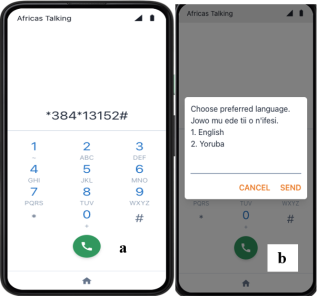
Language support menu: The USSD-based electronic wallet system is initiated by dialing the USSD code, and a language support menu is displayed, where users are asked to select their preferred language (English or Yoruba) during registration. This step ensures that the subsequent menus are displayed in the user's chosen language. Figure 3a shows the process of dialing the USSD code, Figure 3b shows the language selection menu. This menu shows up if you are a first time user and you do not have an account already. You are required to choose a language which will then be used to display all the registration questions that needs to be answered before an account is created.
Figure 3. Dial USSD Code and Language Support Menu.
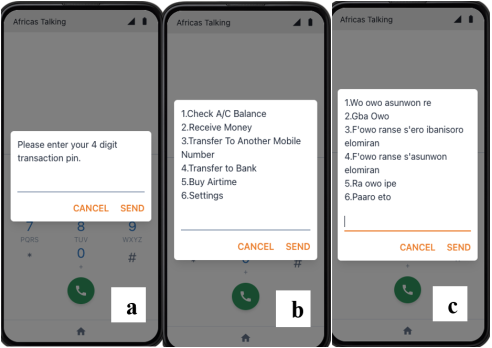
Main menu: Once registered, users must dial the USSD code again to access the application's features. Upon dialing the code, the application prompts users to enter their transaction PIN, as illustrated in Figure 4a. This security measure is essential to prevent unauthorized access, ensuring that if someone else gains possession of the user’s phone, they cannot send money or perform transactions. Figure 4b depicts the main menu, which lists all available features of the application. Users can access any feature by entering the corresponding number. Figure 4c showcases the main menu displayed in Yoruba, demonstrating the system’s multilingual support.
Figure 4. Transaction Verification and Main Menu in both English and Yoruba.
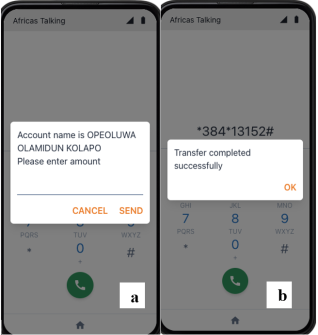
Transfer menu: The transfer menu allows users to send money to other users of the wallet or to Nigerian banks by verifying the recipient's account number through Pooler’s API. Figure 5a shows the account name of the beneficiary being displayed after their account number has been verified, this step is called Name Enquiry and it is very important as it ensures that money is not being sent to the wrong account. Figure 5b shows the success response page after transfer has been made successfully.
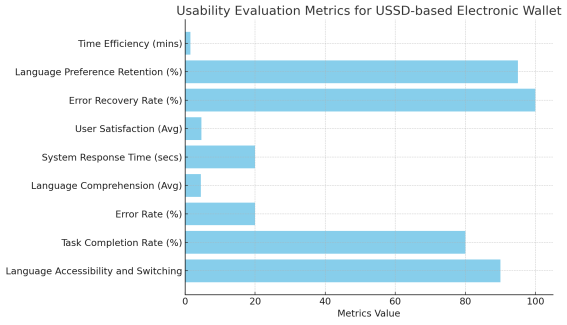
The system was tested using key usability metrics such as task completion rates, error rates, and user satisfaction, which is a strong point of the paper. The 80% task completion rate suggests that the majority of users found the system accessible, while the 20% error rate highlights areas for improvement. The high user satisfaction score (4.7 out of 5) reflects positive feedback from participants, further validating the system’s effectiveness in its target context.
The breakdown of various usability metrics, including language comprehension, system response time, and error recovery rate, adds depth to the evaluation. The discussion on user language preference retention and time efficiency (longest task completion time of 1.55 minutes) provides valuable insights into the system's performance. The first metric that was measured was the time efficiency of the system, which is how long does it takes users to complete a task. From the usability testing, the longest time it took a user to complete a task was 1.55 minutes. The language preference option ensured that 85% of the users that registered on the wallet system come back to use it again, this would have been lower if support for multiple language had not been provided. The recovery rate of error was measured to be 100%, and what this means is that proper error messages are returned to users in an event where they encounter an error, and they can then dial the USSD code again to perform their actions. The user satisfaction rate was also measured to be an average of 4.7 out of 5. This means that out of 5 users using the system, almost all 5 are very satisfied with the performance of the system, and the features available. System response time is the number of seconds it takes for the system to respond to user input from when they dialed the USSD code to when they completed the action, this was measured to be an average of 20 seconds. Error rate was measured to be about 20%, meaning errors only happen on the system 20% of the time it is being used by users. Task completion and language switching and accessibility rates were measured to be 80% and 85% respectively. The language comprehension metric was also measured, with an average of 4 out of 5. This means that an out of 5 users, 4 users were able to comprehend the information and responses returned by the system in both Yoruba and English languages. Figure 6 shows the graph of the usability metrics.
This study was able to develop an electronic wallet system that can be accessed without internet connection. It can also be used by feature phone users as well as smartphone users. To further enhance accessibility, the electronic wallet system developed in this study provided support for English and Yoruba languages. The implication of this is that users were able to seamlessly perform financial transactions such as receiving money, transferring funds to other banks in Nigeria, and purchasing airtime through an intuitive digital wallet. The wallet supports both Yoruba and English languages, reducing barriers to financial access and enabling users to transact conveniently from the comfort of their homes using their phones without the need for internet.
5. Conclusions
The development of the USSD-based electronic wallet demonstrates the power of basic mobile technology in promoting financial inclusion, particularly in areas with limited internet access and smartphone usage. The USSD-based electronic wallet addressed key limitations identified in previous works, such as lack of support for both English and Yoruba and reliance on internet connections and smartphones. This improved accessibility and allowed users to interact in their preferred language and without the need for the internet. The study’s user-centered design approach was crucial, as feedback from 52 respondents showed high satisfaction levels due to the simplicity of the USSD interface and its multilingual support, enabling users of varying tech literacy to navigate easily.
Security features like user authentication helped build trust, while the offline capability to perform transactions without internet access made the wallet especially appealing in rural areas such as Sekona, Ede-South in Osun State, Nigeria. Iterative improvements based on user feedback, such as refining menu structures and enhancing error recovery, further boosted the user experience and reduced mistakes.
Overall, the USSD-based wallet has proven to be a simple, secure, and accessible tool that meets the needs of a diverse user base. However, continued enhancements, particularly in language support and security measures, will be necessary to ensure its relevance and effectiveness as the financial landscape evolves.
Adewusi, O., Msagusa, W. S., Imanirumva, J. P., Obadofin, O., & Ndibwile, J. D. (2025). Hybrid USSD-based authentication for inclusive e-government mobile money services.
Mwale, M., & Banda, D. (2025). From disconnection to inclusion: Advancing financial services in Zambia through USSD technology. International Journal of Social Sciences, Humanities & Management Research, 4(1).
Aker, J. C., & Wilson, K. (2023). Mobile money and financial inclusion: The role of mobile technology in expanding access to financial services in developing economies. Information Technologies & International Development, 19, 1–16.
[5]
Ruslim, T. S., Herwindiati, D. E., & Cokki. (2024). Adoption of e-wallet in the post-pandemic era: A study on Generation X’s intention to use e-wallet. Innovative Marketing, 20(2), 267–280.
Ujjawal, N., & Sharma, S. (2024). Adoption of mobile wallets by tourists for digital payments in India: An investigation of behavioural intention and the moderating impact of digital innovativeness. International Journal of Global Management Perspectives, 1(1), 6–21. Retrieved from
Tijjani, M., Besar, B. N., & Al-Shaghdari, F. M. O. (2022). Financial exclusion in Northern Nigeria: A lesson from developed countries. AFEBI Islamic Finance and Economic Review, 7(01), 45.
Amer, H., Anaan, G., Yousef, I., & Yousef, A. (2023). The efficiency and effectiveness of e-wallet systems in e-commerce platforms. Journal of Survey in Fisheries Sciences, 10(2S), pp. 2634–2644.
[9]
Anunobi S. (2024). Mitigating security vulnerabilities in offline USSD payments in non-smartphones: Enhancing user privacy. (Master’s thesis, Staffordshire University).
[10]
Haoyang, Z., Zhuoyi, H., Rui, L., & Yanfei, X. (2022). A blockchain-based digital wallet application with HoneyBadger-BFT consensus algorithm. pp. 3 - 8. Stanford Secure Computer Systems Group.
[11]
Bongani, C., & Venkata, K. R. (2023). Implementation of a mobile application that runs on USSD codes for mobile payment in network-constrained environments. International Journal of Creative Research Thoughts, pp. 3–8.
Patrick, M. (2023). Implementation of a service-oriented architecture for an e-wallet system for cashless transactions in the Democratic Republic of Congo. Pp. 1 - 17.
Ogbonlaiye, J. B., Kwanashie, M., & Olushola, O. (2025). Effect of financial inclusion on economic growth in Nigeria. International Journal of Research and Innovation in Social Science, 8(12), 3238–3257.
Sholanke, T. F., Kolapo, O., Awoyelu, I. O. (2026). Development of a USSD-based Electronic Wallet System. American Journal of Data Mining and Knowledge Discovery, 11(1), 8-17. https://doi.org/10.11648/j.ajdmkd.20261101.12
Sholanke, T. F.; Kolapo, O.; Awoyelu, I. O. Development of a USSD-based Electronic Wallet System. Am. J. Data Min. Knowl. Discov.2026, 11(1), 8-17. doi: 10.11648/j.ajdmkd.20261101.12
Sholanke TF, Kolapo O, Awoyelu IO. Development of a USSD-based Electronic Wallet System. Am J Data Min Knowl Discov. 2026;11(1):8-17. doi: 10.11648/j.ajdmkd.20261101.12
@article{10.11648/j.ajdmkd.20261101.12,
author = {Temitope Folasade Sholanke and Opeoluwa Kolapo and Iyabo Olukemi Awoyelu},
title = {Development of a USSD-based Electronic Wallet System},
journal = {American Journal of Data Mining and Knowledge Discovery},
volume = {11},
number = {1},
pages = {8-17},
doi = {10.11648/j.ajdmkd.20261101.12},
url = {https://doi.org/10.11648/j.ajdmkd.20261101.12},
eprint = {https://article.sciencepublishinggroup.com/pdf/10.11648.j.ajdmkd.20261101.12},
abstract = {Recently, electronic wallets have emerged as a primary catalyst in driving the growth of cashless and electronic payment systems. Electronic wallets contribute to financial inclusion by providing banking services to unbanked populations and enabling easier access to financial tools without the need for physical bank branches, thereby enhancing the global shift toward cashless societies. This work designed, implemented, and evaluated a Unstructured Supplementary Service Data (USSD) based electronic wallet system aimed at promoting financial inclusion in Nigeria. The system was designed using Unified Modeling Language (UML) tools and implemented with Python, Django, PostgreSQL, and Africa’s talking. A user-centered approach was adopted, emphasizing simplicity, easy navigation, and language accessibility, with support for English and Yoruba to ensure inclusivity. Key usability testing metrics, including task completion rates, error rates, and user satisfaction, were employed to evaluate the system's effectiveness. Results indicated an 80% task completion rate, a 20% error rate, and a high user satisfaction score of 4.7 out of 5. These findings highlight the system’s capability to bridge the digital divide by providing essential financial services with no or less internet access. The USSD-based electronic wallet facilitates account creation, fund transfers, receiving payments, multilingual support and airtime purchases, making it accessible via feature phones. This study underscores the potential of USSD technology to support underserved populations, advancing financial inclusion for individuals who may lack access to smartphones or stable internet connectivity. The implementation of such a system represents a crucial step towards achieving seamless, secure financial transactions in Nigeria, ultimately fostering greater economic empowerment among marginalized communities.},
year = {2026}
}
TY - JOUR
T1 - Development of a USSD-based Electronic Wallet System
AU - Temitope Folasade Sholanke
AU - Opeoluwa Kolapo
AU - Iyabo Olukemi Awoyelu
Y1 - 2026/04/23
PY - 2026
N1 - https://doi.org/10.11648/j.ajdmkd.20261101.12
DO - 10.11648/j.ajdmkd.20261101.12
T2 - American Journal of Data Mining and Knowledge Discovery
JF - American Journal of Data Mining and Knowledge Discovery
JO - American Journal of Data Mining and Knowledge Discovery
SP - 8
EP - 17
PB - Science Publishing Group
SN - 2578-7837
UR - https://doi.org/10.11648/j.ajdmkd.20261101.12
AB - Recently, electronic wallets have emerged as a primary catalyst in driving the growth of cashless and electronic payment systems. Electronic wallets contribute to financial inclusion by providing banking services to unbanked populations and enabling easier access to financial tools without the need for physical bank branches, thereby enhancing the global shift toward cashless societies. This work designed, implemented, and evaluated a Unstructured Supplementary Service Data (USSD) based electronic wallet system aimed at promoting financial inclusion in Nigeria. The system was designed using Unified Modeling Language (UML) tools and implemented with Python, Django, PostgreSQL, and Africa’s talking. A user-centered approach was adopted, emphasizing simplicity, easy navigation, and language accessibility, with support for English and Yoruba to ensure inclusivity. Key usability testing metrics, including task completion rates, error rates, and user satisfaction, were employed to evaluate the system's effectiveness. Results indicated an 80% task completion rate, a 20% error rate, and a high user satisfaction score of 4.7 out of 5. These findings highlight the system’s capability to bridge the digital divide by providing essential financial services with no or less internet access. The USSD-based electronic wallet facilitates account creation, fund transfers, receiving payments, multilingual support and airtime purchases, making it accessible via feature phones. This study underscores the potential of USSD technology to support underserved populations, advancing financial inclusion for individuals who may lack access to smartphones or stable internet connectivity. The implementation of such a system represents a crucial step towards achieving seamless, secure financial transactions in Nigeria, ultimately fostering greater economic empowerment among marginalized communities.
VL - 11
IS - 1
ER -
Department of Computer Science and Cybersecurity, Obafemi Awolowo University, Ile-Ife, Nigeria
Biography:
Temitope Folasade Sholanke is a Lecturer at the Department of Computer Science and Cybersecurity, Obafemi Awolowo University, Ile-Ife, Nigeria. She completed her PhD in Computer Science at Obafemi Awolowo University, Ile-Ife, Nigeria in the year 2024 and Master of Computer Science from the same institution in 2015. Dr. Temitope is a member of the Nigeria Computer Society (NCS) and Nigerian Women in Information Technology (NIWIT). She had published some of her work in both local and international journals and presented in several conferences.
Research Fields:
Artificial Intelligence (AI), Machine Learning, Deep Learning, Intelligent User Interfaces, Computer Vision, AI Personalized Learning Systems, Pattern Recognition and Intelligent Systems, Data Mining and Knowledge Discovery, AI for Identity Management and Human-Centered Educational Technology

Department of Computer Science and Engineering, Obafemi Awolowo University, Ile-Ife, Nigeria
Biography:
Opeoluwa Kolapo is a graduate of Obafemi Awolowo University. He completed his BSc in Computer Science with Mathematics. He is a results-driven, detail-oriented Software Engineer with 5+ years’ experience in the industry. He is passionate about designing, implementing and optimizing backend architectures, and tackling complex technical challenges. He is currently the Lead Software Engineer at Woodcore, a Cloud Banking company that provides Core Banking infrastructure.
Research Fields:
Backend architecture design, Mobile financial inclusion, USSD payment systems, Distributed cloud banking, Multilingual fintech design, Scalable Python development, Digital payment systems, Electronic wallet usability

Department of Computer Science and Engineering, Obafemi Awolowo University, Ile-Ife, Nigeria
Biography:
Iyabo Olukemi Awoyelu is a Professor of Computer Science in the Department of Com-puter Science and Engineering, Obafemi Awolowo University, Ile-Ife, Nigeria. She teaches Database Systems, Principles and Applications of Data Mining, Techniques in Data Analysis and Principles of Compilers. She has over 20 years of teaching and research experience. Her research interests are in Data ware-housing, Data Mining, Data Analytics, Digital Transformation and Recommender Systems. She is a member of Nigeria Com-puter Society (NCS), Nigerian Women in Information Technol-ogy (NIWIT) and Computer Professionals of Nigeria (CPN). She has mentored twenty Postgraduate students and has over thirty (30) published journal articles and referred conference proceedings to her credit.
Research Fields:
Data warehousing, Data Mining, Data Analytics, Artificial Intelligence, Machine Learning, Recommender Systems, Digital Transformation

Sholanke, T. F., Kolapo, O., Awoyelu, I. O. (2026). Development of a USSD-based Electronic Wallet System. American Journal of Data Mining and Knowledge Discovery, 11(1), 8-17. https://doi.org/10.11648/j.ajdmkd.20261101.12
Sholanke, T. F.; Kolapo, O.; Awoyelu, I. O. Development of a USSD-based Electronic Wallet System. Am. J. Data Min. Knowl. Discov.2026, 11(1), 8-17. doi: 10.11648/j.ajdmkd.20261101.12
Sholanke TF, Kolapo O, Awoyelu IO. Development of a USSD-based Electronic Wallet System. Am J Data Min Knowl Discov. 2026;11(1):8-17. doi: 10.11648/j.ajdmkd.20261101.12
@article{10.11648/j.ajdmkd.20261101.12,
author = {Temitope Folasade Sholanke and Opeoluwa Kolapo and Iyabo Olukemi Awoyelu},
title = {Development of a USSD-based Electronic Wallet System},
journal = {American Journal of Data Mining and Knowledge Discovery},
volume = {11},
number = {1},
pages = {8-17},
doi = {10.11648/j.ajdmkd.20261101.12},
url = {https://doi.org/10.11648/j.ajdmkd.20261101.12},
eprint = {https://article.sciencepublishinggroup.com/pdf/10.11648.j.ajdmkd.20261101.12},
abstract = {Recently, electronic wallets have emerged as a primary catalyst in driving the growth of cashless and electronic payment systems. Electronic wallets contribute to financial inclusion by providing banking services to unbanked populations and enabling easier access to financial tools without the need for physical bank branches, thereby enhancing the global shift toward cashless societies. This work designed, implemented, and evaluated a Unstructured Supplementary Service Data (USSD) based electronic wallet system aimed at promoting financial inclusion in Nigeria. The system was designed using Unified Modeling Language (UML) tools and implemented with Python, Django, PostgreSQL, and Africa’s talking. A user-centered approach was adopted, emphasizing simplicity, easy navigation, and language accessibility, with support for English and Yoruba to ensure inclusivity. Key usability testing metrics, including task completion rates, error rates, and user satisfaction, were employed to evaluate the system's effectiveness. Results indicated an 80% task completion rate, a 20% error rate, and a high user satisfaction score of 4.7 out of 5. These findings highlight the system’s capability to bridge the digital divide by providing essential financial services with no or less internet access. The USSD-based electronic wallet facilitates account creation, fund transfers, receiving payments, multilingual support and airtime purchases, making it accessible via feature phones. This study underscores the potential of USSD technology to support underserved populations, advancing financial inclusion for individuals who may lack access to smartphones or stable internet connectivity. The implementation of such a system represents a crucial step towards achieving seamless, secure financial transactions in Nigeria, ultimately fostering greater economic empowerment among marginalized communities.},
year = {2026}
}
TY - JOUR
T1 - Development of a USSD-based Electronic Wallet System
AU - Temitope Folasade Sholanke
AU - Opeoluwa Kolapo
AU - Iyabo Olukemi Awoyelu
Y1 - 2026/04/23
PY - 2026
N1 - https://doi.org/10.11648/j.ajdmkd.20261101.12
DO - 10.11648/j.ajdmkd.20261101.12
T2 - American Journal of Data Mining and Knowledge Discovery
JF - American Journal of Data Mining and Knowledge Discovery
JO - American Journal of Data Mining and Knowledge Discovery
SP - 8
EP - 17
PB - Science Publishing Group
SN - 2578-7837
UR - https://doi.org/10.11648/j.ajdmkd.20261101.12
AB - Recently, electronic wallets have emerged as a primary catalyst in driving the growth of cashless and electronic payment systems. Electronic wallets contribute to financial inclusion by providing banking services to unbanked populations and enabling easier access to financial tools without the need for physical bank branches, thereby enhancing the global shift toward cashless societies. This work designed, implemented, and evaluated a Unstructured Supplementary Service Data (USSD) based electronic wallet system aimed at promoting financial inclusion in Nigeria. The system was designed using Unified Modeling Language (UML) tools and implemented with Python, Django, PostgreSQL, and Africa’s talking. A user-centered approach was adopted, emphasizing simplicity, easy navigation, and language accessibility, with support for English and Yoruba to ensure inclusivity. Key usability testing metrics, including task completion rates, error rates, and user satisfaction, were employed to evaluate the system's effectiveness. Results indicated an 80% task completion rate, a 20% error rate, and a high user satisfaction score of 4.7 out of 5. These findings highlight the system’s capability to bridge the digital divide by providing essential financial services with no or less internet access. The USSD-based electronic wallet facilitates account creation, fund transfers, receiving payments, multilingual support and airtime purchases, making it accessible via feature phones. This study underscores the potential of USSD technology to support underserved populations, advancing financial inclusion for individuals who may lack access to smartphones or stable internet connectivity. The implementation of such a system represents a crucial step towards achieving seamless, secure financial transactions in Nigeria, ultimately fostering greater economic empowerment among marginalized communities.
VL - 11
IS - 1
ER -