
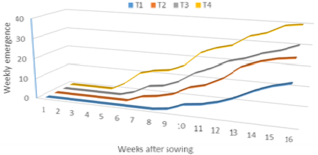
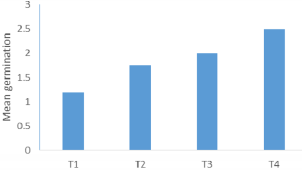
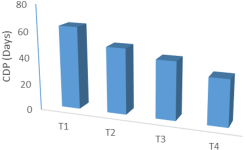
Seed dormancy remains a critical bottleneck in the nursery propagation of Garcinia kola Heckel, a socioeconomically and medicinally important non-timber forest species of West and Central Africa. This study investigated the effect of varying water-soaking durations on dormancy alleviation and germination performance of decoated G. kola seeds under controlled nursery conditions. Freshly collected seeds were decoated and subjected to four pre-germination treatments: no soaking (T1, control), 24-hour soaking (T2), 48-hour soaking (T3), and 72-hour soaking (T4). A Completely Randomized Design (CRD) was employed with 10 seeds per tray and five replicates per treatment, sown in sterilized river sand. Germination onset was earliest in T4 (Week 5), followed by T3 (Week 6), T2 (Week 7), and T1 (Week 9). The highest cumulative germination percentage (CGP) was recorded in T4 (80%), compared with T3 (64%), T2 (56%), and T1 (38%). The complete dormancy period (CDP) ranged from 35 days (T4) to 63 days (T1), decreasing significantly with longer soaking duration. These results indicate that G. kola seeds exhibit both seed coat dormancy and chemically-imposed dormancy, and that 72-hour soaking of decoated seeds is an effective, low-cost, and farmer-accessible method for hastening germination onset and improving seedling yield.
| Published in | American Journal of Plant Biology (Volume 11, Issue 3) |
| DOI | 10.11648/j.ajpb.20261103.11 |
| Page(s) | 39-44 |
| Creative Commons |
This is an Open Access article, distributed under the terms of the Creative Commons Attribution 4.0 International License (http://creativecommons.org/licenses/by/4.0/), which permits unrestricted use, distribution and reproduction in any medium or format, provided the original work is properly cited. |
| Copyright |
Copyright © The Author(s), 2026. Published by Science Publishing Group |
Garcinia Kola, Seed Dormancy, Pre-germination Soaking, Cumulative Germination Percentage, Non-timber Forest Products, Tropical Nursery Propagation
Treatment | CGP (%) | SD (±) |
|---|---|---|
T1 (Control — no soaking) | 38 | 4.2 |
T2 (24-hour soaking) | 56 | 5.1 |
T3 (48-hour soaking) | 64 | 4.8 |
T4 (72-hour soaking) | 80 | 3.9 |
CGP | Cumulative Germination Percentage |
CDP | Complete Dormancy Period |
MGT | Mean Germination Time |
NTFP | Non-Timber Forest Product |
SD | Standard Deviation |
CRD | Completely Randomized Design |
| [1] | Aba, S. C., Onah, C. B., Ndukwe, O. O., & Baiyeri, K. P. (2023). Potting media and seed pre-sowing treatments influencing emergence and early seedling growth of bitter kola (Garcinia kola Heckel) under humidity chamber environment. African Journal of Food, Agriculture, Nutrition and Development, 23(9), 24523-24541. |
| [2] | Afzal, I., Javed, T., Amirkhani, M., & Taylor, A. G. (2020). Modern seed technology: Seed coating delivery systems for enhancing seed and crop performance. Agriculture, 10(11), 526. |
| [3] | Agwu, O. P., Bakayoko, A., Jimoh, S. O., & Stefan, P. (2018). Farmers’ perceptions on cultivation and the impacts of climate change on goods and services provided by Garcinia kola in Nigeria. Ecological Processes, 7(1), 36. |
| [4] | Ajayi, S., & Echi, A. A. (2016). Effect of pre-germination treatments on the dormancy breaking and early growth performance of bitter kola (Garcinia kola-(heckel) in south southern Nigeria. Journal of Research in Forestry, Wildlife and Environment, 8(2), 29-39. |
| [5] | Akinterinwa, E. T., Mayomi, P. T., & Olaolu, O. A. (2025). Pharmacological and Therapeutic Potentials of Garcinia kola. SustainE, 3(3). |
| [6] | Alabi, W. O., Adeoye, A. O., Akinlolu, A. R., & Rebecca, O. O. (2020). Proximate and antimicrobial properties of Garcinia kola; a significant evidence of a functional food snack. Int J Sci Eng Res, 11(5), 33-38. |
| [7] | Aleru, K. K., Agbugba, I. K., & Taremwa, N. K. (2025). The bioeconomic profitability of non-timber forest products in the national building: A review. Rwanda Journal of Agricultural Sciences, 4(1), 169-202. |
| [8] | Amusa, T. O., Avana-Tientcheu, M. L., Awazi, N. P., & Chirwa, P. W. (2024). The role of non-timber forest products for sustainable livelihoods in African multifunctional landscapes. In Trees in a Sub-Saharan multi-functional landscape: Research, management, and policy (pp. 153-178). Cham: Springer Nature Switzerland. |
| [9] | Baskin, C. C., & Baskin, J. M. (2025). Seed dormancy and germination in the Malvaceae: a palaeohistory, subfamily, growth form and geographical distribution perspective. Seed Science Research, 1-28. |
| [10] | Bennett, V., & Saliu, I. O. (2022). A Study on Garcinia kola Seeds in the Niger Delta, Nigeria. International Journal of Pharmacy and Chemistry, 8(3), 40-43. |
| [11] | Dadjo, C., Nyende, A. B., Kahia, J., & Assogbadjo, A. E. (2019). Effect of storage temperature and dormancy breaking pre-treatments on germination and early seedling growth of Garcinia kola (Heckel): a threatened medicinal fruit tree in Benin. Forest Science and Technology, 15(4), 173-179. |
| [12] | Dadjo, C., Nyende, A. B., Salako, K. V., Hounkpèvi, A., & Assogbadjo, A. E. (2020). Socio–economic factors determining conservation and cultivation of Garcinia kola Heckel a medicinal plant extinct in the wild in Benin. Economic Botany, 74(2), 115-125. |
| [13] | Derebe, B., Alemu, A., & Asfaw, Z. (2023). Contribution of nontimber forest products earn to livelihood in rural households and the type of use: a systematic review. International journal of forestry research, 2023(1), 9643290. |
| [14] | Dogara, A. M., Hamad, S. W., Hama, H. A., Bradosty, S. W., Kayfi, S., Al-Rawi, S. S., & Lema, A. A. (2022). Biological evaluation of Garcinia kola Heckel. Advances in pharmacological and pharmaceutical sciences, 2022(1), 3837965. |
| [15] | Ellis RH, Roberts EH. 1980. Towards rational basis for testing seed quality. In: Hebblethwaite P D (ed) Seed Production. Butterworths, London. pp 605-635. |
| [16] | Emmanuel, O., Uche, M. E., Dike, E. D., Etumnu, L. R., Ugbogu, O. C., & Ugbogu, E. A. (2022). A review on Garcinia kola Heckel: Traditional uses, phytochemistry, pharmacological activities, and toxicology. Biomarkers, 27(2), 101-117. |
| [17] | FRIC, 2014. Forestry Research Institute of Cameroon, Annual Meteorological Report. 166p. |
| [18] | Gogo, A. C., Assumpta, U. O., & Esther, A. U. (2025). A Review on the Importance and Acceptability of Garcinia Kola. Quantum Journal of Engineering, Science and Technology, 6(1), 38-46. |
| [19] | Jaganathan, G. K., Sánchez, J. A., Pernús, M., & Liu, B. (2024). Unconventional Germination in Terrestrial Plants: A Counterintuitive Case in Desiccation-Sensitive Garcinia aristata (Clusiaceae) Seeds Showing Seedling Growth Without Roots. Plants, 13(23), 3269. |
| [20] | Larsen SU, Andreasen C. 2004. Light and heavy turf-grass seeds differ in germination percentage and mean germination thermal time. Crop Sci., 44: 1710-1720. |
| [21] | Maňourová, A., Leuner, O., Tchoundjeu, Z., Van Damme, P., Verner, V., Přibyl, O., & Lojka, B. (2019). Medicinal potential, utilization and domestication status of bitter kola (Garcinia kola Heckel) in West and Central Africa. Forests, 10(2), 124. |
| [22] | Manourova, A., Polesny, Z., Lojka, B., Degrande, A., Pribyl, O., Van Damme, P., & Verner, V. (2023). Tracing the tradition: Regional differences in the cultivation, utilization, and commercialization of bitter kola (Garcinia kola, Clusiaceae) in Cameroon. Economic Botany, 77(1), 48-62. |
| [23] | Nwonuala, A. I., & Christo, I. E. (2021). Effect of seed priming on seedling emergence and growth of bitter kola (Garcinia kola) in Owerri, Nigeria. African Journal of Agricultural Research, 17(3), 365-370. |
| [24] | Ogwu, M. C., Ogwu, H. I., Osawaru, M. E., & Izah, S. C. (2024). Garcinia kola Heckel. (Clusiaceae): an overview of the cultural, medicinal, and dietary significance for sustainability. Herbal medicine phytochemistry: Applications and trends, 273-301. |
| [25] | Okonkwo, H. O., Ejizu, A. N., & Eric, E. E. (2020). Assessment of pre-germination treatment methods for reducing Garcinia kola (Heckel) seed dormancy and its germination characteristics dynamics. African Journal of Agriculture, Technology and Environment, 9(1), 245-256. |
| [26] | Olayode, O. O., & Akintayo, O. J. (2023). Seed Germination and Early Seedling Growth of Bitter Kola (Garcinia kola Heckel): a Multipurpose Tree Species. Taiwan Forestry Science, 38(1), 1-11. |
| [27] | Raheem, L. O., Adegoke, C. O., Fabiyi, W. A., Oyeleke, K. O., Azeez, M. M., Folorunso, O. A., Akinlabi, A. M., & Alade, W. A. (2025). Antimicrobial Activities of Bitter Kola and Molecular Analysis of Organisms causing Bronchitis isolated from Sputum among Patients attending Ladoke Akintola University Teaching Hospital Ogbomoso. Sokoto Journal of Medical Laboratory Science, 10(3), 337-348. |
| [28] | Salimata, F., Djézou, K., Antoine, K., Richard, K. K., & Edouard, K. K. (2024). Effects of Hydro Priming on Germination Time and Rate of Small Cola Seeds (Garcinia Kola Heckel, Clusiaceae). Journal of Experimental Agriculture International, 46(9), 194-204. |
| [29] | Tauchen, J., Frankova, A., Manourova, A., Valterova, I., Lojka, B., & Leuner, O. (2023). Garcinia kola: a critical review on chemistry and pharmacology of an important West African medicinal plant. Phytochemistry Reviews, 22(5), 1305-1351. |
| [30] | Tchinmegni, F., Tsobeng, A., Ngonkeu, E., & Tchoundjeu, Z. (2016). Valorisation of non-timber forest product (NTFP): Case of Allanblackia floribunda Oliver. Int. J. Res. Pharm. Biosci, 3, 9-20. |
| [31] | Udo, G., Enyenihi, G., & Ogbuzuru, E. (2024). Effect of Garcinia kola (bitter kola) on growth performance and meat quality of broiler chickens. Journal of Agriculture, Forestry & Environment, 8(1), 159-170. |
| [32] | Upretee, P., Bandara, M. S., & Tanino, K. K. (2024). The role of seed characteristics on water uptake preceding germination. Seeds, 3(4), 559-574. |
| [33] | Yogom, B. T., Avana-Tientcheu, M. L., Mboujda, M. F. M., Momo, S. T., Fonkou, T., Tsobeng, A., Barnaud A., & Duminil, J. (2020). Ethnicity differences in uses and management practices of bitter kola trees (Garcinia kola) in Cameroon. Economic Botany, 74(4), 429-444. |
APA Style
I, T. F., Vartant, D. P. S. (2026). Water Soaking Duration as a Dormancy-Breaking Strategy for Enhancing Germination of Decoated Garcinia kola (Heckel) Seeds. American Journal of Plant Biology, 11(3), 39-44. https://doi.org/10.11648/j.ajpb.20261103.11
ACS Style
I, T. F.; Vartant, D. P. S. Water Soaking Duration as a Dormancy-Breaking Strategy for Enhancing Germination of Decoated Garcinia kola (Heckel) Seeds. Am. J. Plant Biol. 2026, 11(3), 39-44. doi: 10.11648/j.ajpb.20261103.11
@article{10.11648/j.ajpb.20261103.11,
  author = {Tchinmegni Felenou I and Djeukam Pougoum Stelle Vartant},
  title = {Water Soaking Duration as a Dormancy-Breaking Strategy for Enhancing Germination of Decoated Garcinia kola (Heckel) Seeds},
  journal = {American Journal of Plant Biology},
  volume = {11},
  number = {3},
  pages = {39-44},
  doi = {10.11648/j.ajpb.20261103.11},
  url = {https://doi.org/10.11648/j.ajpb.20261103.11},
  eprint = {https://article.sciencepublishinggroup.com/pdf/10.11648.j.ajpb.20261103.11},
  abstract = {Seed dormancy remains a critical bottleneck in the nursery propagation of Garcinia kola Heckel, a socioeconomically and medicinally important non-timber forest species of West and Central Africa. This study investigated the effect of varying water-soaking durations on dormancy alleviation and germination performance of decoated G. kola seeds under controlled nursery conditions. Freshly collected seeds were decoated and subjected to four pre-germination treatments: no soaking (T1, control), 24-hour soaking (T2), 48-hour soaking (T3), and 72-hour soaking (T4). A Completely Randomized Design (CRD) was employed with 10 seeds per tray and five replicates per treatment, sown in sterilized river sand. Germination onset was earliest in T4 (Week 5), followed by T3 (Week 6), T2 (Week 7), and T1 (Week 9). The highest cumulative germination percentage (CGP) was recorded in T4 (80%), compared with T3 (64%), T2 (56%), and T1 (38%). The complete dormancy period (CDP) ranged from 35 days (T4) to 63 days (T1), decreasing significantly with longer soaking duration. These results indicate that G. kola seeds exhibit both seed coat dormancy and chemically-imposed dormancy, and that 72-hour soaking of decoated seeds is an effective, low-cost, and farmer-accessible method for hastening germination onset and improving seedling yield.},
 year = {2026}
}
TY  - JOUR
T1  - Water Soaking Duration as a Dormancy-Breaking Strategy for Enhancing Germination of Decoated Garcinia kola (Heckel) Seeds
AU  - Tchinmegni Felenou I
AU  - Djeukam Pougoum Stelle Vartant
Y1  - 2026/07/22
PY  - 2026
N1  - https://doi.org/10.11648/j.ajpb.20261103.11
DO  - 10.11648/j.ajpb.20261103.11
T2  - American Journal of Plant Biology
JF  - American Journal of Plant Biology
JO  - American Journal of Plant Biology
SP  - 39
EP  - 44
PB  - Science Publishing Group
SN  - 2578-8337
UR  - https://doi.org/10.11648/j.ajpb.20261103.11
AB  - Seed dormancy remains a critical bottleneck in the nursery propagation of Garcinia kola Heckel, a socioeconomically and medicinally important non-timber forest species of West and Central Africa. This study investigated the effect of varying water-soaking durations on dormancy alleviation and germination performance of decoated G. kola seeds under controlled nursery conditions. Freshly collected seeds were decoated and subjected to four pre-germination treatments: no soaking (T1, control), 24-hour soaking (T2), 48-hour soaking (T3), and 72-hour soaking (T4). A Completely Randomized Design (CRD) was employed with 10 seeds per tray and five replicates per treatment, sown in sterilized river sand. Germination onset was earliest in T4 (Week 5), followed by T3 (Week 6), T2 (Week 7), and T1 (Week 9). The highest cumulative germination percentage (CGP) was recorded in T4 (80%), compared with T3 (64%), T2 (56%), and T1 (38%). The complete dormancy period (CDP) ranged from 35 days (T4) to 63 days (T1), decreasing significantly with longer soaking duration. These results indicate that G. kola seeds exhibit both seed coat dormancy and chemically-imposed dormancy, and that 72-hour soaking of decoated seeds is an effective, low-cost, and farmer-accessible method for hastening germination onset and improving seedling yield.
VL  - 11
IS  - 3
ER  -
Department of Agroforestry, Higher Institute of Environmental Sciences (HIES), Yaoundé, Cameroon
Department of Agroforestry, Higher Institute of Environmental Sciences (HIES), Yaoundé, Cameroon

Information



 Share This Article
 Twitter
 Linked In
 Facebook
 Copy
Copy Download