Abstract
The convergence of Cyber-Physical Systems (CPS), smart automation, and digital manufacturing marks a pivotal evolution toward Industry-4.0, characterized by intelligent, adaptive, and data-driven production systems. Core to this transformation are IoT?based Wireless Sensor Networks (WSNs), which serve as the sensory backbone enabling real-time monitoring, predictive control, and autonomous decision?making within digitally integrated manufacturing environments. This review critically examines the primary technical, architectural, and operational challenges inherent in deploying WSNs for smart manufacturing. Key issues include energy-efficient design to sustain long?term sensor operation, large-scale network scalability amid heterogeneous device ecosystems, and stringent requirements for reliability and latency in time-sensitive control loops. Security and privacy concerns are analyzed, with emphasis on lightweight cryptographic protocols and intrusion detection tailored for constrained sensor nodes. The integration of CPS introduces additional complexity in data interoperability and standardization across manufacturing tiers, prompting exploration into middleware platforms and semantic ontologies. Moreover, the potential of edge?intelligent WSNs for data aggregation, anomaly detection, and real?time feedback control is investigated, with attention to balancing computational load and network resource usage. By synthesizing recent academic and industrial research, this review identifies prevailing trends, such as AI-augmented sensor architectures and blockchain?enhanced trust frameworks, and uncovers critical gaps including cross-vendor interoperability, fault-tolerance under dynamic production conditions, and lifecycle co?design of sensor modules with digital twin models. The insights derived provide a roadmap for future innovation, guiding researchers and practitioners toward resilient, efficient, and secure CPS?enabled smart manufacturing solutions in Industry-4.0.
Keywords
Industry-4.0, Cyber-Physical Systems, Wireless Sensor Networks, Smart Automation, Digital Manufacturing,
IoT Security, Interoperability
1. Introduction
The Fourth Industrial Revolution (Industry-4.0) is accelerating a shift toward decentralized, data-driven manufacturing landscapes. Central to this transformation is the integration of Cyber-Physical Systems (CPS) and smart automation into digital manufacturing environments. CPS characterized by the tight coupling of computation, networking, and physical processes empower machines to monitor, communicate, and respond autonomously, thus reshaping production workflows
| [1] | Alessandro Bessi, Mariangela Guidolin et Piero Manfredi, «The role of gas on future perspectives of renewable energy diffusion: Bridging technology or lock-in?». Renewable and Sustainable Energy Reviews, vol. 152, pp. 1364-0321, 2021. |
[1]
. Wireless Sensor Networks (WSNs), which form the sensory layer of such CPS ecosystems, enable real-time monitoring and decision-making by capturing and transmitting critical operational data (e.g., temperature, vibration, energy consumption) across the factory floor
| [2] | Ruben Hidalgo-Leon, Javier Urquizo, Christian E. Silva, Jorge Silva-Leon, Jinsong Wu, Pritpal Singh et Guillermo Soriano, «Powering nodes of wireless sensor networks with energy harvesters for intelligent buildings: A review». Energy Reports, vol. 8, 2022. |
[2]
.
Despite these promising capabilities, deploying IoT-based WSNs within industrial settings presents significant challenges. First, energy efficiency remains a pressing concern: sensor nodes, often battery-powered and embedded in inaccessible locations, demand low-power designs to ensure uninterrupted operation
| [3] | Jernej Protner, Miha Pipan, Hugo Zupan, Matevz Resman et Marko Simic, Niko Herakovic, «Edge Computing and Digital Twin Based Smart Manufacturing». IFAC-PapersOnLine, vol. 54, pp. 831-836, 2021. |
[3]
. Second, the scalability of WSNs in large-scale manufacturing environments is complicated by the presence of heterogeneous devices, evolving topologies, and stringent Quality of Service (QoS) constraints affecting fault detection and predictive maintenance systems
| [4] | R. J. Kuo, Y. R. Zheng, et Thi Phuong Quyen Nguyen, «Metaheuristic-based possibilistic fuzzy k-modes algorithms for categorical data clustering». Information Sciences, vol. 557, 2021. |
[4]
.
Equally critical are issues of data interoperability and security. Industrial CPS environments involve equipment from multiple vendors, each using proprietary protocols and data formats, placing a premium on standard-based middleware or semantic ontologies for seamless integration
| [5] | Mushtaq, M. U., Venter, H., Singh, A.; et Owais, M., «Advances in Energy Harvesting for Sustainable Wireless Sensor Networks: Challenges and Opportunities». Hardware, vol. 3, 2025. |
[5]
. At the same time, safeguarding sensitive operational data and preventing cyber-attacks require lightweight cryptographic schemes, intrusion detection tools, and secure key management tailored for low-resource sensors
| [6] | Zhou, L., Kang, M. et Chen, W., «Lightweight Security Transmission in Wireless Sensor Networks through Information Hiding and Data Flipping». Sensors, vol. 22, p. 823, 2022. |
[6]
.
Finally, there is growing interest in embedding edge-computing intelligence within WSNs. By enabling local data aggregation, anomaly detection, and closed-loop control actions, such on-node computation reduces latency, enhances system responsiveness, and lightens network traffic
| [7] | Al-Saedi, A. A., Boeva, V., Casalicchio, E. et Exner, P., «Context-Aware Edge-Based AI Models for Wireless Sensor Networks An Overview». Sensors, vol. 22, p. 5544, 2022. |
[7]
. However, a key trade-off arises between computational load and communication bandwidth that requires careful optimization.
This article presents a comprehensive synthesis of recent advances in IoT based WSNs for CPS-driven digital manufacturing. Specifically, we focus on the following key issues: energy-efficient network architectures, scalable deployment protocols, data interoperability frameworks, security mechanisms, and edge-enhanced sensing intelligence. Section 2 will explore the theoretical and technological foundations of wireless sensor networks within Industry 4.0 environments. Section 3 will address the core challenges associated with WSNs in digital manufacturing, including energy constraints, scalability, and security. Section 4 will examine recent innovations and techniques aimed at improving energy efficiency, communication reliability, and edge intelligence in CPS-based networks. Section 5 will present a discussion of open research gaps and emerging trends followed by Section 6, which concludes the study by summarizing key findings and proposing future directions for the development of robust, scalable, and secure IoT-enabled WSN architectures in smart factories.
2. Theoretical and Technological Foundations of Wireless Sensor Networks in Industry-4.0
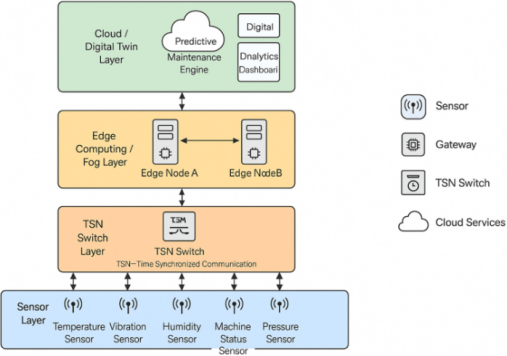
Figure 1. A typical Industry-4.0 WSN architecture highlighting sensor nodes, edge gateways, time-sensitive networking (TSN) integration, and cloud interfaces.
Smart factories, the epitome of Industry-4.0, leverage wireless sensor networks (WSNs) to create a seamless fusion between digital control and physical processes. Their strategic placement throughout the production environment enables continuous real-time sensing, decision-making, and actuation. To harness this transformative potential, a deep understanding of both theoretical paradigms and technological stacks is essential. This section investigates these two complementary dimensions (1) conceptual frameworks underpinning intelligent distributed sensing in industrial contexts, and (2) enabling protocols, architectures, and standards that bring these frameworks to life.
Figure 1 provides an overview of a canonical WSN architecture adapted for Industry-4.0, serving as a visual anchor for the topics discussed.
At the heart of Industry-4.0 lies the concept of Cyber-Physical Systems (CPS) tight integrations of computation, networking, and physical processes. Wireless sensor networks manifest this paradigm by enabling numerous sensor nodes to monitor environmental and operational variables, feeding data into computational layers that support monitoring, control, and optimization. Majid et al.
| [8] | Majid, M., Habib, S., Javed, A. R., Rizwan, M., Srivastava, G., Gadekallu, T. R. et Lin, J. C.-W., «Applications of Wireless Sensor Networks and Internet of Things Frameworks in the Industry Revolution 4.0: A Systematic Literature Review». Sensors, vol. 22, p. 2087. |
[8]
examine these CPS effects and assert that embedded intelligence at the network edge rather than centralized in the cloud provides significant latency and reliability improvements in real-time manufacturing scenarios.
A closely related notion is Edge or Fog Computing, where computational tasks occur on edge gateways or sensor clusters. In-network data fusion algorithms reduce data transmission volumes and latency. For example, Luo et al.
| [9] | F. Zhou, W. Chen et Y. Xiao, «Deep Learning Research With an Expectation-Maximization Model for Person Re-Identification». IEEE Access, vol. 8, pp. 157762-157772, 2020. |
[9]
propose adaptive edge computing models that balance task-handling between sensor nodes and gateways before sending summaries to centralized analytics platforms. Meanwhile, testbeds such as those described by Sun et al.
| [10] | Zhou, B., Baucells Costa, A. et Lukowicz, P., «Accurate Spirometry with Integrated Barometric Sensors in Face-Worn Garments». Sensors, vol. 20, p. 4234, 2020. |
[10]
in smart factory deployments have demonstrated reduced response times and improved fault tolerance.
However, these new paradigms also raise theoretical challenges. Notably, as node and edge processing grows, models are needed to capture trade-offs among energy usage, latency, and reliability particularly in dense, variable industrial environments. Analytical frameworks such as queueing theory and network calculus have been suggested, but applying them at scale remains an open research frontier.
From a systems engineering perspective, such distributed CPS-WSN architectures are governed by models of observability, controllability, and reliability. Real-time schedulability analysis, queuing theory, and distributed consensus algorithms now underpin the behavior of intelligent WSN clusters. These theoretical constructs provide the scaffolding upon which scalable, fault-tolerant, and secure smart manufacturing infrastructures are built. Nevertheless, the successful deployment of such architectures also depends critically on the integration of enabling technologies and protocols.
Effective deployment of WSNs in smart manufacturing hinges on a robust technological foundation. At the physical and MAC layers, IEEE 802.15.4-based protocols (like ZigBee, WirelessHART, 6LoWPAN) are popular due to their low power consumption, mesh networking, and reliability. Pistokopoulos et al.
| [11] | N. Zhang, L. Belostotski et J. W. Haslett, «Relations of Time-Varying Circuit Parameters and Idlerless Parametric Harmonic Generation for Reconfigurable Frequency Multipliers». IEEE Transactions on Microwave Theory and Techniques, vol. 69, pp. 2554-2568, 2021. |
[11]
highlight how WirelessHART’s time-synchronized scheduling and redundancy support are tailored for industrial automation.
For time-critical operations, Time-Sensitive Networking (TSN) originally for wired Ethernet is increasingly being integrated with WSN architectures. Research by Behnke and Austad
| [12] | H. Luo, S. Zhang, B. Gao, W. Zhang, Z. Ma et X. Wu, «Novel capacity configuration method of hybrid energy storage system to smooth output power fluctuation of photovoltaic power plant». Asia-Pacific Conference on Communications Technology and Computer Science, pp. 233-239, 2023. |
[12]
demonstrates proof-of-concept TSN-enabled WirelessHART gateways, capable of maintaining sub-millisecond latency and synchronization.
Beyond communication, edge gateway architectures are critical nodes that translate between wireless sensor fields and cloud systems. These units often run containerized microservices supporting real-time analytics, orchestration, and network management. Bollineni and Velasco-Muñoz
| [13] | Redeker, M., Weskamp, J. N., Rössl, B., et Pethig, F., «A Digital Twin Platform for Industrie 4.0.». Springer, Cham, p. 173–200, 2022. |
[13]
introduced a microservice-based digital twin platform that integrates WSN edge data, though scalability with intermittent connectivity remains an issue.
An effective WSN architecture for Industry-4.0 must also incorporate security and resilience by design. Lightweight cryptography (e.g., AES-CCM) is now standard, but secure boot, anomaly detection, and dynamic rekeying remain active research domains. Ibrahim et al.
| [14] | X. Wang et Q. Li and Z. Lin, «On the Comparison of Mono Visual Odometry Front End in Low Texture Environment». 3rd International Conference on Mechatronics, Robotics and Automation, pp. 195-200, 2020. |
[14]
designed an integrated encryption and anomaly detection stack for industrial sensor networks that balanced performance and robustness. Nonetheless, deployment in real environments highlights the need for seamless trust models, over-the-air updates, and adaptive reconfiguration.
Furthermore, interoperability across vendor-specific WSN components remains a key challenge. The development of open interoperability layers and ontology-driven middleware is being explored to enable seamless plug-and-play integration of sensors, actuators, and controllers from different manufacturers. This is critical for factories that evolve incrementally or operate under multi-supplier constraints.
As WSNs continue to evolve, they are increasingly expected to operate not only as data collectors but also as enablers of cyber resilience, real-time intelligence, and autonomous optimization in industrial systems. To meet these expectations, future research must focus on scalable protocol stacks, cross-domain semantic integration, and dynamic adaptation under changing physical and cyber conditions.
3. Core Challenges in Implementing IoT-Based WSNs for Digital Manufacturing
Wireless Sensor Networks (WSNs) in Industry-4.0’s smart manufacturing environments offer transformative potential for monitoring, automation, and quality control. However, realizing that potential involves surmounting several interwoven challenges. This section divides these core obstacles into two subcategories: general infrastructure and communication difficulties (3.1), and deployment-specific issues in real-world factory settings (3.2). Each subsection explores technical, architectural, and operational constraints that must be addressed to enable dependable, scalable, and secure WSN deployments.
3.1 Communication Infrastructure and Resource Management Constraints
3.1.1. Reliability in Industrial Wireless Channels
Despite their ubiquity, industrial wireless channels suffer from severe fading, electromagnetic interference, and multi-path effects all pronounced in manufacturing environments crowded with metal and machinery. Pistokopoulos et al. observed up to 30 % packet loss in WirelessHART mesh networks operating near production equipment, highlighting the challenge of maintaining consistent connectivity
| [11] | N. Zhang, L. Belostotski et J. W. Haslett, «Relations of Time-Varying Circuit Parameters and Idlerless Parametric Harmonic Generation for Reconfigurable Frequency Multipliers». IEEE Transactions on Microwave Theory and Techniques, vol. 69, pp. 2554-2568, 2021. |
[11]
. These losses not only degrade the accuracy of sensed data but also disrupt closed-loop control systems that rely on timely inputs for actuation.
To mitigate this, adaptive channel hopping (e.g., 6TiSCH) and redundant multi-path routing are often employed. However, introducing redundancy elevates energy consumption and latency a trade-off that tight real-time constraints cannot always accommodate. Advanced techniques like opportunistic forwarding have been proposed
| [10] | Zhou, B., Baucells Costa, A. et Lukowicz, P., «Accurate Spirometry with Integrated Barometric Sensors in Face-Worn Garments». Sensors, vol. 20, p. 4234, 2020. |
[10]
, but these are yet to be validated at industrial scale, raising the need for hybrid solutions that dynamically decide between reliability and resource efficiency.
3.1.2. Time Synchronization and Deterministic Behavior
Smart manufacturing relies on strict timing coordinated robotic arm movements, synchronized sensor-actuator nodes, and time-aware analytics. Time-Sensitive Networking (TSN) protocols now extend these capabilities to the wireless edge, combining IEEE 802.1AS (for synchronization) and 802.1Qbv (for scheduled traffic). However, ensuring tight synchronization across heterogeneous WSN nodes introduces complexity. Gong et al. demonstrated synchronization within 2 µs using TSN enhanced Wi SUN nodes, but only in lab environments. Practical deployments suffer from clock drift, packet jitter, and intermittent node availability, especially in high-vibration conditions
| [15] | Tianyu Zhang, Gang Wang, Chuanyu Xue, Jiachen Wang, Mark Nixon et Song Han, «Time-Sensitive Networking (TSN) for Industrial Automation: Current Advances and Future Directions». ACM Computing Surveys, vol. 57, 2024. |
[15]
.
Solving this requires enhanced timestamping, resilient synchronization protocols (e.g., precision time protocol combined with wireless TSN enforcement), and fallback scheduling that gracefully handles temporary deviations without triggering safety- or performance-critical failures.
3.1.3. Energy-Efficiency vs. Network Longevity
Lifetime remains a critical limitation for battery-powered WSN nodes in industrial settings where constant monitoring is expected over years. Though, energy usage in vibration-sensing nodes deployed on rotating machinery and reported average lifetimes under six months using duty-cycling and adaptive sampling. Higgs et al. stressed that optimizing sleep-wake schedules, adaptive data aggregation, and energy harvesting are essential to achieve multi-year operation
| [16] | Dietrich, S, Kusnezoff, M. et Michaelis, A., «Studies of Indium Tin Oxide-Based Sensing Electrodes in Potentiometric Zirconia Solid Electrolyte Gas Sensors». Sensors, vol. 21, p. 2345, 2021. |
[16]
.
However, harmonizing aggressive energy-saving mechanisms (e.g., intermittent sleep) with accurate event detection and timely communication is difficult. Machine learning approaches such as TinyML-based event prediction have shown promise
| [17] | Kilian Müller, Johannes Weidner, Norman Franchi et Peter Wägemann, «TinyEP: TinyML-enhanced Energy Profiling for Extreme Edge Devices». p. 99, 2024. |
[17]
, though their impact on latency and on-site computation overhead in harsh factory environments remains under-explored.
3.1.4. Scalability of Network and Management
A smart factory may deploy hundreds to thousands of heterogeneous sensor nodes covering vibration, temperature, current, and machine vision. Orchestrating such dense networks while retaining low-latency updates and maintaining node manageability is inherently complex. Decentralized auto-configuration, over-the-air updates, and hierarchical clustering are proposed solutions
| [18] | Xu, R., Hang, L., Jin, W. et Kim, D., «Distributed Secure Edge Computing Architecture Based on Blockchain for Real-Time Data Integrity in IoT Environments». Actuators, vol. 10, p. 197, 2021. |
[18]
, but scaling them beyond pilot systems raises concerns over spectrum contention and cloud-edge management bottlenecks.
Secure multi-tenant orchestration frameworks leveraging microservices offer better horizontal scalability, yet integrating these within legacy Manufacturing Execution Systems (MES) and OT frameworks remains work in progress. Ensuring consistent policy enforcement across administrative domains, especially in modular facilities, represents a persistent roadblock.
3.1.5. Cybersecurity and Zero-Trust Architectures
Security is a non-negotiable requirement in Industry-4.0, but traditional heavy-weight encryption and authentication schemes are ill-suited to resource-limited WSN nodes. A distributed edge architecture leveraging blockchain-based trust anchors and encrypted telemetry streams, while explored lightweight group authentication and anomalydetection frameworks for WSNs
| [19] | Wang, M., Xu, C., Lin, Y., Lu, Z., Sun, J. et Gui, G., «A Distributed Sensor System Based on Cloud-Edge-End Network for Industrial Internet of Things». Future Internet, vol. 15, p. 171, 2023. |
| [20] | Xingxin Yang, Changhong Liu, Lingxi Peng, Shaohu Peng, Yongjun Zhang, Ning Xie et Ray Y. Zhong, «A new BRTCN model for predicting discharge status of WEDM based on acoustic emission». Journal of Manufacturing Systems, vol. 64, pp. 409-423, 2022. |
[19, 20]
. Both show promise; however, they depend on assumptions about node stability and non-capture conditions assumptions that fail in contested factory zones.
Comprehensive zero-trust architectures tailored to the edge are still emerging. Key research questions remain in secure provisioning, revocable authentication lifecycles, and deception techniques such as honeypots and dynamic moving target defenses that deter physical or cyber compromise of edge nodes.
3.2. Deployment-Specific Challenges in Smart Manufacturing
Implementation of WSNs in real-world industrial contexts introduces unique challenges. In manufacturing, unlike controlled labs, environments are dynamic, multi-process, and heavily multi-modal. The following subsections illustrate critical themes, two of which are illustrated in
Figures 2a and 2b.
3.2.1. Environmental Harshness and Sensor Resilience
Machinery in factories generates heat, dust, vibration, and electromagnetic noise conditions that degrade WSN hardware and wireless links alike. For instance,
| [21] | Shaukat, H., Ali, A., Ali, S., Altabey, W. A., Noori, M. et Kouritem, S. A., «Applications of Sustainable Hybrid Energy Harvesting: A Review». Low Power Electron. Appl., vol. 12, p. 62, 2023. |
[21]
observed sensor failure rates of up to 15 % annually in dusty casting facilities. Protective enclosures mitigate this but add thermal and communication overhead. Deployment must account for hardware ruggedization industries, while network redundancy and fault tolerance are engineered via intelligent routing protocols that detect and bypass failing nodes.
Additionally, node power systems must tolerate electric noise and thermal cycling. Hybrid energy systems that combine harvesting (vibration, thermal) with battery storage have shown operational maintenance lifetimes of nearly two years
| [22] | Zheng Zhang, Juan Chen et Qing Guo, «Application of Automated Guided Vehicles in Smart Automated Warehouse Systems: A Survey». Computer Modeling in Engineering & Sciences, vol. 134(3), pp. 1-35, 2022. |
[22]
, though high deployment costs and harsh conditions limit widespread adoption.
3.2.2. Mobility & Topology Dynamics
Manufacturing floors are in constant flux with human workers, AGVs (Automated Guided Vehicles), and reconfigurable production lines. Sensor networks must accommodate dynamic nodes that enter, exit, or move unpredictably.
| [23] | Wang, L.; et Zhang, X., «Anomaly Detection for Automated Vehicles Integrating Continuous Wavelet Transform and Convolutional Neural Network». Appl. Sci., vol. 13, p. 5525, 2023. |
[23]
demonstrated ad-hoc WSN reconfiguration using mobile beacon nodes in an AGV environment, but their design suffered from 300 ms handover latency too slow for precision robotic coordination.
Ensuring smooth network topology adaptation requires real-time topology discovery, path restoration, and low-latency communication guarantees. Intelligent clustering and mobile edge provisioning, combined with predictive mobility models, offer research opportunities to maintain resilience in dynamically changing spaces.
3.2.3. Multi-modal Sensor Fusion and Data Synchronization
Complex smart manufacturing scenarios e.g., CNC machining combined with robotic pick-and-place demand integration of heterogeneous sensor types: vibration, acoustic, temperature, and vision.
| [24] | Po Hu, Zhenyu Han, Hongya Fu, Dedong Han et Dedong Han, «Architecture and implementation of closed-loop machining system based on open STEP-NC controller». The International Journal of Advanced Manufactured, 2015. |
[24]
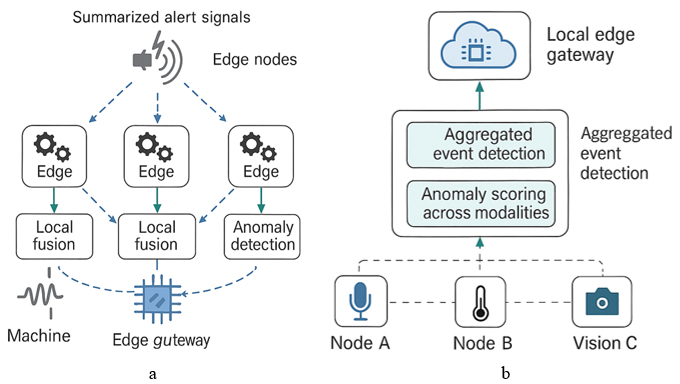
proposed an acoustic–vibration fusion technique employing edge processing to reduce latency by 44 %, shown in
Figure 2a. Their work prioritized single-event detection scenarios, but fusion across modalities and asynchronous sampling remains unaddressed.
Figure 2. Edge-integrated WSN architectures for real-time anomaly detection and multi-modal sensor fusion in smart manufacturing. a In-network acoustic–vibration anomaly detection via edge nodes with distributed processing. b Multi-modal sensor fusion integrating acoustic, thermal, and vision nodes through local edge gateways.
Synchronizing multi-modal measurements brings challenges in timestamp alignment, data volume management, and ensuring consistency across streams for fusion algorithms. Applying sensor fusion at the edge can improve accuracy and reduce network traffic but the optimal balance between local fusion complexity and global analytics remains largely unexplored in industrial settings.
3.2.4. Real-Time Feedback and Closed-loop Control
WSNs are increasingly pivotal to closed-loop control of machinery e.g., dynamically regulating cutting tool rotation based on vibration signature, or adjusting pressure in co-located soft robotics. However, real-time feedback demands ultra-low latency and high reliability, conflicting with typical WSN constraints.
| [25] | Cho, Y. et Noh, S. D., «Design and Implementation of Digital Twin Factory Synchronized in Real-Time Using MQTT». Machines, vol. 759, p. 12, 2024. |
[25]
implemented a feedback loop controlling CNC machining remotely at 20 ms latency using edge-deployed inference, but this required a dedicated sub-6 GHz wireless band with QoS enforcement and prioritized traffic.
Optimal closed-loop operation necessitates message scheduling, priority-based queuing, and traffic partitioning often leveraging TSN and wireless slicing. Integrating smart priority-aware gateways with in-band feedback channel monitoring represents a promising direction for future development.
3.2.5. Digital Twins and WSN Synchronization
Digital twins are digital avatars mirroring physical assets in real time. Effective twins require timely and high-fidelity sensor data. In manufacturing, even millisecond delays may cascade into inefficiencies or failure. Multiple studies have implemented local digital twin updates using edge gateways, illustrated conceptually in
Figure 2b.
The major hurdles are data fusion timing, twin drift correction in response to missing or stale data, and secure updating under fault or attack scenarios. While initial prototypes exist
| [26] | Ahmed I. Ahmed, Lobna A. Said et Ahmed Madian, «Over-The-Air Firmware Updating Model suitable for Industrial IoT based on Microchip AVR MCU». |
[26]
, broader adoption demands standardized interfaces, asynchronous fallback strategies, and regulated human–machine transparency for twins leveraged in operator decision-making loops.
3.2.6. Lifecycle Management and Maintainability
Smart manufacturing demands not just initial deployment but long-term upkeep and adaptability. WSNs are difficult to maintain en masse, especially where nodes are embedded within complex machinery. Over-the-air (OTA) update failures, version mismatches, and unintended reboot cycles can interrupt production.
| [27] | «An Adaptable and Unsupervised TinyML Anomaly Detection System for Extreme Industrial Environments». Sensors, vol. 23, p. 2344, 2023. |
[27]
reported OTA failure rates approaching 20 % in a pilot over six months, significantly affecting system stability.
Lifecycle management requires secure OTA mechanisms, version rollback, rolling-update staging, and remote diagnostics. Standards like FUOTA (Firmware Update Over The Air) are necessary, but institutional policies and resilient hardware modules play equally important tactical roles.
Collectively, these technical, architectural, and operational challenges underscore how the deployment of IoT based WSNs in smart manufacturing environments transcends standard IoT paradigms. The requirements for deterministic timing, reliability under harsh conditions, energy sustainability, security, and maintainability converge to form a multidimensional optimization problem. Addressing these requires interdisciplinary solutions involving control systems, wireless communications, embedded machine learning, cybersecurity, and human–machine systems engineering.
In the next section, we will explore emerging technological advances such as hybrid energy harvesting, trust-aware architectures, federated learning at the edge, and digital twin orchestrations designed to directly address these articulated challenges.
4. Recent Advances for Enhancing Energy Efficiency and Edge Intelligence in CPS-Based Networks
The fourth industrial revolution has ushered in a paradigm shift where Cyber-Physical Systems (CPS) are deeply integrated into the fabric of smart manufacturing. At the core of this transformation lies the need to develop Wireless Sensor Networks (WSNs) that are not only highly reliable and secure but also energy-efficient and intelligent at the edge. These demands are intensified in industrial environments characterized by high device density, dynamic conditions, and latency-sensitive operations. This section delves into two main axes of innovation: (1) advanced energy efficiency strategies, and (2) the rise of edge intelligence for distributed processing and decision-making.
4.1. Advances in Energy Efficiency for Industrial WSNs
Energy efficiency remains a central constraint in the deployment of WSNs, particularly in scenarios where sensors are expected to operate unattended for years. The limitations of battery capacity, environmental factors, and deployment topologies make traditional power supply strategies untenable. Recent efforts focus on three synergistic approaches: energy harvesting, adaptive duty cycling, and energy-aware routing.
4.1.1. Energy Harvesting Integration
Energy harvesting technologies have evolved significantly in recent years, offering viable alternatives to periodic battery replacement. Thermoelectric, piezoelectric, and photovoltaic energy harvesting are increasingly integrated into industrial sensor nodes. For instance, the work of Shaukat et al.
| [28] | Deng, X., Li, J. et Shi, L. et al., «Trustworthy DNN partition for blockchain-enabled digital twin in wireless IIoT networks». ci. China Inf. Sci., vol. 67, p. 219303, 2024. |
[28]
demonstrated a hybrid energy system combining vibration-based and thermal harvesting to extend node lifespan up to two years in harsh industrial environments. Such designs mitigate dependency on batteries and offer maintenance-free operation, particularly valuable in inaccessible or hazardous zones.
Moreover, adaptive harvesting techniques are being developed to maximize energy capture under varying environmental conditions. These include Maximum Power Point Tracking (MPPT) algorithms and context-aware harvesting that adjusts node behavior based on energy input forecasts. However, variability in harvested energy necessitates adaptive workload and communication strategies to avoid performance degradation.
4.1.2. Duty Cycling and Adaptive Sleep Scheduling
Duty cycling, wherein sensor nodes alternate between active and sleep states, is a classical technique for reducing energy consumption. Recent advancements in this area involve predictive scheduling and context-driven duty cycling. Antonini et al.
| [29] | K. Sai Charan, «An Auto-Encoder Based TinyML Approach for Real-Time Anomaly Detection». SAE Int. J. Adv. & Curr. Prac. in Mobility, vol. 5(4): 1496-1501, 2023. |
[29]
proposed an event-driven duty cycle mechanism where nodes remain dormant until specific physical thresholds are detected. Meanwhile, machine learning models particularly lightweight variants such as TinyML have been employed to predict event occurrence, allowing nodes to pre-emptively wake only when relevant changes are likely.
Adaptive scheduling has further improved in multi-hop networks through synchronization protocols that align node wake-up times, thus reducing idle listening and collisions. These scheduling strategies, however, must balance trade-offs between energy savings and data latency, especially in real-time industrial applications.
4.1.3. Energy-Aware Routing and Topology Management
Routing algorithms are being reengineered to optimize for energy consumption without compromising reliability. Recent works incorporate residual energy levels, transmission costs, and topology robustness into route selection metrics. For instance, hierarchical clustering methods using dynamic cluster heads help distribute energy load across nodes
| [30] | Chemouil P., Martini B., Machuca C. M., Papadimitriou P., Borsatti D. et Rovedakis S., «Proceedings of the 27th Conference on Innovation in Clouds, Internet and Networks». Institute of Electrical and Electronics Engineers (IEEE), pp. 153-157, 2024. |
[30]
.
Additionally, reinforcement learning-based routing schemes have gained traction. These models adaptively learn the most energy-efficient paths under real-world network conditions. Hybrid approaches combining proactive and reactive routing also offer energy gains by adjusting to traffic patterns and node failures in real time.
4.2. Edge Intelligence and Distributed Analytics
The shift toward edge intelligence within CPS-enabled networks is motivated by the need to reduce latency, preserve bandwidth, and support real-time decision-making. Rather than routing all sensor data to the cloud, edge nodes now increasingly perform preliminary analytics, anomaly detection, and event correlation. This decentralization introduces a new layer of autonomy and resilience in industrial WSNs.
4.2.1. Embedded Inference and TinyML
The integration of TinyML ultra-compact machine learning models tailored for low-power microcontrollers has opened new avenues in local inference. These models allow sensor nodes to process data streams in situ and only forward meaningful events, thereby conserving energy and reducing uplink traffic.
Recent applications include vibration anomaly detection, predictive maintenance alerts, and human-presence recognition. Sai Charan, K.
| [31] | Dinh C. Nguyen, Ming Ding, Quoc-Viet Pham, Pubudu N. Pathirana, Long Bao Le, Aruna Seneviratne, Jun Li, Dusit Niyato et H. Vincent Poor, «Federated Learning Meets Blockchain in Edge Computing: Opportunities and Challenges». IEEE Internet of Things Journal, 2021. |
[31]
implemented a CNN-based TinyML model on a 32-bit ARM Cortex-M processor, achieving real-time inference for edge-based acoustic classification with sub-millisecond latency.
However, challenges remain in optimizing model size, training adaptability, and robustness to environmental noise. Transfer learning and federated learning paradigms are being explored to enable models to evolve locally without transmitting sensitive raw data to central servers.
4.2.2. Edge Gateway Virtualization and Orchestration
Modern edge gateways serve as intermediaries between field-deployed sensors and higher-layer cloud platforms. They aggregate, filter, and analyze incoming data streams while enforcing policy and security controls. Advances in gateway design include containerized microservices, Software Defined Networking (SDN) integration, and lightweight virtualization.
For instance, Chemouil P. et al.
| [32] | Awan, S., Sajid, M. B. E., Amjad, S., Aziz, U., Gurmani, U. et Javaid, N., «Blockchain Based Authentication and Trust Evaluation Mechanism for Secure Routing in Wireless Sensor Networks». Springer, Cham., vol. 297, 2022. |
[32]
evaluated edge gateway performance in virtualized Time-Sensitive Networking (TSN) environments, demonstrating deterministic traffic handling with millisecond precision. Virtualization further facilitates seamless updates, scalability, and resource isolation among concurrent industrial applications.
Orchestration frameworks now automate the deployment and lifecycle management of edge services, often leveraging Kubernetes or similar platforms customized for resource-constrained environments (e.g., K3s). This promotes modularity, fault-tolerance, and the ability to deploy analytics closer to the data source.
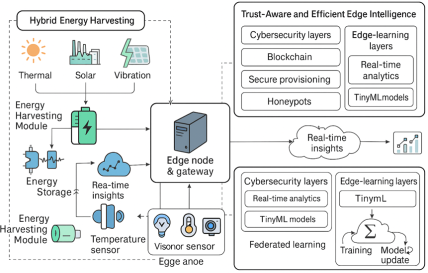
Figure 3. CPS-integrated WSN Architecture for Energy-Aware Edge Intelligence.
4.2.3. Decentralized Decision-Making and Federated Learning
The integration of federated learning (FL) at the edge introduces a privacy-preserving model training paradigm. Edge nodes collaboratively train a global model without exposing raw data, enabling knowledge sharing across distributed manufacturing units. Dinh C. Nguyen et al.
| [33] | Md. Noor-A-Rahim, Jobish John, Fadhil Firyaguna, Dimitrios Zorbas, Hafiz Husnain Raza Sherazi, Sergii Kushch, Eoin O’Connell, Dirk Pesch, Brendan O’Flynn, Martin Hayes, et Eddie Armstrong, «Wireless Communications for Smart Manufacturing and Industrial IoT: Existing Technologies, 5G, and Beyond», 2022. |
[33]
demonstrated that FL improves predictive accuracy in SPAN (Spatial Predictive Analytics for Networks) control tasks without incurring centralized bandwidth costs.
Additionally, rule-based inference engines and distributed knowledge graphs are employed to support context-aware reasoning in CPS networks. These tools empower WSN nodes to make autonomous decisions, detect emergent anomalies, and execute local mitigation actions before involving supervisory systems.
4.2.4. Security and Trust at the Edge
Edge intelligence also introduces novel security challenges. Local analytics necessitate secure execution environments and trustworthy data provenance. Awan et al.
| [34] | V. Ostaševičius, «Digital Twins in Manufacturing Virtual and Physical Twins for Advanced Manufacturing». Springer Cham, 2022. |
[34]
proposed embedding blockchain-based trust anchors within edge nodes to enable encrypted telemetry and verifiable event logs. Lightweight cryptographic protocols are paired with hardware-based Trusted Execution Environments (TEEs) to minimize processing overhead.
Trust management frameworks are evolving to include zero-trust architectures, where every interaction node-to-node or node-to-gateway is continuously verified. Behavioral profiling, anomaly detection, and context-aware authentication are integrated into edge services to safeguard critical manufacturing assets.
Figure 3 encapsulates the co-evolution of energy efficiency and edge intelligence within CPS-integrated WSNs. Sensor nodes, equipped with hybrid energy harvesting modules; perform lightweight inference via TinyML models. These nodes transmit only filtered data or event markers to edge gateways, which host microservice-based analytics and participate in federated learning. The entire system is secured through blockchain-backed identity management and supports dynamic service orchestration for fault-tolerant operation.
5. Open Research Gaps and Emerging Trends in Smart Manufacturing Networks
Thirteen high-quality papers were selected for publication in this special issue from over 80 submissions. The research presented in these papers spans a wide spectrum of emerging and interdisciplinary topics, including artificial intelligence in smart manufacturing networks, intelligent assembly station configuration and management, big data analytics for reconfigurable and adaptive production environments, self-optimization algorithms for dynamic resource allocation, self-diagnosis systems leveraging industrial IoT infrastructures, predictive maintenance and real-time condition monitoring of critical assets, additive manufacturing for mass customization, augmented reality for human-machine collaboration, and innovative automation and robotics for decentralized decision-making in Cyber-Physical production systems.
The selected papers originate from a diverse range of geographical regions, including Europe, America, Asia, and Africa. This diversity underscores the global relevance of smart manufacturing research and reflects strong international collaboration, with several papers jointly authored by researchers from different institutions and continents. In the following section, the individual contributions of the selected papers are briefly reviewed to highlight their novel insights and their relevance to the current and future landscape of smart manufacturing networks.
Rahim et al.
| [35] | Surjya Kanta Pal, Debasish Mishra, Arpan Pal, amik Dutta, Debashish Chakravarty et Srikanta Pal, «Digital Twin – Fundamental Concepts to Applications in Advanced Manufacturing». Springer Cham, vol. 23, p. 465, 2022. |
[35]
provide an extensive review of wireless communication protocols for smart manufacturing and Industrial IoT, covering 5G, IIoT, and M2M modalities. Their work highlights challenges in latency, reliability, and spectrum management for dynamic manufacturing environments. Crucially, they note that integrating multiple wireless standards into a cohesive framework remains an open research problem. Future work must explore unified radio resource management and adaptive channel switching to ensure seamless connectivity across heterogeneous factory devices.
Ostaševičius
| [36] | Attaran, M. et Attaran, S. & Celik, B. G., «The impact of digital twins on the evolution of intelligent manufacturing and Industry 4.0». Adv. in Comp. Int., vol. 3, 2023. |
[36]
delivers a compelling vision of digital twin–driven manufacturing, documenting real-world case studies such as tool vibration harvesting and edge-enabled monitoring. While digital twins offer improved production quality and lifecycle optimization, practical limitations persist in synchronization reliability and security. Future trends should emphasize resilient edge-cloud co-evaluations, continuous model validation, and protocols ensuring twin–physical system trustworthiness under Cyber-Physical interplay.
Redeker & Weskamp
| [37] | Suveg V. Iyer, Kuldip Singh Sangwan et Dhiraj, «Evolution of Digital Twin in Manufacturing Application: Definition, Architecture, Applications, and Tools». Springer Nature Switzerland, 2024. |
[37]
explore digital twin edge monitoring architectures that combine cloud-trained twins with local processing to enable proactive, autonomous responses in advanced manufacturing. They reveal how on-site processing can curb latency and enhance reliability. Yet, there is a research gap in robust orchestration mechanisms for deployments at scale and environments with intermittent connectivity. Future studies should investigate hierarchical twin–twin coordination and redundancy-aware synchronization strategies.
Pal et al.
| [38] | Y. Zhang, «Edge Computing for Digital Twin. In: Digital Twin. Simula SpringerBriefs on Computing». Springer, Cham, vol. 16, 2024. |
[38]
present a foundational treatise on digital twins in advanced manufacturing, emphasizing sensor electronics, signal processing, and AI for decision support. Although their framework promotes proactive decision-making, there is limited guidance on integrating low-power sensor networks at scale. Progress in lightweight firmware, TinyML model updates, and twin-triggered actuation policies are key future directions to support mass deployments in industrial-scale WSN systems.
Attaran et al.
| [39] | Md Noor-A-Rahim, Jobish John, Fadhil Firyaguna et Eddie Armstrong, «Wireless Communications for Smart Manufacturing and Industrial IoT: Existing Technologies, 5G and Beyond». Sensors, 2022. |
[39]
examine the evolution of digital twins within intelligent manufacturing and Industry 4.0, noting improvements in efficiency, waste reduction, and simulation speed. Importantly, they identify fragmentation in AI interpretability and secure twin-to-physical synchronization. An open research need exists for context-aware AI frameworks that blend explainable machine learning, digital twin monitoring, and fine-grained access control. Addressing these gaps could significantly enhance operator trust and regulatory compliance.
Suveg & Kuldip
| [40] | Huanzhuo Wu, Yunbin Shen, Xun Xiao, Artur Hecker et Frank H. P. Fitzek, «In-Network Processing Acoustic Data for Anomaly Detection in Smart Factory». Computer Science > Networking and Internet Architecture, 2021. |
[40]
demonstrate how DTs enable smart manufacturing systems through two-way cyber–physical integration using IoT, cloud systems, and data analytics. They highlight the ability to simulate and optimize assembly without physical prototyping. However, this approach raises performance bottlenecks under real-time, variable conditions. Future studies should evaluate twin-driven decision-making under network disruption and propose robust synchronization methods like consensus-based hybrid controllers.
Zhang
| [41] | Joachim Sachs et Krister Landernäs, «Review of 5G capabilities for smart manufacturing». Computer Science > Networking and Internet Architecture, 2022. |
[41]
introduces hierarchical edge computing architectures that enable low-latency DT inference, AI-enhanced control, and privacy preservation. While edge solutions show promise, they rarely integrate sensor network energy-draining profiles into twin-triggered actuation systems. Research gaps remain in unified protocols coupling real-time edge analytics with dynamic WSN load balancing, benefiting from stand-alone microgrid or lightweight energy-harvesting strategies.
Noor-A-Rahim et al.
| [42] | Liang Qiao et Zhihan Lv, «Context-Aware Cognitive Communication for Sustainable Digital Twins». Springer, Cham. |
[42]
emphasize energy-harvesting challenges and spectrum-management issues of emerging wireless protocols like 5G/6G in factory settings. Though their survey covers LPWAN and M2M standards, implementation experiences of hybrid WSN nodes in harsh industrial environments are lacking. Experimental testbeds integrating mm-wave fallback, narrowband IoT, and embedded energy-harvesters could fill this gap and enable resilient, self-sufficient edge devices.
Wu et al.
| [43] | Can, O., et Turkmen, A., «Digital Twin Driven Intelligent Systems and Emerging Metaverse». Springer, Singapore, 2023. |
[43]
propose in-network acoustic anomaly detection via progressive edge processing, reducing latency by 44% and redistributing computational load. This reveals a major trend: moving intelligence closer to data origin. However, anomaly detection methods are still tailored to single modalities. Future research should generalize this concept to multisensory fusion acoustic, vibration, thermal to support multi-domain predictive maintenance in SMNs.
Joachim & Krister
| [2] | Ruben Hidalgo-Leon, Javier Urquizo, Christian E. Silva, Jorge Silva-Leon, Jinsong Wu, Pritpal Singh et Guillermo Soriano, «Powering nodes of wireless sensor networks with energy harvesters for intelligent buildings: A review». Energy Reports, vol. 8, 2022. |
[2]
review 5G’s non-public network (NPN) capabilities TSN and enhanced URLLC for smart manufacturing trials. Though effective in controlled settings, problems remain in integrating NPN slices with existing wired backbone infrastructures. Open research challenges include cross-domain QoS enforcement, dynamic spectrum sharing, and adaptive beamforming protocols tailored to heterogeneous factory hall layouts.
Liang Qiao et al.
| [42] | Liang Qiao et Zhihan Lv, «Context-Aware Cognitive Communication for Sustainable Digital Twins». Springer, Cham. |
[42]
survey digital twin architectures, introducing the DT-II framework for industrial references but rarely embedding low-level network resilience. A crucial gap exists in aligning twin updates with live WSN conditions, particularly under fault or attack. Future directions should explore closed-loop twin-WNS architectures with embedded trust anchors and anomaly-triggered reconfiguration routines.
Can & Turkmen [
| [43] | Can, O., et Turkmen, A., «Digital Twin Driven Intelligent Systems and Emerging Metaverse». Springer, Singapore, 2023. |
[43]
offer a simulation-centric perspective on twin applications, yet evidence of tangible twin–sensor–actuator co-design is limited in their work. There is a need for integrated frameworks linking high-fidelity simulation models with physical WSN deployments, enabling wearable HMI or AR feedback loops. This coupling could facilitate on-site operator guidance and support evidence-based rapid reconfiguration.
Jernej Protner et al.
| [35] | Surjya Kanta Pal, Debasish Mishra, Arpan Pal, amik Dutta, Debashish Chakravarty et Srikanta Pal, «Digital Twin – Fundamental Concepts to Applications in Advanced Manufacturing». Springer Cham, vol. 23, p. 465, 2022. |
[35]
explore digital twin applications in smart energy systems, emphasizing cross-system orchestration involving hybrid IoT/energy nodes. While their focus is smart grids, analogous challenges exist in SMNs interfacing tool-level sensors with broader factory energy ecosystems. Future research should tackle cross-domain twin synchronization, multi-agent negotiation, and co-optimization of energy and production workflows.
6. Concluding Remarks
The growing convergence of Cyber-Physical systems (CPS) and smart automation in digital manufacturing environments is reshaping the industrial landscape in the era of Industry 4.0. Wireless Sensor Networks (WSNs), when integrated into IoT architectures, provide the necessary infrastructure for real-time data acquisition, contextual awareness, and adaptive process control. However, the practical deployment of WSNs in manufacturing contexts still faces considerable challenges, including energy limitations, communication reliability, latency sensitivity, and data security. This paper has examined the fundamental role of IoT-based WSNs within CPS-enabled smart factories. Through a detailed analysis of existing technologies, we have identified five core dimensions that influence the effectiveness of sensor-based networks: power efficiency, network scalability, secure data transfer, semantic interoperability, and edge computing capabilities. While advancements in distributed processing, AI-enhanced sensing, and adaptive routing protocols have yielded measurable improvements, a unified framework for robust WSN deployment remains an open research frontier. Moving forward, addressing the multi-dimensional trade-offs between energy conservation, low-latency communication, and real-time analytics will be essential. Future research should prioritize cross-layer optimization techniques, modular sensor design, and integration of trusted execution environments (TEEs) to bolster the resilience of digital manufacturing infrastructures. Ultimately, the full potential of Industry 4.0 can only be realized by bridging the gap between theoretical innovations and scalable, secure, and sustainable WSN implementations tailored to the çdynamic requirements of industrial automation.
Abbreviations
AGV | Automated Guided Vehicles |
CNC | Computer Numerical Control |
CPS | Cyber-Physical Systems |
FUOTA | Firmware Update Over The Air |
IoT | Internet of Things |
MPPT | Maximum Power Point Tracking |
QoS | Quality of Service |
SDN | Software Defined Networking |
TinyML | Tiny Machine Learning |
TSN | Time-Sensitive Networking |
WSN | Wireless Sensor Networks |
Author Contributions
Jacques Mudumbi: Conceptualization, Methodology, Software, Visualization, Writing – original draft, Writing – review & editing
Ebedon Mufind: Methodology, Software, Supervision, Validation, Writing – review & editing
Jeremie Ndikumagenge: Methodology, Software, Supervision, Validation, Writing – review & editing
Data Availability Statement
The authors created all the datasets and figures shown in this study, shaping each chart and table themselves. The figures were made with EdrawMax software, built block by block like a clean blueprint on a bright screen.
Conflicts of Interest
The authors declare that they have no known competing financial interests or personal relationships that could have appeared to influence the work reported in this paper.
References
| [1] |
Alessandro Bessi, Mariangela Guidolin et Piero Manfredi, «The role of gas on future perspectives of renewable energy diffusion: Bridging technology or lock-in?». Renewable and Sustainable Energy Reviews, vol. 152, pp. 1364-0321, 2021.
|
| [2] |
Ruben Hidalgo-Leon, Javier Urquizo, Christian E. Silva, Jorge Silva-Leon, Jinsong Wu, Pritpal Singh et Guillermo Soriano, «Powering nodes of wireless sensor networks with energy harvesters for intelligent buildings: A review». Energy Reports, vol. 8, 2022.
|
| [3] |
Jernej Protner, Miha Pipan, Hugo Zupan, Matevz Resman et Marko Simic, Niko Herakovic, «Edge Computing and Digital Twin Based Smart Manufacturing». IFAC-PapersOnLine, vol. 54, pp. 831-836, 2021.
|
| [4] |
R. J. Kuo, Y. R. Zheng, et Thi Phuong Quyen Nguyen, «Metaheuristic-based possibilistic fuzzy k-modes algorithms for categorical data clustering». Information Sciences, vol. 557, 2021.
|
| [5] |
Mushtaq, M. U., Venter, H., Singh, A.; et Owais, M., «Advances in Energy Harvesting for Sustainable Wireless Sensor Networks: Challenges and Opportunities». Hardware, vol. 3, 2025.
|
| [6] |
Zhou, L., Kang, M. et Chen, W., «Lightweight Security Transmission in Wireless Sensor Networks through Information Hiding and Data Flipping». Sensors, vol. 22, p. 823, 2022.
|
| [7] |
Al-Saedi, A. A., Boeva, V., Casalicchio, E. et Exner, P., «Context-Aware Edge-Based AI Models for Wireless Sensor Networks An Overview». Sensors, vol. 22, p. 5544, 2022.
|
| [8] |
Majid, M., Habib, S., Javed, A. R., Rizwan, M., Srivastava, G., Gadekallu, T. R. et Lin, J. C.-W., «Applications of Wireless Sensor Networks and Internet of Things Frameworks in the Industry Revolution 4.0: A Systematic Literature Review». Sensors, vol. 22, p. 2087.
|
| [9] |
F. Zhou, W. Chen et Y. Xiao, «Deep Learning Research With an Expectation-Maximization Model for Person Re-Identification». IEEE Access, vol. 8, pp. 157762-157772, 2020.
|
| [10] |
Zhou, B., Baucells Costa, A. et Lukowicz, P., «Accurate Spirometry with Integrated Barometric Sensors in Face-Worn Garments». Sensors, vol. 20, p. 4234, 2020.
|
| [11] |
N. Zhang, L. Belostotski et J. W. Haslett, «Relations of Time-Varying Circuit Parameters and Idlerless Parametric Harmonic Generation for Reconfigurable Frequency Multipliers». IEEE Transactions on Microwave Theory and Techniques, vol. 69, pp. 2554-2568, 2021.
|
| [12] |
H. Luo, S. Zhang, B. Gao, W. Zhang, Z. Ma et X. Wu, «Novel capacity configuration method of hybrid energy storage system to smooth output power fluctuation of photovoltaic power plant». Asia-Pacific Conference on Communications Technology and Computer Science, pp. 233-239, 2023.
|
| [13] |
Redeker, M., Weskamp, J. N., Rössl, B., et Pethig, F., «A Digital Twin Platform for Industrie 4.0.». Springer, Cham, p. 173–200, 2022.
|
| [14] |
X. Wang et Q. Li and Z. Lin, «On the Comparison of Mono Visual Odometry Front End in Low Texture Environment». 3rd International Conference on Mechatronics, Robotics and Automation, pp. 195-200, 2020.
|
| [15] |
Tianyu Zhang, Gang Wang, Chuanyu Xue, Jiachen Wang, Mark Nixon et Song Han, «Time-Sensitive Networking (TSN) for Industrial Automation: Current Advances and Future Directions». ACM Computing Surveys, vol. 57, 2024.
|
| [16] |
Dietrich, S, Kusnezoff, M. et Michaelis, A., «Studies of Indium Tin Oxide-Based Sensing Electrodes in Potentiometric Zirconia Solid Electrolyte Gas Sensors». Sensors, vol. 21, p. 2345, 2021.
|
| [17] |
Kilian Müller, Johannes Weidner, Norman Franchi et Peter Wägemann, «TinyEP: TinyML-enhanced Energy Profiling for Extreme Edge Devices». p. 99, 2024.
|
| [18] |
Xu, R., Hang, L., Jin, W. et Kim, D., «Distributed Secure Edge Computing Architecture Based on Blockchain for Real-Time Data Integrity in IoT Environments». Actuators, vol. 10, p. 197, 2021.
|
| [19] |
Wang, M., Xu, C., Lin, Y., Lu, Z., Sun, J. et Gui, G., «A Distributed Sensor System Based on Cloud-Edge-End Network for Industrial Internet of Things». Future Internet, vol. 15, p. 171, 2023.
|
| [20] |
Xingxin Yang, Changhong Liu, Lingxi Peng, Shaohu Peng, Yongjun Zhang, Ning Xie et Ray Y. Zhong, «A new BRTCN model for predicting discharge status of WEDM based on acoustic emission». Journal of Manufacturing Systems, vol. 64, pp. 409-423, 2022.
|
| [21] |
Shaukat, H., Ali, A., Ali, S., Altabey, W. A., Noori, M. et Kouritem, S. A., «Applications of Sustainable Hybrid Energy Harvesting: A Review». Low Power Electron. Appl., vol. 12, p. 62, 2023.
|
| [22] |
Zheng Zhang, Juan Chen et Qing Guo, «Application of Automated Guided Vehicles in Smart Automated Warehouse Systems: A Survey». Computer Modeling in Engineering & Sciences, vol. 134(3), pp. 1-35, 2022.
|
| [23] |
Wang, L.; et Zhang, X., «Anomaly Detection for Automated Vehicles Integrating Continuous Wavelet Transform and Convolutional Neural Network». Appl. Sci., vol. 13, p. 5525, 2023.
|
| [24] |
Po Hu, Zhenyu Han, Hongya Fu, Dedong Han et Dedong Han, «Architecture and implementation of closed-loop machining system based on open STEP-NC controller». The International Journal of Advanced Manufactured, 2015.
|
| [25] |
Cho, Y. et Noh, S. D., «Design and Implementation of Digital Twin Factory Synchronized in Real-Time Using MQTT». Machines, vol. 759, p. 12, 2024.
|
| [26] |
Ahmed I. Ahmed, Lobna A. Said et Ahmed Madian, «Over-The-Air Firmware Updating Model suitable for Industrial IoT based on Microchip AVR MCU».
|
| [27] |
«An Adaptable and Unsupervised TinyML Anomaly Detection System for Extreme Industrial Environments». Sensors, vol. 23, p. 2344, 2023.
|
| [28] |
Deng, X., Li, J. et Shi, L. et al., «Trustworthy DNN partition for blockchain-enabled digital twin in wireless IIoT networks». ci. China Inf. Sci., vol. 67, p. 219303, 2024.
|
| [29] |
K. Sai Charan, «An Auto-Encoder Based TinyML Approach for Real-Time Anomaly Detection». SAE Int. J. Adv. & Curr. Prac. in Mobility, vol. 5(4): 1496-1501, 2023.
|
| [30] |
Chemouil P., Martini B., Machuca C. M., Papadimitriou P., Borsatti D. et Rovedakis S., «Proceedings of the 27th Conference on Innovation in Clouds, Internet and Networks». Institute of Electrical and Electronics Engineers (IEEE), pp. 153-157, 2024.
|
| [31] |
Dinh C. Nguyen, Ming Ding, Quoc-Viet Pham, Pubudu N. Pathirana, Long Bao Le, Aruna Seneviratne, Jun Li, Dusit Niyato et H. Vincent Poor, «Federated Learning Meets Blockchain in Edge Computing: Opportunities and Challenges». IEEE Internet of Things Journal, 2021.
|
| [32] |
Awan, S., Sajid, M. B. E., Amjad, S., Aziz, U., Gurmani, U. et Javaid, N., «Blockchain Based Authentication and Trust Evaluation Mechanism for Secure Routing in Wireless Sensor Networks». Springer, Cham., vol. 297, 2022.
|
| [33] |
Md. Noor-A-Rahim, Jobish John, Fadhil Firyaguna, Dimitrios Zorbas, Hafiz Husnain Raza Sherazi, Sergii Kushch, Eoin O’Connell, Dirk Pesch, Brendan O’Flynn, Martin Hayes, et Eddie Armstrong, «Wireless Communications for Smart Manufacturing and Industrial IoT: Existing Technologies, 5G, and Beyond», 2022.
|
| [34] |
V. Ostaševičius, «Digital Twins in Manufacturing Virtual and Physical Twins for Advanced Manufacturing». Springer Cham, 2022.
|
| [35] |
Surjya Kanta Pal, Debasish Mishra, Arpan Pal, amik Dutta, Debashish Chakravarty et Srikanta Pal, «Digital Twin – Fundamental Concepts to Applications in Advanced Manufacturing». Springer Cham, vol. 23, p. 465, 2022.
|
| [36] |
Attaran, M. et Attaran, S. & Celik, B. G., «The impact of digital twins on the evolution of intelligent manufacturing and Industry 4.0». Adv. in Comp. Int., vol. 3, 2023.
|
| [37] |
Suveg V. Iyer, Kuldip Singh Sangwan et Dhiraj, «Evolution of Digital Twin in Manufacturing Application: Definition, Architecture, Applications, and Tools». Springer Nature Switzerland, 2024.
|
| [38] |
Y. Zhang, «Edge Computing for Digital Twin. In: Digital Twin. Simula SpringerBriefs on Computing». Springer, Cham, vol. 16, 2024.
|
| [39] |
Md Noor-A-Rahim, Jobish John, Fadhil Firyaguna et Eddie Armstrong, «Wireless Communications for Smart Manufacturing and Industrial IoT: Existing Technologies, 5G and Beyond». Sensors, 2022.
|
| [40] |
Huanzhuo Wu, Yunbin Shen, Xun Xiao, Artur Hecker et Frank H. P. Fitzek, «In-Network Processing Acoustic Data for Anomaly Detection in Smart Factory». Computer Science > Networking and Internet Architecture, 2021.
|
| [41] |
Joachim Sachs et Krister Landernäs, «Review of 5G capabilities for smart manufacturing». Computer Science > Networking and Internet Architecture, 2022.
|
| [42] |
Liang Qiao et Zhihan Lv, «Context-Aware Cognitive Communication for Sustainable Digital Twins». Springer, Cham.
|
| [43] |
Can, O., et Turkmen, A., «Digital Twin Driven Intelligent Systems and Emerging Metaverse». Springer, Singapore, 2023.
|
Cite This Article
-
APA Style
Mudumbi, J., Mufind, E., Ndikumagenge, J. (2026). Integration of Cyber-Physical Systems and Smart Automation in Digital Manufacturing for Industry-4.0. American Journal of Science, Engineering and Technology, 11(2), 81-91. https://doi.org/10.11648/j.ajset.20261102.14
 Copy
|
Copy
|
 Download
ACS Style
Mudumbi, J.; Mufind, E.; Ndikumagenge, J. Integration of Cyber-Physical Systems and Smart Automation in Digital Manufacturing for Industry-4.0. Am. J. Sci. Eng. Technol. 2026, 11(2), 81-91. doi: 10.11648/j.ajset.20261102.14
Copy
|
Download
AMA Style
Mudumbi J, Mufind E, Ndikumagenge J. Integration of Cyber-Physical Systems and Smart Automation in Digital Manufacturing for Industry-4.0. Am J Sci Eng Technol. 2026;11(2):81-91. doi: 10.11648/j.ajset.20261102.14
Copy
|
Download
-
@article{10.11648/j.ajset.20261102.14,
  author = {Jacques Mudumbi and Ebedon Mufind and Jeremie Ndikumagenge},
  title = {Integration of Cyber-Physical Systems and Smart Automation in Digital Manufacturing for Industry-4.0},
  journal = {American Journal of Science, Engineering and Technology},
  volume = {11},
  number = {2},
  pages = {81-91},
  doi = {10.11648/j.ajset.20261102.14},
  url = {https://doi.org/10.11648/j.ajset.20261102.14},
  eprint = {https://article.sciencepublishinggroup.com/pdf/10.11648.j.ajset.20261102.14},
  abstract = {The convergence of Cyber-Physical Systems (CPS), smart automation, and digital manufacturing marks a pivotal evolution toward Industry-4.0, characterized by intelligent, adaptive, and data-driven production systems. Core to this transformation are IoT?based Wireless Sensor Networks (WSNs), which serve as the sensory backbone enabling real-time monitoring, predictive control, and autonomous decision?making within digitally integrated manufacturing environments. This review critically examines the primary technical, architectural, and operational challenges inherent in deploying WSNs for smart manufacturing. Key issues include energy-efficient design to sustain long?term sensor operation, large-scale network scalability amid heterogeneous device ecosystems, and stringent requirements for reliability and latency in time-sensitive control loops. Security and privacy concerns are analyzed, with emphasis on lightweight cryptographic protocols and intrusion detection tailored for constrained sensor nodes. The integration of CPS introduces additional complexity in data interoperability and standardization across manufacturing tiers, prompting exploration into middleware platforms and semantic ontologies. Moreover, the potential of edge?intelligent WSNs for data aggregation, anomaly detection, and real?time feedback control is investigated, with attention to balancing computational load and network resource usage. By synthesizing recent academic and industrial research, this review identifies prevailing trends, such as AI-augmented sensor architectures and blockchain?enhanced trust frameworks, and uncovers critical gaps including cross-vendor interoperability, fault-tolerance under dynamic production conditions, and lifecycle co?design of sensor modules with digital twin models. The insights derived provide a roadmap for future innovation, guiding researchers and practitioners toward resilient, efficient, and secure CPS?enabled smart manufacturing solutions in Industry-4.0.},
 year = {2026}
}
Copy
|
Download
-
TY  - JOUR
T1  - Integration of Cyber-Physical Systems and Smart Automation in Digital Manufacturing for Industry-4.0
AU  - Jacques Mudumbi
AU  - Ebedon Mufind
AU  - Jeremie Ndikumagenge
Y1  - 2026/06/29
PY  - 2026
N1  - https://doi.org/10.11648/j.ajset.20261102.14
DO  - 10.11648/j.ajset.20261102.14
T2  - American Journal of Science, Engineering and Technology
JF  - American Journal of Science, Engineering and Technology
JO  - American Journal of Science, Engineering and Technology
SP  - 81
EP  - 91
PB  - Science Publishing Group
SN  - 2578-8353
UR  - https://doi.org/10.11648/j.ajset.20261102.14
AB  - The convergence of Cyber-Physical Systems (CPS), smart automation, and digital manufacturing marks a pivotal evolution toward Industry-4.0, characterized by intelligent, adaptive, and data-driven production systems. Core to this transformation are IoT?based Wireless Sensor Networks (WSNs), which serve as the sensory backbone enabling real-time monitoring, predictive control, and autonomous decision?making within digitally integrated manufacturing environments. This review critically examines the primary technical, architectural, and operational challenges inherent in deploying WSNs for smart manufacturing. Key issues include energy-efficient design to sustain long?term sensor operation, large-scale network scalability amid heterogeneous device ecosystems, and stringent requirements for reliability and latency in time-sensitive control loops. Security and privacy concerns are analyzed, with emphasis on lightweight cryptographic protocols and intrusion detection tailored for constrained sensor nodes. The integration of CPS introduces additional complexity in data interoperability and standardization across manufacturing tiers, prompting exploration into middleware platforms and semantic ontologies. Moreover, the potential of edge?intelligent WSNs for data aggregation, anomaly detection, and real?time feedback control is investigated, with attention to balancing computational load and network resource usage. By synthesizing recent academic and industrial research, this review identifies prevailing trends, such as AI-augmented sensor architectures and blockchain?enhanced trust frameworks, and uncovers critical gaps including cross-vendor interoperability, fault-tolerance under dynamic production conditions, and lifecycle co?design of sensor modules with digital twin models. The insights derived provide a roadmap for future innovation, guiding researchers and practitioners toward resilient, efficient, and secure CPS?enabled smart manufacturing solutions in Industry-4.0.
VL  - 11
IS  - 2
ER  -
Copy
|
Download





 Share This Article
 Twitter
 Linked In
 Facebook