Research Article | | Peer-Reviewed

Screening of Sorghum Genotypes Resistance to Sorghum Shoot Fly (Atherigona Soccata) In West Hararghe, Oromia

Received: 27 April 2026     Accepted: 4 June 2026     Published: 25 June 2026
Views:       Downloads:
Abstract

Shoot fly (Atherigona soccata) is one of the major insect pests limiting sorghum production by causing severe seedling damage and significant yield losses. Although management options such as timely planting, seed treatment with systemic insecticides, and foliar insecticide applications are available, their effectiveness is often constrained by rainfall variability and the high cost of insecticides for resource-poor farmers. Therefore, host plant resistance offers an economically viable and environmentally sustainable approach for managing shoot fly infestations. This study aimed to identify sorghum genotypes with stable resistance to shoot fly under field conditions. The experiment was conducted at the Mechara Agricultural Research Center (McARC), Ethiopia, where eighty sorghum genotypes were evaluated for their response to shoot fly infestation. The results revealed substantial variation among genotypes in their level of resistance. Out of the eighty genotypes tested, fifty-nine exhibited resistant or tolerant reactions to shoot fly damage. These resistant/tolerant genotypes represent valuable genetic resources for sorghum improvement programs and can be utilized in future breeding efforts aimed at developing shoot fly-resistant varieties. The identified genotypes provide a sustainable option for enhancing sorghum productivity and reducing yield losses caused by shoot fly infestations.

Published in American Journal of Bioscience and Bioengineering (Volume 14, Issue 1)
DOI 10.11648/j.bio.20261401.12
Page(s) 8-13
Creative Commons

This is an Open Access article, distributed under the terms of the Creative Commons Attribution 4.0 International License (http://creativecommons.org/licenses/by/4.0/), which permits unrestricted use, distribution and reproduction in any medium or format, provided the original work is properly cited.

Copyright

Copyright © The Author(s), 2026. Published by Science Publishing Group

Keywords

Atherigona Soccata, Sorghum, Host Plant Resistance, Genotype Evaluation, Shoot Fly, Breeding, Sustainable Crop Production

1. Introduction
Sorghum (Sorghum bicolor L. Moench) is among the most important cereal crops cultivated in the semi-arid and arid regions of the world. It serves as a staple food for millions of people and plays a critical role in ensuring food security in drought-prone environments. Historical evidence indicates that sorghum originated in the northeastern part of Africa, particularly Ethiopia and neighboring regions, where its domestication began approximately 4,000–3,000 BC . Owing to its remarkable adaptability to moisture-limited conditions and low-input production systems, sorghum is widely cultivated across Africa, Asia, and the Americas . In many African countries, the crop is primarily grown for human consumption, especially in areas characterized by erratic rainfall and poor soil fertility . Beyond its importance as a food crop, sorghum grain is utilized for livestock feed, traditional beverages, and industrial purposes, including bioethanol production through fermentation technologies . Despite its resilience, sorghum productivity is constrained by numerous biotic and abiotic stresses.
Among the biotic factors limiting sorghum production, insect pests represent a major challenge throughout the crop growth cycle, from seedling emergence to grain maturity. Economic losses attributed to insect damage in sorghum-producing regions of the semi-arid tropics exceed US$1 billion annually. More than 150 insect species have been reported on sorghum, although only a limited number are considered economically significant. Among these, the sorghum shoot fly (Atherigona soccata) is one of the most destructive pests, particularly under delayed planting conditions during the rainy season . Infestation by shoot fly causes the characteristic “dead-heart” symptom, resulting in reduced plant population and substantial losses in both grain and fodder yield. Previous studies have shown that each one-percent increase in dead-heart incidence may reduce grain yield by approximately 143 kg ha⁻¹, while severe infestations can result in yield losses approaching 90–100% under favorable conditions for pest development .
The severity of shoot fly infestation is generally greater in late-planted crops, although outbreaks may also occur in early plantings when intermittent rainfall follows a prolonged dry period . Several management practices have been recommended to reduce shoot fly damage, including timely sowing, seed treatment with systemic insecticides, and targeted foliar insecticide applications during the seedling stage . However, the effectiveness of these measures is often limited by unpredictable rainfall patterns and the high cost of chemical inputs, which may be unaffordable for smallholder farmers in semi-arid regions . Consequently, host plant resistance has emerged as one of the most economical, environmentally sound, and sustainable approaches for suppressing shoot fly populations below economically damaging levels .
In the western Hararghe area of eastern Ethiopia, information on sorghum genotypes possessing reliable resistance or tolerance to shoot fly is limited. The identification of resistant germplasm is essential for developing improved varieties and strengthening integrated pest management strategies. Therefore, the present study was conducted to evaluate sorghum genotypes and identify stable sources of resistance or tolerance to shoot fly infestation under field conditions.
2. Materials and Methods
2.1. Description of Experimental Sites
The field experiment was conducted during the 2023 main cropping season at the Mechara Agricultural Research Center (McARC), located in western Hararghe, eastern Ethiopia. The research site is situated at approximately 8°35′ N latitude and 40°19′ E longitude, at an elevation of about 1,700 m above sea level, and lies nearly 434 km east of Addis Ababa. The area receives an average annual rainfall of approximately 1,120 mm. Climatic conditions are characterized by a mean annual temperature of 21°C, with average maximum and minimum temperatures of 28°C and 15°C, respectively.
Experimental Materials: Treatments, Experimental procedures, design and field management
The sorghum genotypes used in this study were obtained from the Fadis Agricultural Research Center. A total of eighty genotypes were evaluated under field conditions using an augmented experimental design without replication. Each genotype was planted in two rows, and all recommended agronomic management practices were applied uniformly throughout the experimental period, except for insecticide treatments, which were intentionally omitted to allow natural shoot fly infestation. Rows were spaced 0.75 m apart, while plants within a row were maintained at a spacing of 0.20 m.
2.2. Data Collection
Shoot fly damage and morphological parameters:
Percent dead heart: The incidence of dead hearts was assessed 21 days after seedling emergence. The number of plants exhibiting dead-heart symptoms was recorded and expressed as a percentage of the total number of plants evaluated in each genotype, following the procedure described by .
Dead Heart%=Number of plants with dead heartTotal Number of plantsX100
Oviposition: Oviposition was assessed at 14 days after seedling emergence (DAE) by recording the number of plants bearing shoot fly eggs in each plot. The level of oviposition was expressed as a percentage of the total plants examined, following the method described by .
Oviposition%=Number of plants with eggsTotal Number of plantsX100
Seedling vigour: Seedling vigour was evaluated 16 days after emergence (DAE) based on plant height, leaf development, and overall plant robustness. Genotypes were rated using a 1–5 scoring scale, where a score of 1 indicated highly vigorous seedlings characterized by greater plant height, extensive leaf expansion, and robust growth, while a score of 5 represented poor seedling vigour, characterized by reduced growth, limited leaf development, and weak plant establishment. The assessment was conducted following the procedure described by .
Overall resistance score: The overall resistance of each genotype to shoot fly infestation was assessed before harvest using a 1–9 rating scale, as described by . The scoring was based on the extent of dead-heart formation, tiller development, and the production of harvestable panicles. A score of 1 indicated a highly resistant genotype, characterized by less than 10% dead hearts, uniform tiller development, and the presence of productive harvestable panicles. In contrast, a score of 9 represented a highly susceptible genotype, exhibiting more than 80% dead hearts and few or no productive tillers. Intermediate scores reflected varying levels of resistance or susceptibility.
2.3. Data Analysis
Data were subjected to descriptive statistics.
3. Results and Discussion
Oviposition Response of Sorghum Genotypes
Substantial variation was observed among the eighty sorghum genotypes for shoot fly oviposition. At 14 days after emergence (DAE), oviposition levels ranged from 25.00% to 81.25%, indicating marked differences in host preference by shoot fly females. The lowest oviposition percentage (25.00%) was recorded in genotype EBI-69076, whereas genotypes EBI-244230, EBI-244707, and EBI-235448 exhibited the highest oviposition level (81.25%). These results suggest that certain genotypes possess traits that reduce attractiveness for egg laying and may contribute to resistance against shoot fly infestation.
Based on oviposition percentage, four genotypes were grouped within the 20.1–30.0% category, twenty-five within 30.1–40.0%, twenty-six within 40.1–50.0%, and twenty-four within 50.1–81.25%. Using a resistance threshold of less than 40% oviposition, thirty genotypes were identified as resistant or tolerant. Reduced oviposition is an important component of host plant resistance because it minimizes egg deposition and subsequently limits larval establishment. Similar findings have been reported by several researchers who identified non-preference for oviposition (antixenosis) as a major mechanism of shoot fly resistance in sorghum . Therefore, the genotypes exhibiting low oviposition percentages may serve as valuable sources of resistance in sorghum improvement programs.
Dead-Heart Incidence
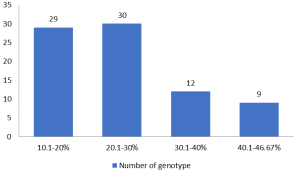
Dead-heart incidence, a direct measure of shoot fly damage, varied considerably among the evaluated genotypes. The percentage of dead hearts ranged from 12.50% to 46.67%, demonstrating substantial genetic variability in response to infestation. The lowest dead-heart incidence (12.50%) was recorded in three genotypes, while the highest incidence (46.67%) was observed in one genotype.
Of the eighty genotypes evaluated, twenty-nine exhibited dead-heart incidence between 10.1 and 20.0%, thirty genotypes ranged from 20.1 to 30.0%, twelve genotypes recorded values between 30.1 and 40.0%, and nine genotypes showed dead-heart incidence ranging from 40.1 to 46.67% (Figure 1). Based on the resistance criterion of less than 35% dead-heart incidence, sixty genotypes were classified as resistant or tolerant. Lower dead-heart formation indicates reduced larval survival and feeding activity, thereby enhancing plant establishment and productivity. Sharma et al. similarly reported that sorghum genotypes with less than 35% dead-heart incidence possess resistance levels comparable to established resistant breeding lines. The large number of resistant genotypes identified in the present study highlights the availability of useful genetic resources for breeding sorghum cultivars with improved resistance to shoot fly.
Figure 1. Number of genotypes based on dead heart percentage.
Seedling Vigour
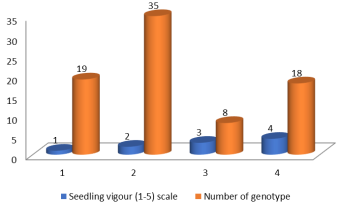
Significant variation was also observed among the genotypes for seedling vigour. Of the eighty genotypes evaluated, twenty-nine received a vigour score of 1, thirty genotypes received a score of 2, twelve genotypes scored 3, and nine genotypes scored 4 (Figure 2). Since lower scores indicate greater vigour, the majority of the evaluated genotypes exhibited good seedling establishment and growth performance.
Most genotypes recorded vigour scores below 2.5, indicating high seedling vigour and a greater degree of resistance to shoot fly damage. Vigorous seedlings are characterized by enhanced growth, increased leaf expansion, and greater plant robustness, enabling them to better withstand insect attack and recover from damage. These findings agree with those of Navinkumar , who reported that genotypes with poor seedling vigour were more susceptible to shoot fly infestation. Likewise, Prasad and Sharma and Nwanze identified seedling vigour as an important morphological trait associated with shoot fly resistance. The predominance of highly vigorous genotypes in the present study suggests the existence of favorable resistance-related characteristics that could be exploited in breeding programs.
Figure 2. Number of genotypes based on Seedling vigour.
Overall Resistance Score
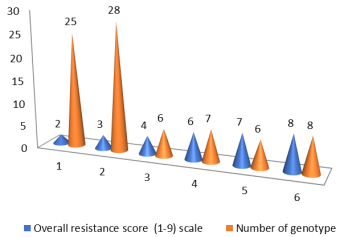
The overall resistance ratings of the evaluated genotypes ranged from 2 to 8 on the standard 1–9 resistance scale. Among the eighty genotypes screened, twenty-five recorded a resistance score of 2, indicating a high level of resistance, whereas eight genotypes received a score of 8, reflecting a high degree of susceptibility to shoot fly infestation (Figure 3).
Genotypes with lower resistance scores consistently exhibited reduced oviposition, lower dead-heart incidence, and superior seedling vigour. Based on the established classification criteria, genotypes with overall resistance scores below 4.5 were considered resistant. These genotypes demonstrated an enhanced capacity to recover from shoot fly attack through the production of productive tillers and harvestable panicles. Recovery resistance is an important mechanism that reduces the impact of early-season infestation and contributes to yield stability.
Figure 3. Number of genotypes based on overall resistance score.
The present findings are consistent with the observations of Riyazaddin , who reported that genotypes with overall resistance scores below 4.5 exhibit effective recovery resistance and improved tolerance to shoot fly damage. Previous studies have further demonstrated that recovery resistance is closely associated with primary resistance mechanisms and the intensity of shoot fly infestation . Therefore, the resistant genotypes identified in this study represent promising genetic resources for the development of sorghum varieties with durable resistance to shoot fly.
Table 1. Mean percentage of oviposition, dead heart, seedling vigour and overall resistance score.

Genotypes

% Ovi

% DH

SV

ORS

EBI-21457

50.00

13.33

1.00

2.00

EBI-69077

33.33

13.33

1.00

2.00

EBI-69078

38.46

23.08

2.00

3.00

EBI-69208

53.33

26.67

2.00

3.00

EBI-212873

50.00

23.08

2.00

3.00

EBI-239125

54.55

45.45

4.00

6.00

EBI-239122

62.50

25.00

2.00

3.00

EBI-240807

42.86

14.29

1.00

2.00

EBI-241726

33.33

13.33

1.00

2.00

EBI-243680

56.25

25.00

2.00

3.00

EBI-243681

33.33

13.33

1.00

2.00

EBI-243682

75.00

25.00

2.00

3.00

EBI-243685

37.50

37.50

3.00

7.00

EBI-243686

46.67

33.33

3.00

6.00

EBI-244707

81.25

37.50

3.00

7.00

EBI-244728

35.71

21.43

2.00

3.00

EBI-69079

40.00

13.33

1.00

2.00

EBI-69271

50.00

35.71

4.00

6.00

EBI-204611

37.50

25.00

2.00

3.00

EBI-213348

43.75

37.50

4.00

7.00

EBI-213349

57.14

28.57

2.00

3.00

EBI-223518

33.33

16.67

1.00

2.00

EBI-230244

42.86

14.29

2.00

2.00

EBI-235447

38.46

15.38

2.00

2.00

EBI-235449

35.71

14.29

2.00

2.00

EBI-239251

78.57

42.86

4.00

8.00

EBI-241197

57.14

42.86

4.00

8.00

EBI-242009

30.77

15.38

1.00

2.00

EBI-243684

37.50

25.00

2.00

3.00

EBI-244702

68.75

43.75

4.00

7.00

EBI-244704

43.75

37.50

4.00

6.00

EBI-244709

57.14

35.71

4.00

6.00

EBI-24405

50.00

37.50

4.00

6.00

EBI-69065

43.75

20.00

2.00

2.00

EBI-69156

37.50

25.00

2.00

3.00

EBI-69229

37.50

25.00

2.00

3.00

EBI-210901

50.00

25.00

2.00

3.00

EBI-214258

56.25

26.67

2.00

3.00

EBI-227103

38.46

15.38

1.00

2.00

EBI-231179

28.57

14.29

1.00

2.00

EBI-235448

81.25

43.75

4.00

8.00

EBI-235450

46.67

20.00

2.00

2.00

EBI-235452

56.25

28.57

2.00

3.00

EBI-235453

68.75

25.00

2.00

3.00

EBI-235458

76.92

15.38

2.00

2.00

EBI-241210

42.86

14.29

2.00

2.00

EBI-244230

81.25

37.50

4.00

6.00

EBI-244710

62.50

46.67

4.00

8.00

EBI-24184

43.75

25.00

3.00

3.00

EBI-61235

50.00

14.29

1.00

2.00

EBI-69230

43.75

26.67

2.00

3.00

EBI-204624

50.00

43.75

4.00

8.00

EBI-210968

53.85

15.38

1.00

2.00

EBI-211193

38.46

23.08

2.00

4.00

EBI-228821

61.54

15.38

1.00

2.00

EBI-228822

62.50

37.50

4.00

8.00

EBI-229229

25.00

18.75

2.00

3.00

EBI-230065

56.25

43.75

4.00

8.00

EBI-235460

43.75

26.67

2.00

4.00

EBI-235470

37.50

25.00

3.00

3.00

EBI-241265

31.25

18.75

1.00

2.00

EBI-241724

25.00

12.50

2.00

2.00

EBI-242046

43.75

25.00

3.00

3.00

EBI-244727

50.00

37.50

4.00

7.00

EBI-24183

31.25

25.00

2.00

3.00

EBI-69076

25.00

12.50

1.00

2.00

EBI-69209

31.25

18.75

1.00

3.00

EBI-69210

50.00

43.75

4.00

8.00

EBI-69211

43.75

28.57

2.00

4.00

EBI-69212

37.50

21.43

2.00

3.00

EBI-69246

50.00

25.00

2.00

3.00

EBI-69566

43.75

20.00

2.00

3.00

EBI-69568

31.25

12.50

1.00

2.00

EBI-204612

50.00

25.00

2.00

3.00

EBI-204628

31.25

18.75

1.00

2.00

EBI-226842

56.25

28.57

2.00

4.00

EBI-241286

50.00

25.00

2.00

4.00

EBI-244698

37.50

25.00

2.00

4.00

EBI-244706

31.25

18.75

1.00

3.00

EBI-244708

56.25

38.46

4.00

7.00

Mean

47.09

25.63

2.29

3.83

Note: %Ovi=Oviposition percentage,%DH=dead heart percentage, SV=seedling vigour, ORS=over all resistance score
4. Conclusion and Recommendations
The present study revealed substantial variation among the evaluated sorghum genotypes in their response to shoot fly (Atherigona soccata) infestation. Assessment of key resistance parameters, including oviposition percentage, dead-heart incidence, seedling vigour, and overall resistance score, identified fifty-nine genotypes as resistant or tolerant to shoot fly damage. These genotypes consistently exhibited desirable resistance characteristics, such as reduced oviposition, lower dead-heart incidence, superior seedling vigour, and favorable overall resistance ratings.
The identification of a large number of resistant or tolerant genotypes demonstrates the availability of valuable genetic resources for improving shoot fly resistance in sorghum. The resistant genotypes identified in this study have the potential to serve as parental materials in breeding programs aimed at developing high-yielding and shoot fly-resistant cultivars. Their utilization could contribute significantly to reducing yield losses, minimizing reliance on insecticides, and enhancing the sustainability of sorghum production systems.
It is recommended that the selected genotypes be further evaluated across multiple locations and seasons to verify the stability of their resistance under varying environmental conditions. In addition, these genotypes should be incorporated into breeding programs to facilitate the development of improved sorghum varieties with durable resistance to shoot fly. The deployment of such varieties will provide an environmentally sound, economically feasible and sustainable strategy for managing shoot fly infestations and improving sorghum productivity in affected regions.
Abbreviations

IQQO

Oromia Agricultural Research Institute

McARC

Mechara Agricultural Research Center

DAE

Days After Emergence

Author Contributions
Daba Etafa: Conceptualization, Data curation, Formal Analysis, Investigation, Methodology, Resources, Validation, Visualization, Writing – original draft, Writing – review & editing
Conflicts of Interest
The author declares no conflict of interest.
References
[1] Blum, A. (1969). Factors associated with tiller survival in sorghum resistant to shoot fly. Crop Science, 9(4), 388–391.
[2] Dhaliwal, G. S., Arora, R., & Dhawan, A. K. (2004). Crop losses due to insect pests in Indian agriculture: An update. Journal of Ecology, 31, 1–7.
[3] Dillon, S. L., Shapter, F. M., Henry, R. J., Cordeiro, G., Izquierdo, L., & Lee, S. L. (2007). Domestication to crop improvement: Genetic resources for sorghum and Saccharum (Andropogoneae). Annals of Botany, 100(5), 975–989.
[4] Doggett, H., Starks, K. J., & Eberhart, S. A. (1970). Breeding for resistance to sorghum shoot fly. Crop Science, 10, 528–531.
[5] FAOSTAT. (2015). Food and Agriculture Organization of the United Nations.
[6] Jotwani, M. G., & Srivastava, K. P. (1970). Studies on sorghum lines resistant to shoot fly. Indian Journal of Entomology, 32, 1–3.
[7] Kamatar, M. Y., Patil, A. M., Yadwad, A., Salimath, P. M., & Swamy Rao, T. (2010). Correlation and path analysis in parents and hybrids for resistance to sorghum shoot fly. International Journal of Plant Sciences, 5(2), 399–403.
[8] Navinkumar, M., Girish, G., Ashok, M. B., et al. (2020). Screening of sorghum mutant lines for shoot fly resistance. International Journal of Current Microbiology and Applied Sciences, 9(12), 1877–1885.
[9] Nimbalkar, V. S., & Bapat, D. R. (1987). Genetic analysis of shoot fly resistance under high level of infestation in sorghum. Journal of Maharashtra Agricultural Universities, 12, 331–334.
[10] Prasad, G. S., Babu, K. S., Subbarayudu, B., Bhagwat, V. R., & Patil, J. V. (2015). Identification of sweet sorghum accessions resistant to shoot fly and stem borer. Sugar Tech, 17(2), 173–180.
[11] Raina, A. K. (1985). Mechanisms of resistance to shoot fly in sorghum: A review. In Proceedings of the International Sorghum Entomology Workshop. ICRISAT.
[12] Reddy, B. V. S., Kumar, A. A., & Ramesh, S. (2007). Sweet sorghum: A water saving bio-energy crop. International Crops Research Institute for the Semi-Arid Tropics (ICRISAT).
[13] Riyazaddin, M. D., Munghate, R. S., Are, A. K., Kishor, P. B. K., Reddy, B. V. S., & Sharma, H. C. (2015). Components of resistance to sorghum shoot fly (Atherigona soccata). Euphytica, 207(2), 419–438.
[14] Sharma, H. C. (1993). Host-plant resistance to insects in sorghum and its role in integrated pest management. Crop Protection, 12(1), 11–34.
[15] Sharma, H. C. (1985). Future strategies for pest control in sorghum in India. Tropical Pest Management, 31(2), 167–185.
[16] Sharma, H. C., & Nwanze, K. F. (1997). Mechanisms of resistance to insects and their usefulness in sorghum improvement (Information Bulletin No. 55). ICRISAT.
[17] Sharma, H. C., Taneja, S. L., Leuschner, K., & Nwanze, K. F. (1992). Techniques to screen sorghum for resistance to insects (Information Bulletin No. 32). ICRISAT.
[18] Singh, S. P., & Jotwani, M. G. (1980). Mechanism of resistance in sorghum to shoot fly I: Ovipositional non-preference. Indian Journal of Entomology, 42, 240–247.
[19] Soto, P. E. (1974). Ovipositional preference and antibiosis in relation to resistance to sorghum shoot fly. Journal of Economic Entomology, 67(2), 265–267.
[20] Taneja, S. L., & Leuschner, K. (1985). Resistance screening and mechanisms of resistance in sorghum to shoot fly. In Proceedings of the International Sorghum Entomology Workshop. ICRISAT.
[21] Zidenga, T. (2004). DNA-based methods in sorghum diversity studies and improvement. Plant Biotechnology Center, Ohio State University.
Cite This Article
  • APA Style

    Etafa, D. (2026). Screening of Sorghum Genotypes Resistance to Sorghum Shoot Fly (Atherigona Soccata) In West Hararghe, Oromia. American Journal of Bioscience and Bioengineering, 14(1), 8-13. https://doi.org/10.11648/j.bio.20261401.12

    Copy | Download

    ACS Style

    Etafa, D. Screening of Sorghum Genotypes Resistance to Sorghum Shoot Fly (Atherigona Soccata) In West Hararghe, Oromia. Am. J. BioSci. Bioeng. 2026, 14(1), 8-13. doi: 10.11648/j.bio.20261401.12

    Copy | Download

    AMA Style

    Etafa D. Screening of Sorghum Genotypes Resistance to Sorghum Shoot Fly (Atherigona Soccata) In West Hararghe, Oromia. Am J BioSci Bioeng. 2026;14(1):8-13. doi: 10.11648/j.bio.20261401.12

    Copy | Download

  • @article{10.11648/j.bio.20261401.12,
      author = {Daba Etafa},
      title = {Screening of Sorghum Genotypes Resistance to Sorghum Shoot Fly (Atherigona Soccata) In West Hararghe, Oromia},
      journal = {American Journal of Bioscience and Bioengineering},
      volume = {14},
      number = {1},
      pages = {8-13},
      doi = {10.11648/j.bio.20261401.12},
      url = {https://doi.org/10.11648/j.bio.20261401.12},
      eprint = {https://article.sciencepublishinggroup.com/pdf/10.11648.j.bio.20261401.12},
      abstract = {Shoot fly (Atherigona soccata) is one of the major insect pests limiting sorghum production by causing severe seedling damage and significant yield losses. Although management options such as timely planting, seed treatment with systemic insecticides, and foliar insecticide applications are available, their effectiveness is often constrained by rainfall variability and the high cost of insecticides for resource-poor farmers. Therefore, host plant resistance offers an economically viable and environmentally sustainable approach for managing shoot fly infestations. This study aimed to identify sorghum genotypes with stable resistance to shoot fly under field conditions. The experiment was conducted at the Mechara Agricultural Research Center (McARC), Ethiopia, where eighty sorghum genotypes were evaluated for their response to shoot fly infestation. The results revealed substantial variation among genotypes in their level of resistance. Out of the eighty genotypes tested, fifty-nine exhibited resistant or tolerant reactions to shoot fly damage. These resistant/tolerant genotypes represent valuable genetic resources for sorghum improvement programs and can be utilized in future breeding efforts aimed at developing shoot fly-resistant varieties. The identified genotypes provide a sustainable option for enhancing sorghum productivity and reducing yield losses caused by shoot fly infestations.},
     year = {2026}
    }
    

    Copy | Download

  • TY  - JOUR
    T1  - Screening of Sorghum Genotypes Resistance to Sorghum Shoot Fly (Atherigona Soccata) In West Hararghe, Oromia
    AU  - Daba Etafa
    Y1  - 2026/06/25
    PY  - 2026
    N1  - https://doi.org/10.11648/j.bio.20261401.12
    DO  - 10.11648/j.bio.20261401.12
    T2  - American Journal of Bioscience and Bioengineering
    JF  - American Journal of Bioscience and Bioengineering
    JO  - American Journal of Bioscience and Bioengineering
    SP  - 8
    EP  - 13
    PB  - Science Publishing Group
    SN  - 2328-5893
    UR  - https://doi.org/10.11648/j.bio.20261401.12
    AB  - Shoot fly (Atherigona soccata) is one of the major insect pests limiting sorghum production by causing severe seedling damage and significant yield losses. Although management options such as timely planting, seed treatment with systemic insecticides, and foliar insecticide applications are available, their effectiveness is often constrained by rainfall variability and the high cost of insecticides for resource-poor farmers. Therefore, host plant resistance offers an economically viable and environmentally sustainable approach for managing shoot fly infestations. This study aimed to identify sorghum genotypes with stable resistance to shoot fly under field conditions. The experiment was conducted at the Mechara Agricultural Research Center (McARC), Ethiopia, where eighty sorghum genotypes were evaluated for their response to shoot fly infestation. The results revealed substantial variation among genotypes in their level of resistance. Out of the eighty genotypes tested, fifty-nine exhibited resistant or tolerant reactions to shoot fly damage. These resistant/tolerant genotypes represent valuable genetic resources for sorghum improvement programs and can be utilized in future breeding efforts aimed at developing shoot fly-resistant varieties. The identified genotypes provide a sustainable option for enhancing sorghum productivity and reducing yield losses caused by shoot fly infestations.
    VL  - 14
    IS  - 1
    ER  - 

    Copy | Download

Author Information