Research Article | | Peer-Reviewed

Mining Potential of Semi-mechanized Gold Mining Waste of Fel and Its Surroundings, Adamawa-Cameroon

Received: 16 January 2026     Accepted: 30 March 2026     Published: 15 April 2026
Views:       Downloads:
Abstract

In order to appreciate the mining waste potential of gold mining exploitation in the locality of Fel and surrounding mining sites, using enrichment factor and mineralization index, were performed geochemical investigations on mining waste from the Neoproterozoic metavolcano-sedimentary formations of the Lom series. The study focuses on geochemical analyses and concerns the assessment of 12 Metallic Trace Elements (MTE) from 10 mining sites. Geochemical analyses show that fine fraction (< 80 μm) always has the best response for all elements. Some MTE have quite remarkable contents in concentrated wastes. This is the case for Au (˃100ppm), Ag (85ppm), Pt (5.8ppm), Th (767ppm), U (29.9ppm), Y (100.6ppm), As (1445.7ppm), Sb (8.4ppm), Se (1.2ppm) and Pb (65.5ppm). On the other hand, some MTE are high in both washed and concentrated wastes, like Au, Se, (As) and (Sb). Light Rare Earth Elements (La, Ce, Pr, Sm, Nd) are characterized by high concentrations, ranging from severe to extremely severe enrichments in concentrated wastes. At the end of this study, it appears that the paragenesis of gold mineralization, induce severe to extremely severe enrichments in Au-Se-Ag-Pt-Th-(As)-(Sb)-(U)-(Y)-(Pb) and Light Rare Earth Elements in the mining wastes of Fel and its surroundings, thus constituting a set of geo-resources that can still be recovered from such wastes.

Published in Earth Sciences (Volume 15, Issue 2)
DOI 10.11648/j.earth.20261502.12
Page(s) 95-108
Creative Commons

This is an Open Access article, distributed under the terms of the Creative Commons Attribution 4.0 International License (http://creativecommons.org/licenses/by/4.0/), which permits unrestricted use, distribution and reproduction in any medium or format, provided the original work is properly cited.

Copyright

Copyright © The Author(s), 2026. Published by Science Publishing Group

Keywords

Washed Wastes, Concentrated Wastes, Geochemistry, Enrichment Factor, Mineralization Index, Mining Potential

1. Introduction
The present study is part of the process of establishing national directives on the management of wastes from extractive industries, transposed into Cameroonian law by legal instruments applicable to environmental management a scribe to human development activities, protection of natural resources and environments. Law No. 2023/014 of December 19, 2023, relative to the Mining Code, prescribes in its article 4, the rules of mining art defined as the technical conditions and methods of exploration and exploitation to better valorize the potential of the deposit, as well as to optimize productivity and conditions of industrial safety, public safety and environmental protection. It also establishes in its article 11, the authorization to exploit mining wastes, hence the importance of this work. The importance of mineral resources exploitation is crucial in the development of a country. According to the 2017 statistical yearbook of the mining, industry and technological development sub-sector, the solid extractive sector has generated to the State of Cameroon, budgetary revenues of 35.39 billion FCFA compared to 406.58 billion FCFA for the liquid extractive sector (hydrocarbons), representing respectively 8.01% and 91.99% for a total of 441.97 billion FCFA. In 2023, the Cameroonian solid extractive sector contributed 719.36 kg of 24-carat gold to the state’s strategic reserve at BEAC, representing approximately 32.5 billion FCFA. Cameroon, like most African countries, relies on its mineral resources to ensure its development. However, this can only happen through a good knowledge of the geology and geochemistry of mineral resources throughout the national territory. In the field, mining companies are engaged in artisanal, semi-mechanized gold mining, implementing concentration techniques that do not guarantee maximum recovery of the substance. Furthermore, these companies don’t take account of other potential mineralization. As a result, other mineral substances often associated with gold mineralization such as platinum, silver, copper, etc., are generally of no importance for the operators to pay any attention. Not far from there, mining wastes consisting of gravel and sand resulting from washing, although being materials that can be used in construction and civil engineering, do not arouse any interest for the neighboring communities. For example, the work of Kitobo on mining waste from Kipushi enabled the identification of recoverable potential, whose processing would produce 80,950 tons of copper and 631,750 tons of zinc exploitable over 20 years . Other authors have worked on the characterization of mining wastes in Morocco, the Democratic Republic of Congo and Cameroon. This is the case of El Hachimi et al., who has work on mining wastes from the Zeïda mine in Morocco and highlighted the high contents of Pb and As with respective maximum values of 5547 g/t and 192.2 g/t in mining residues . According to Pahimi et al., in mining waste from artisanal mines in the locality of Bétaré-Oya it is possible to detect strong pollution by heavy metals and rare Earth elements (REE) whose concentrations are higher than the geochemical background . Ndjigui et al., demonstrated on the sediments of Tongo Gadima in Bétaré-Oya that alteration, erosion, transport and sedimentation strongly mobilize elements such as Ti, Zr, Th, Y, and REE, which are concentrated in sediments, thus increasing the exploitability potential of such sedimentary deposits . According to Tonang Zebaze et al., the studied mining wastes have acidic (2.8) to neutral (6.4) properties, therefore, the mobility of heavy metals is pronounced depending on the pH . The most illustrative cases are those of mining wastes from Mama Wassandé which has a lowest pH (2.8), and higher electrical conductivity of 1300 μS/cm and higher mineralization of Ni, Cu, Zn, Co, As, Sb, Cd, Cr, Se. This gigantism in terms of proportion is due to the fact that, the particles have recently been reworked and are therefore young compared to all other mining wastes in the locality. We are thus witnessing acidification of the waters and a release of heavy metals. That said, the main objective of this work is to characterize the mining waste from Fel and its surroundings on a geochemical level with to the main of determining its valorization potential.
2. Geology of the Study Area
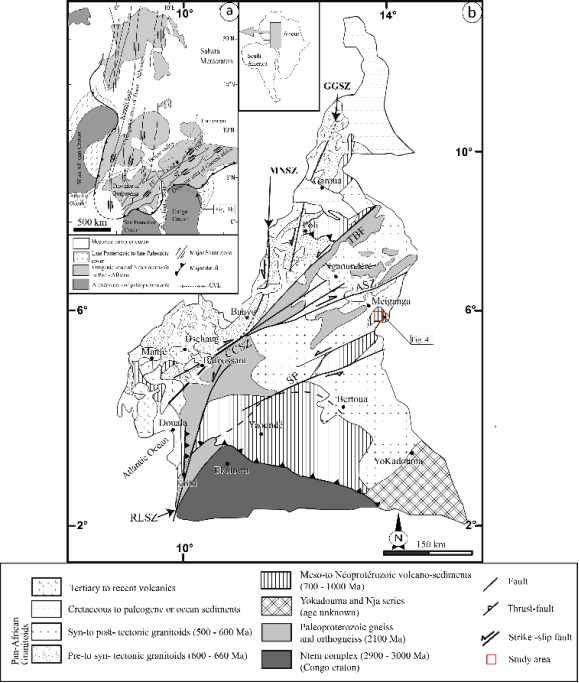
The study area covers the villages of Fel, Kombo Laka, Mborguéné, Mama Wassandé, Ndoyong, Gbatoua and Ngazi, all in Meiganga Subdivision, Mbéré Division, and Adamawa Region. It is located about 152 km from Meiganga and about 10 km from the border with the Central African Republic (Figure 1). The topography of the study area is characterized by an altitude between 871 and 1155 m, with high altitudes covering the entire eastern part, and relatively lower altitudes for half of the western part. The hydrological network of the study area belongs to the Sanaga basin with the Lom as its main collector. In this sector, the drainage system is dendritic, evolving from watercourses of 1st order to watercourses of 4th order. The numerous rivers (Fel, Foum, Mama, Mifeck, Wantia, Moufeck, Mikila, Yoyo and Midal) and the main collector (Lom) are the areas of excellence for gold mining using semi-mechanized artisanal technics. From a lithological point of view, the study area is located in the central domain of the Central Africa Fold Belt (CAFB) (Figure 1). The Upper-Lom series in this area is dominated by undifferentiated schists, micaschists and quartzites which form bands of monoclinal arrangement, oriented in the NE-SW direction. In addition, the geological formations in the study area are crosscut by gold-bearing quartz veins whose size varies from few centimeters to tens of meters in the neighborhood of the granite intrusions . The rocks in this area were strongly mineralized by hydrothermal fluids circulating in a network of fractures developed during Neoproterozoic tectonic events . This is how gold and several other useful substances (Ag, Ba, Zn, Bi, As, B, Sb, W, diamond, rutile and graphite) have been reported . Primary mineralization is also premonitory of certain accumulations in weathering mantle sand detrital sediments, responsible for the emplacement of secondary metalliferous deposits . According to many authors, , the context of gold mineralization in that sector reveals that it is the pneumatolytic veins from the Pan-African granites rather than the granites themselves which carry the gold mineralization. Majority of exploited deposits are located in the Bétaré-Oya – Kombo-Laka corridor, in essentially granitic areas which contain pinched fragments of the shale formation of the Lom Serie. Previous studies carried out by BRGM in 1985 in the Upper-Lom series, revealed very strong mineralization in tungsten (W), Lead (Pb), Gold (Au) and Silver (Ag), perfectly highlighting certain geological entities . In the Lom basin, gold mineralization is accompanied by significantly high levels of Ag, Sb and Zn and numerous inclusions of pyrite and galena, emplaced within the granitoids of the Lom Series through a network of sulfide-rich hydrothermal quartz veins .
Figure 1. Location of the study area and geological context.
a) Pre-Mesozoic configuration of the Pan-African-Brazilian fold belt between NE Brazil and Cameroon ; b) Litho-structural map of Cameroon illustrating the main geotectonic domains (according to Toteu et al. and modified by Van Schmus et al.) . KCF, Kribi-Campos Fault; SF: Sanaga Fault; CCSZ: Central Cameroon Shear Zone; TBF: Tcholliré-Banyo Fault; GGSZ: Godé-Gormaya Shear Zone; MNSZ: Mayo-Nolti Shear Zone; SLC: Sào Luis Craton; SJD: Sériodo-Jaguaribé Domain.
The presence of certain chemical elements in the initial composition of an unaltered rock is a prerequisite for their monitoring during supergene processes, particularly their enrichment . These are generally certain MTEs and REEs trapped in the crystal structure of many rock minerals. Their enrichment in weathering products following the dissolution of host minerals depends on many factors. These include, among others, the crystallo-chemical characteristics of each element, the alterability of the host mineral, the physico-chemical conditions of the environment and the modalities of reincorporation of an element into neoformed secondary constituents . In the Lom series, many authors attest that tectonic event favored the establishment of a geochemical background characterized by mineralization indices of Cu, Pb, Zn, As, Sb, Mo, Ba, B, W, U and Au . Even if the latter are particularly enriched in the mineralized quartz joints and veins which cross-cut the surrounding rocks, their presence is reported in the shales, although in low concentrations. Hence, was addressed in this section the fate of useful elements in mining waste products from the shales of the Upper-Lom series in Fel and its environs. Mineral concentrations are neither accidents, nor anomalies related to a theory close to that of spontaneous generation. Geological agents capable of working on such enrichments are numerous and present in all geological cycles. Amongst them, the most important is hydrothermalism, fractional crystallization of magmas that separates and concentrates some minerals, metamorphism, erosion, differential weathering of rock minerals, and sedimentation. These mineral concentrations constitute deposits whatever their size, volume and value; while taking into account the technical, economic and social conditions of exploitation of the moment reclassifying these mineral concentrations as deposits.
3. Sampling and Analytical Methods
Several field trips were carried out as part of this study. One of them in January 2017 aimed to identify rivers subject to semi-mechanized artisanal gold mining exploitation, identification of tailings dam sand to assess their extent in space. During this field trip, we were also able to appreciate the method of placers exploitation. The last field trip took place in April 2021, a period corresponding to the end of the dry season and in addition, a favorable time for accessibility and sampling. During this fieldwork, ten (10) wastes samples of different mining sites were collected for geochemical study, with seven (7) coming from washing wastes and three (3) from concentrated wastes.
The wastes of mining sites were progressively formed during the exploitation phase, which lasted only a few months and then remained accumulated for about five years. The heterogeneity of the environment is related to two main phenomena. Firstly, we have the granular classification using the density and size of the particles during decantation and the pulp flow from the point of supply to the water drainage weir. Secondly, we have the superposition of successive layers that reflects variations in the characteristics of production. Systematic sampling ensured good representativeness of the granulometric and geochemical characteristics of the wastes. Composite waste samples were taken from the pours of several mining sites namely Foum, Mama Wassande, Fel, Wantia, Mifeck, Moufek, upstream of the Lom River for the washed wastes, and Bondo, Wankoro and downstream of the Lom River at a place called Wakasso bridge for the concentrated wastes. Each composite sample was collected manually from several subsamples, taken from different locations and depths of the pours and packaged in clean plastic bags. The samples were dried, demolding, sieving through a stainless-steel sieve in five particle sizes (< 0,08 mm; 0,08 mm; 0,163 mm; 0,315 mm and 0,5mm) to study the effects of particle size on metal absorption , weighing, packaging, and then transported to the laboratory.
The geochemical analysis carried out covers 12 trace elements. The method usually consists of two steps including the extraction of the desired elements in solution and the determination of the elements by instrumental analysis of the solution. Extraction was total to measure the total abundance of elements of all minerals in the sample. The method of analysis used is the Inductively Coupled Plasma – Mass Spectrometry (ICP-MS) which measures the concentrations of the elements by counting the atoms for each element present in the solution. Generally, the ICP-MS analysis technique provides the widest range of elements associated with the lowest detection limits to ensure maximum exploration power. For the dosage of gold by atomic absorption, the threshold of 0.2 ppb, out of the five fractions was retained. Analysis of the MTE was performed on 10 ml aliquot fractions obtained by mineralization of the samples, with the addition of internal standards (indium, bismuth), HNO3 15N and H2O milli-Q, obtained following a cold attack for 168 hours from 0.1 g to 1 g of each solid sample previously crushed. The attack was carried out with 20 ml of ultra-pure concentrated HNO3 acid in polyethylene bottles. The results of analyses are compared with the normal average levels of MTE in the Earth's crust.
Mineralization is a generic term to designate an abnormally high natural concentration of chemical elements whose exploitation could be of economic interest. The mobilization of chemical elements during alteration processes is a major asset for the accumulation or enrichment of these elements in favorable environments, sometimes with high contents . This can lead to the emplacement of secondary mineralizations, because they are developed at the expense of a primary material. It may also result in the development of anomalies or indications of geochemical mineralization in altered materials. In this work, the determination of mineralized elements through their Mineralization Index (MI) in mining wastes was done using a comparative approach. This enabled to discriminate mineralized elements in each mining waste in the study area, even if there are exceptions due to the ease of extraction and/or available volume. An element is said to be mineralized when it has a content greater than that of its Clarke in a material on one hand, and if and only if the mineralization index of this element is greater than or equal to 2 on the other hand. In other words, the mineralization index is the ratio between the content of the mineralized element in a material by the Clarke of this mineralized element.
MI =XBg
With X: the content of the element studied; Bg (PAAS): Background for a studied element x
According to Table 1, the MI values correspond to two mineralization conditions .
Table 1. Conditions of mineralization.

Conditions

Mineralization

1

MI≥ 2

X >Bg

Presence of mineralization

2

MI< 2

X >Bg

Absence of mineralization

Enrichment, on the other hand, designates an increase in total contents, following anthropogenic contributions, without prejudging a negative change in the quality of the environment . The enrichment factor (EF) of provides information on the increase in the concentration of a chemical element in a material compared to a reference. The element of normalization chosen for this study is scandium. The Enrichment Factor (EF) has been proposed to discriminate between anthropogenic contributions from natural sources. The element chosen as reference must be closely associated with the finest particles and its concentration must not be altered by anthropogenic inputs . The metals Sc , Fe or Al , are elements often used as reference metals. In this study, scandium was chosen as the reference metal for its association with fine particles and its concentration which is very little or not altered by anthropogenic means. EF values between 0.5 and 1.5 indicate a natural origin of the metals, while those above 1.5 are attributed to anthropogenic contributions .
According to Table 2, the EF values correspond to several enrichment classes .
Table 2. EF classes.

Class

Value

Enrichment

1

EF< 1

No enrichment

2

1 ≤ EF < 3

Low enrichment

3

3 ≤ EF < 5

Moderate enrichment

4

5 ≤ EF <10

Moderate to severe enrichment

5

10 ≤ EF <25

Severe enrichment

6

25 ≤ EF <50

Very severe enrichment

7

EF≥50

Extremely severe enrichment

The enrichment factor is calculated following the formula from :
EF =XRsampleXRBg
X: element studied; R: normalizing element.
Bg: background for a studied element x and the normalizing element. As part of this study, we will use the PAAS (Post-Archean Australian Shale) of .
4. Results and Discussion
4.1. Morphological Analysis
From a morphological point of view, the residuum deposits are gray in color due to their richness in quartzo-feldspathic elements. In the shape of a fan or semi-circle, they occupy an area ranging from 300 to 1,300 m2, located along the watercourses. There are approximately 13 (waste dumps) per kilometer. As for concentrate wastes, they only represent approximately 1% of the total volume of material treated and consequently, its storage is disseminated within the wastes from the washing process. Despite this low proportion, waste concentrations remain of very high value in geo-resources, since it is the latter which concentrates the economically exploitable mineral substances from the placers.
4.2. Geochemical Analysis
Geochemical response in different particle size fraction shows that fine-grained fraction tends to have relatively high metal contents, in part because of the high specific surface area of the smaller particles. For the MTEs in Mama Wassandé, Fel and High Lom, the trend clearly indicates a decrease in concentration with an increase in the granulometry of particles. The fraction with smaller size (< 80 μm) has the highest concentration, and the higher fraction (315-500 μm) has the lowest concentration . As part of this study, the contents of gold, silver, uranium, lead, copper, arsenic, thorium, antimony, bismuth, yttrium, selenium and platinum in the samples were compared to the PAAS for each element . The fine fractions (< 80µm) of concentrated wastes (CW) and washed wastes (WW) were selected for their best geochemical responses in terms of mineral concentration. This evaluation of the contents enabled to assess the mineralization indexes up to 2 (MI ≥ 2) and the severe to extremely severe enrichments (EF ≥ 10) and to define the mineral deposits for which there may be economic interest.
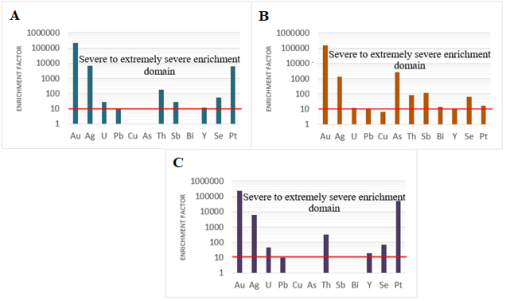
Figure 2a, 2b and 2c perfectly illustrates the enrichments in each of the sites for concentrated wastes. The elements taken into account in this figure only concern those whose mineralization index is greater than or equal to 2. It appears in Figure 2a at Wakasso that the elements Au, Ag, U, Th, Sb, Y, Se and Pt have enrichments ranging from severe to extremely severe, thus offering for this site a strong potential for valorization in these elements. With the exception of Cu, all other elements (Au, Ag, U, Pb, As, Th, Sb, Bi, Y, Se and Pt) present in the concentrated wastes from Wankoro concentrates (Figure 2b) show enrichments ranging from severe to extremely severe, also offering for this site a strong potential for valorization of these elements. Bondo concentrated wastes (Figure 2c) also follow the same trends with severe to extremely severe enrichments in Au, Ag, U, Pb, Th, Y, Se and Pt. Generally, the strong mineral association constituted by Au-Ag-Pt-Th-Se-(U)-(Pb)-(Y)-(Sb) is present in concentrated wastes, whatever the site and therefore, undeniably constitutes a valuable resource in such wastes. Among the mineralized trace elements, U and Pb are excellent radioactive and heat producers. They are of great interest as a source of nuclear energy, although used in several other fields such as geochronology. Au, Ag, Pt, Se and As also have multi-varied usages, particularly in the metallurgical industry as an alloy, in the chemical industry and in medicine.
Figure 2. Evolution of enrichments in concentrate wastes; A) Wakasso; B) Wankoro; C) Bondo.
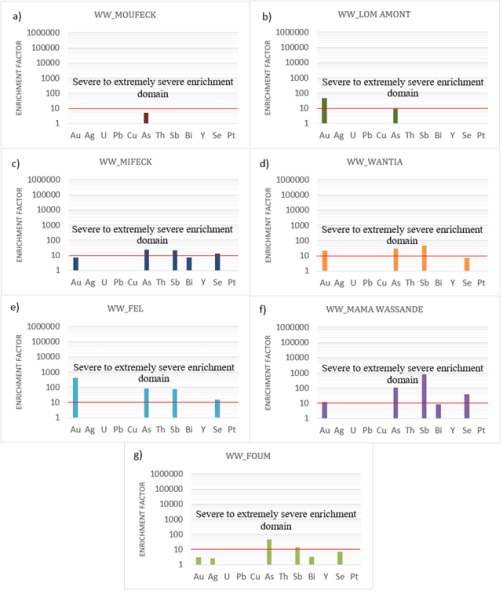
Figure 3a, 3b, 3c, 3d, 3e, 3f, 3g represents the enrichments of washed wastes in different sites and the elements taken into account, only concern those with mineralization index greater than or equal to 2. It appears that in the washed wastes of Moufeck (Figure 3a), we observe only one element (As) with an enrichment not reaching the severe threshold. In the Lom Amont washed wastes (Figure 3b), we observe just two elements (Au and As) with very severe and severe enrichments respectively. The Mifeck washed wastes (Figure 3c) show five elements of which three (As, Sb and Se) are severely enriched. The Wantia washed wastes (Figure 3d) show four elements, three of them (Au, As and Sb) have severe to very severe enrichments. Fel washed wastes (Figure 3e) exhibit four elements (Au, As, Sb and Se), all enriched from severe to extremely severe. The Mama Wassandé washed wastes (Figure 3f) are comparable to the Fel wastes with four elements (Au, As, Sb and Se) enriched from severe to extremely severe, and one element (Bi) moderately enriched. The Foum washed wastes (Figure 3g) show six elements of which only two (As and Sb) are severely to very severely enriched. Thus, we can remember that the mineral association constituted by Au-As-Sb-(Se) can constitute, depending on the site, mineral deposits in the washed wastes.
Table 3. The composition of metallic trace elements of the mining wastes.

Au

Ag

U

Pb

Cu

As

Th

Sb

Bi

Y

Se

Pt

PAAS

1,8ppb

0,05ppm

2,8ppm

17ppm

25ppm

1.5ppm

10.7ppm

0.2ppm

0.13ppm

22ppm

0.05ppm

0.5ppb

FCW_WAKASSO

C. Sam

100000

85,26

19,6

39.24

6.53

2.9

476.3

1.37

0.22

68.69

0.7

762

MI

55555

1705

7

2.3

0.26

1.9

44.51

6.85

1.69

3.12

14

1524

EF

222816

6833,4

28,12

9.23

1.04

7.75

178.22

27.41

6.81

12.49

57.18

6106.7

CW_WANKORO

C. Sam

100000

25,24

12,4

65.49

62.8

1445.7

334.7

8.46

0.64

91.25

1.2

3

MI

55555

504,8

4,42

3.85

2.51

963.8

31.28

42.3

4.92

4.14

24

6

EF

151515

1375,5

12,09

10.47

6.83

2628.5

85.16

115.1

14.1

11.28

66.66

16.35

CW_BONDO

C. Sam

100000

73,1

29,9

38.79

6.51

2.4

767

0.2

0.1

100.63

0.8

5839

MI

55555

1462

10,67

2.28

0.26

1.6

71.68

1

0.76

4.57

16

11678

EF

244379

6425,3

47,04

10.01

1.14

7.04

314.78

4.38

3.39

20.07

71.68

51322.8

WW_MOUFECK

C. Sam

0,6

0,026

1.4

12.61

15.9

3.4

7.1

0.23

0.13

12.36

<0.1

<2

MI

0,33

0,52

0.5

0.74

0.63

2.2

0.66

1.15

1

0.56

<2

/

EF

0,79

1,24

1.19

1.76

1.52

5.42

1.58

2.74

7.26

1.34

<5

/

WW_LOM_AMONT

C. Sam

29,6

0,028

1.4

11.23

17.26

5.5

8.9

0.3

0.17

12.73

<0.1

<2

MI

16,4

0,56

0.5

0.66

0.69

3.6

0.83

1.5

1.3

0.57

<2

/

EF

46,71

1,58

1.42

1.87

1.96

10.42

2.35

4.25

3.72

1.64

<5

/

WW_MIFECK

C. Sam

3,9

0,052

2

14.02

28.42

10.9

10.8

1.31

0.29

9.39

0.2

<2

MI

2,16

1,04

0.71

0.82

1.13

7.2

1

6.55

2.23

0.42

4

/

EF

7,03

3,37

2.32

2.67

3.68

23.59

3.27

21.21

7.26

1.38

13.22

/

WW_WANTIA

C. Sam

10,8

0,016

1,5

14.88

13.75

12.5

7.9

2.69

0.15

10.57

0.1

<2

MI

6

0,32

0.53

0.87

0.55

8.3

0.73

13.45

1.15

0.48

2

/

EF

21,53

1,14

1.92

3.13

1.97

29.9

2.64

48.15

4.15

1.72

7.3

/

WW_FEL

C. Sam

193,6

0,067

1,6

20.95

21.1

34.2

6.8

4.01

0.22

9.68

0.2

<2

MI

107,5

1,34

0,57

1.23

0.84

22.8

0.63

20.05

1.69

0.44

4

/

EF

407,4

5,07

2,16

4.65

3.19

86.36

2.4

75.77

6.43

1.66

15.43

/

WW_MAMA_WASSANDE

C. Sam

5,5

0,065

3

17.19

36.56

40.7

9.8

42.49

0.28

6.8

0.5

<2

MI

3,05

1,3

1,07

1.01

1.46

27.1

0.91

212.4

2.15

0.3

10

/

EF

12,25

5,2

4,3

4.04

5.85

108.8

3.66

850.1

8.66

1.23

40.84

/

WW_FOUM

C. Sam

4,9

0,11

3,1

19.92

16.52

58.3

11.2

2.39

0.36

17.61

0.3

<2

MI

2,72

2,26

1,1

1.17

0.66

38.8

1.04

11.95

2.76

0.8

6

/

EF

3,25

2,7

1,32

1.39

2.31

46.49

1.25

14.26

3.32

0.95

7.3

/

PAAS by .
C. Sam = Concentration of the Sample; MI = Mineralization Index; EF = Enrichment Factor
a) Moufeck; b) Lom Amont; c) Mifeck; d) Wantia; e) Fel; f) Mama Wassandé; g) Foum

Download: Download full-size image

Figure 3. Evolution of enrichments in washed wastes.
From the above, we can think that the remobilization and redistribution of chemical elements during supergene processes (weathering, transport and sedimentation) favored the accumulation of certain trace elements with concentrations greater than or equal to their Clarke. Subsequently, most of these elements present in the residual system were further remobilized in the gold ore processing process where some elements (Au, Ag and Pt) have been significantly enriched in the concentrated wastes. Generally, many of these MTEs are weakly concentrated in washed wastes, but highly concentrated in concentrated wastes. This is the case for Au, Ag, Pt, U, Pb, Y and Th. The best enrichments identified in mining wastes are classified into two groups, those which are represented in all fractions of wastes on the one hand, and those which are characteristic of a particular type of waste on the other hand. For the first case, i.e. the mineralization identified both in washing wastes and in concentrated wastes, we have in order of importance: Au-As-Sb-Se. For the second case, i.e. the mineralization identified only in concentrated wastes, we have in order of importance: Ag-Pt-Th-U-Y.
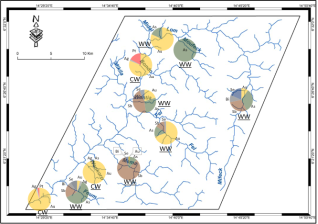
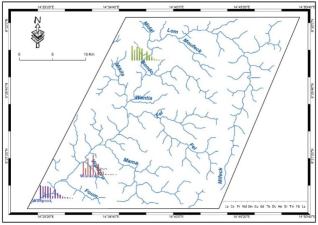
In short, concentrated wastes (CW) and washed wastes (WW) present potential in each of the following ten sites (Figure 4): The concentrated wastes at Wakasso show 09 mineralization out of the studied 12 elements. In order of importance, we cite Au-Ag-Pt-Th-Se-U-Sb-Y-Pb, ranging from extremely severe enrichments (Au, Ag, Pt, Th, Se) to moderate to severe enrichments (Pb), through very severe (U, Sb) and severe (Y) enrichments. Among all these elements, Au, Ag and Pt alone represent more than 99% of the enrichments. Concentrated wastes at Wankoro show 12 mineralization out of the studied 12 elements. In order of importance, we have Au-As-Ag-Sb-Th-Se-Pt-Bi-U-Y-Pb-Cu, ranging from extremely severe enrichments (Au, As, Ag, Sb, Th, Se) to moderate to severe enrichments (Cu), through severe enrichments (Pt, Bi, U, Y, Pb). Among these elements, Au, As and Ag alone represent more than 99% of the enrichments. The concentrated wastes at Bondo show 08 mineralization out of the studied 12 elements. In order of importance, we have Au-Pt-Ag-Th-Se-U-Y-Pb, ranging from extremely severe enrichments (Au, Pt, Ag, Th, Se) to severe enrichments (Pb, Y), through very severe enrichments (U). Among these elements, Au, Pt and Ag alone represent more than 99% of the enrichments. The washed wastes at Moufeck show only 01 mineralization out of the studied 12 elements. Arsenic (As) mineralization presents moderate to severe enrichment. The upstream Lom washed wastes present 02 mineralization out of the studied 12 elements. Au shows very severe enrichment while As shows severe enrichment;
The washed wastes at Mifeck show 05 mineralization out of the studied 12 elements. In order of importance, we have As-Sb-Se-Bi-Au, ranging from severe enrichments (As, Sb, Se) to moderate enrichments (Au). The washed wastes at Wantia show 04 mineralization out of the studied 12 elements. In order of importance, we have Sb-As-Au-Se, ranging from very severe enrichments (Sb) to moderate and severe enrichments (Se). The washed wastes at Fel show 04 mineralization out of the 12 elements studied. In order of importance, we have Au-As-Sb-Se, ranging from extremely severe enrichments (Au, As, Sb) to severe enrichments (Se). The washed wastes at Mama Wassandé show 05 mineralization out of the studied 12 elements. In order of importance, we have Sb-As-Se-Au-Bi, ranging from extremely severe enrichments (Sb, As) to moderate and severe enrichments (Bi). The washed wastes at Foum show 06 mineralization out of the studied 12 elements. In order of importance, we have As-Sb-Se-Bi-Au-Ag, ranging from very severe enrichments (As) to weak enrichments (Ag).
In fact, all elements that present mineralization indices ≥ 2 are potential metalliferous deposits. However, such elements must demonstrate accumulation and an optimal exploitation technique to militate in favor of their valorization. It should also be noted that in placer deposits, the mineral concentrations are already individualized and are located in the layers according to their density and size, and therefore, are easily exploitable by simple separation processes. Gold (Au) has significant enrichment in mining waste. This element is particularly enriched in concentrated wastes, with concentrations > 100,000 ppb, far higher than the average operating content in the deposit (1000 ppb). Most washed wastes also show concentrations higher than their Clarke. This trend is in agreement with many previous works () who documented the accumulation of this element in the alteration products of this large gold basin. For example, during the alteration of a mineralized structure, Au can be released from the primary gangue (sulphide minerals), then accumulate in a particular manner at the base of the sediment strata, in compliance with the normal granular classification system as demonstrated by many authors . The high concentrations of gold in this environment could be explained by such a process. This hypothesis is further reinforced here by the abundance of quartz veins in the area, and their artisanal or semi-mechanized artisanal exploitation by the local population and Chinese companies.
The main source of As and Sb in mining waste could be the alteration of arsenopyrite and stibnite respectively, which are satellite minerals associated with gold mineralization as demonstrated by the following authors . Accordingly, in Bétaré-Oya has also demonstrated high concentrations of arsenic in the soils, sediments and mining wastes in this mining area. This high geogenic As content is essentially linked to the presence of arsenopyrite which is strictly associated with the paragenesis of gold mineralization. The procession of mineralization constituted by Au-As-Sb-Se-(Ag)-(Pt)-(Th) which emerges from the present study is very close to that found in the Lom Series , in Dimako , in Kombo Laka , just to name few.
The behavior of REEs is generally marked by a strong accumulation in concentrated wastes. This can be confirmed here by the La/Y ratio which is high in concentrated wastes (from 11.9 to 19.7) and relatively low in washed wastes (from 1.98 to 4.25). This accumulation results from the remobilization and transport of REEs after hydrolysis of primary minerals, due to acidification of the environment . The enrichment of REEs in concentrated wastes is more marked for LREEs than for HREEs. All elements have concentrations higher than their Clarke with the exception of Lu which has concentration lower than its Clarke value. The enrichment factor has been determined. It varies from 3.87 for Lu to 101.79 for La in the Wakasso wastes (CW_WAKASSO), from 2.21 for Lu to 268.33 for Sm in Wankoro (CW_WANKORO) and from 4.25 for Lu to 186.59 for La in Bondo (CW_BONDO) (Table 4).
Figure 4. Map of enrichments (%) in ETM in concentrated wastes (CW) and washed wastes (WW).
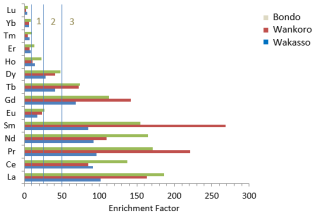
Furthermore, mineralization will be defined for all REEs having a mineralization index greater than 2. The enrichment factor allows us to assess the degree of mineralization for each element. These criteria thus enable to define La, Ce, Pr, Nd, Sm, Eu, Gd, Tb, Dy, Ho and Er as being mineralized in concentrated wastes. The enrichment of these REEs evolves from weak enrichment (1 ˂ EF< 3) for Lu in Wankoro to extremely severe enrichment (EF> 50) for La, Ce, Pr, Nd, Sm, Gd in all sites (Figure 5).
Since the end of the 20th century, REEs have been actively sought after due to their growing importance in the technology industry . Furthermore, they are also very harmful elements for the health of living beings . However, just like trace elements, they are released into the environment during mining operations. This is the case in the present wastes where we certainly record, at a reduced volume, fairly significant accumulations and enrichments of these elements which could also be the subject of valorization.
It appears from Figure 5 that the REEs with extremely severe enrichment in mining wastes are La, Ce, Pr, Nd, Sm and Gd in all concentrated wastes, and Tb in Bondo and Wankoro wastes. These RREs can constitute metalliferous deposits. The REEs with very severely enriched in the wastes are among others Dy in all three wastes, Tb in Wakasso and Eu in Bondo. This level of enrichment in REEs can also constitute a metal deposit. The severely enriched REEs are Ho in all three wastes, Er in Bondo, Eu in Wankoro and Wakasso.
The moderately to weakly enriched REEs are Tm, Yb, Lu in all three sites, and Er at Wankoro and Wakasso. Specifically, these three elements do not constitute mineralization. Rare Earths (La-Ce-Pr-Nd-Sm-Gd-Tb-Dy) associated with Metallic Trace Elements (Au-Ag-Pt-Th-Se-U) in concentrated wastes can constitute metal deposits of 14 valuable elements. Figure 6 expresses the enrichments of the REEs in each of the three sites (Wakasso, Wankoro and Bondo). The resulting finding is marked by a high rate of enrichment of LREEs in the concentrated wastes from such sites. The HREEs show high enrichments for Gd, Tb and Dy, evolving from extremely severe enrichment to very severe enrichment; the others being moderately to weakly enriched.
Figure 5. Evolution of REE enrichments in concentrated wastes; 1: severe enrichment; 2: very severe enrichment; 3: extremely severe enrichment.
Figure 6. Map of REE enrichments in concentrated wastes.
Table 4. Concentrations (ppm) of rare earths in concentrated wastes.

La

Ce

Pr

Nd

Sm

Eu

Gd

Tb

Dy

Ho

Er

Tm

Yb

Lu

PAAS

30

64

7,1

26

4,5

0,88

3,8

0,64

3,5

0,8

2,3

0,33

2,2

0,32

CW_BONDO

C.Sam

1275,5

>2000

277,71

975,05

157,94

5,27

97,84

10,82

38,09

4,15

6,95

0,69

4,09

0,31

MI

42,5

31,2

39,1

37,5

35

5,9

25,7

16,9

10,8

5,1

3

2

1,8

0,9

EF

186,59

137,12

171,61

164,59

154,38

26,27

113,12

74,26

47,80

22,76

13,26

9,19

8,19

4,25

CW_WANKORO

C.Sam

1798,1

>2000

577,09

>2000

442,75

7,66

197,79

16,99

52,16

3,09

5,48

0,59

5,19

0,26

MI

59,9

31,2

81,2

76,9

98,3

8,71

52

26,5

14,9

3,8

2,3

1,7

2,3

0,8

EF

163,09

85,01

221,10

109,31

268,33

23,67

141,78

72,29

40,59

10,51

6,48

4,87

6,44

2,21

CW_WAKASSO

C.Sam

762,9

1459,8

170,25

598,48

95,10

3,79

64,73

6,59

24,79

2,81

4,83

0,54

3,3

0,31

MI

25,4

22,8

23,9

23

21,1

4,3

17

10,3

7

3,5

2,1

1,6

1,5

0,9

EF

101,76

91,25

95,92

92,11

84,75

17,22

68,23

41,23

28,37

14,05

8,40

6,56

6,02

3,87

PAAS: Taylor &McLennan (1985)
C. Sam = concentration of the sample; MI = Mineralization Index; EF = Enrichment Factor
5. Conclusion
The objective of this work was to appreciate mining wastes potential from gold exploitation in the locality of Fel and surrounding mining sites. To achieve this objective, direct observations and systematic sampling of mining wastes were conducted to determine their enrichment factor and mineralization index based on certain MTE (Au, Ag, U, Pb, Cu, As, Th, Sb, Bi, Y, Se, Pt) and REEs. The results from morphological analysis show washed wastes in the shape of a fan or semi-circle, each occupying an area ranging from 300 to 1,300 m2. There are approximately 13 (waste dumps) per kilometer. Concentrated wastes only represent approximately 1% of the total volume of material processed. In the exploitation of placers, concentrated wastes constitute the most solicited phase because it concentrates economically exploitable mineral substances. The geochemistry perfectly highlights significant enrichments in Au, (As), (Sb) and Se both in the washed wastes and in the concentrated wastes, and Ag, Pt, Th, Pb, U and Y only in concentrated wastes. Bi and Cu doesn’t show any significant enrichment in either type of mining waste. Mineralization indexes ≥ 2 suggest that gold mineralization in the study area involves severe to extremely severe enrichments in Au-Ag-Pt-Th-Se-U in the wastes of mining concentrates. The REEs were also characterized by positive anomalies, with severe to extremely severe enrichments for La-Ce-Pr-Nd-Sm-Gd-Tb-Dy. For such ETM and REEs, these high enrichment rates constitute useful mineralization that can be valuable. Regarding the above results, it appears that the exploitation of mineral substances takes place without any respect for the standards in terms of sustainable exploitation of mineral resources, and this is how many potentially valuable ore minerals are abandoned in mining wastes.
Abbreviations

MTE

Metallic Trace Elements

LREE

Light Rare Earth Elements

FCFA

Franc from the French Colonies of Africa

CAFB

Central Africa Fold Belt

ICP-MS

Inductively Coupled Plasma – Mass Spectrometry

MI

Mineralization Index

EF

Enrichment Factor

PAAS

Post-Archean Australian Shale

C.Sam

Concentration of Sample

CW

Concentrated Wastes

WW

Washed Wastes

Acknowledgments
The authors greatly appreciate comments of Editor and anonymous reviewers which help to improve the quality of paper.
Conflict of Interest
The authors declare that they have no conflict of interest.
References
[1] Kitobo W. S. (2009). "Dépollution et valorisation des rejets miniers sulfurés du katanga « Cas des tailings de l’ancien concentrateur de Kipushi »"; Thèse de Doctorat en Sciences de l’ingénieur [Remediation and Recycling of Sulfide Mining Waste from Katanga: “The Case of Tailings from the Former Kipushi Concentrator”] Thèse de Doctorat en Sciences de l’ingénieur, P276.
[2] El Hachimi M. L., El Hanbali M., Fekhaoui M., Bouabdli A., Founti L., Saidi N. (2005). “Impact d’un site minier abandonné sur l’environnement: cas de la mine de Zaida (Haute-Moulouya, Maroc)”, Bulletin de l’Institut scientifique, Rabat, Maroc, section Sciences de la Terre; [Environmental Impact of an Abandoned Mining Site: The Case of the Zaida Mine (Haute-Moulouya, Morocco)] Bulletin de l’Institut scientifique, Rabat, Maroc, section Sciences de la Terre, 27, pp. 93-100.
[3] Pahimi H., Panda C. R., Ngassoum M. B., Tchameni R. (2015). Environmental Impacts of Mining in the Volcano-Sedimentary Basins of Cameroon: Case Study of Artisanal Gold Mine Tailings (Betare Oya, East-Cameroon). International Journal of Energy, Sustainability and Environmental Engineering Vol. 2 (1), 5-15.
[4] Ndjigui P. D., Bassanak O. P., R., Ndong B., F. (2020). TiO2-Zr-Th-Y-rare-earth elements ore deposit in unconsolidated fine-grained sediments from Tongo Gandima in the Bétaré-Oya Gold district, Eastern Cameroon. Geological Journal. 1-23.
[5] Tonang Z. A., Njueya K. A., Nguetnkam J. P., Tchameni R., Kwékam M., and Akang N. B. (2022). Geochemical Assessment for Trace Metal Contamination of Mining Wastes of Fel and Its Environs in Adamawa Region (Cameroon); European Journal of Environment and Earth Sciences. Vol 3 | Issue 5 | 41-50.
[6] Fon A. N., Che V. B., Suh C. E. (2012). Application of electrical resistivity and chargeability data on a GIS platform in delineating auriferous structures in a deeply weathered lateritic terrain, Eastern Cameroon. International Journal of Geosciences. 3: 960-971.
[7] Soba D. (1989). "La série du Lom: étude géologique et géochronologique d’un bassin volcano-sédimentaire de la chaîne panafricaine à l’Est du Cameroun". Thèse Doctorat d’Etat, Université de Paris IV [The Lom Series: A Geological and Geochronological Study of a Volcanic-Sedimentary Basin in the Pan-African Orogenic Belt in Eastern Cameroon] Thèse Doctorat d’Etat, Université de Paris IV, p181.
[8] Milesi J. P., Toteu S. F., Deschamps Y., Feybesse J. L., Lerouge C., Cocherie A., Penaye J., Tchameni R., MolotoA-Kenguemba G., Kampunzu HAB, Nicol N., Duguey E., Leistel J. M., Saint-Martin M., Ralay F., Heinry C., Bouchot V., Doumnang Mbaigane J. C., Kanda Kula V., Chene F., Monthel J., Boutin P., Cailteux J. (2006). An overview of the geology and major ore deposits of Central Africa: Explanatory note for the 1: 4 000 000 map ‘Geology and major ore deposits of Central Africa’. Journal of African Earth Sciences. 44(4-5): 571-595.
[9] Toteu S. F., Deloule E., Penaye J., Tchameni R. (2006). Preliminary U-Pb ionic microprobe data on zircons from Poli and Lom Volcano-sedimentary basins (Cameroon): Evidence for a late-Mesoproterozoic (1100-950Ma) magmatic activity in the Central African Fold Belt. The IGCP-470 second annual field conference 5-10 January 2004, Garoua-Cameroun (abstracts), p6.
[10] NtepGweth P., Dupuy J. J., Matip O., Fogakoh F. A., Kalngui E. (2001). Notice explicative de la carte thématique des ressources minérales du Cameroun. Sopécam-Yaoundé [Explanatory Note on the Thematic Map of Mineral Resources in Cameroon. Sopécam-Yaoundé], 375p.
[11] Vishiti A., Suh C. E., Lehmann B., Shemang M. E., Ngome N. L. J., Nshanji N. J., Chinjo F. E., Mongwe O. Y., Egbe A. J., Peterson S. (2017). Mineral chemistry, bulk rock geochemistry, and S-isotope signature of lode-gold mineralization in the Bétaré-Oya Gold District, South-East Cameroon. Geological Journal. 21(7): 1-18.
[12] Grandin G., Perseil E. A., (1983). "Les Minéralisations Manganésifères Volcano-sédimentaires du Blafo-Guéto (Côte d'Ivoire) - paragénèses - altération climatique" [The Volcanic-Sedimentary Manganese Deposits of Blafo-Guéto (Ivory Coast) - Parageneses - Weathering], Mineralium Deposita. 18(1): 99-111.
[13] Vairon J., Edimo A., Siméon Y., Vadala P. (1986). “Protocole d’accord pour la recherche des minéralisations d’or dans la province aurifère de l’Est (Cameroun)". Bureau de Recherche Géologique et Minière [Memorandum of Understanding for the Exploration of Gold Deposits in the Eastern Gold Province (Cameroon)] Bureau de Recherche Géologique et Minière, p270.
[14] Omang B. O., Suh C. E., Lehmann B., Vishiti A., Chombong N. N., Egbe J. A., Shemang E. M., Fon A. N., Egbe J. A., Shemang E. M. (2015). Microchemical signature of alluvial gold from two contrasting terrains in Cameroon, Journal of African Earth Sciences 112, 1-14.
[15] Caby R. (1989). Precambrian terranes of Benin-Nigeria and northeast Brazil and the Late Proterozoic South Atlantic fit. Geological Society of America. Special Paper230, 145-150.
[16] Ngako V., Affaton P., Njonfang E. (2008). Pan-African tectonics in northwestern Cameroon: implication for the history of western Gondwana, Gondwana Research., 14, 509-522.
[17] Toteu S. F., Van Schmus W. R., Penaye J., Nyobé J. B. (1994). U-Pb and Sm-Nd evidence for Eburnean and Pan-African high-grade metamorphism in cratonic rocks of southern Cameroon. Precambrian Research 67, 321-347.
[18] Ngako V., Affaton P., Nnange J. M., Njanko T., (2003). Pan-African tectonic evolution in central and Southern Cameroon: transpression and transtension during sinistral shear movements, Journal of African Earth Science, 36, 207-214.
[19] Toteu S. F., Penaye J., Poudjom D. Y. (2004). Geodynamic evolution of the Pan-African belt in Central Africa with special reference to Cameroon. Journal of African Earth Science 41, 73-85.
[20] Toteu S. F., Van Schmus R. W., Penaye J., Michard A. (2001). New U-Pb and Sm-Nd data from north central Cameroon and its bearing on the pre-pan-African history of Central Africa. Precambrian Research. 108, 45-73.
[21] Van Schmus W. R., Oliveira E. P., Da Silva Filho A. F, Toteu S. F., Penaye, J., Guimaraes I. P. (2008). The Central African Fold Belt Proterozoic Links between the Borborema Province, NE Brazil, and the Central African Fold Belt. Geological Society London, Special Publications. 69 (99): 202-211.
[22] Mordberg L. E. (1996). Geochemistry of trace elements in Paleozoic bauxite profiles in northern Russia. Journal of Geochemical Exploration. 57 (1-3): 187-199.
[23] Nalovic L., Pinta M. (1969). “Recherches sur les éléments traces dans les sols tropicaux: étude de quelques sols de Madagascar" [Research on trace elements in tropical soils: a study of selected soils from Madagascar], Geoderma. 3 (2): 117-132.
[24] Tijani M. N., Okunlola O. A., Abimbola A. F. (2006). Lithogenic concentrations of trace metals in soils and saprolites over crystalline basements rocks: A case study from SW Nigeria. Journal of African Earth Sciences. 46: 427-438.
[25] Calagari A. A., Farahani K. F., Abedini A. (2015). Geochemical characteristics of a laterite: the Jurassic Zan deposit, Iran. Acta Geodynamica et Geomaterialia. 12(177): 67-77.
[26] Freyssinet Ph., Lecomte P., Edimo A. (1989). Dispersion of gold and base metals in the Mborguene lateritic profile, East Cameroon. Journal of Geochemical Exploration. 32: 99-116.
[27] Manga E. V., Neba N. G., Suh C. E. (2017). Environmental geochemistry of mine tailings soils in the Artisanal Gold Mining District of Bétaré-Oya, Cameroon. Environment and pollution, Canadian center of science and education. 6(1): 52-62.
[28] Zöllmer V and Irion G. (1993). Clay mineral and heavy metal distributions in the northeastern North Sea. Mar. Geol.; 11: 223-230.
[29] Calmano W and Wellerhaus S. (1982). Dredging of contaminated sediments in Weser estuary: Chemical forms of some metals. Environ. Technol.; 3: 199-208.
[30] Colin F., Beauvais A., Ambrosi J-P., Nahon D. (2004). "Les latérites en environnement tropical, source de métaux d'intérêt économique". Assises de la Recherche Française dans le Pacifique, Nouméa [Laterites in tropical environments: a source of metals of economic interest] Assises de la Recherche Française dans le Pacifique, Nouméa, 104-107.
[31] Legros J. P. (2013). "Latérites et autres sols des régions intertropicales". Académie des Sciences et des lettres de Montpellier Conf. No. 4252, Séance académique du 09/12/2013 [Laterites and Other Soils of the Intertropical Regions] Académie des Sciences et des lettres de Montpellier Conf. No. 4252, Séance académique du 09/12/2013, Bulletin No. 44, 369-382.
[32] Blot A. (2002). “Signification des ferruginisations des formations Néoprotérozoïques du Nord-Burkina Faso (Afrique de l’Ouest)” Comptes Rendus Geoscience, [Significance of the iron-rich deposits in the Neoproterozoic formations of northern Burkina Faso (West Africa)]. Comptes Rendus Geoscience, 334(12): 909-915.
[33] Chassin P., Baize D., Cambier P., Sterkman T. (1996). "Les éléments traces métalliques et la qualité des sols. Impact à moyen et à long terme". Etude et gestion des sols, [Trace metals and soil quality. Medium- and long-term impacts], Etude et gestion des sols, 3(4), pp298-306.
[34] Taylor S. R. (1964). Abundance of chemical elements in the continental crust: a new table. Geochimica et Cosmochimica Acta 28, 1273-1285.
[35] Ackermann F. (1980). A procedure for correcting the grain size effect in heavy metal analyses of estuarine and coastal sediments. Environmental Technology, 1, 518-527.
[36] Leleyter L., Baraud F. (2005). "Evaluation de la mobilité des métaux dans les sédiments fluviaux du bassin de la Vire (Normandie, France) par extractions simples ou séquentielles" [Assessment of metal mobility in river sediments of the Vire Basin (Normandy, France) using single or sequential extractions]. Comptes Rendus Geoscience, 337, 571-579.
[37] Nowrouzi M., Pourkhabbaz A. (2014). Application of geoaccumulation index and enrichment factor for assessing metal contamination in the sediments of Hara Biosphere Reserve, Iran. Chemical Speciation & Bioavailability, 26, 99-105.
[38] Tam N. F. Y., Yao M. W. Y. (1998). Normalisation and heavy metal contamination in mangrove sediments. Science of The Total Environment, 216, 33-39.
[39] Marrugo-Negrete J., Pinedo-Hernández J., Díez S. (2017). Assessment of heavy metal pollution, spatial distribution and origin in agricultural soils along Sinú River Basin, Colombia. Environmental Research 154, 380 - 388.
[40] Zhang J., Liu C., 2002. Riverine composition and estuarine geochemistry of particulate metals in China-weathering features, anthropogenic impact and chemical fluxes. Estuary Coast Shelf Science, 54, 1051-1070.
[41] Zhang C., Yu Z. G., Zeng G. M., Jiang M., Yang Z. Z., Cui F., Zhu M. Y., Shen L., Hu L. (2014). Effects of sediment geochemical properties on heavy metal bioavailability. Environment International, 73, 270-281.
[42] Taylor S. R., McLennan S. M. (1985). The Continental Crust: Its Composition and Evolution. Blackwell Scientific Publishers, Oxford.
[43] Freyssinet, Ph., (1990). "Géochimie et minéralogie des latérites du Sud-Mali. Evolution des paysages et prospection géochimique de l'or”. BRGM, Thèse Doctorat [Geochemistry and Mineralogy of Laterites in Southern Mali. Landscape Evolution and Geochemical Prospecting for Gold] BRGM, Thèse Doctorat, 342p.
[44] Hocquard C., Zeegers H., Freyssinet Ph. (1993). Supergene Gold: an approach of economic geology. Chronique de la Recherché Minière [Mining Research Chronicle]. 510: 3-12.
[45] Phillips G. N., Thomson D. F., Kuehn C. A. (1999). Deep weathering of deposits in the Yilgarn and Carlin gold provinces. In Taylor, G., Pain, C., eds., New approaches to an old continent: Proceedings of Regolith 98: Perth, CRC for Landscape Evolution and Mineral Exploration. 1-22.
[46] Sillitoe R. H. (2005). Supergene oxidized and enriched porphyry copper and related deposits. Economic geology 100th anniversary volume. 723-768.
[47] Cline J. S., Hofstra A. S., Muntean J. L., Tosdal R. M., Hickey K. A. (2005). Carlin-type gold deposits in Nevada: Critical geologic characteristics and viable models. Economic Geology 100th anniversary volume. 451- 483.
[48] Asamoah E. (2012). The impact of small-scale gold mining activities on the water quality of river Birim in the Kibi traditional area. Kwame Nkrumah University of Science and Technology, Kumasi Ghana; Master thesis in environmental science. p90.
[49] Coakley G. J. (1996). The Mineral Industry of Ghana, U.S. Geological Survey.
[50] Edjengte D. E. P., Hakkou R., Ekengele N. L., Bitom O. L. D., Zacharie E. B. A., Oubaha S., Khalil A. (2023). Geochemistry and geostatistics for the assessment of trace elements contamination in soil and stream sediments in abandoned artisanal small-scale gold mining (Bétaré-Oya, Cameroon). Applied Geochemistry, 150: 105592, 1-14.
[51] Suh C. E., Lehmann B., Mafany G. T. (2006). Geology and geochemical aspects of lode gold mineralization at Dimako - Mboscorro, SE Cameroon; Geological Society of London; Geochemistry: Exploration, Environment, Analysis, 6, 295-309.
[52] Ekengele N. L., Danala D. S., Zo’oZame P., Jung M. C. (2016). Physical and Metals Impact of Traditional Gold Mining on Soils in Kombo-Laka Area (Meiganga, Cameroon); International Journal of Geosciences, 2016, 7, 1102-1121.
[53] Braun J. J., Pagel M., Muller J. P., Bilong P., Michard A., Guillet B. (1990). Cerium anomalies in lateritic profiles. Geochimica and Cosmochimica Acta 54: 781-795.
[54] Braun J. J., Viers J. M., Dupré B., Polve M., Ndam J. (1998). Solid/Liquid REE fractionation in the lateritic system of Goyoum, East Cameroon: the implication for the present dynamics of the soil covers of the humid tropical regions. Geochimica and Cosmochimica Acta. 62(2): 273-299.
[55] Nesbitt H. W., Markovics G. (1997). Weathering of granodioritic crust, long-term storage of elements in weathering profiles, and petrogenesis of siliciclastic sediments. Geochimica and Cosmochimica Acta, 61, 1653-1670.
[56] Ma J., Wei G., Xu Y., Long W., Sun W. (2007). Mobilization and re-distribution of major and trace elements during extreme weathering of basalt in Hainan Island, south China. Geochimica and Cosmochimica Acta. 71(13): 3223-3237.
[57] Zhou J., Wang X., Nie L., McKinley J. M., Liu H., Zhang B., Han Z. (2020). Geochemical background and dispersion pattern of the world's largest REE deposit of Bayan Obo, China. Journal of Geochemical Exploration, 215, 106545.
[58] Sheppard S. C., Sheppard M. I., Gallerand M. O., Sanipelli B. (2005). Derivation of ecotoxicity thresholds for uranium. Journal of Environmental Radioactivity. 79: 55-83.
[59] Salpeteur I, Angel J. M. (2010). “Valeurs de référence pour les teneurs en éléments traces dans les eaux de rivière et les sédiments, obtenues en France dans le cadre du nouvel Atlas géochimique européen (I)" Environnement, Risques et Santé, [Reference values for trace elements concentrations in river water and sediments, obtained in France as part of the new European Geochemical Atlas (I)]. Environnement, Risques et Santé, 9(2): 121-135.
Cite This Article
  • APA Style

    Arnaud, T. Z., Adoua, N. K., Martial, F. E., Pierre, N. J., Rigobert, T., et al. (2026). Mining Potential of Semi-mechanized Gold Mining Waste of Fel and Its Surroundings, Adamawa-Cameroon. Earth Sciences, 15(2), 95-108. https://doi.org/10.11648/j.earth.20261502.12

    Copy | Download

    ACS Style

    Arnaud, T. Z.; Adoua, N. K.; Martial, F. E.; Pierre, N. J.; Rigobert, T., et al. Mining Potential of Semi-mechanized Gold Mining Waste of Fel and Its Surroundings, Adamawa-Cameroon. Earth Sci. 2026, 15(2), 95-108. doi: 10.11648/j.earth.20261502.12

    Copy | Download

    AMA Style

    Arnaud TZ, Adoua NK, Martial FE, Pierre NJ, Rigobert T, et al. Mining Potential of Semi-mechanized Gold Mining Waste of Fel and Its Surroundings, Adamawa-Cameroon. Earth Sci. 2026;15(2):95-108. doi: 10.11648/j.earth.20261502.12

    Copy | Download

  • @article{10.11648/j.earth.20261502.12,
      author = {Tonang Zebaze Arnaud and Njueya Kopa Adoua and Fozing Eric Martial and Nguetnkam Jean Pierre and Tchameni Rigobert and Kwekam Maurice and Akang Brown Ndelle},
      title = {Mining Potential of Semi-mechanized Gold Mining Waste of Fel and Its Surroundings, Adamawa-Cameroon},
      journal = {Earth Sciences},
      volume = {15},
      number = {2},
      pages = {95-108},
      doi = {10.11648/j.earth.20261502.12},
      url = {https://doi.org/10.11648/j.earth.20261502.12},
      eprint = {https://article.sciencepublishinggroup.com/pdf/10.11648.j.earth.20261502.12},
      abstract = {In order to appreciate the mining waste potential of gold mining exploitation in the locality of Fel and surrounding mining sites, using enrichment factor and mineralization index, were performed geochemical investigations on mining waste from the Neoproterozoic metavolcano-sedimentary formations of the Lom series. The study focuses on geochemical analyses and concerns the assessment of 12 Metallic Trace Elements (MTE) from 10 mining sites. Geochemical analyses show that fine fraction (< 80 μm) always has the best response for all elements. Some MTE have quite remarkable contents in concentrated wastes. This is the case for Au (˃100ppm), Ag (85ppm), Pt (5.8ppm), Th (767ppm), U (29.9ppm), Y (100.6ppm), As (1445.7ppm), Sb (8.4ppm), Se (1.2ppm) and Pb (65.5ppm). On the other hand, some MTE are high in both washed and concentrated wastes, like Au, Se, (As) and (Sb). Light Rare Earth Elements (La, Ce, Pr, Sm, Nd) are characterized by high concentrations, ranging from severe to extremely severe enrichments in concentrated wastes. At the end of this study, it appears that the paragenesis of gold mineralization, induce severe to extremely severe enrichments in Au-Se-Ag-Pt-Th-(As)-(Sb)-(U)-(Y)-(Pb) and Light Rare Earth Elements in the mining wastes of Fel and its surroundings, thus constituting a set of geo-resources that can still be recovered from such wastes.},
     year = {2026}
    }
    

    Copy | Download

  • TY  - JOUR
    T1  - Mining Potential of Semi-mechanized Gold Mining Waste of Fel and Its Surroundings, Adamawa-Cameroon
    AU  - Tonang Zebaze Arnaud
    AU  - Njueya Kopa Adoua
    AU  - Fozing Eric Martial
    AU  - Nguetnkam Jean Pierre
    AU  - Tchameni Rigobert
    AU  - Kwekam Maurice
    AU  - Akang Brown Ndelle
    Y1  - 2026/04/15
    PY  - 2026
    N1  - https://doi.org/10.11648/j.earth.20261502.12
    DO  - 10.11648/j.earth.20261502.12
    T2  - Earth Sciences
    JF  - Earth Sciences
    JO  - Earth Sciences
    SP  - 95
    EP  - 108
    PB  - Science Publishing Group
    SN  - 2328-5982
    UR  - https://doi.org/10.11648/j.earth.20261502.12
    AB  - In order to appreciate the mining waste potential of gold mining exploitation in the locality of Fel and surrounding mining sites, using enrichment factor and mineralization index, were performed geochemical investigations on mining waste from the Neoproterozoic metavolcano-sedimentary formations of the Lom series. The study focuses on geochemical analyses and concerns the assessment of 12 Metallic Trace Elements (MTE) from 10 mining sites. Geochemical analyses show that fine fraction (< 80 μm) always has the best response for all elements. Some MTE have quite remarkable contents in concentrated wastes. This is the case for Au (˃100ppm), Ag (85ppm), Pt (5.8ppm), Th (767ppm), U (29.9ppm), Y (100.6ppm), As (1445.7ppm), Sb (8.4ppm), Se (1.2ppm) and Pb (65.5ppm). On the other hand, some MTE are high in both washed and concentrated wastes, like Au, Se, (As) and (Sb). Light Rare Earth Elements (La, Ce, Pr, Sm, Nd) are characterized by high concentrations, ranging from severe to extremely severe enrichments in concentrated wastes. At the end of this study, it appears that the paragenesis of gold mineralization, induce severe to extremely severe enrichments in Au-Se-Ag-Pt-Th-(As)-(Sb)-(U)-(Y)-(Pb) and Light Rare Earth Elements in the mining wastes of Fel and its surroundings, thus constituting a set of geo-resources that can still be recovered from such wastes.
    VL  - 15
    IS  - 2
    ER  - 

    Copy | Download

Author Information
  • Ministry of Mines, Industry and Technological Development, Bafoussam, Cameroon

  • Department of Earth Sciences, University of Dschang, Dschang, Cameroon
  • Ministry of Mines, Industry and Technological Development, Bafoussam, Cameroon

  • Department of Earth Science, University of Ngaoundere, Ngaoundere, Cameroon

  • Department of Earth Science, University of Ngaoundere, Ngaoundere, Cameroon

  • Department of Earth Sciences, University of Dschang, Dschang, Cameroon

  • Ministry of Mines, Industry and Technological Development, Bafoussam, Cameroon