Research Article | | Peer-Reviewed

Gamelan Music’s Influence on Western Music in the Twentieth Century

Received: 20 April 2026     Accepted: 3 June 2026     Published: 9 June 2026
Views:       Downloads:
Abstract

As early as the nineteenth century, a new concept of music had been developing in the West. World fairs were a crucial means of introducing gamelan music to Western audiences. Through these historical expositions, gamelan influenced many twentieth-century Western composers and encouraged the incorporation of non-Western musical elements into Western compositions. This influence demonstrates composers’ deep engagement with gamelan music and its distinctive musical characteristics. In addition, gamelan also influenced Western colleges and universities through important historical figures, composers, and events, contributing to the development of the concept of bi-musicality. The purpose of this study is to examine the influence of gamelan music on twentieth-century Western music and music education. Using historical research and musical analysis, this article investigates how gamelan music affected the compositional styles of Claude Debussy, Colin McPhee, and Benjamin Britten, and explores how gamelan became integrated into Western academic institutions through the promotion of bi-musicality. The findings indicate that these composers incorporated various elements of gamelan music into their works, including scale systems, textures, ostinato patterns, rhythmic structures, and timbral characteristics. Furthermore, gamelan ensembles and performance-based learning approaches played an important role in expanding ethnomusicological studies in Western universities. The study concludes that gamelan not only influenced the compositional language of major twentieth-century composers but also contributed significantly to cross-cultural musical exchange and the development of music education in the West.

Published in Humanities and Social Sciences (Volume 14, Issue 3)
DOI 10.11648/j.hss.20261403.18
Page(s) 272-281
Creative Commons

This is an Open Access article, distributed under the terms of the Creative Commons Attribution 4.0 International License (http://creativecommons.org/licenses/by/4.0/), which permits unrestricted use, distribution and reproduction in any medium or format, provided the original work is properly cited.

Copyright

Copyright © The Author(s), 2026. Published by Science Publishing Group

Keywords

Gamelan, Bi-musicality, Claude Debussy, Colin Mcphee, Benjamin Britten

1. Introduction
When discussing gamelan, associations with Indonesia ―particularly Java and Bali―naturally come to mind. Gamelan is the traditional ensemble music of Java and Bali in Indonesia, consisting largely of several varieties of gongs and various sets of tuned metal instruments that are struck with mallets. The instrumentation of the gamelan consists of metallophones (instruments with a series of tuned metal plates), xylophones (gambang kayu), drums, gongs, bamboo flutes (suling), bowed and plucked strings; it also takes many forms, from heavy bronze or playful bamboo, to iron slabs and tinkling cymbals. Each instrument of Javanese and Balinese gamelan is paired, and the pairs are slightly detuned to create a shimmering or beating effect. These distinctive sound effects have attracted Western composers and influenced their compositional styles.
2. Gamelan Music’s Influence on Western Composers
In the nineteenth century, World’s Fairs were a crucial way and an early place for introducing gamelan to the West because they attracted many scholars to visit and do research. Through international expositions, gamelan influenced numerous composers and musicians, including Claude Debussy, Colin McPhee, and Benjamin Britten. Each of these composers, in their own ways, approached gamelan music by incorporating its particular elements such as scale systems, textures, and rhythmic patterns into their works. The following sections will explore how gamelan music influenced their compositional styles through selected musical examples.
2.1. Claude Debussy
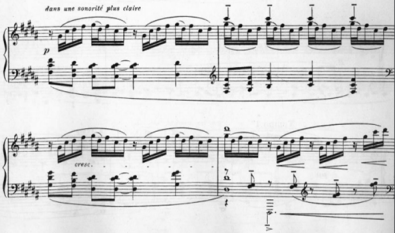
In 1889, the composer Claude Debussy heard the Javanese gamelan at Paris Universal Exposition and he heard Balinese gamelan at later Paris exposition of 1900, suggesting that gamelan likely influenced Debussy’s piano music in some ways because scholars, performers and listeners can find some hints of gamelan music in Debussy’s music by analyzing the style, the texture, and the scale systems . The gamelan scale systems include two essential and predominant scales, pelog and seliser. Pelog is a seven-tone scale. The notes are separated from each other by a series of unequal intervals . Seliser is a four-tone and five-tone scales, sounds like a pentatonic scale. Besides, the specific characteristics of gamelan include many sudden changes in tempo and dynamics which means the musical pattern may be divided into two or more parts to create syncopation and a continuous musical line or pattern and the musical idea of ostinato which means music is built up by several patterns, and these patterns are repeated many times throughout an entire work. Debussy’s piano works, “Pagodes,” is one obvious example of the gamelan’s influence on his piano music because this piece is basically percussive and resonant, similar in gamelan. In addition, this piece includes the musical idea of ostinato and melodies in this piece were used gamelan scale systems (see Figure 1).
Figure 1. Estampes, “Pagodes,” mm. 37-40.
The use of ostinato patterns and the melodies derived from gamelan scale systems clearly reveals Debussy’s engagement with the elements of gamelan music, which provides clearly evidence of gamelan’s influence on his compositional style.
2.2. Colin Mcphee
One of the important expositions was the 1931 Colonial Exposition. The committee of this exhibition dispatched Balinese musicians and dancers to the exposition and they were received with amazement by the spectators: “the musicians and dancers were invariably regaled with the applause and cries of Bravo ! The Balinese music at this exposition influenced well-known composer, Colin McPhee. McPhee was the decisive figure introducing gamelan music to West. This exposition really enforced his determination of Balinese journey . In 1931 McPhee accidently heard recordings of the Balinese gamelan. McPhee was fascinated with the music:
The clear metallic sound of the music was like the stirring of a thousand bells, delicate, confused, with a charm, mystery that was quite overpowering…At the time I knew little about the music of the East…the effect of the music was deeper than I suspect…my imagination took fire…I determined to make a trip to the East to see them for myself . McPhee’s life was completely changed by the effect of Balinese music; he spent almost a decade living in Bali to research the gamelan music. He published books about Balinese music and culture as well as the aspect of Balinese society. He also introduced the sound and philosophy of Bali into Western composition, especially his Tabuh-Tabuhan and his transcriptions of Balinese music for two pianos.
Tabuh-Tabuhan was composed after McPhee had spent four years in Bali devoted to musical research. As for him, this work was largely inspired by the various modes he had learned from the Balinese gamelan technique. The title, derived from the Balinese word Tabuh, refers to broadly percussive elements, rhythmic patterns, and gamelan performance practice, reflecting the strongly percussive character of this work. Besides the using of a Balinese word as the title, McPhee tried to use the western instruments to imitate the sound of the gamelan music.
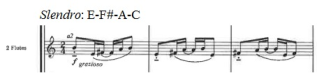
McPhee used materials of Balinese gamelan music as his composed idea in Tabuh-Tabuhan, such as repeating melodies, variety of theme groups, complex rhythm, and complicated texture and structure. For instance, it is obvious to see that the harmonic and melodic materials of this piece are Balinese in some ways, chords and melodies are generated from four-tone and five-tone scales, derived from the form of the Balinese scale called Slendro (see Figure 2).
Figure 2. Tabuh- Tabuhan, first movement, mm. 1-3.
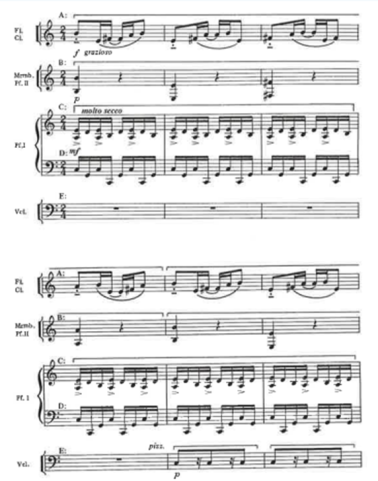
In addition, throughout this work, there are several pitch groups that often sound simultaneously, and McPhee keeps these pitch groups the same throughout a single transcription, adhering to Balinese models of pitch constancy within a single composition . One of the important characteristics in Balinese gamelan music is “Ostinatos.” Balinese music is built up by several patterns, and these patterns will be repeated many times throughout the whole work. Thus, in Tabuh-Tabuhan, it is easy to see that the first movement is sectional with each theme group. At the opening, we can see the five theme group which presents the five separate ostinatos (see Figure 3) .
Figure 3. Tabuh- Tabuhan, first movement, mm. 1-6.

Besides, Mcphee transcribes several traditional Balinese music and uses them as the melodic materials in this work. For instance, the melodic and rhythmic motifs in the first movement (see Figure 4) are derived from Gending Ganderangan, the traditional Balinese dance music (see Figure 5).
Figure 4. Tabuh- Tabuhan, first movement, mm. 9-11.

Figure 5. Gending Ganderangan, Transcription by McPhee from Music in Bali.
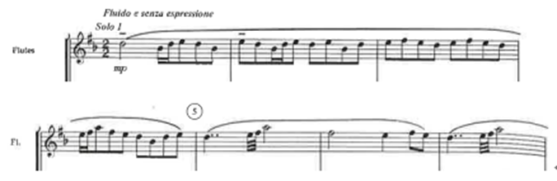
Moreover, According to the sources McPhee identified: “The first section is my arrangement of a Balinese flute melody. The second is the quiet passage from the modern gamelan piece, Kebiar Ding. The third is the…gamelan anklung. This last represents the style rather than the actual music, which I composed myself .” McPhee used some transcriptions of gamelan music as the theme in the second movement, “Nocturne.” The beginning melody of the second movement is McPhee’s arrangement of a Balinese flute melody which is modeled on Lagu ardja (see Figure 6) and the next section of the second movement (see Figure 7) stays close to McPhee’s transcribed source Kebyar ding (see Figure 8).
Figure 6. Tabuh- Tabuhan, second movement, mm. 1-7.
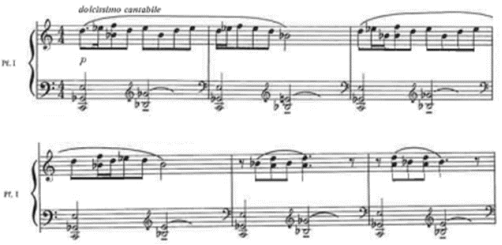
Figure 7. Tabuh- Tabuhan, Second movement, mm. 49-54.
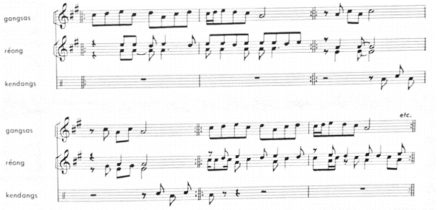
Figure 8. Kebyar Ding. Transcription by McPhee from Music in Bali.
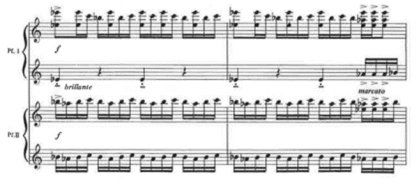
In addition, McPhee imitated the style of angklung in the following section. The characteristics of angklung he described are: “The constant interlocking of…parts, and the sudden rhythmic breaks that occur from time to time, maintain a steady tension throughout the music .” It is obvious to see this specific feature of rhythm in the succeeding parts (see Figure 9) ; one of his transcriptions presents the idea he was imitating (see Figure 10) .
Figure 9. Tabuh- Tabuhan, second movement, mm. 77-78.

Figure 10. The gamelan anklung repertory. Transcription by McPhee from Music in Bali.
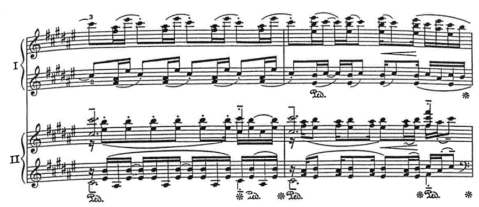
According to McPhee’s observations about Balinese rhythm, he writes that gamelan’s “chief strength is its rhythm ,” suggesting that the rhythm plays a crucial role in Balinese music. The rhythm of Balinese music is diverse and complex. There are usually multiple rhythm patterns in each gamelan piece. For instance, in McPhee’s transcription of Balinese ceremony music for two pianos, we can see many syncopated rhythms, a variety of cross-rhythms, and cross-accents that presents a rhythmic counterpoint (see Figure 11). On any page of Tabuh-Tabuhan comes some evidence of these rhythmic ideas (see Figure 12).
Figure 11. Gambangan. Transcribed for two pianos by McPheee from Balinese ceremony music, mm. 18-19.
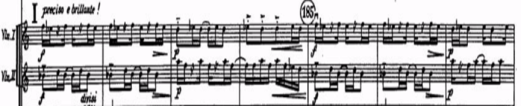
Figure 12. Tabuh- Tabuhan, first movement, mm. 181-187.
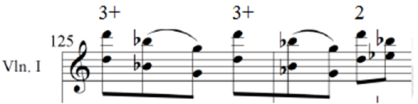
Moreover, McPhee used another rhythmic motif which he called “complex and of apparently inexhaustible” as his rhythmic material which is the rhythm patterns derived from some version of the grouping of eighth notes or sixteenth notes as 3+3+2, a division of the bar (see Figure 13, Figure 14). This mode of rhythm appears frequently in Balinese music. The transcription by McPhee, Gending Tembung illustrates this form of rhythm that McPhee was imitating (see Figure 15), and McPhee also gave the example of its rhythmic pattern (see Figure 16) .
Figure 13. Tabuh- Tabuhan, first movement, mm.125-126, 265-270.
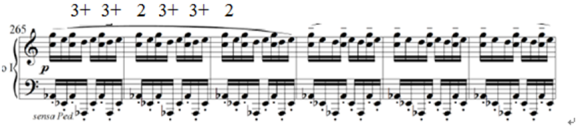
Figure 14. Tabuh- Tabuhan, first movement, mm. 265-270.
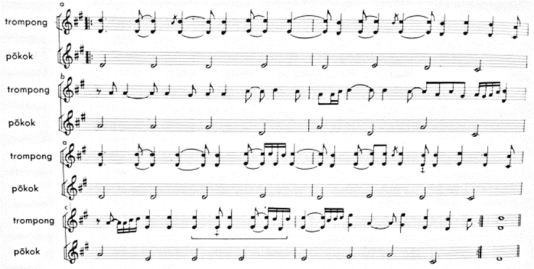
Figure 15. Gending Tembung. Transcription by McPhee from Music in Bali.
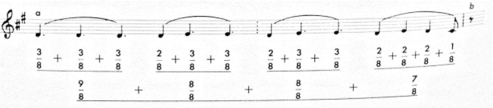
Figure 16. Rhythmic pattern given by McPhee from Music in Bali.
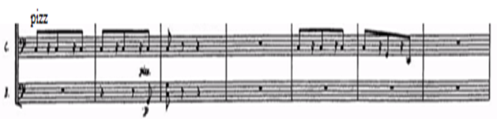
Within gamelan are the percussive orchestra instruments, especially the drum. Drum in gamelan music plays an important role of the leader, just like the conductor controls the rhythm and the dynamic throughout the whole piece. In order to emphasize its percussive sound, McPhee used pizzicato of the cello and bass (see Figure 17), and staccato of the harp and piano to imitate the drum beat.
Figure 17. Tabuh- Tabuhan, first movement, mm.7-12.
Through analyzing Tabuh-Tabuhan we can see that McPhee was influenced deeply by composition techniques of gamelan music; he used a lot of motifs, melodies, rhythms and dynamics of gamelan music in his Tabuh-Tabuhan. Every characteristic of Balinese music in this work, such as variety of theme groups, complex rhythm, and its complicated texture and structure among every instrument truly corresponds with the team spirit in Balinese gamelan music. After analyzing this work, it is clear to see how McPhee used elements of Balinese gamelan music in his work.
2.3. Benjamin Britten
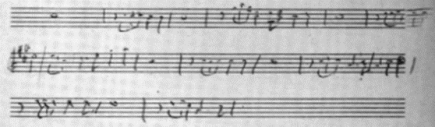
McPhee’s transcriptions of Balinese music for two pianos influenced another well-known composer, Benjamin Britten. In 1941, McPhee and Britten performed these pieces and recorded them in New York. Because of involvement with McPhee, Britten’s musical idea of composition was influenced by gamelan imperceptibly. In addition, the most important reason that Britten was inspired by Balinese music materials was due to his travel to Bali in 1956 for a world tour. During his journey, Britten attended many gamelan rehearsals and live performances, recorded many pieces of gamelan music, and wrote gamelan sketches. The experience in Bali and the Balinese music that Britten recorded and gamelan sketches he wrote enforced the Balinese influence on his composing technique, especially in his ballet, The Prince of the Pagodas and his opera, Death in Venice. These two pieces are full of Balinese materials, such as Balinese scale, repetition and syncopation of rhythmic pattern, percussive sound quality, and gamelan passages. For instance, one of gamelan passages in The Prince of the Pagodas, such as Figure 18, is directly borrowed from the gamelan sketches (see Figure 19) .
Figure 18. Britten’s gamelan sketches from Bali.
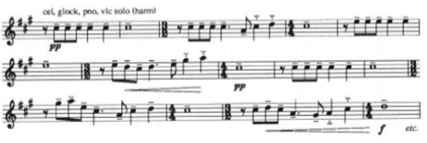
Figure 19. The Prince of the Pagodas, Act II.
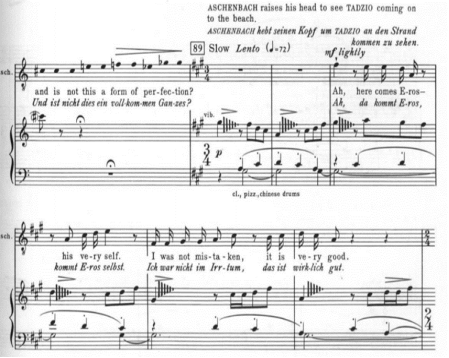
Figure 20. Death in Venice, rehearsal 89.

Besides, Britten was good at using Western instruments to imitate gamelan sonority. For instance, in The Prince of the Pagodas, “the introduction of the gamelan sonority in Act II is twice marked ‘Gamelin’ and the entrance of the percussion in Act III is again merely labeled ‘Gamelin’ .” Additionally, Britten tried to use Western percussion instruments in different ways to produce gamelan sounds for instance, by composing rapid figurations for two piccolos and xylophone to replace gamelan instruments like the, gangsa gantung and by using ostinato passage for vibraphone and celeste to replace the jegogan and jublag. In Death in Venice, Britten used gamelan passages derived from Balinese scales to represent one crucial character, Tadzio, such as Figure 20, and he used the vibraphone to play this gamelan passage, which mimicked in this passage the sound of a Balinese trompong. Every gamelan material that Britten used in his piece definitely proved that gamelan influence on his composing ideas .
3. Gamelan Music’s Influence on Western Academies
“Since mid-nineteenth century a number of gamelan sets had been brought to Europe by the Dutch colonial government and by individuals .” People who were the gamelan enthusiasts started forming groups to perform gamelan music in the West and gamelan even found its way into the academy. According to sources, in 1857 Delft Royal Academy students formed a gamelan group to perform processional music. In 1958 a complete set of gamelan was brought by Mantle Hood, a founder of the Institute of Ethnomusicology at the University of California, Los Angeles (UCLA). Hood also organized what were called “performance-study group” of non-western music ensembles to convey the idea of “bi-musicality” which means Western music students should acquire some practical experience of the music being studied. Hood felt that the best way to understand another music system is to learn to perform it, which is a very simple but powerful idea. The academy also hired one or more native musicians or teachers to be an important ingredient in performance-study group because they served not only as a teacher or teaching assistant for the ensemble but also as a resource for research. As Ethnomusicology was getting popular in music field, some universities began to recognize non-Western music performance as an academic pursuit. Most of the graduates of the UCLA ethnomusicology program promoted the concept of bi-musicality, which was the root of gamelan activity in the United States. Unlike the Western orchestra, where students who join the orchestra would have taken lessons for many years; students in gamelan ensemble are not expected to have any previous training. It even allows students who have never learned to play any instruments to join the ensemble. That’s why gamelan can be a popular program in the West. “As public performance became routine, the boundary between “performance-study” group and performance group became blurred .” To follow the idea of performance-study, the gamelans were begun to purchase by many universities with program in ethnomusicology or even without program in ethnomusicology. Because of its conspicuous presence among academic non-Western music ensembles, gamelan has become an icon of non-Western performing ensembles .
4. Conclusion
Gamelan was introduced through historical figures and events to the West and it profoundly influenced West academies, musical and performance studies, and composers in twentieth century.
As demonstrated in this article, composers such as Debussy, McPhee, and Britten were all clearly influenced by gamelan music. By incorporating its elements such as scale systems, texture, and rhythmic patterns, they expanded their musical language, and their works collectively reflect the significant impact of gamelan on Western composition.
Furthermore, gamelan’s influence made the concept of bi-musicality promoted and stimulated composers’ creativity which influenced later composers’ diversity compositional ideas. These composers’ works are a good contribution to an introduction of gamelan concepts and music to the world and they also provide a vital influence on the cross-cultural explorations of the late twentieth century.
Abbreviations

UCLA

University of California, Los Angeles

Author Contributions
Yichun Chen: Conceptualization, literature review, methodology, formal analysis, investigation, writing—original draft preparation, writing—review and editing, and final approval of the manuscript.
Conflicts of Interest
The authors declare no conflicts of interest.
References
[1] Fauser, Annegret. Musical Encounters at the 1889 Paris World's Fair. Rochester: University of Rochester Press; 2005, pp 195-215.
[2] Tenzer, Michel. Balinese Gamelan Music. Tokyo: Tuttle Pub; 2011, pp 31.
[3] Sumarsam, Javanese Gamelan and The West. New York: University of Rochester Press; 2013, 108-111.
[4] J. Oja, Carol. Colin McPhee: Composer in Two Worlds. Washington: Smithsonian Institution Press; 1990, pp 60.
[5] McPhee, Colin. A House in Bali. Oxford University Press; 1979, pp 9.
[6] J. Oja, Carol. A Western Interlude. In Colin McPhee: Composer in Two Worlds. Washington: Smithsonian Institution Press; 1990, pp 104-113.
[7] McPhee, Colin. Music in Bali: a study in from and instrumental organization in Balinese orchestra music. New York: Da Capo Press; 1976, pp 72-250.
[8] Cooke, Mervyn. Britten and Bali. Journal of Musicological Research. 1987, 7(4), 307-339.
[9] Cooke, Mervyn. Britten and The Far East. The Boydell Press; 1998, pp 78-105.
[10] Solís, Ted. Performing Ethnomusicology: Teaching and Representation in World Music Ensembles. Berkeley: University of California Press; 2004, pp 12-34.
Cite This Article
  • APA Style

    Chen, Y. (2026). Gamelan Music’s Influence on Western Music in the Twentieth Century. Humanities and Social Sciences, 14(3), 272-281. https://doi.org/10.11648/j.hss.20261403.18

    Copy | Download

    ACS Style

    Chen, Y. Gamelan Music’s Influence on Western Music in the Twentieth Century. Humanit. Soc. Sci. 2026, 14(3), 272-281. doi: 10.11648/j.hss.20261403.18

    Copy | Download

    AMA Style

    Chen Y. Gamelan Music’s Influence on Western Music in the Twentieth Century. Humanit Soc Sci. 2026;14(3):272-281. doi: 10.11648/j.hss.20261403.18

    Copy | Download

  • @article{10.11648/j.hss.20261403.18,
      author = {Yichun Chen},
      title = {Gamelan Music’s Influence on Western Music in the Twentieth Century},
      journal = {Humanities and Social Sciences},
      volume = {14},
      number = {3},
      pages = {272-281},
      doi = {10.11648/j.hss.20261403.18},
      url = {https://doi.org/10.11648/j.hss.20261403.18},
      eprint = {https://article.sciencepublishinggroup.com/pdf/10.11648.j.hss.20261403.18},
      abstract = {As early as the nineteenth century, a new concept of music had been developing in the West. World fairs were a crucial means of introducing gamelan music to Western audiences. Through these historical expositions, gamelan influenced many twentieth-century Western composers and encouraged the incorporation of non-Western musical elements into Western compositions. This influence demonstrates composers’ deep engagement with gamelan music and its distinctive musical characteristics. In addition, gamelan also influenced Western colleges and universities through important historical figures, composers, and events, contributing to the development of the concept of bi-musicality. The purpose of this study is to examine the influence of gamelan music on twentieth-century Western music and music education. Using historical research and musical analysis, this article investigates how gamelan music affected the compositional styles of Claude Debussy, Colin McPhee, and Benjamin Britten, and explores how gamelan became integrated into Western academic institutions through the promotion of bi-musicality. The findings indicate that these composers incorporated various elements of gamelan music into their works, including scale systems, textures, ostinato patterns, rhythmic structures, and timbral characteristics. Furthermore, gamelan ensembles and performance-based learning approaches played an important role in expanding ethnomusicological studies in Western universities. The study concludes that gamelan not only influenced the compositional language of major twentieth-century composers but also contributed significantly to cross-cultural musical exchange and the development of music education in the West.},
     year = {2026}
    }
    

    Copy | Download

  • TY  - JOUR
    T1  - Gamelan Music’s Influence on Western Music in the Twentieth Century
    AU  - Yichun Chen
    Y1  - 2026/06/09
    PY  - 2026
    N1  - https://doi.org/10.11648/j.hss.20261403.18
    DO  - 10.11648/j.hss.20261403.18
    T2  - Humanities and Social Sciences
    JF  - Humanities and Social Sciences
    JO  - Humanities and Social Sciences
    SP  - 272
    EP  - 281
    PB  - Science Publishing Group
    SN  - 2330-8184
    UR  - https://doi.org/10.11648/j.hss.20261403.18
    AB  - As early as the nineteenth century, a new concept of music had been developing in the West. World fairs were a crucial means of introducing gamelan music to Western audiences. Through these historical expositions, gamelan influenced many twentieth-century Western composers and encouraged the incorporation of non-Western musical elements into Western compositions. This influence demonstrates composers’ deep engagement with gamelan music and its distinctive musical characteristics. In addition, gamelan also influenced Western colleges and universities through important historical figures, composers, and events, contributing to the development of the concept of bi-musicality. The purpose of this study is to examine the influence of gamelan music on twentieth-century Western music and music education. Using historical research and musical analysis, this article investigates how gamelan music affected the compositional styles of Claude Debussy, Colin McPhee, and Benjamin Britten, and explores how gamelan became integrated into Western academic institutions through the promotion of bi-musicality. The findings indicate that these composers incorporated various elements of gamelan music into their works, including scale systems, textures, ostinato patterns, rhythmic structures, and timbral characteristics. Furthermore, gamelan ensembles and performance-based learning approaches played an important role in expanding ethnomusicological studies in Western universities. The study concludes that gamelan not only influenced the compositional language of major twentieth-century composers but also contributed significantly to cross-cultural musical exchange and the development of music education in the West.
    VL  - 14
    IS  - 3
    ER  - 

    Copy | Download

Author Information
  • School of Music, Zhaoqing University, Zhaoqing, China