Research Article | | Peer-Reviewed

The Relationship Between Board of Directors Characteristics and Bank Value: Does Bank Loan Quality Matters (Empirical Study on EGX Listed Banks)

Received: 5 September 2025     Accepted: 20 October 2025     Published: 31 January 2026
Views:       Downloads:
Abstract

This study examines the relationship between board of directors’ characteristics and bank value and investigates whether bank loan quality mediates this relationship. Data were collected from banks listed on the Egyptian Stock Exchange over a 10-year period (2014–2023). The study uses a Tobin’s Q–based measure as a proxy for bank value. Seven board characteristics are analyzed: board size, CEO duality, board independence, gender diversity, education level, meeting frequency, and CEO experience. Bank loan quality is measured using non-performing loans. The analysis employs the SPSS PROCESS tool with 5000 bootstrap samples to estimate the total, direct, and indirect effects of board characteristics on bank value. Results confirm that bank loan quality significantly mediates the relationship between board characteristics and bank value. Banks with certain board characteristics show different levels of bank value compared to those without these characteristics. When bank loan quality is held constant, the effect of board characteristics on bank value remains significant. This research answers two key questions: How do board characteristics influence bank value? And does bank loan quality transfer the influence of these characteristics on bank value? The study offers practical recommendations for policymakers, bank managers, and investors.

Published in Innovation Business (Volume 1, Issue 1)
DOI 10.11648/j.ib.20260101.11
Page(s) 1-20
Creative Commons

This is an Open Access article, distributed under the terms of the Creative Commons Attribution 4.0 International License (http://creativecommons.org/licenses/by/4.0/), which permits unrestricted use, distribution and reproduction in any medium or format, provided the original work is properly cited.

Copyright

Copyright © The Author(s), 2026. Published by Science Publishing Group

Previous article
Keywords

Bank Value, Bank Loan Quality, Board of Directors’ Characteristics

1. Introduction and Problem Statement
This study examines how board of directors’ characteristics influence bank value and explores whether bank loan quality mediates this relationship. Corporate governance plays a critical role in enhancing shareholder wealth and firm performance. The introduction of reforms such as the Sarbanes-Oxley Act of 2002 reshaped the regulatory framework, emphasizing the need for transparency, accountability, and effective board oversight. These reforms not only impacted firms listed in the United States but also reverberated globally, affecting corporate governance practices in emerging markets and developed economies alike .
Recent financial scandals and bank failures underscore the importance of robust corporate governance mechanisms. High-profile cases, such as the collapses of Enron (2001), WorldCom (2002), Lehman Brothers (2008), and more recent failures including Signature Bank and First Republic Bank in 2023, have attracted significant attention to governance practices. These events demonstrate that a board’s composition, structure, and operational efficiency are crucial for long-term corporate survival and market performance. The evolving regulatory environment, driven by such scandals, has made it essential for banks and other financial institutions to review and enhance their governance practices to safeguard investor interests .
The internal mechanisms of corporate governance, such as board composition, managerial ownership, and the involvement of non-managerial shareholders, are central to effective oversight. In contrast, external mechanisms such as statutory audits and market evaluations offer additional layers of scrutiny. Banks, which operate in highly regulated and risk-sensitive environments, require a board that is not only strategically competent but also vigilant about risk management. Research suggests that an efficient board can improve strategic decision-making, monitor managerial performance, and ultimately enhance bank value .
A considerable body of literature has explored the link between board characteristics and firm performance. However, the mediating effect of bank loan quality on the relationship between board characteristics and bank value has received limited attention. Prior studies have indicated that board attributes such as independence, size, diversity, and expertise can significantly affect bank performance . For instance, an increase in independent directors on a board is often associated with enhanced oversight and risk mitigation, which can contribute to higher bank value. This is particularly relevant in contexts where effective risk management is critical to sustaining profitability and ensuring long-term stability .
Board size is another important factor influencing governance effectiveness. Boards that are either too small or excessively large can face challenges in decision-making and strategic oversight. Small boards may lack the diversity of thought and the range of expertise necessary for comprehensive governance, whereas very large boards may suffer from coordination problems and diluted accountability . This study posits that an optimal board size is crucial for balancing diverse perspectives with efficient decision-making, thereby impacting both the quality of risk management practices and overall bank performance.
Diversity within the board, particularly gender diversity, has also been shown to enhance decision-making by bringing varied perspectives and problem-solving approaches to the table. Recent evidence suggests that greater gender diversity on boards contributes to improved financial performance and better governance outcomes. This is because diverse boards are more likely to consider multiple dimensions of risk and innovation, leading to more balanced and effective oversight .
Board expertise, especially in the banking and financial sectors, is another key determinant of performance. Directors with a background in finance or banking are better positioned to understand complex financial issues and evaluate risk appropriately. Such expertise is vital for overseeing the intricate operations of banks, ensuring that loan portfolios are managed prudently and that risks are mitigated effectively . Financially knowledgeable board members are more likely to scrutinize loan approval processes, thereby reducing the incidence of non-performing loans and improving overall credit risk management.
The mediating variable in this study—bank loan quality—plays a crucial role in linking board characteristics to bank value. Loan quality, typically measured by the level of non-performing loans (NPLs), directly impacts a bank’s profitability and market valuation. A higher quality loan portfolio minimizes the risk of defaults and reduces the need for significant loan loss provisions, thereby enhancing bank performance. The quality of bank loans is influenced by the board’s oversight and its capacity to enforce stringent risk management practices. Boards with higher proportions of independent and experienced directors are better equipped to monitor loan portfolios and ensure robust credit risk assessment procedures .
Furthermore, the presence of diverse and financially savvy directors can lead to more effective evaluations of the bank’s credit risk and loan quality. Diverse boards are more adept at recognizing potential risks and may advocate for a diversified loan portfolio, which helps mitigate concentration risk and supports sustainable bank performance. By fostering better governance practices and promoting rigorous loan approval standards, such boards contribute indirectly to an improvement in bank value . Studies have indicated that banks with lower levels of non-performing loans tend to have higher profitability and market value, as investors perceive them as more stable and less risky .
The nexus between board characteristics, loan quality, and bank value underscores the complex interplay between governance structures and financial performance. In this context, board characteristics are hypothesized to influence bank value indirectly through their effect on loan quality. A well-composed board not only makes strategic decisions but also plays a critical role in ensuring that risk management practices are rigorous and effective. By maintaining a high-quality loan portfolio, banks can avoid the adverse impacts associated with high levels of non-performing loans, such as increased loan loss provisions and reduced profitability.
Recent events in the banking sector further illustrate the significance of these relationships. The collapse of Silicon Valley Bank (SVB) in March 2023 provides a pertinent case study. SVB’s failure, attributed in part to a traditional bank run and a concentration of high-risk investments, highlights how lapses in risk management and governance can have catastrophic outcomes. The bank’s portfolio suffered significant losses due to an increase in interest rates and a lack of diversification, which ultimately led to a sharp decline in the market value of its securities. This incident reinforces the need for effective board oversight in managing loan quality and mitigating financial risks . Startup businesses made up a large portion of SVB's depositors. According to Jay Jung, the founder and managing partner of EMBARC Advisors, they deposited substantial sums of money from investors because technology was in high demand during the pandemic.
Previous explanation emphasizes the importance of Corporate Governance Mechanisms, Especially Board of director’s characteristics and their effect on bank value through the mediation role of bank loan quality.
The problem of the study can be expressed in the following questions.
1) What is the relationship between board of directors’ characteristics and bank value?
2) Does bank loan quality acts as a mediator variable and transfers the influence of the board of directors' characteristics on bank value?
2. Research Objectives
The main objective is to investigate relationship between board of directors’ characteristics and bank value. The secondary objective is to explore the mediating impact of bank loan quality on this relationship.
3. Research Contributions
1) Clarifies how board characteristics like size, independence, expertise, diversity, CEO duality, education, meeting frequency, and experience affect bank value.
2) Examines bank loan quality as a mediator using non-performing loans, linking board of directors' characteristics to bank value.
3) Offers actionable recommendations for policymakers, bank managers, and investors based on robust statistical analysis via SPSS PROCESS bootstrapping.
4) Expands the empirical context by focusing on banks listed on the Egyptian Stock Exchange over a ten-year period.
4. Literature Review and Hypotheses Development
The literature review will be organized as follows:
1) The total effect (BOD characteristics – Bank value)
2) The mediating role of BLQ
a. BOD characteristics-BLQ link
b. BLQ link-Bank value
4.1. The Board of Directors Characteristics and Bank Value
The relationship between board of directors’ characteristics and bank value has attracted considerable scholarly attention in recent years. Researchers have examined how various attributes of board composition—such as board size, independence, leadership structure, and diversity—affect firm Value.
Ragothaman and Gollakota (2009) established that board characteristics, including size, the proportion of female board members, and CEO duality, significantly influence firm value. Their study hypothesized that larger boards may provide diverse perspectives, yet may also encounter coordination challenges that diminish their effectiveness. This foundational work laid the groundwork for understanding how nuanced board structures relate to firm value, providing a benchmark for subsequent research in corporate governance.
Building on this foundation, Fuadah et al. (2022) explored the influence of ownership structure on firm value and risk disclosure within the context of corporate governance. They categorized ownership into family, government, and foreign ownership, demonstrating that the ownership type can modulate the relationship between board characteristics and firm value. This study underscores the idea that board effectiveness cannot be examined in isolation; rather, it is interwoven with broader ownership dynamics that shape decision-making processes and strategic outcomes.
Latif et al. (2022) extended the literature by focusing on emerging economies, particularly in Malaysia. Using panel data regression models, they analyzed a large sample of firms to ascertain whether robust corporate governance practices—embodied in board structure and risk disclosure practices—enhance firm value. Their findings indicate that effective board characteristics contribute to increased transparency and risk management, which in turn elevate firm value. This research emphasizes the importance of tailoring corporate governance frameworks to the unique institutional and economic conditions of developing markets.
The work by Kusnadi (2023) further deepens the discourse by linking board governance with financial policy decisions, such as cash holding. Through content analysis of annual reports of publicly traded companies in Singapore and Malaysia over a 23-year period, Kusnadi demonstrated that sound corporate governance practices can optimize financial resource allocation, thereby influencing overall firm value. This study illustrates that the benefits of an effective board extend beyond strategic oversight to tangible financial outcomes, including liquidity management and investment decisions.
Finally, Dewi et al. (2023) examined corporate governance mechanisms through an integrated lens, focusing on board structure, audit committees, and ownership patterns. Their research highlights the complex interplay between governance mechanisms and firm value, suggesting that a well-structured board can foster stronger stakeholder relationships and more effective oversight. The Organization for Economic Cooperation and Development (OECD) definition of corporate governance, which emphasizes the relationship between a company’s board, shareholders, management, and stakeholders, supports these findings by framing governance as a multidimensional construct that ultimately influences firm value.
Collectively, these studies reveal that board of directors’ characteristics are integral to understanding variations in firm value. They indicate that while effective board structures are crucial for optimizing firm value, the relationship is further nuanced by factors such as ownership structure and broader corporate governance practices. Subsequent research, particularly in the banking sector, has started to explore additional mediating variables—such as bank loan quality—to provide a more comprehensive picture of how board characteristics impact bank value. These insights highlight the importance of considering both direct and indirect effects when evaluating the efficacy of board governance in financial institutions.. So, the research will test the first main hypothesis as follows:
H0: There is no relationship between the board of director characteristics and Bank value.
And the sub-hypothesis will be:
H0.1: There is no relationship between the size of the board of director and Bank value.
H0.2: There in no relationship between CEO Duality and Bank value.
H0.3: There is no relationship between the presence of independent members in directors’ board and Bank value.
H0.4: There is no relationship between gender diversity and Bank value.
H0.5: There is no relationship between number of the board of directors’ Meetings and Bank value.
H0.6: There is no relationship between the board of directors’ education level and bank.
H0.7: There is no relationship between CEO number of experience years and Bank Value.
4.2. The Mediating Role of Bank Loan Quality (Non-performing Loans)
This section reviews the literature on the mediating role of bank loan quality, particularly non-performing loans, in the relationship between board of directors’ characteristics and bank value.
Board characteristics have long been recognized as essential components of corporate governance. Several studies have documented that attributes such as board size, independence, diversity, and expertise play a crucial role in strategic decision-making and monitoring . Belaid’s empirical findings indicate that governance practices can influence financial performance and firm value, with larger banks benefiting more from robust governance mechanisms. This relationship is particularly relevant in the banking sector, where effective governance helps in navigating financial risks and regulatory challenges.
The literature further suggests that the quality of bank loans, operationalized through the level of non-performing loans, mediates the impact of board characteristics on bank value. Abdel-Maksoud and Elsayed (2014) explored the impact of governance on the Egyptian banking sector, emphasizing that adherence to newly issued governance regulations post-2011 has significantly shaped banks’ operational efficiency. They argued that enhanced governance can improve the overall quality of bank loans, thereby indirectly increasing bank value. This notion is supported by the observation that banks derive a substantial portion of their income from lending activities, making the management of loan quality a critical factor in achieving financial success.
Research on Loan Loss Provisions (LLP) adds another layer to this discussion. Heningtyas and Widagdo (2019) summarized the role of LLP as a tool for risk management. Their review of the literature highlights that establishing appropriate LLP allows banks to control potential risks associated with non-performing loans. This approach not only minimizes losses but also stabilizes earnings, thereby improving bank value. The strategic use of LLP, in conjunction with sound board practices, is increasingly viewed as a measure to safeguard and enhance financial performance.
The interplay between governance decisions and loan portfolio management is further illuminated by studies such as those by Beatty and Liao (2011) and Zimmerman (1996). These researchers found that management choices regarding loan concentration significantly influence the success of financial institutions. Their work suggests that when boards exercise prudent oversight and strategic judgment in managing loan portfolios, banks can achieve better loan quality, which in turn supports higher market valuation.
More recent evidence from Tarchouna and Jarraya (2021) reinforces the idea that corporate governance practices have the potential to reduce non-performing loans. Their study demonstrated that improved governance mechanisms lead to enhanced credit risk management and, consequently, a lower incidence of non-performing loans. This reduction in risk exposure is directly associated with an increase in bank value, thereby confirming the mediating role of loan quality.
In summary, the literature indicates that bank loan quality serves as a critical mediator between board characteristics and bank value. Effective governance, through the implementation of strategic board practices and risk management measures such as LLP, contributes to improved loan quality. This improved quality reduces the burden of non-performing loans and ultimately enhances the financial performance and value of banks. So, the Second main hypothesis represented as:
H02: There is no indirect relationship between board of directors’ characteristics and Bank value through Bank loan quality (non-performing loans).
And, the sub– Hypothesis that explain the total effect:
H02.1: There is no indirect relationship between board of directors’ Size and Bank value through Bank loan quality (non-performing loans).
H02.2: There is no indirect relationship between CEO duality and Bank value through Bank loan quality (non-performing loans).
H02.3: There is no indirect relationship between the presence of independent members in board of directors’ and Bank value through Bank loan quality (non-performing loans).
H02.4: There is no indirect relationship between board of directors’ gender diversity and Bank value through Bank loan quality (non-performing loans).
H02.5: There is no indirect relationship between board of directors’ Education levels and Bank value through Bank loan quality (non-performing loans).
H02.6: There is no indirect relationship between board of directors’ Meetings number and Bank value through Bank loan quality (non-performing loans).
H02.7: There is no indirect relationship between CEO Experience years and Bank value through Bank loan quality (non-performing loans).
4.3. The Bank Loan Quality - Bank Value Link
This review synthesizes the literature on the relationship between board of directors’ characteristics (BOD) and bank value (BV) with an emphasis on the mediating role of bank loan quality (BLQ).
The literature establishes that a bank’s loan portfolio quality is critical for its performance and market valuation. A robust portfolio minimizes defaults, credit losses, and provisioning expenses, leading to increased profitability and a higher market value . The notion is that non-performing loans signal deteriorating asset quality, which can ultimately trigger liquidation processes. A strong loan portfolio also enhances a bank’s market share and reputation by attracting a broader clientele and generating steady income.
Empirical evidence supports the significance of loan quality on key financial metrics. Angbazo (1997) found that default risk adversely affects net interest margins, suggesting that inadequate loan quality can constrain a bank’s growth prospects and reduce shareholder returns. In the context of bank capital, Mehran and Thakor (2011) demonstrated that effective monitoring, which improves loan quality, is positively associated with capital adequacy and overall bank stability. Wilcox (1990) further provided evidence that higher loan quality leads to elevated bank valuations, a finding that is corroborated by subsequent research. Zhang and Wu (2014) highlighted that superior loan quality not only increases bank value but also mitigates bank risk, reinforcing the protective role of quality credit portfolios in uncertain market conditions.
The impact of loan quality extends to the stock market as well. Carey and Gordy (2002) noted that banks with high-quality loan portfolios tend to have higher stock prices, underscoring the market’s sensitivity to credit risk management. This relationship emphasizes that loan quality serves as a crucial performance indicator that can bridge the effects of board decisions on bank value. In light of these findings, research hypotheses have been developed to explore both the direct effects of board characteristics on bank value and the indirect effects mediated through loan quality.
Overall, the literature suggests that banks with well-governed boards, which are characterized by attributes such as optimal size, independence, diversity, and expertise, are better positioned to manage their loan portfolios effectively. This effective management, in turn, leads to improved loan quality and, consequently, enhanced bank value. Future research should continue to refine the measurement of both board characteristics and loan quality to further elucidate these relationships, while also considering external factors such as market conditions and regulatory frameworks.
This comprehensive review supports the view that bank loan quality plays a pivotal role in transferring the influence of board of directors’ characteristics on bank value, offering actionable insights for policymakers, bank managers, and investors. So, the third main hypothesis represented as follows:
H03: There is no direct relationship between board of directors’ characteristics and bank value.
And, the sub– Hypothesis that explain the total effect:
H03.1: There is no direct relationship between board of directors’ size and bank value.
H03.2: There is no direct relationship between board of CEO duality and bank value.
H03.3: There is no direct relationship between the presence of independent members in the Board of directors and bank value.
H03.4: There is no direct relationship between board of directors’ gender diversity and bank value.
H03.5: There is no direct relationship between board of directors’ education levels and bank value.
H03.6: There is no direct relationship between board of directors’ meeting numbers and bank value.
H03.7: There is no direct relationship between CEO Experience years and bank value.
5. Method
5.1. Sample and Population
The Population Consists of 13 EGX-listed banks from year 2014 to year 2023. The final sample will be 10 EGX-listed banks from year 2014 to year 2023. The financial information needed to measure the study variables in the multiple linear regression model are obtained from the published financial reports and the Egyptian stock exchange reports.
5.2. The Variables Measurements
5.2.1. Dependent Variable – Bank Value
Bank value refers to the total worth of a business (bank), considering all its asset, liabilities and potential for future earnings. It is often assessed using different financial metrices, depending on the perspective: (Abdelsalam and Weetman 2016), (Lee and Kim 2019) and (Chung and Pruitt 1994 So, bank value measured by Tobin’ Q that equals = Bank Value = ((Market value of total shares) + book value of total debts) / Book value of total assets).
5.2.2. Independent Variables (Board of Directors Characteristics)
BOD = (BODSIZ, CEDO, BODIND, GENDIV, BODMEET, BODEDU, CEOEXPYER)
1) BODSIZ Board size variable represents the number of members of the board of directors. the number of members of the board of directors is an odd number with the minimum number being 3 and the maximum number being 11.
2) CEODO variable represents the dual role of the chair of the director board and the CEO of the company. It is the dummy variable equal to 1 if companies have the duality and otherwise equal to 0.
3) BODIND, BOD INDEPEN. is a variable that represents the presence of independent members on the board of directors. This is the dummy variable which equals to 1 if the board of directors has independent members, otherwise equal to 0.
4) GENDIV: Gender Diversity variable represents the number of female members of the board of directors. It is a dummy variable that set 1 if the company’s director board has female members and set 0, otherwise.
5) BODMEET: represents the number of meetings for members of the board of directors.
6) BODEDU: represents the number of board of directors’ members have education level (BSC, MSC, PHD). It is measured by giving BSC 1 Point, MSC 2 Points and PHD 3 Points, in case more than Board of directors have same Education level they will judge to Board size.
7) BODEXPYRE: represents the number of Experience years of CEO and board.
5.2.3. Mediator Variable (Bank Loan Quality)
Following Yang (2020), Allen et al. (2001), Clair (1992) and Altman and Sabato (2007), non-Performing Loans are used for measuring the bank loan quality which equals Gross Non-Performing Loans and Advances /Gross Loans and Advances.
Loan Loss Provision Coverage =Pretax income +Loan loss provision / Net charge offs
Write-Offs = Net charge-offs/Gross Loans and Advances
5.2.4. Control Variables
Four control variables are used namely: Bank size, Bank age, financial leverage and Loan sales growth.
Bank size (BSIZE) is measured as the logarithm of total assets. Nguyen, Rahman, Tong, and Zhao, (2015); and Rubino, Tenuta, and Cambrea, (2016). Cheng, (2008).
Bank Age (BAGE), According to several studies, like Soliman, and Ragab, (2013), firm age will be measured by the logarithm of the number of years since its incorporation. Consequently, the uncertain relationship of bank age on bank value.
Financial leverage (FLEV) is calculated as the total debt divided by the total assets of the bank. Nguyen, Rahman, Tong, and Zhao, (2015), Rubino, Tenuta, and Cambrea, (2016), and Soliman, and Ragab, (2013).
Loan Sales Growth (LSG) takes into account the firm’s growth opportunities and is measured by the ratio of sales growth. Sales growth is estimated to cause higher long-term profit .
5.3. Research Model
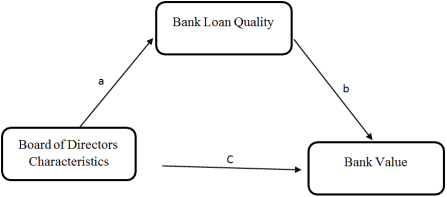
The Mediation Analysis:
The meditation analysis is used according to Hayes (2017) and Abulezz (2022) as follows.
Figure 1. Model discussion.
The Model Equations:
1) BLQ = β1 + a BOD+∑K controls +e BLQ (1) (Indirect effect)
2) BV = β3 + c’ BOD+ b BLQ +∑c controls +e BV (2) (Direct effect)
3) BV = β2 + c BOD+∑β controls + e BV (3) (Total effect)
Where:
BOD: Board of Directors Characteristics (Antecedent)
BLQ: Bank Loan Quality (Mediator)
BV: Bank Value (Outcome)
β1, β2, β3: Regression Constants
a, b, c’: Regression Coefficients
e: Error
5.4. Empirical Findings and Discussions
5.4.1. Descriptive Statistics
Table 1 presents descriptive statistics for the full sample of 100 firm-year observations. In order to avoid the influence of outliers, variables are winsorized at the top 5% and bottom 95% percentiles of their distributions. And Tables 3, 4 and 5 presents frequency tables for three categorical (binary) variables: CEODO, BODIND, and GENDIV. Each table shows the frequency (count), percentage, and cumulative percentage of observations for each category (0 or 1).
Table 1. Descriptive Statistics.

Variable

Obs.

Mean

St. Dev.

Min

Max

BVw

100

.97176

.0702938

.8965862

1.167891

BODSIZ

100

10.14

1.758213

6

13

BODEDU

100

14.97

4.712877

8

26

BODMEET

100

8.9

3.109126

6

17

CEOEXP

100

34.51

6.821675

20

50

Controls variables descriptive statistics

LNNPLw

100

21.18215

1.408994

19.47958

24.84957

SIZEw

100

25.0582

.834627

23.78881

26.8342

LEVw

100

.905927

.0286485

.8577171

.9481288

Growthw

100

.1981226

.1376497

.0143944

.5325

Agew

100

3.488505

.2534652

2.890372

3.7612

The mean of industry-Bank value (BVw) is .9717691 with a standard deviation of 0.0702938 and falls between 0.8965862 and 1.167891. The mean of Board size (BODSIZ) is 10.14 with a standard deviation of 1.758213 and falls between 6 and 13. The mean of Board education (BODEDU) is 14.97 with a standard deviation of 4.712877 and falls between 8 and 26. The mean of Board meetings (BODMEET) is 8.9 with a standard deviation of 3.109126 and falls between 6 and 17. The mean of CEO experience years (CEOEXP) is 34.51 with a standard deviation of 6.821675 and falls between 20 and 50.
As to the mediator variable, the mean of nature Log of Loan loss provision (LNNPLw) is 21.18215 with a standard deviation of 1.408994 and falls between 19.47958 and 24.84957. As to the control variables, the mean of Bank size (SIZEw) is 25.0582 with a standard deviation of 0.834627 and falls between 23.78881 and 26.8342. The mean of financial leverage (LEVw) is 0.9059278 with a standard deviation of 0.0286485 and falls between 0.8577171 and 0.9481288. The mean of Loan sales growth (Growthw) is 0.1981226 with a standard deviation of 0.1376497 and falls between 0.143944 and 0.5325. The mean of Bank age (Agew) is 3.488505 with a standard deviation of 0.2534652 and falls between 2.890372 and 3.7612.
Table 2. Descriptive Statistics- Frequency table for CEO Duality role.

CEDO

Freq.

Percent

Cum.

0

56

56%

56

1

44

44%

100

Total

100

100

Table 3. Descriptive Statistics- Frequency table for BOD Independence.

BODIND

Freq.

Percent

Cum.

0

1

1%

1

1

99

99%

100

Total

100

100

Table 4. Descriptive Statistics- Frequency table for BOD Gender diversity.

GENDIV

Freq.

Percent

Cum.

0

20

20%

20

1

80

80%

100

Total

100

100

Table 2 CEODO (CEO Duality role) defines 56% of observations (56 out of 100) have a value of 0, meaning the CEO does not hold both CEO and Chairman roles. 44% of observations (44 out of 100) have a value of 1, indicating CEO duality is present. CEO duality is relatively balanced, though slightly more firms separate the CEO and Chairman roles.
Table 3 BODIND (Board Independence) defines 1% of observations (1 out of 100) have a value of 0, meaning only one firm does not have independent directors. 99% of observations (99 out of 100) have a value of 1, indicating that nearly all firms have independent board members. Board independence is a standard governance practice in the sample, aligning with good corporate governance principles.
Table 4 GENDIV (Gender Diversity on the Board) defines 20% of observations (20 out of 100) have a value of 0, meaning these firms have no gender diversity. 80% of observations (80 out of 100) have a value of 1, indicating that most firms in the sample have gender-diverse boards. Gender diversity is present in a significant majority of firms, suggesting efforts toward inclusive governance.
5.4.2. Correlation Analysis
Pearson correlation is used to test the correlations among all variables used in regression models of the study. The correlation results are used to get some preliminary insights into the data and provide a first indication about the multi-collinearity problem. Table 5 presents Pearson correlation between all variables. This table reveals that the highest correlation coefficients between independent variables is 72.83 percent.
This implies that there is indicator of multicollinearity between all independent variables as correlation coefficients are more than 70 percent. Table 5 shows that there is a significant negative correlation of 37.62% between BVw** as a dependent variable and BOD Size, which suggests that companies with BOD size equal or more than 11 members tend to have better bank value. In addition, there is a significant positive relation between BVw and LNNPLw, which implies that companies engage in LNNPLw tend to have better bank value.
There is a significant positive relation between BVw and Bank size, which implies that companies engage in BANKSIZw tend to have better bank value. In addition, there is a significant negative relation between LEVw and LNNPLw, which implies that companies engage in Leverage tend to have worse bank loan quality Also, there is a significant negative association between Gender diversity, and sales loans growth, which reveals that companies with high sales loan growth tend to have worse bank value.
Table 5. Correlation matrix.

BVw

CEODO

BODIND

GENDIV

BODSIZ

BODEDU

BODMEET

BVw

1

CEODO

-0.8160

1

BODIND

-0.7738

-0.2613

1

GENDIV

0.2569

0.9208

0.6195

1

BODSIZ

-0.3762

-0.2091

0.1804

1

**0.0001

*0.0368

***0.0725

0.3807

BODEDU

-0.3041

0.7283

1

**0.0021

0.3213

0.1380

0.3058

**0.0000

BODMEET

0.2424

0.3925

0.3651

1

-0.2064

0.6805

0.3511

**0.0151

**0.0001

**0.0002

CEOEXP

0.3460

0.3580

-0.2115

0.5743

**0.0004

0.5092

**0.0003

*0.0347

0.2240

0.6820

LNNPLw

0.6782

0.2577

-0.3539

-0.2731

0.1859

**0.0000

**0.0096

0.3387

0.3345

**0.0003

**0.0060

***0.0640

SIZEw

0.5396

0.3174

-0.2523

0.2927

**0.0000

0.9850

0.1270

**0.0013

**0.0113

**0.0031

0.1454

LEVw

-0.2458

-0.4593

-0.6992

-0.2232

-0.2768

0.8836

-0.2123

**0.0137

Growthw

0.2334

-0.2332

-0.9446

**0.0175

-0.2696

**0.0195

-0.6659

0.7780

0.6466

Agew

0.2334

-0.1712

0.3976

-0.6386

**0.0194

-0.8816

-0.3490

-0.5499

***0.0886

**0.0000

CEOEXP

LNNPL

SIZEw

LEVw

Growthw

Agew

CEOEXP

1

LNNPL

0.3037

1

**0.0021

SIZEw

0.4150

0.6940

1

**0.0000

**0.0000

LEVw

-0.1798

-0.3405

1

0.1780

***0.0735

**0.0005

Growthw

-0.1774

0.1902

1

-0.5635

0.3410

***0.0775

***0.0581

Agew

0.2828

0.3858

0.2328

0.2454

1

**0.0044

**0.0001

0.2676

**0.0197

**0.0139

***. Correlation is significant at the level 0.1 (2-tailed)
**. Correlation is significant at the level 0.01 (2-tailed)
*. Correlation is significant at the level 0.05 (2-tailed)
5.4.3. Statistical Analysis
When empirically testing a causal process that involves a mediation component, of primary interest is the estimation and interpretation of the direct and indirect effects along with inferential tests thereof. To derive these effects, one must also estimate the constituent components of the indirect effect, meaning the effect of X on M, as well as the effect of M on Y. Researchers often estimate the total effect of X on Y.
Output from the SPSS version of PROCESS can be found in the following tables. Using OLS regressions, PROCESS estimates models (1) and (2) and thereby provides a, b, c’ along with standard regression statistics such as R2 for each of the equations. It also creates a section of output containing the direct and indirect effects of X. the option” total” generates output for c, the total effect of Xon Y. Number of bootstrap samples for percentile bootstrap confidence intervals is 5000. Level of confidence for all confidence intervals in output is 95%.
Regression Models for Board of directors’ size (BODSIZ):
NPLw = β1 + a BODSIZ + µ1 SIZw+ µ2 LEVw+ µ3 Growthw+ µ4 Agew +e… (Model 1)
BVw= β2 + c’ BODSIZ+ b NPL + µ1 SIZw+ µ2 LEVw+ µ3 Growthw+ µ4 Agew +e BV (Model 2)
BVw = β3 + c BODSIZ+ µ1 SIZw+ µ2 LEVw+ µ3 Growthw+ µ4 Agew + e BV (Model 3)
Board of directors’ size Total, Direct and Indirect Effects:
The output from the SPSS version of PROCESS creates a section of output containing the direct and indirect effects of X on Y. The option "total" generates output for c, the total effect of X on Y as seen in Total, direct and indirect table. Number of bootstrap samples for percentile bootstrap confidence intervals is 5000. Level of confidence for all confidence intervals in output is 95%.
The regression coefficients and results are summarized in Table 6.
Table 6. Summary of Regression coefficients for BOD size.

Me (NPL)

Y (Bank value)

Coeff.

S.E

P-Value

Coeff.

S.E

P-Value

X (BOD SIZ)

a=-.1398

.0573

.0166

C’=-.0040

.0031

.2039

Me (NPL)

--

--

--

b=.0387

.0050

.0000

µ1 (SIZE)

1.0601

.1406

.0000

.0073

.0084

.3850

µ2 (LEV)

-2.7401

2.8695

.3421

.4713

.2184

.0335

µ3 (Growth)

1.4625

.6550

.0282

-.0033

.0244

.8914

µ4 (Age)

1.5741

.3145

.0000

-.1126

.0194

.0000

Const.

β1=-.7.2595

4.6149

.1191

β2=-.0255

.3427

.9410

R2 = 62.66%

R2 =61.27%

F =29.8745

F =38.0247

P =.0000

P =.0000

As can be seen, a=-.1398, b=.0387, c’=-.0040. The estimated equations 1 and 2 are:
Me= -7.2595+ -.1398X + 1.0601µ1+ -2.7401µ2+ 1.4625µ3+ 1.5741µ4 +e… (Model 1)
Y= -.0255 -.0040X+.0387M +.0073µ1+.4713µ2-.0033µ3-.1126µ4 +e BV (Model 2)
P-value according to the previous table.
Which means that:
1) The indirect effect = (a*b) = (-.1398) *(.0387) =-.0054
2) The direct effect =c’= -.0040
3) The total effect =c’+(a*b) =-.00941
Regression Models for CEO Duality role (CEODO):
NPLw = β1 + a CEODO + µ1 SIZw+ µ2 LEVw+ µ3 Growthw+ µ4 Agew +e… (Model 1)
BVw = β2 + c’ CEODO+ b NPL + µ1 SIZw+ µ2 LEVw+ µ3 Growthw+ µ4 Agew (Model 2)
BVw = β3 + c CEODO+ µ1 SIZw+ µ2 LEVw+ µ3 Growthw+ µ4 Agew + e BV (Model 3)
CEO duality role Total, Direct and Indirect Effects:
The output from the SPSS version of PROCESS creates a section of output containing the direct and indirect effects of X on Y. The option "total" generates output for c, the total effect of X on Y as seen in Total, direct and indirect table. Number of bootstrap samples for percentile bootstrap confidence intervals is 5000. Level of confidence for all confidence intervals in output is 95%.
The regression coefficients and results are summarized in Table 7.
Table 7. Summary of Regression coefficients for CEO Duality.

Me (NPL)

Y (Bank value)

Coeff.

S.E

P-Value

Coeff.

S.E

P-Value

X (CEODO)

a=.4791

.1943

.0155

C’=-.0214

.0085

.0138

Me (NPL)

--

--

--

b=.0435

.0053

.0000

µ1 (SIZE)

1.1483

.1492

.0000

.0037

.0083

.6570

µ2 (LEV)

-1.0661

3.2394

.7428

.4438

.2165

.0432

µ3 (Growth)

1.2332

.6764

.0714

.0085

.0241

.7254

µ4 (Age)

1.3653

.3656

.0003

-.1108

.0193

.0000

Const.

β1=-11.8443

4.9638

.0190

β2=-.0503

.3209

.8757

R2 =62.60%

R2 =62.40

F =26.0722

F =26.3968

P =.0000

P =.0000

As can be seen, a=.4791, b=.0435, c’=-.0214. The estimated equations 1 and 2 are:
Me= 11.8443 +.4791X+ 1.1483µ1- 1.0661µ2+ 1.2332µ3+ 1.3653µ4 +e… (Model 1)
Y= -.3209 -.0214X+.0435M+.0037µ1+.4438µ2+.0085µ3-.1108µ4 +e BV (Model 2)
P-value according to the previous table.
Which means that:
1) The indirect effect = (a*b) = (.4791) *(.0435) =.02084
2) The direct effect =c’=-.0214
3) The total effect =c’+(a*b) =-.00056
Regression Models for Board Independence (BODIND):
NPLw = β1 + a BODIND + µ1 SIZw+ µ2 LEVw+ µ3 Growthw+ µ4 Agew +e… (Model 1)
BVw = β2 + c’ BODIND+ b NPL + µ1 SIZw+ µ2 LEVw+ µ3 Growthw+ µ4 Agew +e BV (Model 2)
BVw = β3 + c BODIND+ µ1 SIZw+ µ2 LEVw+ µ3 Growthw+ µ4 Agew + e BV (Model 3)
Board of directors’ Independence Total, Direct and Indirect Effects:
The output from the SPSS version of PROCESS creates a section of output containing the direct and indirect effects of X on Y. The option "total" generates output for c, the total effect of X on Y as seen Total, direct and indirect table. Number of bootstrap samples for percentile bootstrap confidence intervals is 5000. In addition, due to estimation problems, some bootstrap samples had to be replaced, and the number of times this happened was 2811. Level of confidence for all confidence intervals in output is 95%.
The regression coefficients and results are summarized in Table 8.
Table 8. Summary of Regression coefficients for BOD Independence.

Me (NPL)

Y (Bank value)

Coeff.

S.E

P-Value

Coeff.

S.E

P-Value

X (BODIND)

a=.1318

.1876

.4840

C’=-.0756

.0068

.0000

Me (NPL)

--

--

--

b=.0407

.0051

.0000

µ1 (SIZE)

1.1366

.1556

.0000

.0083

.0085

.3313

µ2 (LEV)

-2.2089

3.2761

.5018

.4715

.2146

.0305

µ3 (Growth)

1.5949

.7040

.0258

-.0073

.0243

.7631

µ4 (Age)

1.5724

.3394

.0000

-.1155

.0197

.0000

Const.

β1=-11.2297

5.1985

.0333

β2=-.0478

.3221

.8823

R2 =60.04%

R2 =61.58%

F =63.4129

F =41.8781

P =.0000

P =.0000

As can be seen, a=.1318, b=.0407, c’=-.0756. The estimated equations 1 and 2 are:
Me= -11.2297 +.1318X+ 1.1366µ1+ -2.2089µ2+ 1.5949µ3+ 1.5724µ4+e…(Model 1)
Y= -.0478 -.0756X+.0407M+.0083µ1+.4715µ2-.0073µ3-.1155µ4+e Bv (Model 2)
P-value according to the previous table.
Which means that:
1) The indirect effect = (a*b) = (.1318) *(.0407) =.005364
2) The direct effect =c’= -.0756
3) The total effect =c’+(a*b) = -.070236
Regression results for Gender diversity (GENDIV) Model (1):
NPLw = β1 + a GENDIV + µ1 SIZw+ µ2 LEVw+ µ3 Growthw+ µ4 Agew +e… (Model 1)
BVw = β2 + c’ GENDIV+ b NPL + µ1 SIZw+ µ2 LEVw+ µ3 Growthw+ µ4 Agew (Model 2)
BVw = β3 + c GENDIV+ µ1 SIZw+ µ2 LEVw+ µ3 Growthw+ µ4 Agew + e BV (Model 3)
Gender diversity Total, Direct and Indirect Effects:
The output from the SPSS version of PROCESS creates a section of output containing the direct and indirect effects of X on Y. The option "total" generates output for c, the total effect of X on Y as seen in Total, direct and indirect table. Number of bootstrap samples for percentile bootstrap confidence intervals is 5000. Level of confidence for all confidence intervals in output is 95%.
The regression coefficients and results are summarized in Table 9.
Table 9. Summary of Regression coefficients for Gender diversity.

Me (NPL)

Y (Bank value)

Coeff.

S.E

P-Value

Coeff.

S.E

P-Value

X (GENDIV)

a=.2395

.1996

.2332

C’=-.0024

.0151

.8729

Me (NPL)

--

--

--

b=.0405

.0051

.0000

µ1 (SIZE)

1.1752

.1524

.0000

.0079

.0079

.3212

µ2 (LEV)

-2.0622

3.2046

.5215

.4914

.2110

.0220

µ3 (Growth)

1.4742

.7070

.0398

-.0037

.0256

.8840

µ4 (Age)

1.5337

.3324

.0000

-.1158

.0204

.0000

Const.

β1=-11.8474

5.1649

.0240

β2=-.1234

.2967

.6785

R2 =60.43%

R2 =60.48%

F =30.0794

F =31.4968

P =.0000

P =.0000

As can be seen, a=.2395, b=.0405, c’=-.0024. The estimated equations 1 and 2 are:
Me= -11.8474 +.2395X+ 1.1752µ1- 2.0622µ2+ 1.4742µ3+ 1.5337µ4+e… (Model 1)
Y= -.1234 -.0024X+.0405M+.0079µ1+.4914µ2- 0037µ3-.1158µ4+e BV (Model 2)
P-value according to the previous table.
Which means that:
1) The indirect effect = (a*b) = (.2395) * (.0405) =.009699
2) The direct effect =c’= -.0024
3) The total effect =c’+(a*b) =.007299
Regression Models for Board education (BODEDU):
NPLw = β1 + a BODEDU + µ1 SIZw+ µ2 LEVw+ µ3 Growthw+ µ4 Agew +e… (Model 1)
BVw = β2 + c’ BODEDU+ b NPL + µ1 SIZw+ µ2 LEVw+ µ3 Growthw+ µ4 Agew (Model 2)
BVw = β3 + c BODEDU+ µ1 SIZw+ µ2 LEVw+ µ3 Growthw+ µ4 Agew + e BV (Model 3)
Board of directors’ Education level Total, Direct and Indirect Effects:
The output from the SPSS version of PROCESS creates a section of output containing the direct and indirect effects of X on Y. The option "total" generates output for c, the total effect of X on Y as seen in Total, direct and indirect table. Number of bootstrap samples for percentile bootstrap confidence intervals is 5000. Level of confidence for all confidence intervals in output is 95%.
The regression coefficients and results are summarized in Table 10.
Table 10. Summary of Regression coefficients for Board Education.

Me (NPL)

Y (Bank value)

Coeff.

S.E

P-Value

Coeff.

S.E

P-Value

X (BODEDU)

a=-.0132

.0171

.4434

C’=-.0018

.0009

.0457

Me (NPL)

--

--

--

b=.0401

.0051

.0000

µ1 (SIZE)

1.1118

.1559

.0000

.0045

.0092

.6307

µ2 (LEV)

-2.7481

3.2299

.3970

.4196

.2296

.0709

µ3 (Growth)

1.6009

.6978

.0240

.0000

.0232

.9996

µ4 (Age)

1.5522

.3324

.0000

-.1175

.0197

.0000

Const.

β1=-9.7227

5.3110

.0703

β2=.0685

.3700

.8536

R2 =60.19%

R2 =61.69%

F =29.5794

F =40.7679

P =.0000

P =.0000

As can be seen, a=-.0132, b=.0401, c’=-.0018. The estimated equations 1 and 2 are:
Me= -9.7227 -.0132X+ 1.1118µ1- 2.7481µ2+ 1.6009µ3+ 1.5522µ4+e… (Model 1)
Y=.0685 -.0018X+.0401M+.0045µ1+.4196µ2+.000µ3-.1175µ4+e BV (Model 2)
P-value according to the previous table.
Which means that:
1) The indirect effect = (a*b) = (-.0132) * (.0401) = -.00052
2) The direct effect =c’=.0401
3) The total effect =c’+(a*b) =.003958
Regression models for Board meeting numbers (BODMEET):
NPLw = β1 + a BODMEET + µ1 SIZw+ µ2 LEVw+ µ3 Growthw+ µ4 Agew +e… (Model 1)
BVw = β2 + c’BODMEET+ b NPL + µ1 SIZw+ µ2 LEVw+ µ3 Growthw+ µ4 Agew (Model 2)
BVw = β3 + c BODMEET+ µ1 SIZw+ µ2 LEVw+ µ3 Growthw+ µ4 Agew + e BV (Model 3)
Board of directors’ meetings number Total, Direct and Indirect Effects:
The output from the SPSS version of PROCESS creates a section of output containing the direct and indirect effects of X on Y. The option "total" generates output for c, the total effect of X on Y as seen in Total, direct and indirect table. Number of bootstrap samples for percentile bootstrap confidence intervals is 5000. Level of confidence for all confidence intervals in output is 95%.
The regression coefficients and results are summarized in Table 11.
Table 11. Summary Regression coefficients for Board meetings.

Me (NPL)

Y (Bank value)

Coeff.

S.E

P-Value

Coeff.

S.E

P-Value

X (BODMEET)

a=-.0188

.0351

.5921

C’=-.0025

.0016

.1362

Me (NPL)

--

--

--

b=.0402

.0050

.0000

µ1 (SIZE)

1.1346

.1551

.0000

.0074

.0089

.4078

µ2 (LEV)

-2.9838

3.4811

.3935

.3915

.2525

.1245

µ3 (Growth)

1.5389

.7060

.0318

-.0085

.0250

.7351

µ4 (Age)

1.6921

.4308

.0002

-.0993

.0208

.0000

Const.

β1=-10.5849

5.2856

.0481

β2=-.0498

.3510

.8876

R2 =60.15%

R2 =61.31%

F =28.6347

F =37.5723

P =.0000

P =.0000

As can be seen, a=-.0188, b=.0402, c’=-.0025. The estimated equations 1 and 2 are:
Me= -10.5849 -.0188X+ 1.1346µ1- 2.9838µ2+ 1.5389µ3+ 1.6921µ4+e… (Model 1)
Y= -.0498 -.0025X+.0402M+.0074µ1+.3915µ2-.0085µ3-.0993µ4+e BV (Model 2)
P-value according to the previous table.
Which means that:
1) The indirect effect = (a*b) = (-.0188) * (.0402) = -.000755
2) The direct effect =c’= -.0025
3) The total effect =c’+(a*b) = -.0032
Regression models for CEO experience years (CEOEXP):
NPLw = β1 + a CEOEXP + µ1 SIZw+ µ2 LEVw+ µ3 Growthw+ µ4 Agew +e… (Model 1)
BVw = β2 + c’CEOEXP+ b NPL + µ1 SIZw+ µ2 LEVw+ µ3 Growthw+ µ4 Agew (Model 2)
BVw = β3 + c CEOEXP+ µ1 SIZw+ µ2 LEVw+ µ3 Growthw+ µ4 Agew + e BV (Model 3)
CEO Experience years Total, Direct and Indirect Effects:
The output from the SPSS version of PROCESS creates a section of output containing the direct and indirect effects of X on Y. The option "total" generates output for c, the total effect of X on Y as seen in Total, direct and indirect table. Number of bootstrap samples for percentile bootstrap confidence intervals is 5000. Level of confidence for all confidence intervals in output is 95%.
The regression coefficients and results are summarized in Table 12.
Table 12. Summary of Regression coefficients CEO experience years.

Me (NPL)

Y (Bank value)

Coeff.

S.E

P-Value

Coeff.

S.E

P-Value

X (CEOEXP)

a=-.0144

.0130

.2702

C’=-.0011

.0006

.0673

Me (NPL)

--

--

--

b=.0399

.0052

.0000

µ1 (SIZE)

1.1798

.1569

.0000

.0115

.0088

.1947

µ2 (LEV)

-2.4806

3.2699

.4500

.4696

.2156

.0319

µ3 (Growth)

1.5520

.7007

.0292

-.0044

.0229

.8496

µ4 (Age)

1.6781

.3612

.0000

.1062

.0202

.0000

Const.

β1=-11.8000

5.3801

.0308

β2=-.1763

.3066

.5667

R2 =60.40%

R2 =61.36%

F =31.9908

F =28.3792

P =.0000

P =.0000

As can be seen, a=-.0144, b=.0399, c’=-.0011. The estimated equations 1 and 2 are:
Me= -11.8000 -.0144X+ 1.1798µ1- 2.4806µ2+ 1.5520µ3+ 1.6781µ4+e… (Model 1)
Y= -.1763 -.0011X+.0399M+.0115µ1+.04696µ2-.0044µ3+.1062µ4+e BV (Model 2)
P-value according to the previous table.
Which means that:
1) The indirect effect = (a*b) = (-.0144) * (.0399) = -.00057
2) The direct effect =c’= -.0011
3) The total effect =c’+(a*b) = -.00167
5.5. Interpretation of Path Coefficients
5.5.1. Path Coefficient (X Me) = a
The “BOD size” (a) coefficient in model (1) a = -.1398, tells us that two cases that differ by one unit on X are estimated to differ by .1398 units on M. So, banks that have 6-11 members in BOD size (X = 1) are, on average, 13.98% lower (because “a” is negative) in the level of NPL than banks that have 3-5 members in BOD size (X = 0), holding C constant.
The “CEO Duality” (a) coefficient in model (1) a =.4791, tells us that two cases that differ by one unit on X are estimated to differ by .4791 units on M. So, banks that have CEO dual role (X = 1) are, on average, 47.91% Higher (because “a” is positive) in the level of NPL than banks that do not have CEO dual role (X = 0), holding C constant.
The “BOD Independence” (a) coefficient in model (1) a =.1318, tells us that two cases that differ by one unit on X are estimated to differ by .1318 units on M. So, banks that have BOD Independence (X = 1) are, on average, 13.18% Higher (because “a” is positive) in the level of NPL than banks that do not have BOD Independence (X = 0), holding C constant.
The “Gender Diversity” (a) coefficient in model (1) a =.2395, tells us that two cases that differ by one unit on X are estimated to differ by .2395 units on M. So, banks that have Gender Diversity (X = 1) are, on average, 23.95% Higher (because “a” is positive) in the level of NPL than banks that do not have Gender Diversity (X = 0), holding C constant.
The “BOD Education” (a) coefficient in model (1) a = -.0132, the BOD education has 3 levels BSC (1) point, MSC (2) points, PHD (3 points) to do the measures we sum all BOD education levels and take the result. So, tells us that two cases that differ by one unit on X are estimated to differ by .0132 units on M. So, banks that have sum of BOD Education more than 9 (X = 1) are, on average, 1.32% lower (because “a” is negative) in the level of NPL than banks that have sum less than 9 BOD Education (X = 0), holding C constant.
The “BOD Meetings number” (a) coefficient in model (1) a = -.0188, tells us that two cases that differ by one unit on X are estimated to differ by .0188 units on M. So, banks that have at least 4 meetings in BOD size (X = 1) are, on average, 1.88% lower (because “a” is negative) in the level of NPL than banks that have less than 4 meetings in BOD meetings number (X = 0), holding C constant.
The “CEO Experience years” (a) coefficient in model (1) a = -.0104, tells us that two cases that differ by one unit on X are estimated to differ by .0104 units on M. So, banks that have at least 30 years in CEO Experience years (X = 1) are, on average, 1.04% lower (because “a” is negative) in the level of NPL than banks that have less than 30 years in CEO Experience years (X = 0), holding C constant.
5.5.2. Path Coefficient (Me Y) = b
The regression coefficient for the mediator NPL in model (2), bBODSIZ, bCEODO, bBODIND, bGENDIV, bBODEDU, bBODMEET, bCEOEXP =.0387,.0435,.0407,.0405,.0401,.0402,.0399 respectively means that two banks that have the same BOD characteristics (BOD size, CEO duality, BOD independence, Gender diversity, BOD education, BOD meetings number and CEO experience years) (i.e., eq X) but differ by one unit in their NPL level (M) are estimated to differ by “b value” unit in Bank value (Y) statistically controlling for (bank size, leverage, sales loan growth and bank age). If The sign of b is negative, meaning that those relatively higher in NPL are estimated to be relatively lower in their bank value but If The sign of b is positive, meaning a positive path relationship.
5.5.3. The Indirect Effect of BOD Characteristics on Bank Value =(a*b).
The indirect effect is quantified as the product of the effect of the BOD characteristics (BOD size, CEO duality, BOD independence, Gender diversity, BOD education, BOD meetings number and CEO experience years) on NPL (a) and the effect of NPL on bank value when BOD characteristics is held fixed (b). Doing the math by multiplying these two coefficients yields the indirect effect of the BOD characteristics on bank value through NPL: for example (a*b) for BOD Gender diversity as previously calculated and explained in previous section (5.3) statistical analysis below Tables 6, 7, 8 , 9, 10, 11 and 12 abGENDIV=.2395*.0405=.0096. So relative to banks that do not have Gender diversity, banks with Gender diversity are, on average,.9% higher in their bank value as a result of the effect of Gender diversity on NPL, which in turn affect bank value.
5.5.4. The Direct Effect (X→ Y) of BOD Characteristics on Bank Value (c'GENDIV = -.0024)
The estimated direct effect of BOD characteristics on bank value is c' = -0024. That is, two cases that differ by one unit on X but are equal on M are estimated to differ by .0024 units on Y, statistically controlling for C. Because the two groups were coded such that they differ by one unit on X, substantively, we can say that independent of the effect of NPL on bank value (because M&C is being held constant in the derivation of c'), banks that have Gender diversity (X = 1) are estimated to be 2.4% higher on average in their bank value than banks that don't have Gender diversity (X = 0).
5.5.5. The Total Effect of BOD Characteristics on Bank Value = c'+ (a*b) =.0096 - 0024 =.0072
Relative to banks that do not have Gender diversity (X = 0), firms with Gender diversity (X = 1) are, on average, 7.2% higher in their bank value, holding C constant.
5.6. Statistical Inference and Hypotheses Test
5.6.1. Inference About the Total Effect of X on Y
The total effect of BOD characteristics (X) on bank value (Y) is the sum of the direct effect of BOD characteristics (BOD size, CEO duality, BOD independence, Gender diversity, BOD education, BOD meetings and CEO experience years) on bank value and indirect effect of BOD characteristics on bank value through Bank loan quality (M).
Inference for the total effect is simple and straightforward. Although the total effect is the sum of two links of influence, it can be estimated directly by regressing Y on just X, without M in the model in Table 13.
Table 13. The models equations summary.

BOD characteristics

Models

BOD size

Y = β3 + c BODSIZ+ µ1 SIZw+ µ2 LEVw+ µ3 Growthw+ µ4 Agew + e BV

CEO duality

Y = β3 + c CEODO+ µ1 SIZw+ µ2 LEVw+ µ3 Growthw+ µ4 Agew + e BV

BODIND

Y = β3 + c BODIND+ µ1 SIZw+ µ2 LEVw+ µ3 Growthw+ µ4 Agew + e BV

GENDIV

Y = β3 + c GENDIV+ µ1 SIZw+ µ2 LEVw+ µ3 Growthw+ µ4 Agew + e BV

BODEDU

Y = β3 + c BODEDU+ µ1 SIZw+ µ2 LEVw+ µ3 Growthw+ µ4 Agew + e BV

BODMEET

Y = β3 + c BODMEET+ µ1 SIZw+ µ2 LEVw+ µ3 Growthw+ µ4 Agew + e BV

CEOEXP

Y = β3 + c CEOEXP+ µ1 SIZw+ µ2 LEVw+ µ3 Growthw+ µ4 Agew + e BV

The regression coefficient for X in that model, c in the regression equation, is the total effect of BOD characteristics. The total effect of BOD characteristics (BOD size, CEO duality, BOD independence, Gender diversity, BOD education, BOD meetings and CEO experience years) are found in the regression output in the model information under "Total Effect Model”.
The total effect is c = the amounts in Table 14, it meets statistical significance using an α = 0.05, 0.1 or 0.001 decision criterion, t and p-value. This means that the null hypothesis H0 is rejected. Otherwise not reject. Table 14 summarizing test decisions of the total effect for the first link hypothesis.
Table 14. The Total effect hypothesis results.

BOD characteristics

Hypothesis

C

t-value

P-value

Sig

Decision

BODSIZ

H0.1: There is no relationship between the size of the board of director and Bank value.

-0.0094

-2.5945

0.011

sig at 5%

NOT supported

CEODU

H0.2: There in no relationship between CEO Duality and Bank value.

-0.0006

-0.0442

0.9649

Not significance

Supported

BODIND

H0.3: There is no relationship between the presence of independent members in directors’ board and Bank value.

0.0702

-8.3372

0.000

sig at 10%

NOT supported

GENDIV

H0.4: There is no relationship between gender diversity and Bank value.

-0.0121

-0.8428

0.4015

Not significance

supported

BODEDU

H0.5: There is no relationship between number of the board of directors’ Meetings and Bank value.

-0.0023

-2.0919

0.0391

sig at 5%

NOT supported

BODMEET

H0.6: There is no relationship between the board of directors’ education level and bank value.

-0.0032

-1.8238

0.0714

sig at 5%

NOT supported

CEOEXP

H0.7: There is no relationship between CEO number of experience years and Bank Value.

-0.0017

-2.3173

0.0227

sig at 5%

NOT supported

5.6.2. Inference About the Direct Effect of X on Y
Inference for the direct effect of BOD characteristics on bank value in a mediation analysis is typically undertaken using the standard method used for inference for any regression coefficient in a regression model. This involves testing a null hypothesis about c' against an alternative hypothesis or the construction of a confidence interval for c'. Researchers focus on ascertaining whether a claim that Tc’ is different from zero is justified based on the data available. If so, this supports the argument that overconfidence is related to bank value independent of the mechanism represented by BLQ. If not, one can claim that there is no evidence of association between BOD characteristics and bank value when the mechanism through BLQ is accounted for.
The direct effect is c’ = the amounts in Table 15, it meets statistical significance using an α= 0.05, 0.1 or 0.001 decision criterion, t and p-value. This means that the null hypothesis H0 is rejected. Otherwise not reject. Table 15 summarizing test decisions of the direct effect for the third link hypothesis.
Table 15. The direct effect hypothesis results.

BOD characteristics

Hypothesis

c

t-value

P-value

Sig

Decision

BODSIZ

H03.1: There is no direct relationship between board of directors’ size and bank value.

-0.004

-1.2794

0.2039

not sig

supported

CEODU

H03.2: There is no direct relationship between board of CEO duality and bank value.

-0.0214

-2.5099

-0.0138

5%

Not supported

BODIND

H03.3: There is no direct relationship between the presence of independent members in the Board of directors and bank value.

-0.0756

-11.193

0

1%

Not supported

GENDIV

H03.4: There is no direct relationship between board of directors’ gender diversity and bank value.

-0.0024

-0.1604

0.8729

not sig

supported

BODEDU

H03.5: There is no direct relationship between board of directors’ education levels and bank value.

-0.0018

-2.0257

0.0457

5%

Not supported

BODMEET

H03.6: There is no direct relationship between board of directors’ meeting numbers and bank value.

-0.0025

-1.5031

0.1362

not sig

supported

CEOEXP

H03.7: There is no direct relationship between CEO Experience years and bank value.

-0.0011

-1.8514

0.0673

10%

Not supported

5.6.3. Inference About the Indirect Effect of X on Y Through M
The indirect effect quantifies how much two cases that differ by a unit on BOD characteristics (BOD size, CEO duality, BOD independence, Gender diversity, BOD education, BOD meetings and CEO experience years) are estimated to differ on bank value as a result of BOD characteristics on BLQ, which in turn influences bank value. The indirect effect is relevant as to whether X effect on Y can be said to be transferred through the mechanism represented by the X - M → Y causal chain of events. As with the direct effect, researchers typically want to know whether the data allow for the claim that this estimated difference in Y attributable to this mechanism can be said to be different from zero. If so, one can claim M serves as a mediator of the effect. of X on Y. As with inference about the direct effect, this inference can be formulated in terms of a null hypothesis test about TaTb or by constructing an interval estimate.
The table include the indirect effect for all BOD characteristics, and statistical significance using an α = 0.05, 0.1 or 0.001 decision criterion and p-value. With levels of confidence, Tc resides somewhere between intervals. Which means reject or accept the null hypothesis. Table 16 summarizing test decisions of the indirect effect with the mediating of BLQ for the first link hypothesis.
Table 16. The indirect effect hypothesis results.

BOD characteristics

Hypothesis

P-value

Sig

Decision

BODSIZ

H02.1: There is no indirect relationship between board of directors’ Size and Bank value through Bank loan quality (non-performing loans).

-0.0054

1%

Not supported

CEODU

H02.2: There is no indirect relationship between CEO duality and Bank value through Bank loan quality (non-performing loans).

0.0208

5%

Not supported

BODIND

H02.3: There is no indirect relationship between the presence of independent members in board of directors’ and Bank value through Bank loan quality (non-performing loans).

0.0054

1%

Not supported

GENDIV

H02.4: There is no indirect relationship between board of directors’ gender diversity and Bank value through Bank loan quality (non-performing loans).

-0.0097

1%

Not supported

BODEDU

H02.5: There is no indirect relationship between board of directors’ Education levels and Bank value through Bank loan quality (non-performing loans).

-0.0005

1%

Not supported

BODMEET

H02.6: There is no indirect relationship between board of directors’ Meetings number and Bank value through Bank loan quality (non-performing loans).

-0.0008

1%

Not supported

CEOEXP

H02.7: There is no indirect relationship between CEO Experience years and Bank value through Bank loan quality (non-performing loans).

-0.0006

1%

Not supported

6. Discussion of Results
The results reveal a robust positive association between board of directors’ characteristics and bank value, thereby rejecting the first null hypothesis. Our findings corroborate earlier studies that argue board composition—encompassing size, CEO duality, independence, gender diversity, educational background, meeting frequency, and CEO experience—enhances firm value . This can be interpreted as an evidence that boards equipped with diverse and experienced members offer better oversight and strategic guidance, which translates into improved market valuation.
Moreover, the analysis confirms that bank loan quality (BLQ) serves as a significant mediating variable. The rejection of the second null hypothesis indicates that BLQ channels the influence of board characteristics on bank value. This mediation effect aligns with prior research and supports resource dependency theory , suggesting that effective board structures enhance internal processes and external relationships, thereby reducing non-performing loans. In turn, better loan quality contributes to higher bank value.
The study further rejects the hypothesis that there is no direct relationship between board characteristics and bank value. The persistence of a direct effect, even after accounting for BLQ, emphasizes the intrinsic value that strong corporate governance adds to a bank. This direct relationship reinforces agency theory , which posits that independent and diverse boards mitigate managerial opportunism and enhance risk management.
Finally, control variables such as bank size, leverage, sales growth, and bank age exhibit distinct relationships with both BLQ and bank value.
7. Limitations
Despite robust evidence, the findings of this study are subject to several limitations. Measurement issues arise as board characteristics—such as independence, diversity, and expertise—are quantified using proxies like the percentage of independent directors or gender ratios. These measures may not fully capture the board’s qualitative impact on risk management and decision-making. Similarly, bank value is often assessed through metrics like Tobin’s Q, ROA, or ROE. Such indicators are influenced by external market conditions, regulatory shifts, and investor sentiment, potentially obscuring the direct effect of board characteristics on bank value.
In examining bank loan quality as a mediator, macroeconomic factors—such as interest rate fluctuations, inflation, and economic cycles—can distort its measurement. Banks might also manipulate loan classifications, which challenges data reliability. The study’s context further limits generalizability. The relationship between board characteristics, loan quality, and bank value likely varies across industries and financial systems. For instance, in developed markets, stringent regulatory frameworks may diminish the board’s relative impact compared to emerging markets, where corporate governance practices are less established .
Additional challenges include endogeneity and causality issues. Reverse causality may occur; poor bank performance might prompt changes in board composition rather than result from them. Other confounding variables, such as CEO traits, ownership structure, and broader economic conditions, might simultaneously influence loan quality and bank value. Finally, practical limitations in board influence are noted. Even effective boards may be constrained by external factors, such as borrower behavior and economic crises, which affect non-performing loans regardless of governance quality.
8. Implications
First, banks should consider psychological traits alongside traditional board characteristics when selecting directors. A larger board without a high education level may negatively impact bank value, whereas board independence has a positive influence. CEO duality tends to weaken performance, highlighting the need to separate the CEO and board chair roles to enhance oversight and decision-making.
Second, banks should refine their recruitment strategies to prioritize highly qualified board members. Hiring directors with strong decision-making skills and financial expertise can lead to better governance and improved bank value. This aligns with the need for a balanced and competent board structure.
Finally, banks should implement training programs to manage cognitive biases effectively. These programs should help directors balance short-term and long-term strategic goals, ensuring sustainable performance. By optimizing board composition and leveraging bank loan quality as a mediating factor, banks can strengthen governance practices and enhance overall financial stability.
9. Future Studies
Future studies should further examine the impact of board characteristics on bank value across various banking institutions. Researchers could explore how shifts in board composition affect non-performing loans and overall firm performance over time. Comparative cross-country analyses may reveal the influence of differing institutional frameworks on this relationship. Additionally, employing behavioral approaches could illuminate how board decision-making processes shape risk-taking and credit policies.
Abbreviations

CG

Corporate Governance

BOD

Board of Directors

BODSIZ

Board of Directors’ Size

BODIND

Board of Directors’ Independence

BODEDU

Board of Directors’ Education Level

BODMEET

Board of Directors’ Meetings Numbers

GENDIV

Gender Diversity

CEODU

Chief Executive Officer Duality

CEOEXP

Chief Executive Officer Experiences Year

BV

Bank Value

FM

Firm Value

BLQ

Bank Loan Quality

NPL

Non-performing Loans

LEV

Financial Leverage

LSG

Loan Sales Growth

BSIZ

Bank Size

BAGE

BANK AGE

OECD

Organization for Economic Cooperation and Development

MBS

Mortgage-backed Securities

CDO

Collateralized Debts Obligations

PD

Probability of Default

LGD

Loss Given Default

EAD

Exposure at Default

ROA

Return on Assets

ROE

Return on Equity

RAROC

Risk-Adjusted Return on Capital

CAR

Capital Adequacy Ratio

LLP

Loan Loss Provision

IFRS

International Financial Reporting Standards

DCF

Discounted Cash Flow

EVA

Economic Value Added

ROI

Return on Investment

DDM

Dividend Discount Models

WACC

Weighted Average Cost of Capital

BSC

Bachelor of Science Degree

MSC

Master of Science Degree

PHD

Doctor of Philosophy Degree

Author Contributions
Kareem Ahmed Omran is the sole author. The author read and approved the final manuscript.
Conflicts of Interest
The authors declare no conflicts of interest.
References
[1] Abdelsalam, O., & Weetman, P. (2016). Introducing corporate governance into financial reporting regulation: The case of Egypt. Journal of International Accounting, Auditing and Taxation, 25(1), 35-50.
[2] Abulezz, M. E. (2022). Empirical Research Methods in Accounting, 3rd edition, author, Zagazig, (in Arabic).
[3] Adams, R. B., & Ferreira, D. (2009). Women in the boardroom and their impact on governance and performance. Journal of Financial Economics, 94(2), 291–309.
[4] Adams, R. B., & Mehran, H. (2012). Bank board structure and performance: Evidence for large bank holding companies. Journal of Financial Intermediation, 21(2), 243-267.
[5] Adams, R. B., Hermalin, B. E., & Weisbach, M. S. (2010). The role of boards of directors in corporate governance: A conceptual framework and survey. Journal of Economic Literature, 48(1), 58-107.
[6] Adeusi, S. O., Akeke, N. I., Aribaba, F. O., & Adebisi, O. S. (2013). Corporate governance and firm financial performance: Do ownership and board size matter? Academic Journal of Interdisciplinary Studies.
[7] Allen, L., Saunders, A., & Walter, I. (2001). Consolidation in the banking industry: Causes and consequences. Journal of Banking & Finance, 25(5), 913-939.
[8] Altman, E., & Sabato, G. (2007). Modeling credit risk for SMEs: Evidence from the US market. Abacus, 43(3), 332-357.
[9] Amer, M. (2016). Corporate governance and financial performance: Evidence from Egypt. Journal of Business Research, 10(2), 87-101.
[10] Angbazo, L. (1997). Commercial bank net interest margins, default risk, interest-rate risk, and off-balance sheet banking. Journal of Banking & Finance, 21(1), 55-87.
[11] Beatty, A., & Liao, S. (2011). Do Delays in Expected Loss Recognition Affect Banks’ Willingness to Lend? Journal of Accounting and Economics, 52, 1-20.
[12] Belaid, F. (2014). Corporate governance and firm performance: Evidence from the MENA region. International Journal of Business and Management, 9(8), 12-25.
[13] Carey, M. S., & Gordy, M. B. (2002). The simple intensity-based approach to credit risk modeling. Economic Review, 87(4), 37-48.
[14] Chung, K. H., & Pruitt, S. W. (1994). A simple approximation of Tobin’s q. Financial Management, 23(3), 70-74.
[15] Clair, R. T. (1992). Loan growth and bank risk: Some lessons from Japan. Economic Review, 77(2), 19-34.
[16] Dewi, R. S., Sari, M. P., & Setiawan, D. (2023). Financial distress prediction using machine learning models. International Journal of Economics and Finance, 15(1), 50-67.
[17] Fahlenbrach, R., & Stulz, R. M. (2011). Bank CEO incentives and the credit crisis. Journal of Financial Economics, 99(1), 11–26.
[18] Faleye, O. (2007). Classified boards, firm value, and managerial entrenchment. Journal of Financial Economics, 83(2), 501-529.
[19] Federal reserve board, (2023) review of the reserve’s supervision and regulation of Silicon Valley bank. Washington, D. C. 20551 on April 28, 2023.
[20] Fuadah, L. L., Putra, R. A., & Firmansyah, M. A. (2022). The impact of financial literacy on investment decision-making. International Journal of Business and Economics, 24(3), 100-120.
Cite This Article
  • APA Style

    Omran, K. A. (2026). The Relationship Between Board of Directors Characteristics and Bank Value: Does Bank Loan Quality Matters (Empirical Study on EGX Listed Banks). Innovation Business, 1(1), 1-20. https://doi.org/10.11648/j.ib.20260101.11

    Copy | Download

    ACS Style

    Omran, K. A. The Relationship Between Board of Directors Characteristics and Bank Value: Does Bank Loan Quality Matters (Empirical Study on EGX Listed Banks). Innov. Bus. 2026, 1(1), 1-20. doi: 10.11648/j.ib.20260101.11

    Copy | Download

    AMA Style

    Omran KA. The Relationship Between Board of Directors Characteristics and Bank Value: Does Bank Loan Quality Matters (Empirical Study on EGX Listed Banks). Innov Bus. 2026;1(1):1-20. doi: 10.11648/j.ib.20260101.11

    Copy | Download

  • @article{10.11648/j.ib.20260101.11,
      author = {Kareem Ahmed Omran},
      title = {The Relationship Between Board of Directors Characteristics and Bank Value: Does Bank Loan Quality Matters (Empirical Study on EGX Listed Banks)},
      journal = {Innovation Business},
      volume = {1},
      number = {1},
      pages = {1-20},
      doi = {10.11648/j.ib.20260101.11},
      url = {https://doi.org/10.11648/j.ib.20260101.11},
      eprint = {https://article.sciencepublishinggroup.com/pdf/10.11648.j.ib.20260101.11},
      abstract = {This study examines the relationship between board of directors’ characteristics and bank value and investigates whether bank loan quality mediates this relationship. Data were collected from banks listed on the Egyptian Stock Exchange over a 10-year period (2014–2023). The study uses a Tobin’s Q–based measure as a proxy for bank value. Seven board characteristics are analyzed: board size, CEO duality, board independence, gender diversity, education level, meeting frequency, and CEO experience. Bank loan quality is measured using non-performing loans. The analysis employs the SPSS PROCESS tool with 5000 bootstrap samples to estimate the total, direct, and indirect effects of board characteristics on bank value. Results confirm that bank loan quality significantly mediates the relationship between board characteristics and bank value. Banks with certain board characteristics show different levels of bank value compared to those without these characteristics. When bank loan quality is held constant, the effect of board characteristics on bank value remains significant. This research answers two key questions: How do board characteristics influence bank value? And does bank loan quality transfer the influence of these characteristics on bank value? The study offers practical recommendations for policymakers, bank managers, and investors.},
     year = {2026}
    }
    

    Copy | Download

  • TY  - JOUR
    T1  - The Relationship Between Board of Directors Characteristics and Bank Value: Does Bank Loan Quality Matters (Empirical Study on EGX Listed Banks)
    AU  - Kareem Ahmed Omran
    Y1  - 2026/01/31
    PY  - 2026
    N1  - https://doi.org/10.11648/j.ib.20260101.11
    DO  - 10.11648/j.ib.20260101.11
    T2  - Innovation Business
    JF  - Innovation Business
    JO  - Innovation Business
    SP  - 1
    EP  - 20
    PB  - Science Publishing Group
    UR  - https://doi.org/10.11648/j.ib.20260101.11
    AB  - This study examines the relationship between board of directors’ characteristics and bank value and investigates whether bank loan quality mediates this relationship. Data were collected from banks listed on the Egyptian Stock Exchange over a 10-year period (2014–2023). The study uses a Tobin’s Q–based measure as a proxy for bank value. Seven board characteristics are analyzed: board size, CEO duality, board independence, gender diversity, education level, meeting frequency, and CEO experience. Bank loan quality is measured using non-performing loans. The analysis employs the SPSS PROCESS tool with 5000 bootstrap samples to estimate the total, direct, and indirect effects of board characteristics on bank value. Results confirm that bank loan quality significantly mediates the relationship between board characteristics and bank value. Banks with certain board characteristics show different levels of bank value compared to those without these characteristics. When bank loan quality is held constant, the effect of board characteristics on bank value remains significant. This research answers two key questions: How do board characteristics influence bank value? And does bank loan quality transfer the influence of these characteristics on bank value? The study offers practical recommendations for policymakers, bank managers, and investors.
    VL  - 1
    IS  - 1
    ER  - 

    Copy | Download

Author Information