Research Article | | Peer-Reviewed

Stakeholders, Sustainable Finance and Governance in the Classical Faculties of the University of Yaoundé 1 (Cameroon)

Received: 26 June 2025     Accepted: 21 January 2026     Published: 31 January 2026
Views:       Downloads:
Abstract

This scientific reflection questions the low sustainability of financial governance practices within the faculty institutions of the University of Yaoundé 1. The global challenges of university governance call for more virtuous management practices. This is why, in 2017, the Conference of Ministers of Education of the States and Governments of La Francophonie recommended not only the integration of sustainable financing principles into sectoral and sub-sectoral budgetary guidelines for education, but also a transformation of financial management practices in educational institutions. Today, the reality of university governance in Cameroon is quite different. Indeed, the report on medium-term expenditure planning (2020-2022) reveals that Cameroon is struggling to integrate sustainable finance practices into sectoral education governance, particularly in public higher education institutions. So why is it that state university faculties do not integrate the principles of sustainable finance into their day-to-day financial management? Taking the University of Yaoundé 1 as a case study, the methodological approach is hypothetical-deductive. The analysis combines qualitative and quantitative methods. The field survey targeted managers at three levels of intervention in the financial governance chain: institution directors and/or their deputies (N=03), department heads (N=20) and teaching and non-teaching staff (N=85). The results reveal a real lack of understanding of the principles of sustainable finance in the financial governance chain. This lack of knowledge is accompanied by insufficient consideration of extra-financial criteria, such as stakeholders and social issues, in the day-to-day financial management of the faculties of the University of Yaoundé 1.

Published in Innovation Business (Volume 1, Issue 1)
DOI 10.11648/j.ib.20260101.12
Page(s) 21-26
Creative Commons

This is an Open Access article, distributed under the terms of the Creative Commons Attribution 4.0 International License (http://creativecommons.org/licenses/by/4.0/), which permits unrestricted use, distribution and reproduction in any medium or format, provided the original work is properly cited.

Copyright

Copyright © The Author(s), 2026. Published by Science Publishing Group

Keywords

Governance, University, Financing, Sustainability, Stakeholders

1. Introduction
Increasing necessary spending is no longer the panacea for achieving Sustainable Development Goal 4 (SDG4) . It is now necessary to reconcile the mobilization of financial resources with their sustainable management. This requires clear commitments from States towards so-called "innovative" financing policies. Innovative financing is a resource mobilization mechanism based on a collection and use approach that differs from traditional financing. In other words, it involves stable and predictable financing, compared to official development assistance . These complementary resources are not intended to replace traditional financing. Finally, their mode of governance requires taking into account the principles of sustainable financing .
2. Context of the Study
In December 2017, the Conference of Ministers of Education of the States and Governments of the Francophonie (Confemen), meeting in Rabat, noted a significant gap to be filled in relation to the targets set for education by 2030. This international conclave focused on education financing. According to the report, the participants noted that "universal access to quality technical, vocational and higher education, including university, is likely not to be effective for most African countries by 2030" .
Better still, according to this document, "these delays place Africa and the African countries of the Confemen far from the targets of SDG4." The 200 participants will note with statistical emphasis to support that these gaps are greater in the countries that struggle the most to mobilize resources for financing education, such as Chad, the Democratic Republic of Congo and Cameroon . It will be recommended to these States to activate the levers of sustainable finance.
3. Problem of the Study
The Cameroonian government took up the debates and resolutions of the Confemen in 2017 . This meeting recommended not only the integration of sustainable financing principles into sectoral and sub-sectoral budgetary guidelines in education, but also a change in financial management practices in educational institutions. Today, the reality in university governance in Cameroon is quite different. In the Cameroonian government's medium-term expenditure planning document (dating from 2019) (2020-2022), we learn that Cameroon is struggling to integrate practices consistent with sustainable finance into education sector governance.
In reality, there is talk of an increase in financial resources, but no guidance, no imperative, nor requirement for the integration of sustainable finance is formulated either in budgetary guidelines or in financial management practices. The problem of weak governance sustainability within state universities in Cameroon thus clearly emerges. In what way do traditional faculties not sufficiently integrate the principles of sustainable financing in their daily financial management? Three elements allow us to provide a provisional answer: a weak appropriation of the principles of sustainable finance by managers; insufficient consideration of stakeholders in the financial management of the faculty; and an ostracizing normative framework in budgetary matters. This study therefore aims at a differential analysis of data on sustainable financing management practices. The aim is to measure the level of appropriation of the principles of sustainable finance in the financial management of faculties. It is also a question of determining whether the heads of departments, as well as the teaching and non-teaching staff, are stakeholders in the sustainable financial management of the faculty.
4. Theoretical and Methodological Approach
4.1. Conceptual Framework of the Study
Sustainable finance refers to all financial practices aimed at promoting community participation over the long term to better defend its interests . In other words, it involves considering that the various actors (particularly passive ones) in the system and the management chain can actively participate in better directing available capital towards financing investments that have a positive impact on society in the medium and long term.
According to the French monetary institution, sustainable finance traditionally covers three concepts: solidarity finance, socially responsible finance, and green finance . The institution explains solidarity finance as referring to initiatives and regulations aimed at facilitating the financing of projects intended to combat exclusion and improve social cohesion. Green finance encompasses investment initiatives with a positive impact on the ecosystem, particularly the energy transition and the fight against global warming.
4.2. Stakeholder Approach as a Theoretical Anchor
Environmental, social and governance issues have gradually given rise to a collective awareness of the limits of the classic economic model which advocates a purely financial approach . We are talking about a participatory approach to the design of strategy, but especially to the budgetary management of a faculty training program. Here, the theoretical approach of stakeholders finds its full meaning. Jérôme Ballet is one of the theoreticians. The particularity of his analysis is based on the postulate that the efficiency of a structure in terms of governance inevitably involves taking into account its internal stakeholders .
The university faculty is not an abstract entity that exists in a vacuum. It shares interests with other internal stakeholders who also each defend their own specific interests without being the sovereign managers of the faculty institution. These are the heads of department, the teaching and non-teaching staff. They contribute directly or indirectly to value creation, and they also have their say on the financial strategy pursued and the construction of the economic governance model .
Sustainable finance advocates (as we have said) responsible social investment. This involves taking into account theextra-financial criteria, financial performance such as a negotiated and therefore participatory governance model. In reality, the financial management of a faculty that aims to be sustainable must no longer be limited to strict and non-collaborative standards and procedures. The stakeholders of the faculty institution must be involved in any form whatsoever in the budgetary management of the faculty, from the budget development process to the planning and execution of the budget as well as in the monitoring and control of budgetary expenditure.
Rather than considering strategy solely in terms of the single dimension of combating competition, stakeholder theory advocates the integration of all partners into the process. Credit managers in faculties adopt a management framework that is sufficiently inclusive and representative of all internal stakeholders within the faculty. It is a concept based on constructive negotiation, where arrangements are made so that each stakeholder, with an interest, finds it in their interest to cooperate.
4.3. Methodological Approach
This study covers two main faculties of the University of Yaoundé 1: the Faculty of Arts, Letters and Human Sciences and the Faculty of Education. The scientific approach adopted isempirical deductive. The study integrates a quantitative and qualitative analytical approach (mixed-methods study). Said analysis is based on analytical triangulation: a cross-referencing between content analysis, data from questionnaires and data from interview guides. In other words, the content analysis took into account reports and other budgetary and regulatory documents related to faculty governance and sustainable finance in the higher education sub-sector.
The questionnaire and the interview guide are tools that allowed the data collection. Via the questionnaire, we interviewed 105 teaching and non-teaching staff. The Likert scale was chosen to formulate the questions crossing our two main variables. The interview guide built on 07 items was administered to 04 stakeholders all credit managers in the target faculties. The interviews allowed us to have data as well as the appropriation of the principles of sustainable development as on the measurement in the light of the indicators of participatory management. For the statistical processing of the data, we used SPSS 28.0.1 software, Microsoft EXCEL version 365. At the end of the triangular processing, we obtained relevant results.
5. Study Results
5.1. Poor Understanding of the Principles of Sustainable Finance
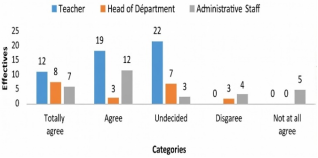
The political, administrative, and scientific discourse on sustainable finance is relatively old . It originated with the issue of preserving biodiversity, the fight against climate change, and protecting the environment. However, 58.09% of our respondents expressed their approval (strongly agree and agree) with the statement that university faculty budget managers do not have a sufficient grasp of the definition and principles that frame the concept of sustainable finance (see graph 1). We can mention a low media coverage of the concept at the national level. Specialists and national scientific work on the field are struggling to emerge. According to one of our interviewees, "sustainable finance has penetrated the scientific field and still tends to cover little management practices (...), continuing education and internal refresher seminars are rare in our university administrations."
Source: field surveys, May 2022

Download: Download full-size image

Figure 1. Insufficient mastery of the definition and principles of sustainable financing by budget managers.
Moreover, the literature review on this concept informs us that it has already been the subject of numerous scientific articles, press articles, seminars, conferences, and international symposia. The most recent activities being the conference in May 2022 (May 8 and 9) at Laval University and the one on June 28 and 29, 2022 in Dakar organized by the Higher Institute of Finance in Senegal. This certainly explains why a dozen of our respondents express their disagreement with the idea that the concept is truly poorly understood by managers.
5.2. Insufficient Consideration of Stakeholders in Financial Management
Only 4 respondents to the questionnaire out of the 105 interviewed stated that department heads, teaching and non-teaching staff are taken into account in the financial management of our target university faculties (see Table 1). It should be remembered that with Ballet and its theoretical approach, we have determined that these aforementioned actors are the stakeholders in university governance. Excluding them from the daily management chain precisely leads to a weak appropriation of sustainable finance practices in governance. Yet, these are sufficiently equipped and qualified people who, in a cross-functional organization of budget management, could be of definite contribution. (Insert Table 1 here).
Table 1. Teaching staff stakeholders in financial management.

Faculty

Items: Teachers are involved in the financial management of the faculty

Total

Completely agree

All right

Undecided

Disagree

I don't agree at all

Flash

0

0

16

26

19

61

ESF

1

3

3

15

22

44

Total

1

3

19

41

41

105

Source: field survey, November 2021
5.3. Normative Framework for Budget Preparation and Ostracism of Stakeholders in Financial Management
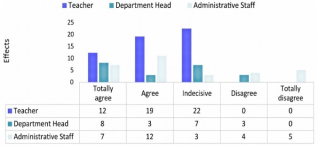
Statistical data is important enough, which is why we talk about ostracism. Teaching and non-teaching staff are not actively involved in any way in budget preparation, implementation, and monitoring. However, finding common interests with teachers and working in interdisciplinary teams, for example, with other departments and organizations, can contribute significantly to increasing stakeholder input and exploring different ways to achieve common goals in order to find shared solutions for sustainable financial governance.
This ban has an explanation. Interviewees 2 and 3 lead us on this path. Indeed, for them, budget preparation is governed by a regulatory text. This text specifies that budget preparation is the responsibility of a specific department within the faculty. Clearly, from a regulatory perspective, the preparation of university faculty budgets does not follow a participatory or cross-functional management approach.
Upon analysis of the contents, the text in question is Presidential Decree No. 93/036 of January 19, 1993, on the administrative and academic organization of the University of Yaoundé 1. In its Article 120, the decree specifies that the preparation and execution of a faculty's budget is the domain of the administrative and financial division . This service, placed under the leadership of a division head, includes a financial service. It is this service, according to Article 124 of the same decree, which, through its budget office, is responsible for preparing the budget, including the preparation of financial documents, updating commitment files and credit slips; it is the accounting body of the faculty. Our respondents corroborate Ultimately, a handful of administrative executives think, alone, in their offices, of financial orientations and transmit the copy of the work to the processing chain, which for the most part will only validate them.
Source: field survey, May 2022

Download: Download full-size image

Figure 2. The regulatory framework is not favorable to collaborative management.
5.4. Hypothesis Testing
Based on these statistical results, it is appropriate to proceed to verify our provisional answer. Some authors believe that it is essential in the context of a study in human and educational sciences, to verify through the research hypotheses retained the effective influence that the independent variables exert on the dependent variable. We choose the Khi 2 statistical test to determine the degree of dependence of our different variables.
H1: There is a significant relationship between low appropriation of sustainable finance principles and insufficient integration of sustainable financing principles into financial management practices in faculty.
H2: There is a significant relationship between low stakeholder involvement and insufficient integration of sustainable financing principles into faculty financial management practices.
H3: There is a significant relationship between the budgetary regulatory framework and the insufficient integration of sustainable financing principles into financial management practices in faculties. (Insert Table 2 here).
Table 2. Summary table of hypothesis tests with Chi2.

Research hypotheses

Γ

ddl

X2Cal

X2Lu

Decision

HS1

5%

8

X2Cal=42.36

X2lu=15.51

X2Cal > X2Lu Confirm HR1

HS2

5%

8

X2Cal=33.47

X2lu=15.51

X2Cal > X2Lu Confirms HR2

HS3

5%

8

X2Cal=39.25

X2lu=15.51

X2Cal > X2Lu Confirm HR1

According to this summary table, each time, the calculated chi-square was higher than the calculated chi-square. The alternative hypothesis is retained. In other words, the question that furnished this research was to know in what way traditional faculties do not sufficiently integrate the principles of sustainable financing in their daily financial management. We answer that this is through: an insufficient mastery of the definition and principles of sustainable development; weak involvement of stakeholders; and an ostracizing regulatory framework.
6. Discussion of Study Results
From the outset, it should be emphasized, along with , that the concept of sustainable finance is broad and plural. It covers various areas of the financial field. These areas take the form of regulations, directives, case law, or recommendations and best practices. Sustainable finance is based on an ethical and sometimes narrow, long-term vision of financial investment. Therefore, notional and conceptual appropriation becomes difficult.
Bochatey also believes that sustainable finance remains poorly defined . For him, sustainable finance is a broad concept that sometimes leads to situations of confusion. Rhetorically, Bochatey believes that it is more of a fad that is swallowing up what should be a paradigmatic alternative. For him, Many sources of financing claim to be sustainable, but how can we know if they really are? There is no agreed-upon international evaluation framework that provides information on the indicators of truly sustainable financing. It seeks to reconcile economic performance with positive social and environmental impacts. It is available in different models, some of which overlap. In such a context, the appropriation of the notion itself becomes problematic.
Based on the premise that it is currently difficult to agree on what constitutes sustainable financing or not, integrating the plurality of actors in a financial management system into a collaborative decision-making process becomes difficult. This is especially true since, according to According to some authors , cross-functional management doesn't only have advantages. Indeed, taking stakeholders into account can be a source of abuse of power, particularly in budgetary matters. Faculties in particular and the university environment in general are now battlegrounds for all sorts of positioning struggles. According to Lemonnier, in an organization where everyone is trying to maintain or strengthen their position, it becomes risky to opt for participatory management.
Furthermore, most of the time, the manager does not have the necessary means and resources at his disposal. Regulatory anchoring sometimes imposes a way of managing his department. Ultimately, with sustainable finance, we are faced with a plural notion which suffers from the absence of an international definitional and regulatory framework. Furthermore, let us underline that there is a divergence between sustainable development from an environmental point of view and the attractiveness of a country . Nevertheless, we believe that sustainable finance is the predominant economic tool for sustainable development and its objectives for ecological, energy, and social transition. Sustainable development is a key economic and social issue. Sustainable finance is its application in the field of economic financing.
7. Conclusion
This reflection haswanted to understand how traditional faculties do not sufficiently integrate the principles of sustainable financing in their daily financial management. Our analyses led to three elements. First, there is a real lack of mastery of the definition and principles of sustainable development in the financial management system. Second, we noted a low involvement of stakeholders in traditional faculties in financial management. This ostracism does not bode well for the practice of sustainable financing. Finally, we noted that the normative and regulatory framework for budget management is not conducive to the practice of sustainable financing. We therefore call for its reform. Although sustainable finance has evolved and produced positive results in certain aspects of education, the path to disruptive finance compatible with a failing international financial system remains to be explored.
Abbreviations

CONFEMEN

Conference of Ministers of Education of the States and Governments of the Francophonie

SDG

Sustainable Development Goal

Author Contributions
Kana Etoundi Rene Rodrigue Lionel is the sole author. The author read and approved the final manuscript.
Conflicts of Interest
The author declares no conflicts of interest.
References
[1] Avom, D., Gandjon, Fankem, GS 2012. Does sustainable development constitute an element of territorial attractiveness? Application to the countries of Central Africa, Market and organizations, l'harmattan, Vol 2, N 16, pp 77-102.
[2] Auvray, T., Bédu, N., Granier, C., Rigot S. 2022. The finance industry, Paris, Landmarks, EditionThe Discovery, 128 pages.
[3] Ballet, J., & Bazin, D. 2004. Taking environmental issues seriously: the ambiguity of the stakeholder approach, VertigeO, Electronic Journal of Environmental Sciences, Vol 5, No. 2.
[4] Bank of France. 2022. Macroeconomic Conjecture Point. June 2022, Paris.
[5] Bégassen D., Lambrecht, P., et al. 2022. Legal Aspects of Sustainable Finance, Brussels, Larcier 162 pages.
[6] Bochatey, M. 2019. Sustainable finance, a fad or a real paradigm shift, Bachelor's thesis at HES at the Haute Ecole de Genève, 127 pages.
[7] Brodin, C. 2015. Beyond aid, innovative financing, Financial Techniques and Development, Volume 4, No. 121 pp. 49-58.
[8] Confemen. 2018. International Seminar on Education Financing. Sustainable Education Financing: What Strategies Should Be Considered? 25 pages.
[9] Confemen. 2017. Technical report 2017. 183 pages.
[10] Duval, G., Mussot, P. 2019. Sustainable finance tomorrow, Official Journal of the French Republic.
[11] Presidential Decree No. 93/036 of January 19, 1993 on the administrative and academic organization of the University of Yaoundé 1.
[12] Faten, B., Mbarek, S., Pallas, V. 2022. Innovating for responsible and sustainable finance, Innovations Vol 2, No. 68, pp 5-19.
[13] Fonkeng, GE, Chaffi, CY, and Bomda, J. 2014. Summary of research methodology in social sciences, Yaoundé, Graphicam.
[14] Frimousse, S., Peretti, JM. 2021. The contribution of green and sustainable finance to extra-financial performance, Management question(s), Flight 6 No. 36, pp 141-166.
[15] Lemonnier, J. 2022. Cross-functional management: tools to promote collective intelligence, Paris, Viubert.
[16] Obrecht, A., Pham, M., Spehn, D., Bremond, A. 2021. Achieving the SDGs with biodiversity, Swiss Academy of Natural Sciences (SCNAT), Forum Biodiverität Schwei.
Cite This Article
  • APA Style

    Lionel, K. E. R. R. (2026). Stakeholders, Sustainable Finance and Governance in the Classical Faculties of the University of Yaoundé 1 (Cameroon). Innovation Business, 1(1), 21-26. https://doi.org/10.11648/j.ib.20260101.12

    Copy | Download

    ACS Style

    Lionel, K. E. R. R. Stakeholders, Sustainable Finance and Governance in the Classical Faculties of the University of Yaoundé 1 (Cameroon). Innov. Bus. 2026, 1(1), 21-26. doi: 10.11648/j.ib.20260101.12

    Copy | Download

    AMA Style

    Lionel KERR. Stakeholders, Sustainable Finance and Governance in the Classical Faculties of the University of Yaoundé 1 (Cameroon). Innov Bus. 2026;1(1):21-26. doi: 10.11648/j.ib.20260101.12

    Copy | Download

  • @article{10.11648/j.ib.20260101.12,
      author = {Kana Etoundi Rene Rodrigue Lionel},
      title = {Stakeholders, Sustainable Finance and Governance in the Classical Faculties of the University of Yaoundé 1 (Cameroon)},
      journal = {Innovation Business},
      volume = {1},
      number = {1},
      pages = {21-26},
      doi = {10.11648/j.ib.20260101.12},
      url = {https://doi.org/10.11648/j.ib.20260101.12},
      eprint = {https://article.sciencepublishinggroup.com/pdf/10.11648.j.ib.20260101.12},
      abstract = {This scientific reflection questions the low sustainability of financial governance practices within the faculty institutions of the University of Yaoundé 1. The global challenges of university governance call for more virtuous management practices. This is why, in 2017, the Conference of Ministers of Education of the States and Governments of La Francophonie recommended not only the integration of sustainable financing principles into sectoral and sub-sectoral budgetary guidelines for education, but also a transformation of financial management practices in educational institutions. Today, the reality of university governance in Cameroon is quite different. Indeed, the report on medium-term expenditure planning (2020-2022) reveals that Cameroon is struggling to integrate sustainable finance practices into sectoral education governance, particularly in public higher education institutions. So why is it that state university faculties do not integrate the principles of sustainable finance into their day-to-day financial management? Taking the University of Yaoundé 1 as a case study, the methodological approach is hypothetical-deductive. The analysis combines qualitative and quantitative methods. The field survey targeted managers at three levels of intervention in the financial governance chain: institution directors and/or their deputies (N=03), department heads (N=20) and teaching and non-teaching staff (N=85). The results reveal a real lack of understanding of the principles of sustainable finance in the financial governance chain. This lack of knowledge is accompanied by insufficient consideration of extra-financial criteria, such as stakeholders and social issues, in the day-to-day financial management of the faculties of the University of Yaoundé 1.},
     year = {2026}
    }
    

    Copy | Download

  • TY  - JOUR
    T1  - Stakeholders, Sustainable Finance and Governance in the Classical Faculties of the University of Yaoundé 1 (Cameroon)
    AU  - Kana Etoundi Rene Rodrigue Lionel
    Y1  - 2026/01/31
    PY  - 2026
    N1  - https://doi.org/10.11648/j.ib.20260101.12
    DO  - 10.11648/j.ib.20260101.12
    T2  - Innovation Business
    JF  - Innovation Business
    JO  - Innovation Business
    SP  - 21
    EP  - 26
    PB  - Science Publishing Group
    UR  - https://doi.org/10.11648/j.ib.20260101.12
    AB  - This scientific reflection questions the low sustainability of financial governance practices within the faculty institutions of the University of Yaoundé 1. The global challenges of university governance call for more virtuous management practices. This is why, in 2017, the Conference of Ministers of Education of the States and Governments of La Francophonie recommended not only the integration of sustainable financing principles into sectoral and sub-sectoral budgetary guidelines for education, but also a transformation of financial management practices in educational institutions. Today, the reality of university governance in Cameroon is quite different. Indeed, the report on medium-term expenditure planning (2020-2022) reveals that Cameroon is struggling to integrate sustainable finance practices into sectoral education governance, particularly in public higher education institutions. So why is it that state university faculties do not integrate the principles of sustainable finance into their day-to-day financial management? Taking the University of Yaoundé 1 as a case study, the methodological approach is hypothetical-deductive. The analysis combines qualitative and quantitative methods. The field survey targeted managers at three levels of intervention in the financial governance chain: institution directors and/or their deputies (N=03), department heads (N=20) and teaching and non-teaching staff (N=85). The results reveal a real lack of understanding of the principles of sustainable finance in the financial governance chain. This lack of knowledge is accompanied by insufficient consideration of extra-financial criteria, such as stakeholders and social issues, in the day-to-day financial management of the faculties of the University of Yaoundé 1.
    VL  - 1
    IS  - 1
    ER  - 

    Copy | Download

Author Information