Abstract
The current study presents a comparative analysis of national curriculum frameworks of Pakistan, India, Sri Lanka and Bangladesh for English Language education at pre-primary and primary levels. It helped gaining the idea how does each country conceptualize the learning of English Language at early stages through curriculum standards, pedagogy, skill development and assessment. A mixed-method approach helped combining qualitative content analysis with quantitative text-mining techniques e.g. Bag-of-Words and cosine similarity. Competency-based design, emphasis on oral skills, learner-centered pedagogy and formative assessment were among commonalities whereas the difference was among thematic areas; the focus of India is on multilingualism, Pakistan’s on ethical literacy, Bangladesh’s on intercultural competence and Sri Lanka’s on ethnic harmony and environmental awareness. These differences present unique cultural and political contexts but share a regional commitment to inclusivity and sustainable development. The study proposes a practical model for regional and policy harmonization through cross- national curriculum research.
Keywords
Comparative Curriculum Studies, South Asian Education Systems, Pre-Primary Curriculum, Early Childhood Literacy, Curriculum Policy Analysis
1. Introduction
Education is the main tool to shape socio-cultural and economic development of any country, particularly in South Asia where diverse linguistics practices, colonial history, and rapidly emerging global trends have influenced curriculum design. The teaching of English Language at pre-primary and primary levels plays a central role to this transformation, as English Language functions as both Lingua-franca and a key to gaining high status in the society
| [11] | Rahman, T., “Language and Politics in Pakistan: A Study of English Language Education Policy,” Oxford University Press, 2020. |
[11]
. Having said that, it is pertinent to mention that English Language education at early grades in South Asian countries witness great inequalities since elite schools follow internationally recognized curricula whereas public-sector system lag behind in implementing learner-centered and skills- based approaches in the classroom teaching. The comparative analysis of the curriculum frameworks of four South- Asian countries, i.e. Pakistan’s Single National Curriculum (SNC 2020/2022-23), India’s National Curriculum Framework for School Education (NCFSE 2023), Bangladesh’s National Curriculum Framework (NCF 2021), and Sri Lanka’s National Curriculum has been done to map this disparity.
This study highlights the focus of these countries on English Language education at pre-primary to primary education (Pre-1 to Grade 5) and explores the conceptual frameworks of early English literacy, integrated skills and inclusive pedagogy. A mix-method approach has been adopted during this study where qualitative content analysis of national curriculum documents of these countries with quantitative cosine similarity metrics helped measuring textual overlaps and differences. This mix-method approach not only helps finding thematic priority areas and gaps but also provides insights into regional curriculum integration. The findings intend to inform policymakers, curriculum experts and educators in South Asia about the harmony, context-specific reforms, and foundational literacy skills in the curriculum to bridge the gap in educational landscape of public and private institutes to ensure prevalence of overall improved education system.
2. Research Approach
Comparative Qualitative Research with Quantitative Elements (Mixed-Methods)
1) The study provides the opportunity to compare curriculum frameworks of four South Asian countries (Pakistan, India, Sri Lanka, Bangladesh) through document analysis.
2) The primary approach is qualitative documents analysis of national curriculum identifying standards, pedagogy, skills and assessment.
3) This is coupled with a quantitative text-mining approach (cosine similarity indices) to gauge the degree of similarity and dissimilarity numerically.
3. Research Questions
1) Which aspects of the English language curricula for Pre-1 to Primary levels (Grades 1–5) can be compared for Pakistan’s SNC 2020, India’s NCFSE 2023, Bangladesh’s NCF 2021, and Sri Lanka’s National Curriculum?
2) What similarities and dissimilarities appear in handling key language skills (listening, speaking, reading, and writing) across these four national curricula?
3) Is there any alignment of assessment strategies and evaluation frameworks curriculum with standards, pedagogy and skills of English language learning at the foundational level?
4) How much do these curricula integrate global competencies, cultural representation, and inclusivity into English language instruction?
5) How do cosine similarity and dissimilarity indices obtained from computational text analysis of curriculum documents reveal trends and gaps?
6) How can the comparative analysis's conclusions guide regional cooperation and changes to South Asia's early English language instruction system?
4. Methodology
4.1. Research Design
This study is a mixed-methods investigation that combines quantitative text-analysis components with a comparative qualitative research design. English language instruction from pre-primary to primary levels is the main focus of the analysis, which focusses on curriculum frameworks from four South Asian nations: Bangladesh, India, Sri Lanka, and Pakistan. The study provides both empirical rigor and depth of interpretation by combining qualitative content analysis with quantitative computational techniques.
4.2. Data Sources
Official curriculum frameworks and education policy documents make up the primary data:
1)
Pakistan: Single National Curriculum (SNC) 2020 / 2022–23
2)
India: National Curriculum Framework for School Education (NCFSE) 2023
| [2] | Government of India, Ministry of Education, 2023, “National Council of Educational Research and Training, National Curriculum Framework for School Education 2023,” 2023. [Online]. Available: https://ncf.ncert.gov.in |
[2]
3)
Bangladesh: National Curriculum Framework (NCF) 2021
| [3] | Government of the People’s Republic of Bangladesh, Ministry of Education, 2021, “National Curriculum and Textbook Board, National Curriculum Framework 2021,” 2021. [Online]. Available: https://nctb.gov.bd |
[3]
4)
Sri Lanka: National Curriculum Framework | [4] | Government of Sri Lanka, Ministry of Education, 2015, “National Institute of Education, Activity-Based Oral English Syllabus: Grades 1–2,” 2015. [Online]. Available:
https://www.nie.ac.lk/ |
[4]
To guarantee accuracy and dependability, these documents were sourced from government publications and other vetted sources.
4.3. Data Collection
Relevant portions of the document's goals, pedagogical guidelines, skill progression, content structure, and assessment frameworks were methodically taken out and condensed. Meaningful cross-national comparison was made possible by treating each curriculum as a complete dataset.
4.4. Analytical Framework
4.4.1. Qualitative Content Analysis
To find recurrent themes, pedagogical philosophies, and curriculum priorities among the four national frameworks, a thematic content analysis was carried out. Key themes pertaining to instructional strategies, assessment tactics, and language learning objectives were extracted through a methodical coding process. In order to show the areas of convergence and divergence among the educational systems of Bangladesh, India, Sri Lanka, and Pakistan, the resulting data were then compiled in a comparative manner.
4.4.2. Quantitative Text Analysis
A quantitative text analysis was conducted using a Bag-of-Words (BoW) model in conjunction with cosine similarity to evaluate textual similarity; higher correspondence was indicated by values closer to 1
| [15] | Smith, J. and Lee, S., “Quantitative Text Analysis in Curriculum Studies: Using Cosine Similarity to Map Educational Policy,” Journal of Comparative Education, vol. 45, no. 2, pp. 112–128, 2023. |
[15]
. Using a 0–1 scale, this computational method assessed the degree of similarity between texts. To quantify textual variation, a dissimilarity index (1 – similarity) was also calculated, providing a structured, data-driven view of the level of alignment and differentiation among the curriculum documents.
4.5. Presentation of Results
Findings are presented through:
1) Comparative Tables and Similarity Matrices to display computed similarity and dissimilarity scores;
2) Visual Graphs and Pie Charts to illustrate curriculum alignment patterns;
3) Narrative synthesis that combines thematic interpretation with numerical trends, placing findings within more general regional educational priorities and challenges.
A thorough basis for discussions of educational policy across national borders is provided by this dual-method approach, which guarantees that the study captures both the complex philosophical foundations of each curriculum and their empirical textual relationships.
5. Comprehensive Analysis
The English language curricula for grades 1 through 5 in Bangladesh's National Curriculum Framework (NCF) 2021, India's National Curriculum Framework for School Education (NCFSE) 2023, Sri Lanka’s National Curriculum, and Pakistan's Single National Curriculum (SNC) 2020/2022-23 are all compared in this thorough analysis. We created quantitative indices to show alignments and differences using cosine similarity on condensed texts from official documents. There are differences in multilingual strategies and particular competencies, but similarities in fundamental objectives (such as communication for global citizenship) and approaches (activity-based learning) predominate. Pairwise indices are described in tables along with clear descriptions of the displayed graphs and charts. Although teacher preparedness and rural implementation present challenges, evidence from various sources suggests that these frameworks strive for equity; however, regional disparities remain significant
| [10] | UNESCO, “Global Monitoring Report: Comparative Analysis of Primary Curricula in South Asia,” 2022. [Online]. Available: https://unesco.org |
| [13] | British Council, “English in South Asia: A Report on Policy and Practice in Pakistan, India, and Bangladesh,” 2023. [Online]. Available: https://britishcouncil.org |
[10, 13]
.
6. General Aims and Objectives
In one way or the other, all curricula focus on communicative English for personal, social, and international contexts, building up from oral bases to balanced levels. Pakistan and Sri Lanka place prime importance on ethnic coexistence and everyday skill
| [1] | National Curriculum COuncil, Ministry of Federal Education and Professional Training, Pakistan, “Single National Curriculum: English Grades I–V, Government of Pakistan,” 2020. [Online]. Available:
https://pectaa.edu.pk/uploads/SNC-2020/English_12th_August.pdf |
| [4] | Government of Sri Lanka, Ministry of Education, 2015, “National Institute of Education, Activity-Based Oral English Syllabus: Grades 1–2,” 2015. [Online]. Available:
https://www.nie.ac.lk/ |
| [5] | Government of Sri Lanka, Ministry of Education, 2015, "National Institute of Education, English Teacher’s Guide: Grade 5,” 2015. [Online]. Available: https://nie.lk |
[1, 4, 5]
; India focuses on multilingual FLN
| [2] | Government of India, Ministry of Education, 2023, “National Council of Educational Research and Training, National Curriculum Framework for School Education 2023,” 2023. [Online]. Available: https://ncf.ncert.gov.in |
[2]
; and Bangladesh stresses ICC for democratic expression
| [3] | Government of the People’s Republic of Bangladesh, Ministry of Education, 2021, “National Curriculum and Textbook Board, National Curriculum Framework 2021,” 2021. [Online]. Available: https://nctb.gov.bd |
| [6] | Government of the People’s Republic of Bangladesh, Ministry of Education, “National Curriculum and Textbook Board, English Language Teaching in Bangladesh: Curriculum and Pedagogy 2018,” 2018. [Online]. Available:
https://nctb.gov.bd |
[3, 6]
. In the midst of complex national adaptations, the average similarity score (0.78) indicates shared regional priorities
| [1] | National Curriculum COuncil, Ministry of Federal Education and Professional Training, Pakistan, “Single National Curriculum: English Grades I–V, Government of Pakistan,” 2020. [Online]. Available:
https://pectaa.edu.pk/uploads/SNC-2020/English_12th_August.pdf |
| [5] | Government of Sri Lanka, Ministry of Education, 2015, "National Institute of Education, English Teacher’s Guide: Grade 5,” 2015. [Online]. Available: https://nie.lk |
[1, 5]
.
Table 1. Comparison of Curriculum Goals across South Asian Nations (Pre-1 to Grade 5).
Curriculum | Pre-1/Foundational Goals | Grades 1-2 Goals | Grades 3-5 Goals |
Pakistan SNC 2020/2022-23 | Mother tongue focus with English exposure for print awareness; build oral skills for respect. | Foundational phonemic awareness, basic vocabulary; promote values like peace. | Literacy enhancement, critical thinking, narrative writing; global preparation with cultural integration. |
India NCFSE 2023 | Oral L2/L3 exposure via play; emergent literacy from age 3. | Conversational fluency, story comprehension; L2 reading/writing initiation. | Fluency in reading, paragraph writing; critical expression in multilingual contexts. |
Bangladesh NCF 2021 | Basic ICC for expression and cultural awareness. | Effective daily/creative use; literature appreciation. | Advanced ICC for academic/global; democratic language attitudes. |
Sri Lanka National Curriculum | Oral exposure in grades 1-2 (no pre-1 specified). | Oral proficiency via themes; polite expressions. | Four skills balance; real-life communicative competence, literature intro. |
6.1. Skills Development
From speaking and listening to reading and writing, skills develop methodically. Early on, oral focus has high pairwise similarities (e.g., 0.88 PK–SL)
| [1] | National Curriculum COuncil, Ministry of Federal Education and Professional Training, Pakistan, “Single National Curriculum: English Grades I–V, Government of Pakistan,” 2020. [Online]. Available:
https://pectaa.edu.pk/uploads/SNC-2020/English_12th_August.pdf |
| [4] | Government of Sri Lanka, Ministry of Education, 2015, “National Institute of Education, Activity-Based Oral English Syllabus: Grades 1–2,” 2015. [Online]. Available:
https://www.nie.ac.lk/ |
| [5] | Government of Sri Lanka, Ministry of Education, 2015, "National Institute of Education, English Teacher’s Guide: Grade 5,” 2015. [Online]. Available: https://nie.lk |
[1, 4, 5]
. India's multilingual scaffolding under NEP 2020 differs from others' CLT emphasis resulting in differences (e.g., 0.32 PK–IN), as detailed in
Table 2.
| [7] | Government of Sri Lanka, Ministry of Education, 2016, “National Institute of Education, English Language Teaching in Sri Lanka: Policy and Practice,” 2016. [Online]. Available: https://nie.lk |
[7]
:
Table 2. English Language Skill Development focus by Country (Grades 1-5).
Skill | Pakistan (Grades 1-5) | India (Ages 3-8/Grades 3-5) | Bangladesh (Pre-1 to 5) | Sri Lanka (Grades 1-5) |
Listening | Attentive group listening, complex patterns. | Songs appreciation, “wh” questions. | Interpret meanings contextually. | Sound recognition, info extraction. |
Speaking | Presentations, dialogues. | Narrate stories, sequenced ideas. | Expressive clarity, creative use. | Descriptions, presentations. |
Reading | Fluency, critical strategies. | Phonological awareness, book interest. | Appreciate literature. | Aloud reading, pleasure reading (from grade 3). |
Writing | Sentences to essays, editing. | Paragraphs, stories. | Creative writing. | Sentences/paragraphs (from grade 3). |
6.2. Content and Themes
With notable parallels (e.g., 0.86 BD–SL) in environmental and cultural integration, themes in all curricula are derived from social values and daily life
| [3] | Government of the People’s Republic of Bangladesh, Ministry of Education, 2021, “National Curriculum and Textbook Board, National Curriculum Framework 2021,” 2021. [Online]. Available: https://nctb.gov.bd |
| [4] | Government of Sri Lanka, Ministry of Education, 2015, “National Institute of Education, Activity-Based Oral English Syllabus: Grades 1–2,” 2015. [Online]. Available:
https://www.nie.ac.lk/ |
[3, 4]
. There are differences between Sri Lanka's ERA themes and India's bilingual texts
| [4] | Government of Sri Lanka, Ministry of Education, 2015, “National Institute of Education, Activity-Based Oral English Syllabus: Grades 1–2,” 2015. [Online]. Available:
https://www.nie.ac.lk/ |
| [5] | Government of Sri Lanka, Ministry of Education, 2015, "National Institute of Education, English Teacher’s Guide: Grade 5,” 2015. [Online]. Available: https://nie.lk |
[4, 5]
.
Table 3. Primary Level Content and Themes in Regional Curricula.
Curriculum | Pre-1 Content | Grades 1-2 Content | Grades 3-5 Content |
Pakistan | Environment objects, rhymes. | Ethics, nature; basic texts. | Global citizenship; dialogues. |
India | Songs, picture books; family. | Stories, interactions. | Descriptive texts, heritage. |
Bangladesh | Sensory, social contexts. | Everyday communication, literature. | Cultural norms, expression. |
Sri Lanka | N/A. | School, animals (ERA themes). | Science, stories, poems. |
6.3. Pedagogical Approaches
With a high alignment (average similarity 0.78 in experiential learning), pedagogy is largely activity-based and learner-centered across all frameworks
| [1] | National Curriculum COuncil, Ministry of Federal Education and Professional Training, Pakistan, “Single National Curriculum: English Grades I–V, Government of Pakistan,” 2020. [Online]. Available:
https://pectaa.edu.pk/uploads/SNC-2020/English_12th_August.pdf |
| [2] | Government of India, Ministry of Education, 2023, “National Council of Educational Research and Training, National Curriculum Framework for School Education 2023,” 2023. [Online]. Available: https://ncf.ncert.gov.in |
| [3] | Government of the People’s Republic of Bangladesh, Ministry of Education, 2021, “National Curriculum and Textbook Board, National Curriculum Framework 2021,” 2021. [Online]. Available: https://nctb.gov.bd |
| [4] | Government of Sri Lanka, Ministry of Education, 2015, “National Institute of Education, Activity-Based Oral English Syllabus: Grades 1–2,” 2015. [Online]. Available:
https://www.nie.ac.lk/ |
| [5] | Government of Sri Lanka, Ministry of Education, 2015, "National Institute of Education, English Teacher’s Guide: Grade 5,” 2015. [Online]. Available: https://nie.lk |
[1-5]
. There are slight differences between Pakistan's concept-driven approaches, India's multilingual play-based education
| [2] | Government of India, Ministry of Education, 2023, “National Council of Educational Research and Training, National Curriculum Framework for School Education 2023,” 2023. [Online]. Available: https://ncf.ncert.gov.in |
[2]
, and Bangladesh's digital orientation.
Table 4. Pedagogical Approaches and Methods for Early Language Learning.
Curriculum | Pre-1 Methods | Grades 1-2 Methods | Grades 3-5 Methods |
Pakistan | Play-based, VARK modes. | Interactive role-plays. | Inquiry, projects. |
India | Play, TPR, multilingual. | Story-based, read-aloud. | Activity-oriented, differentiated. |
Bangladesh | Exploratory, play-based. | Task-based, collaborative. | Problem-solving, digital. |
Sri Lanka | N/A. | CLT, games/songs. | Textbook-based, ICT blended. |
6.4. Assessment Methods
The majority of assessment techniques are formative, with continuous and observation-based evaluation strategies convergent
| [1] | National Curriculum COuncil, Ministry of Federal Education and Professional Training, Pakistan, “Single National Curriculum: English Grades I–V, Government of Pakistan,” 2020. [Online]. Available:
https://pectaa.edu.pk/uploads/SNC-2020/English_12th_August.pdf |
| [4] | Government of Sri Lanka, Ministry of Education, 2015, “National Institute of Education, Activity-Based Oral English Syllabus: Grades 1–2,” 2015. [Online]. Available:
https://www.nie.ac.lk/ |
[1, 4]
. Similarities (e.g., 0.79 PK–BD) highlight shared formative principles. While differences reflect Bangladesh's real-time assessments
| [7] | Government of Sri Lanka, Ministry of Education, 2016, “National Institute of Education, English Language Teaching in Sri Lanka: Policy and Practice,” 2016. [Online]. Available: https://nie.lk |
[7]
, India's portfolio-based systems, and Sri Lanka's project-based evaluations, similarities (e.g., 0.79 PK–BD) highlight shared formative principles
| [2] | Government of India, Ministry of Education, 2023, “National Council of Educational Research and Training, National Curriculum Framework for School Education 2023,” 2023. [Online]. Available: https://ncf.ncert.gov.in |
[2]
.
Table 5. Assessment Strategies and Evaluative Frameworks.
Curriculum | Pre-1 Assessment | Grades 1-2 Assessment | Grades 3-5 Assessment |
Pakistan | Checklists, portfolios. | Formative quizzes. | Rubrics, presentations. |
India | Observation, HPC. | Portfolios, low-stakes. | Formative/summative, feedback. |
Bangladesh | Real-time observation. | Continuous, peer/teacher. | Multidimensional portfolios. |
Sri Lanka | N/A. | Activity participation. | Checklists, projects/exams. |
7. Key Points on Comparison
All four curricula focus on building a strong foundation in English for young kids. They start with speaking and listening in the early grades, then move on to reading and writing by grades 3 to 5. The whole approach is hands-on and centered around the child, so kids actually use what they learn and feel more confident.
It can be noticed some big similarities. They all pull in themes from daily life, teach values like respect and caring for the environment, and use ongoing assessments to see how students are doing. But the way they bring in English isn’t exactly the same everywhere. In Pakistan and Sri Lanka, kids start with their mother tongue in pre-primary and pick up English gradually. India uses a multilingual model, treating English as a second or third language for kids aged 3 to 8. Bangladesh puts a lot of focus on intercultural communication right from pre-primary.
Research shows these guidelines aim for fairness, but real-world problems get in the way. Training teachers and having enough resources, especially in rural areas, make a big difference in how well the programs actually work.
Evidence leans toward play-based methods being effective for early literacy, though controversies exist around balancing local languages with English proficiency in non-English dominant contexts.
7.1. Pakistan’s Single National Curriculum 2020
Pakistan rolled out its Single National Curriculum (SNC) in 2020, trying to level the playing field for students across all provinces. The idea is simple: make learning more student-focused and inclusive, utilizing standardized pedagogical frameworks
| [8] | National Curriculum Council (NCC), Ministry of Federal Education and Professional Training, Pakistan, “Glossary of Curriculum Terms: A Dictionary for Educational Standards,” 2022. [Online]. Available: https://pportal.punjab.gov.pk |
| [9] | Punjab Education Foundation, “Dictionary of Pedagogical Terms for Primary Education in Pakistan,” 2021. [Online]. Available: https://pef.edu.pk |
[8, 9]
and make sure what kids learn lines up with both national goals and global standards especially when it comes to language. English shows up early, starting in pre-primary. At first, lessons stick to general language in the mother tongue, with a gentle nudge toward English think print awareness and simple names in English. As students move up, the curriculum builds up all four language skills, weaving them together year after year. Alongside language, the SNC pushes for values, ethics, and caring for the environment, using themes that actually matter in daily life. The goal is to make language lessons more than just grammar drills students connect what they learn to the world around them and their role in society.
7.2. India’s National Curriculum Framework for School Education 2023
India’s National Curriculum Framework (NCF) 2023 is part of a bigger shake-up under the National Education Policy (NEP) 2020. The focus? Flexibility, lots of languages, and a more well-rounded approach to learning. English comes in as a second or third language, and kids get early exposure, mostly through talking and listening, starting as young as three. By grade 3, students hit key milestones in English literacy, with Foundational Literacy and Numeracy (FLN) at the core, supported by structured educational terminologies
| [12] | National Council of Educational Research and Training (NCERT), “Dictionary of Education for Primary Schools,” India, 2021. [Online]. Available: https://ncert.nic.in |
[12]
. The NCF doesn’t want classrooms full of bored kids memorizing facts. Instead, it champions play, hands-on experiences, and learning that sparks curiosity and real communication. Lessons are rooted in context, not rote memory, and kids are encouraged to use language creatively, no matter the subject.
7.3. Bangladesh’s National Curriculum Framework 2021
Bangladesh’s National Curriculum Framework (NCF) 2021 reflects a paradigm shift from content-heavy instruction to a competency-based, learner-centered model
| [14] | Ministry of Primary and Mass Education, Bangladesh, “Glossary of Competency-Based Learning Terms,” 2021. [Online]. Available: https://mopme.gov.bd |
[14]
. It aims to develop students’ Intercultural Communicative Competence (ICC) in English to engage effectively in global contexts while retaining local identity. English language learning begins at the pre-primary level, focusing on listening and speaking before transitioning to reading and writing. The framework emphasizes experiential and activity-based methods that relate classroom learning to real-life situations, minimizing dependence on textbooks. By encouraging creativity, collaboration, and critical thinking, it seeks to equip learners with 21st-century communication skills essential for personal and national development.
7.4. Sri Lanka’s National Curriculum
Sri Lanka’s National Curriculum for English Education is designed to promote communicative proficiency and intercultural awareness among learners. The program begins with activity-based oral English in grades 1–2, fostering listening and speaking through songs, games, and role-play. From grade 3 onwards, students transition to formal literacy skills, with reading and writing introduced through familiar and culturally relevant themes. The curriculum strongly supports Communicative Language Teaching (CLT), aiming to make English learning meaningful and interactive. Despite challenges in rural implementation due to resource disparities and teacher training gaps, the framework remains committed to developing functional English skills for all learners.
8. Findings
8.1. Key Points on Similarity and Dissimilarity Indices
1) Similarity Index Overview: When you look at the curricula documents, you see a lot of overlap about 78% on average. Most of them line up on big things like goals (think communicative competence), how students move from speaking to reading and writing, teaching methods (activity-based, learner-centered stuff), and the focus on formative assessment. So, there’s a clear trend across the region toward English teaching that’s child-centered and rooted in real life. Pakistan and Sri Lanka show the most similarity (88%), and Bangladesh and Sri Lanka aren’t far behind (86%). They all hit similar themes, like the environment and values.
2) Dissimilarity Index Overview: On the other hand, you get about 22% difference across these curricula. The biggest gaps? India leans harder into multilingual integration, Sri Lanka waits longer to introduce formal skills, and Bangladesh puts a unique focus on intercultural communicative competence. Lower similarities, like between India and Bangladesh (71%), usually come down to things like India’s push for multilingual support versus Bangladesh’s emphasis on intercultural skills.
3) Controversies and Uncertainties: Sure, the numbers show a lot of agreement, but how these ideas play out in the real world is a different story. Resource gaps think rural schools make a big difference in how things actually work, which messes with equity. Studies say these frameworks help open doors, but there’s still a real problem with teacher training. Plus, there’s ongoing debate about how to balance local languages with the strong push for English.
8.2. Pairwise Similarity and Dissimilarity Table
As shown in
Table 6, the cosine similarity scores for each pair, based on a bag-of-words look at the curriculum summaries. Basically, 1-similarty means completely similar, (0-1) means not at all, and anything in between tells you how close they are. Dissimilarity is just 1 minus that score.
Table 6. Pairwise Cosine Similarity and Dissimilarity Indices of Curricula.
Pair | Similarity Index | Dissimilarity Index | Key Similar Aspects | Key Dissimilar Aspects |
Pakistan-India | 0.68 | 0.32 | Progressive skills from oral to writing; activity-based pedagogy. | India’s multilingual focus vs. Pakistan’s concept-based shift. |
Pakistan-Bangladesh | 0.79 | 0.21 | Competency-based objectives; experiential approaches. | Bangladesh’s ICC emphasis vs. Pakistan’s ethical themes. |
Pakistan-Sri Lanka | 0.88 | 0.12 | Oral emphasis in early grades; CLT methods, formative assessment. | Sri Lanka’s ERA themes vs. Pakistan's broader global adaptation. |
India-Bangladesh | 0.71 | 0.29 | Learner-centric, real-life applications; continuous assessment. | India’s play-based multilingualism vs. Bangladesh’s democratic ICC. |
India-Sri Lanka | 0.72 | 0.28 | Activity-based early oral skills; integrated themes like environment. | India’s foundational literacy goals vs. Sri Lanka’s ethnic harmony focus. |
Bangladesh-Sri Lanka | 0.86 | 0.14 | Experiential pedagogy; real-life themes, skill integration. | Bangladesh’s competency progression vs. Sri Lanka’s modular reforms. |
8.3. Bar Graph Description
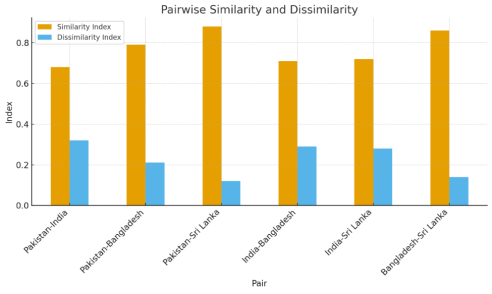
The comparative alignment of the curricula is visually represented in
Figure 1. The data indicates that the pairs of Pakistan, Sri Lanka (0.88) and Bangladesh, Sri Lanka (0.86) exhibit the highest similarity indices within the region. Conversely, the Pakistan, India pair shows a lower index of 0.68, suggesting a more distinct divergence in educational frameworks. As illustrated, the y-axis represents the similarity coefficient (0-1.0), highlighting the variations in regional educational priorities.
Figure 1. Comparison of Similarity and Dissimilarity Indices between Country Pairs.
8.4. Pie Chart Description
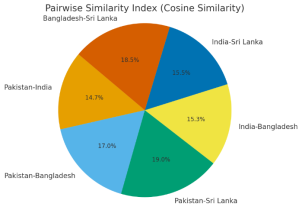
The aggregate relationship between regional curricula is illustrated in
Figure 2. A thematic analysis of the datasets reveals a substantial overlap, with similarity accounting for 78% of the total indices. This dominance underscores a regional consensus on core competencies and learner-centred methodologies. The remaining 22% represents the dissimilarity index, which reflects country-specific cultural nuances, varied linguistic policies, and unique national educational priorities.
Figure 2. Aggregate Percentage Distribution of Curricular Similarity vs. Dissimilarity.
8.5. Heatmap Analysis of Regional Curricular Trends
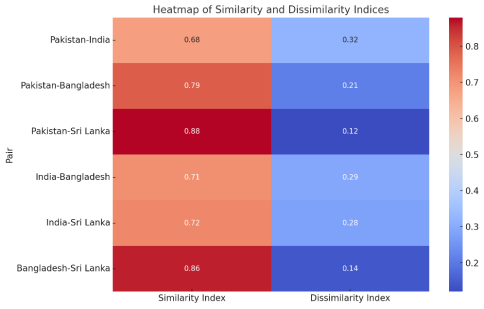
The similarity scores presented in
Figure 3 indicate a largely unified approach to early English education across the South Asian region. These high levels of convergence suggest substantial opportunities for regional collaboration and the exchange of best practices. However, the observed variations remain significant, as each nation adapts its framework to align with specific linguistic requirements and cultural contexts. These localized modifications ensure that the curricula remain relevant to the unique demographic needs of each country while maintaining a shared regional trajectory toward English proficiency.
Figure 3. Heatmap of Curricular Similarity Scores across South Asian Nations.
9. Key Insights
1) Beginning English: Sri Lanka and Pakistan start teaching English in Grade 1 (Sri Lanka places a lot of emphasis on oral communication). India's NCF-SE 2023 prioritises mother tongue in the early years and keeps English later/formalized in Grades 3-5. Bangladesh uses English for Today to teach English in primary school.
2) Pedagogy trend: Instead of focusing on rote grammar, all four emphasize competencies, activity-based learning, and integration of LSRW.
3) Assessment: Clear shift to formative assessment, especially in India (Foundational) and Bangladesh (NCF-2021).
10. Conclusion
This study provides a comprehensive comparative analysis of primary-level English language education in Pakistan, India, Sri Lanka, and Bangladesh, highlighting both similarities and dissimilarities in their national curricula. The study findings recommend that all four countries emphasize learner-centered pedagogy, foundational literacy, and competency-based approaches, however they differ in the integration of cultural identity, linguistic range, and global standards. Pakistan’s Single National Curriculum (SNC 2020) reflects a shift towards inclusivity and conceptual learning, whereas India’s NCFSE 2023 strongly advocates multilingual education and foundational literacy. Bangladesh’s NCF 2021 highlights democratic citizenship and integrated competencies, while Sri Lanka’s curriculum promotes ethnic harmony and modular reforms.
The use of cosine similarity metrics enhances the qualitative findings by quantitatively demonstrating solid curricular overlaps between Pakistan–Sri Lanka and Bangladesh–Sri Lanka. It also highlights gaps in multilingual policy formulation and socio-cultural contextualization. This mixed-method approach underlines the value of combining content analysis with computational tools to enrich educational research. Overall, this research contributes towards regional policy discourse by classifying best practices and gaps in early English language education. It advocates for increased collaboration among South Asian countries to balance global literacy competencies with cultural and linguistic diversity to ensure equitable access to quality education. These insights provide policymakers, educators, and curriculum developers with a framework for reforming and complementing early language education to prepare better citizens for global challenges while preserving local identities.
Abbreviations
SNC | Single National Curriculum (Pakistan) |
NCFSE | National Curriculum Framework for School Education (India) |
NCF | National Curriculum Framework (Bangladesh) |
NEP | National Education Policy (India) |
FLN | Foundational Literacy and Numeracy |
ICC | Intercultural Communicative Competence |
CLT | Communicative Language Teaching |
LSRW | Listening, Speaking, Reading, and Writing |
ERA | Environmental Related Activities |
VARK | Visual, Auditory, Read/Write, and Kinesthetic (Learning Styles) |
TPR | Total Physical Response |
ICT | Information and Communication Technology |
HPC | Holistic Progress Card |
BoW | Bag-of-Words |
Author Contributions
Danish Sarfraz: Conceptualization, Formal Analysis, Funding acquisition, Investigation, Methodology, Writing – original draft, Writing – review & editing
Zahida Batool: Conceptualization, Formal Analysis, Investigation, Methodology, Project administration, Supervision, Validation, Writing – review & editing
Nida Nayyar: Formal Analysis, Investigation, Validation, Visualization, Writing – review & editing
Sana Mudassar: Resources, Supervision, Validation, Visualization, Writing – review & editing
Sharoon Bhatti: Formal Analysis, Investigation, Methodology, Project administration, Visualization, Writing – review & editing
Conflicts of Interest
The authors declare no conflicts of interest.
References
| [1] |
National Curriculum COuncil, Ministry of Federal Education and Professional Training, Pakistan, “Single National Curriculum: English Grades I–V, Government of Pakistan,” 2020. [Online]. Available:
https://pectaa.edu.pk/uploads/SNC-2020/English_12th_August.pdf
|
| [2] |
Government of India, Ministry of Education, 2023, “National Council of Educational Research and Training, National Curriculum Framework for School Education 2023,” 2023. [Online]. Available:
https://ncf.ncert.gov.in
|
| [3] |
Government of the People’s Republic of Bangladesh, Ministry of Education, 2021, “National Curriculum and Textbook Board, National Curriculum Framework 2021,” 2021. [Online]. Available:
https://nctb.gov.bd
|
| [4] |
Government of Sri Lanka, Ministry of Education, 2015, “National Institute of Education, Activity-Based Oral English Syllabus: Grades 1–2,” 2015. [Online]. Available:
https://www.nie.ac.lk/
|
| [5] |
Government of Sri Lanka, Ministry of Education, 2015, "National Institute of Education, English Teacher’s Guide: Grade 5,” 2015. [Online]. Available:
https://nie.lk
|
| [6] |
Government of the People’s Republic of Bangladesh, Ministry of Education, “National Curriculum and Textbook Board, English Language Teaching in Bangladesh: Curriculum and Pedagogy 2018,” 2018. [Online]. Available:
https://nctb.gov.bd
|
| [7] |
Government of Sri Lanka, Ministry of Education, 2016, “National Institute of Education, English Language Teaching in Sri Lanka: Policy and Practice,” 2016. [Online]. Available:
https://nie.lk
|
| [8] |
National Curriculum Council (NCC), Ministry of Federal Education and Professional Training, Pakistan, “Glossary of Curriculum Terms: A Dictionary for Educational Standards,” 2022. [Online]. Available:
https://pportal.punjab.gov.pk
|
| [9] |
Punjab Education Foundation, “Dictionary of Pedagogical Terms for Primary Education in Pakistan,” 2021. [Online]. Available:
https://pef.edu.pk
|
| [10] |
UNESCO, “Global Monitoring Report: Comparative Analysis of Primary Curricula in South Asia,” 2022. [Online]. Available:
https://unesco.org
|
| [11] |
Rahman, T., “Language and Politics in Pakistan: A Study of English Language Education Policy,” Oxford University Press, 2020.
|
| [12] |
National Council of Educational Research and Training (NCERT), “Dictionary of Education for Primary Schools,” India, 2021. [Online]. Available:
https://ncert.nic.in
|
| [13] |
British Council, “English in South Asia: A Report on Policy and Practice in Pakistan, India, and Bangladesh,” 2023. [Online]. Available:
https://britishcouncil.org
|
| [14] |
Ministry of Primary and Mass Education, Bangladesh, “Glossary of Competency-Based Learning Terms,” 2021. [Online]. Available:
https://mopme.gov.bd
|
| [15] |
Smith, J. and Lee, S., “Quantitative Text Analysis in Curriculum Studies: Using Cosine Similarity to Map Educational Policy,” Journal of Comparative Education, vol. 45, no. 2, pp. 112–128, 2023.
|
Cite This Article
-
APA Style
Sarfraz, D., Batool, Z., Nayyar, N., Mudassar, S., Bhatti, S. (2026). Comparative Analysis of South Asian Primary English Curricula: Evaluating National Frameworks in Pakistan (2020), India (2023), Sri Lanka, and Bangladesh (2021). International Journal of Education, Culture and Society, 11(2), 69-78. https://doi.org/10.11648/j.ijecs.20261102.16
 Copy
|
Copy
|
 Download
ACS Style
Sarfraz, D.; Batool, Z.; Nayyar, N.; Mudassar, S.; Bhatti, S. Comparative Analysis of South Asian Primary English Curricula: Evaluating National Frameworks in Pakistan (2020), India (2023), Sri Lanka, and Bangladesh (2021). Int. J. Educ. Cult. Soc. 2026, 11(2), 69-78. doi: 10.11648/j.ijecs.20261102.16
Copy
|
Download
AMA Style
Sarfraz D, Batool Z, Nayyar N, Mudassar S, Bhatti S. Comparative Analysis of South Asian Primary English Curricula: Evaluating National Frameworks in Pakistan (2020), India (2023), Sri Lanka, and Bangladesh (2021). Int J Educ Cult Soc. 2026;11(2):69-78. doi: 10.11648/j.ijecs.20261102.16
Copy
|
Download
-
@article{10.11648/j.ijecs.20261102.16,
  author = {Danish Sarfraz and Zahida Batool and Nida Nayyar and Sana Mudassar and Sharoon Bhatti},
  title = {Comparative Analysis of South Asian Primary English Curricula: Evaluating National Frameworks in Pakistan (2020), India (2023), Sri Lanka, and Bangladesh (2021)},
  journal = {International Journal of Education, Culture and Society},
  volume = {11},
  number = {2},
  pages = {69-78},
  doi = {10.11648/j.ijecs.20261102.16},
  url = {https://doi.org/10.11648/j.ijecs.20261102.16},
  eprint = {https://article.sciencepublishinggroup.com/pdf/10.11648.j.ijecs.20261102.16},
  abstract = {The current study presents a comparative analysis of national curriculum frameworks of Pakistan, India, Sri Lanka and Bangladesh for English Language education at pre-primary and primary levels. It helped gaining the idea how does each country conceptualize the learning of English Language at early stages through curriculum standards, pedagogy, skill development and assessment. A mixed-method approach helped combining qualitative content analysis with quantitative text-mining techniques e.g. Bag-of-Words and cosine similarity. Competency-based design, emphasis on oral skills, learner-centered pedagogy and formative assessment were among commonalities whereas the difference was among thematic areas; the focus of India is on multilingualism, Pakistan’s on ethical literacy, Bangladesh’s on intercultural competence and Sri Lanka’s on ethnic harmony and environmental awareness. These differences present unique cultural and political contexts but share a regional commitment to inclusivity and sustainable development. The study proposes a practical model for regional and policy harmonization through cross- national curriculum research.},
 year = {2026}
}
Copy
|
Download
-
TY  - JOUR
T1  - Comparative Analysis of South Asian Primary English Curricula: Evaluating National Frameworks in Pakistan (2020), India (2023), Sri Lanka, and Bangladesh (2021)
AU  - Danish Sarfraz
AU  - Zahida Batool
AU  - Nida Nayyar
AU  - Sana Mudassar
AU  - Sharoon Bhatti
Y1  - 2026/04/15
PY  - 2026
N1  - https://doi.org/10.11648/j.ijecs.20261102.16
DO  - 10.11648/j.ijecs.20261102.16
T2  - International Journal of Education, Culture and Society
JF  - International Journal of Education, Culture and Society
JO  - International Journal of Education, Culture and Society
SP  - 69
EP  - 78
PB  - Science Publishing Group
SN  - 2575-3363
UR  - https://doi.org/10.11648/j.ijecs.20261102.16
AB  - The current study presents a comparative analysis of national curriculum frameworks of Pakistan, India, Sri Lanka and Bangladesh for English Language education at pre-primary and primary levels. It helped gaining the idea how does each country conceptualize the learning of English Language at early stages through curriculum standards, pedagogy, skill development and assessment. A mixed-method approach helped combining qualitative content analysis with quantitative text-mining techniques e.g. Bag-of-Words and cosine similarity. Competency-based design, emphasis on oral skills, learner-centered pedagogy and formative assessment were among commonalities whereas the difference was among thematic areas; the focus of India is on multilingualism, Pakistan’s on ethical literacy, Bangladesh’s on intercultural competence and Sri Lanka’s on ethnic harmony and environmental awareness. These differences present unique cultural and political contexts but share a regional commitment to inclusivity and sustainable development. The study proposes a practical model for regional and policy harmonization through cross- national curriculum research.
VL  - 11
IS  - 2
ER  -
Copy
|
Download





 Share This Article
 Twitter
 Linked In
 Facebook