Abstract
This work proposes a combined integration approach for a photovoltaic (PV) system and a Unified Power Quality Conditioner (UPQC) in order to simultaneously improve the power quality and energy efficiency of distribution networks. The study aims to determine the optimal positioning and sizing of these two devices in the standard IEEE 69-bus radial distribution network, using multi-objective optimization. The goal is to minimize active and reactive power losses while improving the voltage profile of the network. The optimization problem is solved using Genetic Algorithms, combined with the Backward/Forward Sweep (BFS) power flow calculation method, which is particularly suited to radial networks. The results show that combined integration (PV + UPQC) offers significantly better performance than individual integrations. Active losses decrease from 224.93 kW to 48.45 kW (a reduction of 78.46%), while reactive losses decrease from 102.14 kVAr to 25.95 kVAr (a reduction of 74.60%). In addition, the minimum grid voltage is improved from 0.90919 p.u. to 0.96791 p.u. These results validate the effectiveness of the multi-objective approach using genetic algorithms for the optimal dimensioning and stabilization of distribution networks integrating renewable sources and active compensation devices.
Keywords
Multi-Objective Optimization, Genetic Algorithm, UPQC, Photovoltaic (PV) System, Radial Distribution Network,
Power Quality
1. Introduction
Global population growth and increased industrialization are driving exponential energy demand, placing unprecedented pressure on existing electricity distribution networks. These networks, often designed in a radial and unidirectional manner, face major challenges, including line losses (active and reactive) and voltage profile degradation
.
Historically, improving power quality and compensating for reactive power relied on passive devices such as capacitors, reactors or phase-shifting transformers. However, with the increase in non-linear loads and the need for dynamic and rapid compensation, these static solutions are often proving insufficient
| [2] | O. I. Hassane, « Multi-criteria optimization of capacitor and DSTATCOM positioning in a distribution network » [in French], Thesis, Dept. Elect. Eng., University of Abomey-Calavi, Cotonou, Benin, 2023. |
[2]
.
The growing integration of renewable energies, particularly photovoltaic (PV) systems, is a sustainable solution. PV helps reduce dependence on fossil fuels and transmission losses through local injection of active power. However, its intermittent and unpredictable nature can cause voltage fluctuations and power imbalances if its management is not optimized
| [3] | J. Fengli, P. Zailin, W. Shihong, H. Rui, et Z. Yunan, « Power flow calculation for radial distribution systems with distributed generation », in 2012 IEEE International Conference on Mechatronics and Automation, IEEE, 2012, p. 1287-1291.
https://doi.org/10.1109/ICMA.2012.6284321 |
| [4] | L. Xia, X. Lin, R. Zhou, et K. Zhang, « Research on Multi-Objective Reactive Power Optimization of Distribution Grid with Photovoltaics », World Electr. Veh. J., vol. 16, no 2, p. 70, 2025, https://doi.org/10.3390/wevj16020070 |
| [5] | S. Lakshmi et S. Ganguly, « Simultaneous optimisation of photovoltaic hosting capacity and energy loss of radial distribution networks with open unified power quality conditioner allocation », IET Renew. Power Gener, vol. 12, no 12, p. 1382-1389, sept. 2018,
https://doi.org/10.1049/iet-rpg.2018.5389 |
| [6] | A. H. SOMBORO, D. COULIBALY, et M. GUINDO, « Impact of the injection of output from the 33 MWp solar photovoltaic power plant on Mali's interconnected grid in static operation» [in French], Afr. Sci., vol. 22, no 2, p. 58-73, janv. 2023,
https://doi.org/22(2)%20(2023)%2058%20-%2073 |
[3-6]
.
To mitigate these effects, power electronics devices such as the Unified Power Quality Conditioner (UPQC) play a crucial role. The UPQC combines a series active filter (DVR) and a parallel active filter (D-STATCOM), enabling simultaneous compensation for voltage, current and harmonic problems
| [7] | R. Sirjani et A. R. Jordehi, « Optimal placement and sizing of distribution static compensator (D-STATCOM) in electric distribution networks: A review », Renew. Sustain. Energy Rev., vol. 77, p. 688-694, 2017,
http://dx.doi.org/10.1016/j.rser.2017.04.035 |
| [8] | A. Ebrahimi, M. Moradlou, M. Bigdeli, et M. R. Mashhadi, « Optimal sizing and allocation of PV-DG and DSTATCOM in the distribution network with uncertainty in consumption and generation », Discov. Appl. Sci., vol. 7, no 5, p. 411, avr. 2025,
https://doi.org/10.1007/s42452-025-06870-0 |
| [9] | K. Gaddala et P. Sangameswara Raju, « Optimal UPQC location in power distribution network via merging genetic and dragonfly algorithm », Evol. Intell., vol. 15, no 2, p. 1219-1232, juin 2022, https://doi.org/10.1007/s12065-020-00364-1 |
[7-9]
.
The synergistic integration of PV and UPQC represents a promising solution. PV provides active energy, while UPQC ensures grid stability, using the common DC bus for energy transfer and quality improvement
,
11]. While many studies address the placement of a single device (PV or UPQC), the main contribution of this work is the simultaneous and multi-objective co-optimization of the sizing and placement of both devices (PV and UPQC) in a single integrated model. This approach is essential to fully capture the synergistic benefits and achieve a true system-wide optimum, demonstrating a performance significantly superior to individual placement scenarios. The effectiveness of such devices (PV and UPQC) is highly dependent on their optimal location and sizing within the distribution network
,
13].
Suboptimal placement can not only negate the expected benefits, but also introduce new disturbances. To solve this problem, a Multi-Objective Optimization (OMO) approach is adopted. Unlike single-objective methods, OMO allows several criteria to be balanced simultaneously, such as minimizing active and reactive losses and improving the voltage profile
,
15]. The objective of this work is therefore to determine the optimal size and location of the PV and UPQC in the IEEE 69-bus network, by applying a Genetic Algorithm
,
17] coupled with the Backward/Forward Sweep (BFS) power flow method
,
19].
2. Materials and Methods
2.1. The Test Network
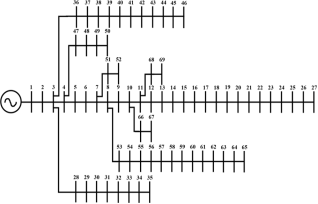
The study is conducted on the standard IEEE 69-bus radial distribution network (
Figure 1). This test network consists of 69 nodes and 68 branches
| [2] | O. I. Hassane, « Multi-criteria optimization of capacitor and DSTATCOM positioning in a distribution network » [in French], Thesis, Dept. Elect. Eng., University of Abomey-Calavi, Cotonou, Benin, 2023. |
[2]
.
Its basic features are:
1) Basic power: 100 MVA
2) Basic voltage: 12, 66 KV
2.2. Modelling Photovoltaic (PV) Power Generation
The photovoltaic system is modelled by injecting active power at a node on bus . The assumption used for this study is that the PV operates at unity power factor. Consequently, the reactive power injected by the PV is considered to be zero, .
The new active power is injected at bus () is given by the equation:
Where is the active power at node (kW) and is the active power injected by the PV (kW).
2.3. Modelling of the UPQC
The UPQC is a customized power device designed to improve power quality. It is conceptually modelled by combining a distribution static compensator (D-STATCOM) and a dynamic voltage restorer (DVR).
For the purpose of this static multi-objective optimization problem, which utilizes the Backward/Forward Sweep (BFS) power flow method, the UPQC is modeled exclusively by its impact on power injection. The primary benefit of the UPQC in this static analysis is the dynamic compensation of reactive power, which directly influences the power losses and the voltage profile.
Therefore, the UPQC is treated as a shunt static compensator (D-STATCOM) capable of injecting or absorbing reactive power () at the optimally determined bus .
The power balance equation for a bus where the UPQC is installed is modified as follows:
Where:
is the total reactive power at bus after compensation (kVAr).
is the initial reactive power demand at bus (kVAr).
is the reactive power injected by the UPQC (kVAr).
The detailed dynamic control strategies (such as SRF, PQ theory, DC-link control, and PWM strategy) are necessary for transient studies but are omitted here as they do not influence the steady-state load flow calculations used for sizing and placement.
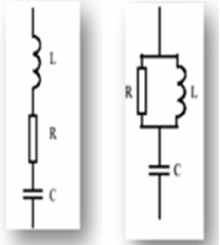
Figure 2. Serial and Parallel Active Filter.
3. Problem Formulation
The main objective of this study is to simultaneously optimize the IEEE 69-bus network by integrating PV and UPQC. The problem is formulated as a multi-objective optimization aimed at minimizing power losses and improving the voltage profile of the network
| [20] | M. Duong, T. Pham, T. Nguyen, A. Doan, et H. Tran, « Determination of Optimal Location and Sizing of Solar Photovoltaic Distribution Generation Units in Radial Distribution Systems », Energies, vol. 12, no 1, p. 174, janv. 2019,
https://doi.org/10.3390/en12010174 |
[20]
.
3.1. Decision Vector
The decision vector is defined as follows:
(3)
Where: and are the location (bus index) and capacity (kW) of the Photovoltaic system, and are the location (bus index) and reactive power capacity (kVAr) of the UPQC.
3.2. Function Objective
The objective functions are technical in nature, minimizing both active losses and voltage instability on the grid by minimizing voltage deviation:
The problem involves two conflicting objectives: minimizing power losses (F1) and minimizing the voltage deviation from the nominal value (F2). To solve this multi-objective problem using the standard Genetic Algorithm, the objectives are aggregated into a single function, F(x), using the Weighted Sum Method. This approach converts the two objective functions into a single fitness function by assigning a weight to each objective.
To ensure both objectives are treated equally regardless of their magnitude, they are first normalized with respect to their values in the base case (without PV or UPQC). The aggregated objective function F(x) to be minimized is defined as:
Minimize(4)
Where:
and are the values of and for the base case scenario (no PV, no UPQC).
and are the weighting factors. In this study, and are chosen to reflect an equal priority between loss minimization and voltage profile improvement.
Equal weights were selected to provide a balanced priority between technical efficiency (loss reduction) and power quality (voltage profile stability), as both are equally critical for the optimal operation of the distribution network.
3.3. Constraints Involved
In order to ensure the physical and secure operation of the network, the following constraints are imposed on the optimization program
| [21] | A. Manjula et G. Yesuratnam, « Optimal allocation of PV units using metaheuristic optimization considering PEVs charging demand », Int. J. Appl. Power Eng. IJAPE, vol. 14, no 2, p. 282-290, juin 2025,
https://doi.org/10.11591/ijape.v14.i2.pp282-290 |
[21]
:
3.3.1. Voltage Constraints at Nodes
To ensure energy stability and quality, the voltage level at each node of bus must be maintained within a predefined range.
(5)
3.3.2. Power Injection Constraints (PV and UPQC)
The power of PV is limited:
The power of the UPQC is limited:
(7)
3.4. Genetic Algorithm Parameters
The performance and convergence of the Genetic Algorithm strongly depend on the selection of its parameters. The Genetic Algorithm was implemented in MATLAB, and the parameters were tuned based on established practices and iterative tests to ensure a balance between exploration (diversity) and exploitation (convergence speed). The parameters used for the optimization are detailed in
Table 1:
Table 1. Optimization Parameter.
Parameter | Value |
Population Size | 100 |
Number of Generations (Stopping Criterion) | 100 |
Crossover Rate | 0.85 |
Mutation Rate | 0.2 |
3.5. Algorithm and Resolution Tool
The multi-objective optimization problem formulated above is solved using the following approach:
Power flow: calculated using the Backward/Forward Sweep (BFS) method, adapted to radial networks.
Optimization: performed by Genetic Algorithm, which efficiently explores the multi-objective search space.
Simulation tool: MATLAB.
4. Analysis of Results and Discussions
This section presents the simulation results of the integration of the PV system and the UPQC, first separately, then in combination, on the IEEE 69-bus test network. The objective is to estimate the impact of each device on power losses (active and reactive) and the improvement in the voltage profile.
4.1. Individual Optimization Scenarios
The sequential approach allows the effectiveness of the Genetic Algorithm in determining the best location for each device to be evaluated.
4.1.1. PV Only Scenario
The integration of a single photovoltaic (PV) source on the optimal bus (bus 61 for a capacity of 1 MW), determined by the Genetic Algorithm, demonstrates marked efficiency in reducing power losses. The injection of active power by the PV directly reduces the current in the lines, which translates into a reduction in ohmic losses. Compared to the base case, active losses were reduced by 50.41% (from 224.93 kW to 111.54 kW), and reactive losses by 47.52% (from 102.14 kVAr to 53.596 kVAr). In terms of voltage quality, the profile has also been improved, with the minimum voltage increasing from 0.90919 p.u. to 0.94783 p.u., and the quadratic deviation decreasing to 0.0450 p.u. instead of 0.0993 p.u.
4.1.2. Unified Power Quality Conditioner Scenario UPQC
The optimal location of the UPQC alone (at bus 61 for an optimal capacity of 1.33MVAr) was determined based on its ability to compensate for reactive energy and correct voltage fluctuations. Although the UPQC is a power quality compensation device, it also contributes to reducing system losses. This scenario shows a reduction in active losses of 32.42% (from 224.93 kW to 152 kW) and reactive losses of 30.99% (from 102.14 kVAr to 70.487 kVAr). The impact on stability is significant, with a reduced quadratic voltage deviation of 0.0640 p.u., confirming that UPQC enhances the stability of the distribution network.
4.1.3. Comparison of PV and UPQC Results
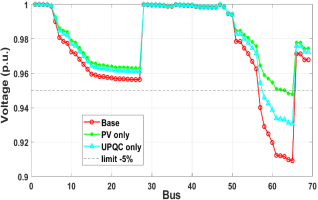
According to the summary and comparison in
Table 2 and
Figure 3, integrating a PV system minimizes losses and stabilizes the grid better than installing a UPQC.
The selection of Bus 61 by the Genetic Algorithm is justified by the network topology and the base case analysis. In the initial uncompensated scenario, Bus 61 is identified as the bus with the lowest voltage profile (0.90919 p.u.). Placing the compensating devices at this critical point maximizes the effectiveness of the voltage boost and, consequently, the reduction in network losses.
Table 2. Summary of Active Losses and Reactive Losses.
| Base | PV only | UPQC only |
| | | Reduction % | | Reduction % |
Active losses kW | 224, 93 | 111, 54 | 50, 41 | 152 | 32, 42 |
Reactive losses kVAr | 102, 14 | 53, 596 | 47, 52 | 70, 487 | 30, 99 |
The comparative analysis shows that PV alone offers better performance than UPQC alone, both in terms of loss reduction and voltage regulation. However, each technology acts on different levers: PV reduces active flows, while UPQC dynamically regulates reactive flows. These results suggest that joint injection could combine the advantages of both approaches.
Figure 3. Voltage Profile for Two Scenarios.
4.2. Combined Optimization Scenario for a PV and an UPQC
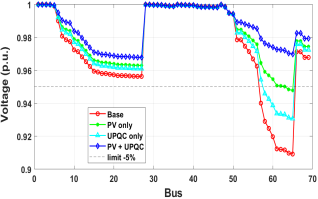
The combined scenario (
Figure 4) represents the application of multi-objective optimization aimed at combining the benefits of reducing PV losses and improving voltage quality through UPQC. All inject into bus 61 with a capacity of 1MW for PV and 1.44MVAr for UPQC.
Figure 4. Voltage Profile for All Scenarios.
The simulation results confirm the maximum efficiency of this synergy (
Table 3). The network achieves optimal performance with a 78.46% reduction in active losses (from 224.93 kW to 48.449 kW) and a 74.60% reduction in reactive losses (from 102.14 kVAr to 25.947 kVAr). The voltage profile is the most stable of all scenarios with an uneven voltage deviation of 0.0239 p.u., with the minimum voltage improved to 0.96791 p.u., significantly exceeding acceptable thresholds and validating the relevance of the Genetic Algorithm for solving this multi-objective problem in the distribution network.
Table 3. Results for All Scenarios.
Scenario | Active losses (KW) | Reactive losses (KVAr) | Minimum voltage (p.u.) |
Base | 224, 93 | 102, 14 | 0, 90919 |
PV only | 111, 54 | 53, 596 | 0, 94783 |
UPQC only | 152 | 70, 487 | 0, 93073 |
PV+ UPQC | 48, 449 | 25, 947 | 0, 96791 |
Comparison of active losses (base: 224, 93 kW)
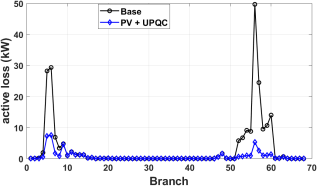
Active losses in the PV+UPQC scenario (
Figure 5) are significantly reduced by 78.46% compared to the losses initially estimated on the basic electricity distribution network.
Figure 5. Active Power Optimization PV+UPQC.
Comparison of reactive losses (base: 102, 14 kVA)
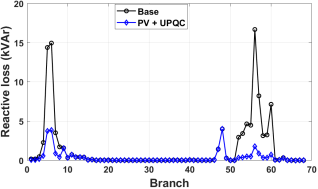
The PV+UPQC scenario (
Figure 6) also shows a significant reduction in reactive losses. The system is optimized with a reduction of 74.60% compared to the base network.
Figure 6. Reactive Power PV+UPQC.
The results of the simulations of these scenarios confirm that the optimization of the basic network's performance has been achieved. The network has been stabilized, with a significant reduction in active and reactive losses and perfect improvements in the basic voltage profile.
4.3. Benchmark Comparison with Other Optimization Methods
To assess the effectiveness of the proposed Genetic Algorithm-based approach, the results obtained are compared with those reported in the recent literature using other established meta-heuristic algorithms for similar problems (optimal placement of DG or UPQC) on the IEEE 69-bus network. As shown in
Table 4, the loss reduction achieved by our combined PV + UPQC approach using Genetic Algorithm significantly outperforms results obtained by single-device optimization or other comparative studies, demonstrating the high quality of the solution found by the Genetic Algorithm for this co-optimization problem.
Table 4. Benchmark Comparison.
Reference | Optimization Algorithm | Problem Solved | Loss Reduction (%) |
Our Work | GA | PV + UPQC | 78.46 |
| [22] | Y. K. Poudel, «Optimal Sizing and Placement of Distributed Generators and Capacitors in Nepal’s Sankhu Feeder Using the Water Cycle Algorithm», Int. J. Electr. Compon. Energy Convers., vol. 10, no 1, p. 15, 2024,
https://doi.org/10.11648/j.ijecec.20241001.12 |
[22] | Water Cycle Algorithm (WCA) | DG only | 69.14 |
| [23] | K. Gholami, S. Karimi, et E. Dehnavi, « Optimal unified power quality conditioner placement and sizing in distribution systems considering network reconfiguration », Int. J. Numer. Model. Electron. Netw. Devices Fields, vol. 32, no 1, p. e2467, janv. 2019, https://doi.org/10.1002/jnm.2467 |
[23] | PSO | UPQC Placement only | 73.05 |
| GA | DG + CAPACITOR | 58.17 |
It is important to clarify that this benchmark comparison is based on results directly reported in the cited literature and was not re-simulated under identical conditions by the authors.
5. Conclusions
This work proposed a multi-objective optimization method for the optimal sizing and placement of a PV system and an UPQC in the IEEE 69-bus network. The approach, based on a Genetic Algorithm combined with the Backward/Forward Sweep method, significantly reduced active and reactive losses and improved the voltage profile of the network.
The study first compared the performance of the devices alone (PV alone and UPQC alone) before validating the combined approach. The results confirm the superiority of joint optimization of the two devices. This scenario (PV + UPQC) reduced active losses from 224.93 kW to 48.449 kW, a significant reduction of 78.46% compared to the base network. Reactive losses were also optimized, falling from 102.14 kVAr to 25.947 kVAr, a reduction of 74.60%. The minimum network voltage was also improved, from 0.90919 p.u. to 0.96791 p.u., ensuring a stable voltage profile and complying with the network's operational constraints.
Thus, the coordinated integration of renewable generation and power conditioning devices is an effective strategy for stabilizing modern distribution networks and improving their energy efficiency. Future research could extend this study by investigating more advanced meta-heuristic algorithms, such as NSGA-III or the Multi-Objective Grey Wolf Optimizer (MOGWO), and by incorporating the impact of time-varying load profiles and uncertainty in solar irradiance to further refine the optimization results.
Abbreviations
PV | Photovoltaic |
UPQC | Unified Power Quality Conditioner |
OMO | Multi-Objective Optimization |
IEEE | Institute of Electrical and Electronic Engineers |
kVA | Kilovolt-Ampere |
kVAr | Kilovolt-Ampere Reactive |
p.u | Per Unit |
Acknowledgments
The authors gratefully acknowledge the reviewers of this paper for their valuable advice and guidance.
Author Contributions
Hassane Ousseyni Ibrahim: Conceptualization, Resources
Massalatchi Dankaoura Moustapha: Data curation, Methodology
Moussa Gonda: Formal Analysis, Investigation
Abdoul Malik Maman Issaka: Formal Analysis, Investigation
Conflicts of Interest
The authors declare no conflicts of interest.
References
| [1] |
O. O. Oluwole, « Optimal allocation of distributed generation for power loss reduction and voltage profile improvement », masters, University of Cape Town South Africa, 2016. online:
https://open.uct.ac.za/server/api/core/bitstreams/45e210de-feea-49d9-a5b4-047ebb6a32fc/content
|
| [2] |
O. I. Hassane, « Multi-criteria optimization of capacitor and DSTATCOM positioning in a distribution network » [in French], Thesis, Dept. Elect. Eng., University of Abomey-Calavi, Cotonou, Benin, 2023.
|
| [3] |
J. Fengli, P. Zailin, W. Shihong, H. Rui, et Z. Yunan, « Power flow calculation for radial distribution systems with distributed generation », in 2012 IEEE International Conference on Mechatronics and Automation, IEEE, 2012, p. 1287-1291.
https://doi.org/10.1109/ICMA.2012.6284321
|
| [4] |
L. Xia, X. Lin, R. Zhou, et K. Zhang, « Research on Multi-Objective Reactive Power Optimization of Distribution Grid with Photovoltaics », World Electr. Veh. J., vol. 16, no 2, p. 70, 2025,
https://doi.org/10.3390/wevj16020070
|
| [5] |
S. Lakshmi et S. Ganguly, « Simultaneous optimisation of photovoltaic hosting capacity and energy loss of radial distribution networks with open unified power quality conditioner allocation », IET Renew. Power Gener, vol. 12, no 12, p. 1382-1389, sept. 2018,
https://doi.org/10.1049/iet-rpg.2018.5389
|
| [6] |
A. H. SOMBORO, D. COULIBALY, et M. GUINDO, « Impact of the injection of output from the 33 MWp solar photovoltaic power plant on Mali's interconnected grid in static operation» [in French], Afr. Sci., vol. 22, no 2, p. 58-73, janv. 2023,
https://doi.org/22(2)%20(2023)%2058%20-%2073
|
| [7] |
R. Sirjani et A. R. Jordehi, « Optimal placement and sizing of distribution static compensator (D-STATCOM) in electric distribution networks: A review », Renew. Sustain. Energy Rev., vol. 77, p. 688-694, 2017,
http://dx.doi.org/10.1016/j.rser.2017.04.035
|
| [8] |
A. Ebrahimi, M. Moradlou, M. Bigdeli, et M. R. Mashhadi, « Optimal sizing and allocation of PV-DG and DSTATCOM in the distribution network with uncertainty in consumption and generation », Discov. Appl. Sci., vol. 7, no 5, p. 411, avr. 2025,
https://doi.org/10.1007/s42452-025-06870-0
|
| [9] |
K. Gaddala et P. Sangameswara Raju, « Optimal UPQC location in power distribution network via merging genetic and dragonfly algorithm », Evol. Intell., vol. 15, no 2, p. 1219-1232, juin 2022,
https://doi.org/10.1007/s12065-020-00364-1
|
| [10] |
A. Ranjan et J. Choudhary, « Meta-heuristic-based power quality improvement in UPQC-based grid-connected hybrid renewable energy system », Multimed. Tools Appl., vol. 84, no 15, p. 14553-14582, juin 2024,
https://doi.org/10.1007/s11042-024-18729-4
|
| [11] |
D. Lu, W. Li, L. Zhang, Q. Fu, Q. Jiao, et K. Wang, « Multi-objective optimization and reconstruction of distribution networks with distributed power sources based on an improved BPSO algorithm », Energies, vol. 17, no 19, p. 4877, 2024,
https://doi.org/10.3390/en17194877
|
| [12] |
J. S. Espinosa Gutiérrez et A. Aguila Téllez, « Optimal Placement of a Unified Power Quality Conditioner (UPQC) in Distribution Systems Using Exhaustive Search to Improve Voltage Profiles and Harmonic Distortion », Energies, vol. 18, no 17, p. 4499, 2025,
https://doi.org/10.3390/
en18174499
|
| [13] |
T. H. B. Huy, D. N. Vo, K. H. Truong, et T. Van Tran, « Optimal distributed generation placement in radial distribution networks using enhanced search group algorithm », IEEE Access, vol. 11, p. 103288-103305, 2023,
https://doi.org/10.1109/ACCESS.2023.3316725
|
| [14] |
J.-K. Hao et C. Solnon, « Metaheuristics », online:
https://leria-info.univ-angers.fr/~jinkao.hao/papers/IAMeta2012.pdf
|
| [15] |
A. Zhou, B.-Y. Qu, H. Li, S.-Z. Zhao, P. N. Suganthan, et Q. Zhang, « Multiobjective evolutionary algorithms: A survey of the state of the art », Swarm Evol. Comput., vol. 1, no 1, p. 32-49, mars 2011,
https://doi.org/10.1016/j.swevo.2011.03.001
|
| [16] |
J. H. Holland, « GENETIC ALGORITHMS AND CLASSIFIER SYSTEMS: FOUNDATIONS AND FUTURE DIRECTIONS », Int. Conf. Genet. Algorithms Their Appl., 1987.
|
| [17] |
BENHAMA Abdelouhab et BENKHELOUF Yacine, « Comparative study of multi-objective genetic algorithms » [in French], University Abderrahmane MIRA of Bejaia, 2015.
|
| [18] |
J.-H. Teng, «A direct approach for distribution system load flow solutions», IEEE Trans. Power Deliv., vol. 18, no 3, p. 882-887, juill. 2003,
https://doi.org/10.1109/TPWRD.2003.813818
|
| [19] |
I. Chaker, J.-M. Reboul, D. Houivet, H. Gualous, et H. A. Barkad, « Genetic algorithm applied to energy management at a multi-source power plant installed at the University of Djibouti » [in French], in annual conferences of GDR SEEDS and JCGE 2022, Le Croisic (Loire Atlantique), France: CNRS, June 2022. online:
https://hal.science/hal-04062442
|
| [20] |
M. Duong, T. Pham, T. Nguyen, A. Doan, et H. Tran, « Determination of Optimal Location and Sizing of Solar Photovoltaic Distribution Generation Units in Radial Distribution Systems », Energies, vol. 12, no 1, p. 174, janv. 2019,
https://doi.org/10.3390/en12010174
|
| [21] |
A. Manjula et G. Yesuratnam, « Optimal allocation of PV units using metaheuristic optimization considering PEVs charging demand », Int. J. Appl. Power Eng. IJAPE, vol. 14, no 2, p. 282-290, juin 2025,
https://doi.org/10.11591/ijape.v14.i2.pp282-290
|
| [22] |
Y. K. Poudel, «Optimal Sizing and Placement of Distributed Generators and Capacitors in Nepal’s Sankhu Feeder Using the Water Cycle Algorithm», Int. J. Electr. Compon. Energy Convers., vol. 10, no 1, p. 15, 2024,
https://doi.org/10.11648/j.ijecec.20241001.12
|
| [23] |
K. Gholami, S. Karimi, et E. Dehnavi, « Optimal unified power quality conditioner placement and sizing in distribution systems considering network reconfiguration », Int. J. Numer. Model. Electron. Netw. Devices Fields, vol. 32, no 1, p. e2467, janv. 2019,
https://doi.org/10.1002/jnm.2467
|
| [24] |
R. Wibowo et O. Seto, « Optimal placement of intermittent DG renewable energy and capacitor bank for power losses reduction and voltage profile improvement in microgrids systems », J. Eng. Sci. Technol., vol. 17, no 5, p. 3539-3554, 2022, online:
http://jestec.taylors.edu.my/Vol%2017%20Issue%205%20October%202022/17_5_36.pdf
|
Cite This Article
-
APA Style
Ibrahim, H. O., Moustapha, M. D., Gonda, M., Issaka, A. M. M. (2026). Multi-Objective Optimization of the Combined Sizing and Placement of a PV System and an UPQC in an IEEE 69-Bus Distribution Network Using a Genetic Algorithm. International Journal of Energy and Power Engineering, 15(1), 37-44. https://doi.org/10.11648/j.ijepe.20261501.13
 Copy
|
Copy
|
 Download
ACS Style
Ibrahim, H. O.; Moustapha, M. D.; Gonda, M.; Issaka, A. M. M. Multi-Objective Optimization of the Combined Sizing and Placement of a PV System and an UPQC in an IEEE 69-Bus Distribution Network Using a Genetic Algorithm. Int. J. Energy Power Eng. 2026, 15(1), 37-44. doi: 10.11648/j.ijepe.20261501.13
Copy
|
Download
AMA Style
Ibrahim HO, Moustapha MD, Gonda M, Issaka AMM. Multi-Objective Optimization of the Combined Sizing and Placement of a PV System and an UPQC in an IEEE 69-Bus Distribution Network Using a Genetic Algorithm. Int J Energy Power Eng. 2026;15(1):37-44. doi: 10.11648/j.ijepe.20261501.13
Copy
|
Download
-
@article{10.11648/j.ijepe.20261501.13,
  author = {Hassane Ousseyni Ibrahim and Massalatchi Dankaoura Moustapha and Moussa Gonda and Abdoul Malik Maman Issaka},
  title = {Multi-Objective Optimization of the Combined Sizing and Placement of a PV System and an UPQC in an IEEE 69-Bus Distribution Network Using a Genetic Algorithm},
  journal = {International Journal of Energy and Power Engineering},
  volume = {15},
  number = {1},
  pages = {37-44},
  doi = {10.11648/j.ijepe.20261501.13},
  url = {https://doi.org/10.11648/j.ijepe.20261501.13},
  eprint = {https://article.sciencepublishinggroup.com/pdf/10.11648.j.ijepe.20261501.13},
  abstract = {This work proposes a combined integration approach for a photovoltaic (PV) system and a Unified Power Quality Conditioner (UPQC) in order to simultaneously improve the power quality and energy efficiency of distribution networks. The study aims to determine the optimal positioning and sizing of these two devices in the standard IEEE 69-bus radial distribution network, using multi-objective optimization. The goal is to minimize active and reactive power losses while improving the voltage profile of the network. The optimization problem is solved using Genetic Algorithms, combined with the Backward/Forward Sweep (BFS) power flow calculation method, which is particularly suited to radial networks. The results show that combined integration (PV + UPQC) offers significantly better performance than individual integrations. Active losses decrease from 224.93 kW to 48.45 kW (a reduction of 78.46%), while reactive losses decrease from 102.14 kVAr to 25.95 kVAr (a reduction of 74.60%). In addition, the minimum grid voltage is improved from 0.90919 p.u. to 0.96791 p.u. These results validate the effectiveness of the multi-objective approach using genetic algorithms for the optimal dimensioning and stabilization of distribution networks integrating renewable sources and active compensation devices.},
 year = {2026}
}
Copy
|
Download
-
TY  - JOUR
T1  - Multi-Objective Optimization of the Combined Sizing and Placement of a PV System and an UPQC in an IEEE 69-Bus Distribution Network Using a Genetic Algorithm
AU  - Hassane Ousseyni Ibrahim
AU  - Massalatchi Dankaoura Moustapha
AU  - Moussa Gonda
AU  - Abdoul Malik Maman Issaka
Y1  - 2026/01/20
PY  - 2026
N1  - https://doi.org/10.11648/j.ijepe.20261501.13
DO  - 10.11648/j.ijepe.20261501.13
T2  - International Journal of Energy and Power Engineering
JF  - International Journal of Energy and Power Engineering
JO  - International Journal of Energy and Power Engineering
SP  - 37
EP  - 44
PB  - Science Publishing Group
SN  - 2326-960X
UR  - https://doi.org/10.11648/j.ijepe.20261501.13
AB  - This work proposes a combined integration approach for a photovoltaic (PV) system and a Unified Power Quality Conditioner (UPQC) in order to simultaneously improve the power quality and energy efficiency of distribution networks. The study aims to determine the optimal positioning and sizing of these two devices in the standard IEEE 69-bus radial distribution network, using multi-objective optimization. The goal is to minimize active and reactive power losses while improving the voltage profile of the network. The optimization problem is solved using Genetic Algorithms, combined with the Backward/Forward Sweep (BFS) power flow calculation method, which is particularly suited to radial networks. The results show that combined integration (PV + UPQC) offers significantly better performance than individual integrations. Active losses decrease from 224.93 kW to 48.45 kW (a reduction of 78.46%), while reactive losses decrease from 102.14 kVAr to 25.95 kVAr (a reduction of 74.60%). In addition, the minimum grid voltage is improved from 0.90919 p.u. to 0.96791 p.u. These results validate the effectiveness of the multi-objective approach using genetic algorithms for the optimal dimensioning and stabilization of distribution networks integrating renewable sources and active compensation devices.
VL  - 15
IS  - 1
ER  -
Copy
|
Download





 Share This Article
 Twitter
 Linked In
 Facebook