
In this study, the thermo-acoustical and physicochemical behavior of a binary liquid mixture was investigated over the entire concentration range at 298.15K. Utilizing experimentally measured data of density (ρ) viscosity (η) and ultrasonic velocity (u), primary physical properties were computed, including the intermolecular free length (Lf), surface tension (S), acoustic impedance (Z), and relaxation time (τ). To gain deeper insights into the structural arrangements and the nature of molecular interactions within the mixture, the corresponding excess parameters excess surface tension (SE), excess acoustical impedance (ZE), excessrelaxation time (τE) and excess intermolecular free length (LfE) were derived. The variations of these excess properties as a function of mixture composition were analyzed and fitted using the Redlich–Kister polynomial equation. The trends observed in these excess parameters offer direct evidence regarding the strength and nature of the molecular packing and hetero-molecular interactions present within the system. These results contribute valuable empirical profiles required for validating fluid theories and optimizing chemical processing models. The sign and magnitude of the calculated excess values reveal the existence of weak interactions between the component molecules, providing vital thermodynamic data for industrial and process engineering applications. The variation of physical properties such as surface tension (S), intermolecular free length (Lf), relaxation time (τ) and acoustic impedance (Z) with mixture composition confirms the presence of molecular interactions among the constituent components. Furthermore, the positive deviations observed across all corresponding excess parameters (SE), (ZE), (LfE) and (τE) indicate weak-to-moderate interactions within these systems, dominated primarily by π–π and solute-solvent interaction
| Published in | Science Discovery Chemistry (Volume 1, Issue 2) |
| DOI | 10.11648/j.sdc.20260102.12 |
| Page(s) | 73-90 |
| Creative Commons |
This is an Open Access article, distributed under the terms of the Creative Commons Attribution 4.0 International License (http://creativecommons.org/licenses/by/4.0/), which permits unrestricted use, distribution and reproduction in any medium or format, provided the original work is properly cited. |
| Copyright |
Copyright © The Author(s), 2026. Published by Science Publishing Group |
Density, Surface Tension, Molecular Interaction, Speed of Sound, Viscosity, Relaxation Time, Aromatic Hydrocarbon
Component | Formula | CAS Reg. No. | Supplier | Mass Fraction Purity (%) | Water Content | Method Purity analysis method |
|---|---|---|---|---|---|---|
Cumene | C9H12 | 80-15-9 | CDH, (P) Ltd. New Delhi, India | 99.0% | 0.1% | Double distillation |
Mesitylene | C9H12 | 108-67-8 | CDH, (P) Ltd. New Delhi, India | 99.0% | 0.01% | Double distillation |
Ethyl benzene | C8H10 | 100-41-4 | CDH, (P) Ltd. New Delhi, India | 99.0% | 0.1% | Double distillation |
Toluene | C7H8 | 108-88-3 | CDH, (P) Ltd. New Delhi, India | 99.0% | 0.1% | Double distillation |
n-Propyl benzene | C9H12 | 103-65-1 | CDH, (P) Ltd. New Delhi, India | 99.0% | 0.01% | Double distillation |
t-Butyl benzene | C10H14 | 98-06-6 | CDH, (P) Ltd. New Delhi, India | 99.0% | 0.1% | Double distillation |
Biphenyl | C12H10 | 92-52-4 | CDH, (P) Ltd. New Delhi, India | 99.0% | 0.05% | Double distillation |
Compound | ρ (g.cm-3) | u (m.s-1) | η (m Pa s) | |||
|---|---|---|---|---|---|---|
Observed | Literature | Observed | Literature | Observed | Literature | |
Cumene | 0.8532 | 0.8581 [26] | 1326 | 1325 [31] | 0.7337 | 0.7337 [26] |
0.5574 [27] | 1308 [35] | 0.7390 [27] | ||||
Mesitylene | 0.8616 | 0.8612 [23] | 1338 | 1336 [23] | 0.6449 | 0.6486 [32] |
0.8611 [24] | 1336 [25] | 0.6600 [36] | ||||
Ethylbenzene | 0.8674 | 0.8620 [16] | 1324 | 1312 [16] | 0.6345 | 0.6280 [16] |
0.8626 [17] | 1318 [36] | 0.6373 [16] | ||||
Toluene | 0.8576 | 0.8624 [15] | 1306 | 1307 [19] | 0.5527 | 0.5525 [21] |
0.8622 [18] | 1309 [20] | 0.5531 [22] | ||||
n-Propylbenzene | 0.8624 | 0.8577 [28] | 1315 | 1320 [33] | 0.7931 | 0.7995 [30] |
0.8577 [29] | 1320 [34] | 0.7827 [28] | ||||
t-butylbenzene | 0.8624 | 0.8624 [24] | 1316 | 1315 [23] | 0.7449 | NA |
0.8622 [23] | 1315 [25] | NA | ||||
Biphenyl | 0.7920 | NA | 1118 | NA | 0.6108 | NA |
Mole fraction Cumene (x1) | Density (ρ) g.cm-3 | Viscosity () mPa.s | Speed of Sound (u) ms-1 | Intermolecular free length (Lf × 104) /m | Relaxation time (τ) × 105s | Surface tension (S) × 10-3 / N.m-1 | Acoustic impedance (Z) × 10−2 g.cm..s−1 |
|---|---|---|---|---|---|---|---|
isopropyl benzene + ethyl benzene | |||||||
0.0000 | 0.8630 | 0.6345 | 1308 | 2.1109 | 0.5730 | 0.26128 | 11.2880 |
0.1193 | 0.8612 | 0.6472 | 1310 | 2.1077 | 0.5854 | 0.26165 | 11.3042 |
0.2209 | 0.8600 | 0.6633 | 1314 | 2.1064 | 0.5977 | 0.26221 | 11.3109 |
0.3312 | 0.8596 | 0.6715 | 1316 | 2.1042 | 0.6079 | 0.26264 | 11.3123 |
0.4397 | 0.8592 | 0.3882 | 1317 | 2.1022 | 0.6189 | 0.26297 | 11.3243 |
0.5319 | 0.8588 | 0.6931 | 1318 | 2.1003 | 0.6248 | 0.26317 | 11.3276 |
0.6395 | 0.858 | 0.7042 | 1320 | 2.0947 | 0.6311 | 0.26328 | 11.3315 |
0.7301 | 0.8572 | 0.7124 | 1321 | 2.0909 | 0.6369 | 0.26331 | 11.3328 |
0.8315 | 0.8564 | 0.7198 | 1322 | 2.0864 | 0.6424 | 0.26343 | 11.3334 |
0.9313 | 0.8554 | 0.7249 | 1324 | 2.0818 | 0.6483 | 0.26355 | 11.3288 |
1.0000 | 0.8532 | 0.7337 | 1326 | 2.0776 | 0.6521 | 0.26366 | 11.3134 |
isopropyl benzene + toluene | |||||||
0.0000 | 0.8672 | 0.5527 | 1312 | 2.0879 | 0.5083 | 0.26375 | 11.3777 |
0.1193 | 0.8628 | 0.5801 | 1314 | 2.0873 | 0.5267 | 0.26375 | 11.3749 |
0.2209 | 0.8612 | 0.6046 | 1315 | 2.0866 | 0.5435 | 0.26374 | 11.3702 |
0.3312 | 0.8600 | 0.6293 | 1316 | 2.0859 | 0.5616 | 0.26374 | 113657 |
0.4397 | 0.8592 | 0.6457 | 1318 | 2.0854 | 0.5789 | 0.26374 | 11.3671 |
0.5319 | 0.8584 | 0.6706 | 1319 | 2.0851 | 0.5949 | 0.26373 | 11.3573 |
0.6395 | 0.8576 | 0.6869 | 1320 | 2.0838 | 0.6084 | 0.26371 | 11.3447 |
0.7301 | 0.8568 | 0.7032 | 1321 | 2.0826 | 0.6176 | 0.26371 | 11.3355 |
0.8315 | 0.8556 | 0.7191 | 1322 | 2.0811 | 0.6302 | 0.26368 | 11.3281 |
0.9313 | 0.8544 | 0.7266 | 1324 | 2.0792 | 0.6436 | 0.26368 | 11.3208 |
1.0000 | 0.8532 | 0.7337 | 1326 | 2.0776 | 0.6521 | 0.26366 | 11.3134 |
isopropyl benzene + meistylene | |||||||
0.0000 | 0.8616 | 0.6449 | 1338 | 2.0206 | 0.5229 | 0.26205 | 11.5282 |
0.1193 | 0.8612 | 0.6216 | 1336 | 2.0288 | 0.5395 | 0.26224 | 11.5116 |
0.2209 | 0.8608 | 0.6384 | 1335 | 2.0352 | 0.5558 | 0.26242 | 11.4976 |
0.3312 | 0.8604 | 0.6551 | 1334 | 2.0421 | 0.5723 | 0.26260 | 114823 |
0.4397 | 0.86 | 0.6718 | 1333 | 2.0490 | 0.5889 | 0.26278 | 11.4724 |
0.5319 | 0.8596 | 0.6885 | 1332 | 2.0541 | 0.6051 | 0.26294 | 11.4558 |
0.6395 | 0.8592 | 0.6967 | 1331 | 2.0596 | 0.6138 | 0.26311 | 11.4445 |
0.7301 | 0.8588 | 0.7048 | 1330 | 2.0650 | 0.6227 | 0.26325 | 11.4141 |
0.8315 | 0.8584 | 0.7130 | 1329 | 2.0703 | 0.6345 | 0.26340 | 11.3703 |
0.9313 | 0.8576 | 0.7293 | 1328 | 2.0752 | 0.6474 | 0.26355 | 11.3485 |
1.0000 | 0.8532 | 0.7337 | 1326 | 2.0776 | 0.6521 | 0.26366 | 11.3134 |
isopropyl benzene + n-propyl benzene | |||||||
0.0000 | 0.8624 | 0.7931 | 1315 | 2.0899 | 0.7091 | 0.26375 | 11.3406 |
0.1193 | 0.8620 | 0.7896 | 1316 | 2.0890 | 0.7057 | 0.26374 | 11.3439 |
0.2209 | 0.8618 | 0.7884 | 1317 | 2.0882 | 0.7043 | 0.26373 | 11.3499 |
0.3312 | 0.8614 | 0.7724 | 1318 | 2.0870 | 0.6987 | 0.26372 | 11.3592 |
0.4397 | 0.8604 | 0.7664 | 1319 | 2.0864 | 0.6945 | 0.26371 | 11.3573 |
0.5319 | 0.8596 | 0.7626 | 1320 | 2.0857 | 0.6864 | 0.26371 | 11.3553 |
0.6395 | 0.8588 | 0.7558 | 1321 | 2.0839 | 0.6788 | 0.26370 | 11.3480 |
0.7301 | 0.8584 | 0.7524 | 1322 | 2.0824 | 0.6722 | 0.26369 | 11.3434 |
0.8315 | 0.8576 | 0.74630 | 1324 | 2.0806 | 0.6663 | 0.26368 | 11.3361 |
0.9313 | 0.8560 | 0.7422 | 1325 | 2.0787 | 0.6600 | 0.26367 | 11.3314 |
1.0000 | 0.8532 | 0.7337 | 1326 | 2.0776 | 0.6521 | 0.26366 | 11.3134 |
isopropyl benzene + t-butyl benzene | |||||||
0.0000 | 0.8624 | 0.7449 | 1316 | 2.0868 | 0.6649 | 0.26229 | 11.3492 |
0.1193 | 0.8620 | 0.7445 | 1317 | 2.0858 | 0.6650 | 0.26245 | 11.3525 |
0.2209 | 0.8612 | 0.7440 | 1318 | 2.0852 | 0.6646 | 0.26260 | 11.3506 |
0.3312 | 0.8604 | 0.7436 | 1319 | 2.0852 | 0.6634 | 0.26275 | 11.3487 |
0.4397 | 0.8596 | 0.7420 | 1320 | 2.0846 | 0.6628 | 0.26290 | 11.3467 |
0.5319 | 0.8586 | 0.7398 | 1321 | 2.0833 | 0.6609 | 0.26302 | 11.3421 |
0.6395 | 0.8572 | 0.7389 | 1322 | 2.0821 | 0.6581 | 0.26318 | 11.3401 |
0.7301 | 0.8564 | 0.7373 | 1323 | 2.0810 | 0.6564 | 0.26330 | 11.3355 |
0.8315 | 0.8556 | 0.7364 | 1324 | 2.0799 | 0.6552 | 0.26344 | 11.3281 |
0.9313 | 0.8548 | 0.7351 | 1325 | 2.0785 | 0.6537 | 0.26357 | 11.3208 |
1.0000 | 0.8532 | 0.7337 | 1326 | 2.0776 | 0.6521 | 0.26366 | 11.3134 |
isopropyl benzene + Biphenyl | |||||||
0.0000 | 0.7920 | 0.6108 | 1118 | 3.1484 | 0.8135 | 0.24088 | 8.8546 |
0.1193 | 0.7956 | 0.6215 | 1144 | 3.0214 | 0.8174 | 0.24360 | 9.1519 |
0.2209 | 0.8036 | 0.6357 | 1174 | 2.9130 | 0.8043 | 0.24593 | 9.4047 |
0.3312 | 0.8084 | 0.6510 | 1186 | 2.7958 | 0.7922 | 0.24846 | 9.6852 |
0.4397 | 0.8144 | 0.6710 | 1198 | 2.6802 | 0.7694 | 0.25093 | 9.9528 |
0.5319 | 0.8248 | 0.6932 | 1212 | 2.5809 | 0.7654 | 0.25303 | 10.1780 |
0.6395 | 0.8276 | 0.7308 | 1242 | 2.4652 | 0.7708 | 0.25548 | 10.4378 |
0.7301 | 0.8324 | 0.7161 | 1274 | 2.3677 | 0.7254 | 0.25753 | 10.6598 |
0.8315 | 0.8436 | 0.7215 | 1286 | 2.2591 | 0.6973 | 0.25983 | 10.9071 |
0.9313 | 0.8484 | 0.7295 | 1300 | 2.1518 | 0.6715 | 0.26210 | 11.1494 |
1.0000 | 0.8532 | 0.7337 | 1326 | 2.0776 | 0.6521 | 0.26366 | 11.3134 |
Mole fraction 1,3-Dioxolane (x1) | Excess intermolecular free length () × 102/m | Excess relaxation time (τE) s | Excess Surface tension (SE) × 105 / N.m-1 | Excess Acoustic impedance (ZE) × 10−2 g.cm..s−1 | ||
|---|---|---|---|---|---|---|
isopropyl benzene + ethyl benzene | ||||||
0.0000 | 0.0000 | 0.00000 | 0.0000 | 0.0000 | ||
0.1193 | 0.16 | 0.43676 | 0.2379 | 0.8754 | ||
0.2209 | 0.32 | 0.72839 | 0.4209 | 1.4266 | ||
0.3312 | 0.46 | 0.90782 | 0.5309 | 2.0071 | ||
0.4397 | 0.55 | 0.96210 | 0.5605 | 2.4819 | ||
0.5319 | 0.58 | 0.92590 | 0.5330 | 2.7511 | ||
0.6395 | 0.57 | 0.80293 | 0.4496 | 2.8413 | ||
0.7301 | 0.51 | 0.64369 | 0.3445 | 2.6765 | ||
0.8315 | 0.37 | 0.41820 | 0.1976 | 2.1711 | ||
0.9313 | 0.17 | 0.16072 | 0.0318 | 1.2824 | ||
1.0000 | 0.0000 | 0.00000 | 0.0000 | 0.0000 | ||
isopropyl benzene + toluene | ||||||
0.0000 | 0.0000 | 0.00000 | 0.0000 | 0.0000 | ||
0.1193 | 0.06 | 0.21918 | 0.0828 | 0.5663 | ||
0.2209 | 0.12 | 0.43716 | 0.1441 | 0.9464 | ||
0.3312 | 0.18 | 0.61139 | 0.1942 | 1.1641 | ||
0.4397 | 0.23 | 0.71314 | 0.2246 | 1.2107 | ||
0.5319 | 0.26 | 0.74060 | 0.2339 | 1.1429 | ||
0.6395 | 0.25 | 0.69868 | 0.2237 | 0.9657 | ||
0.7301 | 0.23 | 0.59731 | 0.1958 | 0.7553 | ||
0.8315 | 0.18 | 0.40745 | 0.1420 | 0.4772 | ||
0.9313 | 0.08 | 0.13696 | 0.0641 | 0.1829 | ||
1.0000 | 0.0000 | 0.00000 | 0.0000 | 0.0000 | ||
isopropyl benzene + meistylene | ||||||
0.0000 | 0.0000 | 0.00000 | 0.0000 | 0.0000 | ||
0.1193 | 0.12 | 0.25255 | 0.0661 | 0.8414 | ||
0.2209 | 0.21 | 0.51377 | 0.1385 | 1.7902 | ||
0.3312 | 0.27 | 0.72991 | 0.2084 | 2.8454 | ||
0.4397 | 0.31 | 0.86512 | 0.2608 | 3.7452 | ||
0.5319 | 0.32 | 0.91295 | 0.2867 | 4.2780 | ||
0.6395 | 0.31 | 0.88310 | 0.2888 | 4.4877 | ||
0.7301 | 0.27 | 0.78031 | 0.2618 | 4.2077 | ||
0.8315 | 0.21 | 0.57424 | 0.1946 | 3.2736 | ||
0.9313 | 0.12 | 0.27069 | 0.0844 | 1.5877 | ||
1.0000 | 0.0000 | 0.00000 | 0.0000 | 0.0000 | ||
isopropyl benzene + n-propyl benzene | ||||||
0.0000 | 0.0000 | 0.00000 | 0.0000 | 0.0000 | ||
0.1193 | 0.08 | 0.40892 | 0.0667 | 0.9631 | ||
0.2209 | 0.14 | 0.61699 | 0.1384 | 1.7335 | ||
0.3312 | 0.18 | 0.76785 | 0.2041 | 2.3545 | ||
0.4397 | 0.20 | 0.84005 | 0.2507 | 2.7297 | ||
0.5319 | 0.20 | 0.84200 | 0.2720 | 2.8523 | ||
0.6395 | 0.19 | 0.77527 | 0.2709 | 2.7525 | ||
0.7301 | 0.16 | 0.66144 | 0.2444 | 2.4543 | ||
0.8315 | 0.12 | 0.47154 | 0.1829 | 1.8752 | ||
0.9313 | 0.06 | 0.22019 | 0.0851 | 1.0395 | ||
1.0000 | 0.0000 | 0.00000 | 0.0000 | 0.0000 | ||
isopropyl benzene + t-butyl benzene | ||||||
0.0000 | 0.0000 | 0.00000 | 0.0000 | 0.0000 | ||
0.1193 | 0.16 | 0.17860 | 0.0445 | 0.5832 | ||
0.2209 | 0.26 | 0.26612 | 0.1614 | 0.9137 | ||
0.3312 | 0.32 | 0.29988 | 0.3483 | 1.1795 | ||
0.4397 | 0.38 | 0.28547 | 0.5453 | 1.3356 | ||
0.5319 | 0.41 | 0.24716 | 0.6867 | 1.3780 | ||
0.6395 | 0.34 | 0.18489 | 0.7796 | 1.3133 | ||
0.7301 | 0.27 | 0.12781 | 0.7648 | 1.1562 | ||
0.8315 | 0.19 | 0.07008 | 0.6107 | 0.8607 | ||
0.9313 | 0.11 | 0.03086 | 0.2803 | 0.4383 | ||
1.0000 | 0.0000 | 0.00000 | 0.0000 | 0.0000 | ||
isopropyl benzene + Biphenyl | ||||||
0.0000 | 0.0000 | 0.00000 | 0.0000 | 0.0000 | ||
0.1193 | 0.15 | 0.16024 | 0.1241 | 0.5812 | ||
0.2209 | 0.24 | 0.25412 | 0.2346 | 1.0269 | ||
0.3312 | 0.32 | 0.33524 | 0.3094 | 1.3341 | ||
0.4397 | 0.36 | 0.38741 | 0.3401 | 1.4698 | ||
0.5319 | 0.37 | 0.40528 | 0.3352 | 1.4649 | ||
0.6395 | 0.35 | 0.38973 | 0.2960 | 1.3308 | ||
0.7301 | 0.30 | 0.34176 | 0.2371 | 1.1194 | ||
0.8315 | 0.20 | 0.24529 | 0.1456 | 0.7859 | ||
0.9313 | 0.07 | 0.10119 | 0.0313 | 0.3676 | ||
1.0000 | 0.0000 | 0.00000 | 0.0000 | 0.0000 | ||
ρ | Density of the Mixture (g.cm-3) |
u | Sound Speed of the Mixture (m.s-1) |
𝑢𝐸 | Excess Sound Velocity (m.s-1) |
𝜂 | Viscosity (m.Pas) |
M | Molar Mass |
T | Temperature |
P | Pressure |
V | Volume |
ηE | Excess Viscosity (m.Pas) |
T | Temperature (Kelvin) |
(τ) | Relaxation Time |
(τE) | Excess Relaxation Time |
(Lf) | Intermolecular Free Length |
() | Excess Intermolecular Free Length |
(βad) | Adiabatic Compressibility (Pa-1) |
(S) | Surface Tension (N.m-1) |
(SE) | Excess Surface Tension (N.m-1) |
(Z) | Acoustic Impedance (g.cm.s−1) |
(ZE) | Excess Acoustic Impedance (g.cm.s−1) |
𝑌𝐸 | Thermodynamic Excess Function |
X1 | Mole Fraction of Isopropyl Benzene (Cumene) |
| [1] | A. Pineiro, P. Brocos, A. Amigo, M. Pintos, and R. Bravo, Refractive index of binary mixtures of tetra hydro furan with 1-alkanols at 25°C and temperature dependence of n and ρ for the pure liquids, J. Solution Chemistry, 2002, 31, pp. 369–380. |
| [2] | A. J. Treszczanowicz, T. Treszczanowicz, T. Kasprzycka-Guttman, and T. S. Pawloeski, Excess molar volumes for binary mixtures of 1-alkanoland 1-alkene. I. The system1-alkanol+1-octene at 25°C, J. Solution Chemistry, 2002, 31, pp. 455–466. |
| [3] | A. J. Treszczanowicz, and T. Treszczanowicz, Thermodynamic excess properties of the 1-alkylamine + alkane systems in terms of an associated mixture model with equation of state contribution, Journal of Physics Chemistry, 2003, 217, pp. 689–706. |
| [4] | C. M. Kinart, W. J. Kinart, D. ChecinskaMajak, and A. Cwiklinska, Volumetric behaviour of binary liquid mixtures of 2-methoxy ethanol with n-butylamine, sec-butylamine and tertbutylamine, Journal of Molecular Liquid, 2004, 109, pp. 19–22. |
| [5] | J. Wisniak, R. Infante, R. D. Peralta, and L. F. Ramos, Excess molar volume of 2,2’-oxybis [propane] with benzene, toluene, cyclo hexane, and methyl ethanoate at298.15, Journal of Physics Chemistry Liquid, 2001,39, pp. 625–636. |
| [6] | P. P. Singh, R. Malik, S. Maken, W. E. AcreeJr, and A. I. Zvaigzni, Thermo chemical investigations of associated solutions: 12. Mole fraction versus volume fraction based association constants for predicting excess molar enthalpies of acetone–bromo form–alkane mixtures, ThermochimicaActa, 1990,165, pp. 113–127. |
| [7] | P. P. Singh, R. Malik, S. Maken, and W. E. Acree Jr., Thermodynamic properties of ternary non electrolyte solutions. Part 3. —Excess molar volumes of 2-propanone–tri bromo methane–alkane mixtures, Journal of Chemical Society, Faraday Transactions, 1990, 86, pp. 2853–2857. |
| [8] | A. K. Nain, Densities and volumetric properties of binary mixtures of formamide with 1-butanol, 2-butanol, 1,3-butanediol and 1,4-butanediol at temperatures between 293.15 and 318.15 K, Journal of Solution Chemistry,2007, 36(4), pp. 497–516, |
| [9] | A. Pal, and A. Kumar, Excess molar volumes and viscosities for binary mixtures of alkoxypropanols with 1-alkanols at 298.15 K, Journal of Molecular Liquids,2006, 123(2-3), pp. 146151, |
| [10] | M. V. Rathnam, S. Mohite, and M. S. S. Kumar, Density, excess volume, and viscosity of vinyl acetate or benzyl acetate with (o-, m-, p-) xylenes and ethylbenzene at T = (303.15 and 313.15) K, Journal of Solution Chemistry, 2010, 39(11), pp. 1735–1748, |
| [11] | V. A. Rana, H. Chaube, and D. H. Gadani, Dielectric permittivity, density, viscosity and refractive index of binary mixtures of anisole with methanol and 1-propanol at different temperatures, Journal of Molecular Liquids,2011, 264(3), pp. 191–196, |
| [12] | S. Nallani, and V. Jaana, Thermodynamic and transport properties of binary liquid mixtures of n-methylacetamide with alkyl (methyl, ethyl, n-propyl and n-butyl) acetates at 308.15 K, Rasayan Journal of Chemistry, 2008, 1(3), pp. 602–608, |
| [13] |
D. D. Perrin, and W. L. F. Armarego, purification of Laboratory Chemicals 3rdEdn. (Pergamon, UK) 1988,
https://www.scirp.org/reference/referencespapers?referenceid=1287461 |
| [14] | Y. Zhao, J. wang, X. Xuan, and J. Lu, Effect of Temperature on Excess Molar Volumes and Viscosities for Propylene Carbonate + N, N-Dimethylformamide Mixtures, Journal of Chemical Engineering Data, 2000, 45(3), pp. 440-444, |
| [15] | E. Hanan, M. El-sayed, and A. Abdul-Fattah, Asfour. Density and viscosity of the regular quinary system: Benzene (1) + Toluene (2) + Ethyl benzene (3) + Heptane (4) + Cyclooctane (5) and its quaternary sub-systems at 293.15 and 298.15K, Journal of Solution Chemistry, 2013, 42, pp. 136-150, |
| [16] | V. K. Rattan, S. Singh, and B. P. S. Sethi, Viscosity, density and Ultrasonic velocities of binary mixtures of Ethylbenzene with ethanol, 1-propanol and 1-butanol at (298.15 and 308.15) K, Journal of Chemical Engineering Data, 2004, 49(4), pp. 1074- 1077, |
| [17] | J. A. Riddick, W. B. Bunger, and T. K. Sakano, Organic solvents: Physical properties and Methods of Purification, 4th ed.: Willey Interscience. New York, 1986, |
| [18] |
Thermodynamic Research Center, Texas A & M University, College Station, T RC Thermodynamic Tables Hydrocarbons, Suppl. No. 92, 1988,
https://books.google.co.in/books/about/TRC_Thermodynamic_Tables.html?id=vClCAQAAIAAJ&redir_esc=y |
| [19] |
A. K. Nain, and D. Chand, Correlation between molecular interactions and excess thermodynamic parameters of binary mixtures. J. Pure Appl. Ultrason, 2021, 43, pp. 8-16,
https://docs.google.com/gview?url= http://www.ultrasonicsindia.org/USI-43(1-2)2021.pdf&embedded=true |
| [20] | M. I. Aralaguppi, T. M. Aminabhavi, S. B. Harogoppad, and R. H. balindgi, Journal of Chemical Engineering Data, 1992, 37(3), pp. 29-303, |
| [21] | B. K. Sarkar, A. Choudhury, and B. Sinha, Excess molar volume, excess viscosities and ultrasonic speed of sound of binary mixtures of 1,2-Dimethoxyethane with some aromatic liquids at 298.15K. Journal of Solution Chemistry, 2012, 41, pp. 53-74, |
| [22] | A. K. Nain, Ultrasonic and viscometric studies of molecular interactions in binary mixtures of tetrahydrofuran with some aromatic hydrocarbons at temperatures from 288.15 to 318.145K, Physics and Chemistry of Liquids,2007,45(4), pp. 371-388, |
| [23] | J. M. Resa, C. Gonzalez, S. Prieto, E. Diez, and M. Iglesias, Mixing properties of propyl acetate + aromatic hydrocarbons at 298.15K. Korean Journal of Chemical Engineering, 2006, 23(1), pp. 93-101, |
| [24] |
TRC thermodynamic tables, Thermodynamic Research Center, Texas A & M University, College Station, TX 1994,
https://link.springer.com/chapter/10.1007/978-3-642-74140-1_6 |
| [25] |
J. M. Resa, C. Gonzalez, de L. Ortiz, and J. Lanz, Densities, excess molar volume and refractive indices of ethyl acetate and aromatic hydrocarbon binary mixtures, Journal of Chemical Thermodynamics, 2002, 34(7), pp. 995-1004,
https://www.sciencedirect.com/journal/the-journal-of-chemical-thermodynamics/vol/34/issue/7 |
| [26] |
D. K. Sharma, C. P. Prajapati, and S. Kumar, Density, Ultrasonic Velocity, Viscosity and their Excess Parameters of Some Binary Liquid Mixtures of Cumene with Aromatic Hydrocarbons at 298.15 K, Der PharmaChemica, 2024, 16(2), pp. 301-306,
https://www.derpharmachemica.com/archive/dpc-volume-16-issue-2-year-2024.html |
| [27] | M. A. Saleh, M. Habibullah, M. Shamsuddin Ahmed, M. Ashraf Uddin, S. M. H. Uddin, M. Afsar Uddin and F. M. Khan, Excess molar volume and viscosities of some alkanols with Cumene, Physics and Chemistry of liquids, 2006, 44(1), pp. 31- 43, |
| [28] | S. Aktar, M. Abdur Rahman, M. ShahadatHossian, and S. Akhtar, Excess molar volume and deviation in viscosity of the binary liquid mixtures of 1-Pentanol + Aromatic Hydrocarbons at 298.15K, European Scientific Journal, 2015, 11(5), pp. 213-225, |
| [29] |
M. Page, J. Huot, and A. Jolicoeur, Comprehensive thermodynamic investigation of water-ethanolamine mixtures at 10, 25 and 40°C. Canadian Journal of Chemistry, 1993, 45, pp. 1064-1072,
https://www.sciencedirect.com/org/journal/canadian-journal-of-chemistry/issues |
| [30] | N. G. Tsierkezos, M. M. Palaiologou, and I. E. Molinou, Densities and Viscosities of 1-Pentanol binary mixtures at 293.15K. Journal of ChemicalEngineering Data, 2000, 45, pp. 272-275, |
| [31] | M. Kumar, and V. K. Rattan, Thermophysical properties for binary mixture of Di methyl sulfoxide and isopropyl benzene at various temperatures, Journal of Thermodynamics, 2013, 23, |
| [32] | M. K. Hossani, A. Rahman, and S. Akhatar, Molar Interactions of Some Aromatic Hydrocarbons in n-Heptane by Viscometric Measurements at 298.15K, The Chittagong University Journal Science,2018, 40, pp. 97-110, |
| [33] |
Sh. Fujii, K. Tamura, and S. Murakam, Thermodynamic properties of (an alkylbenzene+ cyclohexane) at the temperature 298.15 K, Journal of Chemical Thermodynamics,1995, 27(12), pp. 1319–28,
https://www.sciencedirect.com/science/article/pii/S0021961485701401 |
| [34] | D. L. Prak, S. L. Graft, Th. R. Johnson, J. S. Cowart, and P. C. Trulove, Binary mixtures of aromatic compounds (n-Propylbenzene, 1, 3, 5-trimethylbenzene, and 1, 2, 4-trimethylbenzene) with 2, 2, 4, 6, 6-pentamethylheptane: densities, viscosities, speeds of sound, bulk moduli, surface tensions, and flash points at 0.1 MPa. Journal of Chemical Engineering Data, 2020, 65(5), pp. 2625-2641, |
| [35] | R. Padmanaban, A. Gayathri, S. Kapoor, G. A. Iyengar, Dong-Eun Lee, V. Kannan, V. Karthikeyan, D. S. Assi, and A. L. Vellaisamy Roy, Comparative Evaluation of Thermophysical and Acoustical Properties of Binary Mixtures of Cumene + Methyl Acetate and Cumene + Ethyl Acetate over the Range of Molar Compositions and Temperatures from 298.15 to 318.15 K: Experimental Measurements and Application of Deviation Modeling, Journal of Chemical Engineering Data, 2025, 70, pp. 3491−3508, |
| [36] | S. C. Bhatia, R. Ruman, and R. Bhatia, Viscosities, densities, speeds of sound and refractive indices of binary mixtures of o-xylene, m-xylene, p-xylene, ethylbenzene and mesitylene with 1-decanol at 298.15viscosity of the binary liquid mixtures of 1-Pentanol + Aromatic Hydrocarbons at 298.15K, European Scientific Journal, 2015, 11(5), pp. 213-225, |
| [37] |
H. J. McSkimin, Ultrasonic Methods for Measuring the Mechanical Properties of Liquids and Solids. In: Mason, W. P., Ed., Physical Acoustics, Academic Press, New York, 1964, 271.
https://www.scirp.org/reference/referencespapers?referenceid=1287201 |
| [38] | E. L Carstensen, Measurement of Dispersion of Velocity of Sound in Liquids, The Journal of the Acoustical Society of America, 1954, 26, pp. 858-861. |
| [39] | O. Redlich, and A. T. Kister, Algebraic representation of thermodynamic properties and the classification of solutions, Indian Engineering Chemistry,1948, 40, pp. 345–348, |
| [40] | N. N. Padole, and N. N. Padole, Fundamentals of acoustics. Handbook of Vibroacoustics, Noise and Harshness, Singapore: Springer Nature Singapore, 2024, pp. 915–950, |
| [41] | I. Mejri, T. Kouissi, A. Toumi, N. Ouerfelli, and M. Bounaz, Volumetric, ultrasonic and viscosimetric studies for the binary mixture (1, 4-Dioxane+Water) at T=(295.15, 298.15, 301.15, 304.15, 307.15, 310.15 and 313.15) K, Journal of Solution Chemistry, 2021, 50(9), pp. 1131–1168, |
| [42] | H. Artigas, C. Lafuente, M. C. Lopez, F. M. Royo, and J. S. Urieta, Zeit. Calorimetric Behaviour of Primary Bromo butanes with Isomeric Butanols. Journal of Physics Chemistry, 2001, 215, pp. 933-942. |
| [43] | I. Gascon, S. Martin, P. Cea, M. C. Lopez, and F. M. Royo, Density and Speed of Sound for Binary Mixtures of a Cyclic Ether with a ButanolIsomer, Journal of Solution Chemistry,2002, 31(11), pp. 905-915. |
| [44] | R. Alkins, K. Hynynen, 10.08–Ultrasound therapy, in: A. Brahme (Ed.), Comprehensive Biomedical Physics, 2014, pp. 153–168, |
| [45] | S. K. Md. Nayeem, M. Kondaiah, K. Sreekanth, M. Srinivasa Reddy, and D. Krishna Rao, Thermoacoustic, volumetric, and viscometric investigations in the binary mixtures of 1, 4-dioxane with n-hexane or n-heptane or n-octane, Journal of Thermal Analysis Calorimetry, 2016, 123, pp. 2241–2255, |
| [46] | R. Aurebach. Experimentia, 1948, 4, pp. 473, |
| [47] | Hu, J. Relaxation time approximation revisited and pole/cut structure in retarded correlators." ArXiv preprint arXiv: 2409.05131, 2024, |
| [48] | S. S. Aswale, S. R. Aswale, and R. S. Hajare, Adiabatic compressibility, intermolecular free length and acoustic relaxation time of aqueous antibiotic cefotaxime sodium, Journal of Chemical and Pharmaceutical Research, 2012, 4(5), pp2671-2677, |
| [49] | J. F. Kincaid, and H. Eyring, Free volumes and free angle ratios of molecules in liquids, Journal of Chemistry Physics, 1938, 6(10), pp. 620–629, |
| [50] |
L. E. Kinsler. And A. R. Rray, Fundamental of Acoustic Wiley eastern, New Delhi, 1989.
https://jontalle.web.engr.illinois.edu/Public/BOOKS/KinslerFreyCoopSanders.00.pdf |
| [51] | A. Hyder, A. K. Nair A K, Indian journal of pure and applied Physics, 2000, 63(7), pp. 413. |
| [52] | N. Das, M. Kumar Praharaj, and S. Panda, Understanding ultrasonic wave behavior in liquid Media: a comprehensive overview, Current Analytical Chemistry, 2025, 21(4), pp. 276–287, |
| [53] | I. Saxena, Ultrasonic investigation of molecular interactions in poly methyl meth acrylate – toluene binary liquid mixture, Journal of Science Technology, 2024, 9, pp. 1–12, |
| [54] | A. Awasthi, M. Rastogi, M. Gupta, and J.P. Shukla, Ultrasonic investigation of molecular association in ternary mixtures, Journal of Molecular Liquid, 1999, 80(1), pp. 77–88, |
| [55] | M. S Reddy, S. k. Md. Nayeem, C. Soumini, K. Thomas, S. S. Raju, and B. HariBabu, Study of molecular interactions in binary liquid mixtures of [Emim] [BF4] with 2- methoxyethanol using thermo acoustic, volumetric and optical properties, ThermochimicaActa, 2016, 630, pp. 37–49, |
| [56] | G. A. Rodríguez, F. Martínez, and E. F. Vargas, Molar dissolution enthalpies of some sodium sulfonamides in water and normal saline solution at several temperatures, Journal of Thermal Analysis Calorimetry, 2025, pp. 1–14, |
| [57] | P. B. Nalle, S. D. Birajdar, B. R. Shinde, R. G. Dorik, and K. M. Jadhav, Effect of drug Piper nigrum on physicochemical properties of zinc chloride at varying concentration and temperature investigated through ultrasonic tool, Cogent. Chemistry, 2016, 2(1), pp. 1216721, |
| [58] | A. J. A. Baskar, R. Kumar, R. Vijay Solomon, M. Sundararajan, V. Kannappan, D. Roop Singh, and M. Jaccob, Ultrasonic, spectrophotometric and theoretical studies of sigma and PI interactions of iodine with substituted benzene, RSC Adv., 2015, 5(56), pp. 44873–44885, |
| [59] | M. S. Reddy, K. Thomas, S. S. Raju, S. k. Md. Nayeem, I. Khan, K. B. M. Krishana, and B. HariBabu, Excess thermodynamic properties for binary mixtures of ionic liquid 1-ethyl-3-methylimidazolium ethyl sulfate and 2-methoxyethanol from T=(298.15 to 328.15) K at atmospheric pressure, Journal of Solution Chemistry, 2016, 45, pp. 675–701, |
| [60] | A. Bagheri, M. Fazli, and M. Bakhshaei, Effect of temperature and composition on the surface tension and surface properties of binary mixtures containing DMSO and short chain alcohols, Journal of Chemical Thermodynamics, 2016, 101, pp. 236–324. |
| [61] | J. Nath, and A. D. Tripathi. Binary systems of 1,1,2,2-tetrachloroethane with benzene, toluene p-xylene acetone and cyclohexane. Excess Volumes, Ultrasonic Velocities, and Adiabatic Compressibilities at 298.15 and 308.15, Journal of Chemical Engineering Data, 1983, 28, pp. 263, |
| [62] | D. Drăgoescu, and S. Alexander, Thermophysical Properties for Binary Mixtures of Cumene and Linear/Cyclic Ketones, at Several Temperatures and Atmospheric Pressure, Journal of Solution Chemistry, 2025, 54, pp. 1–30, |
APA Style
Sharma, D. K., Prajapati, C., Khanwalkar, G., Sahu, S. (2026). Examination of Excess Thermodynamic Properties Catalysed by Aromatic Hydrocarbons for the Binary Liquid Systems at 298.15K. Science Discovery Chemistry, 1(2), 73-90. https://doi.org/10.11648/j.sdc.20260102.12
ACS Style
Sharma, D. K.; Prajapati, C.; Khanwalkar, G.; Sahu, S. Examination of Excess Thermodynamic Properties Catalysed by Aromatic Hydrocarbons for the Binary Liquid Systems at 298.15K. Sci. Discov. Chem. 2026, 1(2), 73-90. doi: 10.11648/j.sdc.20260102.12
@article{10.11648/j.sdc.20260102.12,
  author = {Dhirendra Kumar Sharma and Chandrapal Prajapati and Gauri Khanwalkar and Sandeep Sahu},
  title = {Examination of Excess Thermodynamic Properties Catalysed by Aromatic Hydrocarbons for the Binary Liquid Systems at 298.15K},
  journal = {Science Discovery Chemistry},
  volume = {1},
  number = {2},
  pages = {73-90},
  doi = {10.11648/j.sdc.20260102.12},
  url = {https://doi.org/10.11648/j.sdc.20260102.12},
  eprint = {https://article.sciencepublishinggroup.com/pdf/10.11648.j.sdc.20260102.12},
  abstract = {In this study, the thermo-acoustical and physicochemical behavior of a binary liquid mixture was investigated over the entire concentration range at 298.15K. Utilizing experimentally measured data of density (ρ) viscosity (η) and ultrasonic velocity (u), primary physical properties were computed, including the intermolecular free length (Lf), surface tension (S), acoustic impedance (Z), and relaxation time (τ). To gain deeper insights into the structural arrangements and the nature of molecular interactions within the mixture, the corresponding excess parameters excess surface tension (SE), excess acoustical impedance (ZE), excessrelaxation time (τE) and excess intermolecular free length (LfE) were derived. The variations of these excess properties as a function of mixture composition were analyzed and fitted using the Redlich–Kister polynomial equation. The trends observed in these excess parameters offer direct evidence regarding the strength and nature of the molecular packing and hetero-molecular interactions present within the system. These results contribute valuable empirical profiles required for validating fluid theories and optimizing chemical processing models. The sign and magnitude of the calculated excess values reveal the existence of weak interactions between the component molecules, providing vital thermodynamic data for industrial and process engineering applications. The variation of physical properties such as surface tension (S), intermolecular free length (Lf), relaxation time (τ) and acoustic impedance (Z) with mixture composition confirms the presence of molecular interactions among the constituent components. Furthermore, the positive deviations observed across all corresponding excess parameters (SE), (ZE), (LfE) and (τE) indicate weak-to-moderate interactions within these systems, dominated primarily by π–π and solute-solvent interaction},
 year = {2026}
}
TY  - JOUR
T1  - Examination of Excess Thermodynamic Properties Catalysed by Aromatic Hydrocarbons for the Binary Liquid Systems at 298.15K
AU  - Dhirendra Kumar Sharma
AU  - Chandrapal Prajapati
AU  - Gauri Khanwalkar
AU  - Sandeep Sahu
Y1  - 2026/06/15
PY  - 2026
N1  - https://doi.org/10.11648/j.sdc.20260102.12
DO  - 10.11648/j.sdc.20260102.12
T2  - Science Discovery Chemistry
JF  - Science Discovery Chemistry
JO  - Science Discovery Chemistry
SP  - 73
EP  - 90
PB  - Science Publishing Group
SN  - 3143-0597
UR  - https://doi.org/10.11648/j.sdc.20260102.12
AB  - In this study, the thermo-acoustical and physicochemical behavior of a binary liquid mixture was investigated over the entire concentration range at 298.15K. Utilizing experimentally measured data of density (ρ) viscosity (η) and ultrasonic velocity (u), primary physical properties were computed, including the intermolecular free length (Lf), surface tension (S), acoustic impedance (Z), and relaxation time (τ). To gain deeper insights into the structural arrangements and the nature of molecular interactions within the mixture, the corresponding excess parameters excess surface tension (SE), excess acoustical impedance (ZE), excessrelaxation time (τE) and excess intermolecular free length (LfE) were derived. The variations of these excess properties as a function of mixture composition were analyzed and fitted using the Redlich–Kister polynomial equation. The trends observed in these excess parameters offer direct evidence regarding the strength and nature of the molecular packing and hetero-molecular interactions present within the system. These results contribute valuable empirical profiles required for validating fluid theories and optimizing chemical processing models. The sign and magnitude of the calculated excess values reveal the existence of weak interactions between the component molecules, providing vital thermodynamic data for industrial and process engineering applications. The variation of physical properties such as surface tension (S), intermolecular free length (Lf), relaxation time (τ) and acoustic impedance (Z) with mixture composition confirms the presence of molecular interactions among the constituent components. Furthermore, the positive deviations observed across all corresponding excess parameters (SE), (ZE), (LfE) and (τE) indicate weak-to-moderate interactions within these systems, dominated primarily by π–π and solute-solvent interaction
VL  - 1
IS  - 2
ER  -
Department of Chemistry, Bundelkhand University, Jhansi, India
Department of Chemistry, Bundelkhand University, Jhansi, India
Department of Chemistry, Bundelkhand University, Jhansi, India
Department of Chemistry, Bundelkhand University, Jhansi, India
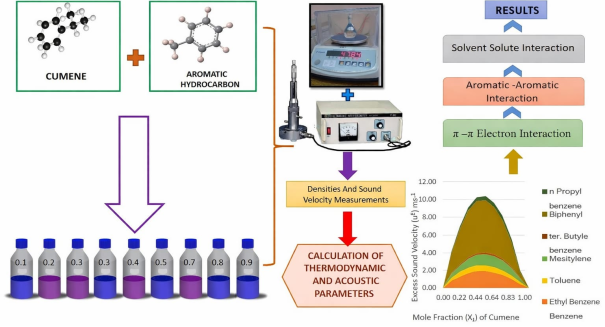
Figure 1. Interactions between Isopropyl Benzene (Cumene) with Aromatic Hydrocarbons at 298.15K.
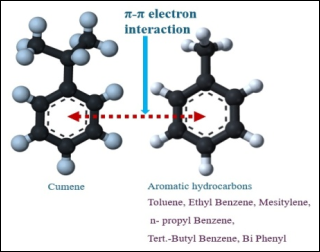
Figure 2. Interactions between isopropyl benzene (cumene) and aromatic hydrocarbons.
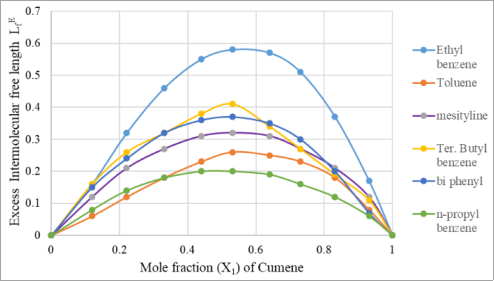
Figure 3. Excess intermolecular free length () as a function of isopropyl benzene (cumene) mole fraction (X1) for various binary liquid mixtures containing aromatic hydrocarbons at 298.15 K.
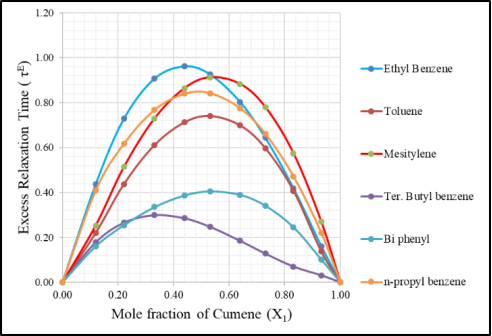
Figure 4. Excess relaxation time (τE) as a function of isopropyl benzene (cumene) mole fraction (X1) for various binary liquid mixtures containing aromatic hydrocarbons at 298.15 K.
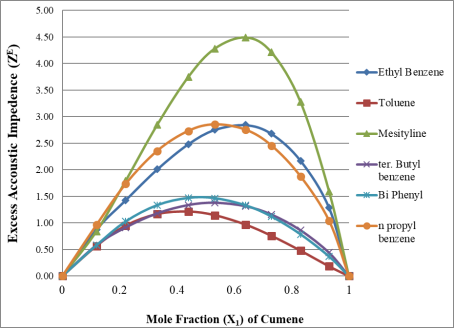
Figure 5. Excess acoustic impedance (ZE) as a function of isopropyl benzene (cumene) mole fraction (X1) for various binary liquid mixtures containing aromatic hydrocarbons at 298.15 K.
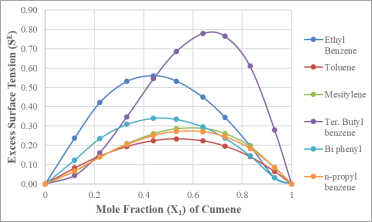
Figure 6. Excess surface tension (SE) as a function of isopropyl benzene (cumene) mole fraction (X1) for various binary liquid mixtures containing aromatic hydrocarbons at 298.15 K.
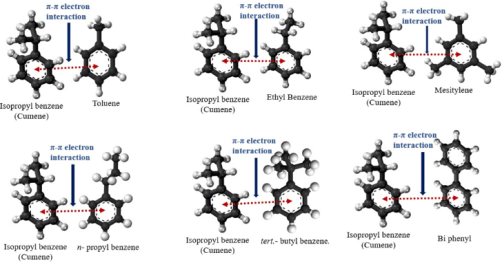
Figure 7. Schematic representation of the structural and molecular interactions between isopropyl benzene (cumene) and various aromatic hydrocarbons.

Information



 Share This Article
 Twitter
 Linked In
 Facebook
 Copy
Copy Download