1. Introduction
1.1. Background on Soil Salinity
Soil salinization is a major global and Ethiopian constraint to food security, environmental sustainability, and soil productivity
| [1] | Worku, A., B. Bedadi, and M. Mohammed, Assessment and Mapping of Fertility Status of Salt Affected soils Amibara Area, Central Rift Valley of Ethiopia. 2015, M. Sc. Thesis, Dept. Soil Sci., School of Nature Res. Manage. and Environ. |
[1]
. Globally, it affects over 3% of land, with more than half of countries impacted, contributing to land degradation and biomass loss
| [2] | Admas, H., S. Abbi, and T. Kassahun, Assessment of salt-affected soil extent and spatial variability using GIS and remote sensing in Asaita district, Northeastern Ethiopia. Scientific Reports, 2025. 15(1): p. 28038. |
| [3] | Mwesige, F. F., The extent and distribution of salt-affected soils in sub-Saharan Africa from 1970 to the present: a review of the current state of knowledge. Frontiers in Soil Science, 2025. 5: p. 1571243. |
| [4] | Wondim, G. B., A. W. Daba, and A. S. Qureshi, Effects of salinity on producers’ livelihoods and socio-economic conditions; the case of Afar Region, Northeastern Ethiopia. Journal of Sustainable Agricultural Sciences, 2020. 46(3): p. 35–46. |
[2-4]
. Salt-affected soils, including saline, sodic, and saline-sodic types, result from excess soluble salts and sodium, reducing permeability, limiting root growth, and causing osmotic stress, specific ion toxicity, and nutrient imbalances
| [5] | Assefa, K. and K. Kibret, Evaluation of the effect of salt affected soil on selected hydraulic properties of soils in Meki Ogolcha Area in East Showa Zone of Oromia Region, Ethiopia. Evaluation, 2016. 6(21). |
[5]
. Globally, they cover more than one billion hectares (~7% of land and 20% of irrigated land), causing the loss of ~3 ha per minute, with 20% of cultivated lands affected and severity worsened by poor irrigation and water quality
| [6] | Daba, A. W. and A. S. Qureshi, Review of soil salinity and sodicity challenges to crop production in the lowland irrigated areas of Ethiopia and its management strategies. Land, 2021. 10(12): p. 1377. |
[6]
. In Sub-Saharan Africa, ~19 million ha are salt-affected, and Ethiopia ranks first in Africa and seventh globally, with arid and semi-arid lowlands (~75 million ha) particularly vulnerable
| [7] | Tessema, N., et al., Soil and irrigation water salinity, and its consequences for agriculture in Ethiopia: a systematic review. Agriculture, 2022. 13(1): p. 109. |
[7]
.
In Ethiopia, salt-affected soils cover ~11 million ha (~36% of the country), especially in the Rift Valley, Afar, and Somali lowlands, driven by natural factors such as saline parent materials, low rainfall, high evaporation, and human-induced factors including improper irrigation, poor drainage, deforestation, and overgrazing
| [7] | Tessema, N., et al., Soil and irrigation water salinity, and its consequences for agriculture in Ethiopia: a systematic review. Agriculture, 2022. 13(1): p. 109. |
[7]
. Salinity and sodicity degrade soil structure, reduce water retention and infiltration, hinder root development, increase osmotic potential, induce ion toxicity, and disrupt nutrient availability, collectively limiting crop and livestock productivity, raising production costs, and aggravating food insecurity. Saline soils exhibit flocculation and higher water-holding capacity due to Ca
2+ and Mg
2+, whereas sodic and saline-sodic soils show swelling, dispersion, higher bulk density, lower porosity, and restricted water availability
| [8] | Worku, A. and B. Bedadi, Studies on soil physical properties of salt affected soil in Amibara area, central rift valley of Ethiopia. International Journal of Agricultural Sciences and Natural Resources, 2016. 3(2): p. 8–17. |
| [9] | Borena, F. R. and J. M. Hassen, Impacts of soil salinity on irrigation potential: In the case of Middle Awash, Ethiopian Review. Open Access Library Journal, 2022. 9(4): p. 1–18. |
[8, 9]
.
1.2. Classes Salt of Affected Soils
All soils contain some salts, but excessive soluble salts or exchangeable sodium require targeted management. Salt-affected soils are classified as saline, sodic, or saline-sodic using indicators such as electrical conductivity (ECe), exchangeable sodium percentage (ESP), sodium adsorption ratio (SAR), and pH (pHe)
| [10] | Alemayehu, H. and W. Haile, Review on Causes and Management Strategies of Salt Affected Soils in Lowlands of Ethiopia. Archives of Crop Science, 2022. 5(2): p. 151–163. |
[10]
. Saline soils have high soluble salts (e.g., Ca
2+, Mg
2+, Na
+, Cl⁻, SO₄
2⁻) that hinder plant growth but maintain good structure and permeability, with ESP < 15% and SAR < 13; their pH is generally below 8.2 and buffered by calcium carbonate
| [10] | Alemayehu, H. and W. Haile, Review on Causes and Management Strategies of Salt Affected Soils in Lowlands of Ethiopia. Archives of Crop Science, 2022. 5(2): p. 151–163. |
| [11] | Bekele, D., Soil Salinity and Sodicity Effects on Plants and their Adaptation Mechanism. 2021. |
[10, 11]
. Sodic soils are dominated by exchangeable sodium, causing clay dispersion, poor structure, low permeability, and restricted root growth, while saline-sodic soils combine high soluble salts and high exchangeable sodium, making reclamation more complex. Excess salts and sodium increase sodium saturation in the soil exchange complex, adversely affecting water infiltration, nutrient availability, and plant growth. Using ECe, SAR, ESP, and pHe, soils can be further categorized into non-saline non-sodic, saline, sodic, and saline-sodic, providing critical guidance for appropriate reclamation and management strategies
| [1] | Worku, A., B. Bedadi, and M. Mohammed, Assessment and Mapping of Fertility Status of Salt Affected soils Amibara Area, Central Rift Valley of Ethiopia. 2015, M. Sc. Thesis, Dept. Soil Sci., School of Nature Res. Manage. and Environ. |
[1]
.
Saline soils specifically contain cations (Ca
2+, Mg
2+, Na
+) and anions (Cl⁻, SO₄
2⁻), with minor K
+, HCO₃⁻, NO₃⁻, and CO₃
2⁻, and are dominated by calcium and magnesium sulfates and/or chlorides
| [10] | Alemayehu, H. and W. Haile, Review on Causes and Management Strategies of Salt Affected Soils in Lowlands of Ethiopia. Archives of Crop Science, 2022. 5(2): p. 151–163. |
| [11] | Bekele, D., Soil Salinity and Sodicity Effects on Plants and their Adaptation Mechanism. 2021. |
[10, 11]
. Soluble carbonates are usually absent, and despite high salt content, these soils require targeted leaching or amendment to prevent crop stress, while their structure and permeability allow reclamation without major structural correction.
Sodic soils have excessive exchangeable sodium (ESP > 15% or SAR > 13) and ECe < 4 dS m
-1, restricting crop growth
| [1] | Worku, A., B. Bedadi, and M. Mohammed, Assessment and Mapping of Fertility Status of Salt Affected soils Amibara Area, Central Rift Valley of Ethiopia. 2015, M. Sc. Thesis, Dept. Soil Sci., School of Nature Res. Manage. and Environ. |
| [11] | Bekele, D., Soil Salinity and Sodicity Effects on Plants and their Adaptation Mechanism. 2021. |
[1, 11]
. High sodium disperses clay, causing poor aggregation, low infiltration, crusting, difficult tillage, and limited root development. Soil pH often exceeds 8.2 due to sodium hydrolysis and low calcium carbonate buffering. The soil solution is low in total salts but rich in bicarbonate and carbonate, precipitating Ca
2+ and Mg
2+ while Na
+ accumulates, especially with continued water loss.
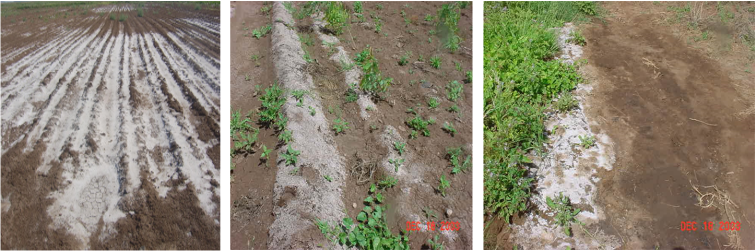
Saline-sodic soils contain excessive soluble salts and exchangeable sodium, limiting crop growth, and are defined by ECe > 4 dS m⁻¹ at 25 °C with ESP > 15% or SAR > 13. They are generally well-structured and permeable, with pH buffered around 8.2–8.5 by calcium carbonate and often a whitish surface
| [10] | Alemayehu, H. and W. Haile, Review on Causes and Management Strategies of Salt Affected Soils in Lowlands of Ethiopia. Archives of Crop Science, 2022. 5(2): p. 151–163. |
| [11] | Bekele, D., Soil Salinity and Sodicity Effects on Plants and their Adaptation Mechanism. 2021. |
[10, 11]
. Excess salts can partly offset the dispersive effect of sodium
| [1] | Worku, A., B. Bedadi, and M. Mohammed, Assessment and Mapping of Fertility Status of Salt Affected soils Amibara Area, Central Rift Valley of Ethiopia. 2015, M. Sc. Thesis, Dept. Soil Sci., School of Nature Res. Manage. and Environ. |
| [11] | Bekele, D., Soil Salinity and Sodicity Effects on Plants and their Adaptation Mechanism. 2021. |
[1, 11]
, but leaching salts without first reducing exchangeable sodium may convert soils to sodic conditions with higher pH, clay dispersion, poor infiltration, and difficult tillage. Gypsum, when present, can dissolve during leaching to replace sodium with calcium while removing soluble salts. These soils result from combined salinization and alkalization, and successful reclamation requires addressing sodium before salt removal
| [10] | Alemayehu, H. and W. Haile, Review on Causes and Management Strategies of Salt Affected Soils in Lowlands of Ethiopia. Archives of Crop Science, 2022. 5(2): p. 151–163. |
[10]
.
Table 1.
Summary of classification of salt affected soils based on their chemical | [6] | Daba, A. W. and A. S. Qureshi, Review of soil salinity and sodicity challenges to crop production in the lowland irrigated areas of Ethiopia and its management strategies. Land, 2021. 10(12): p. 1377. |
| [13] | Walche, A., et al., Assessment and Characterization of Agricultural Salt‐Affected Soils around Abaya and Chamo Lakes, South Ethiopia Rift Valley. Applied and Environmental Soil Science, 2023. 2023(1): p. 3946508. |
| [14] | Daba, A. W., et al., Assessment of salt affected soil and irrigation water quality in Amibara and Dubti irrigated areas, Afar Regional states of Ethiopia. American-Eurasian Journal of Sustainable Agriculture, 2021. 15(1): p. 1–14. |
Classification | EC of saturation extracts (ECe) at 25 oC (mmhos/cm) | Exchangeable Na percentage (ESP) | pH (H2O) | Soil physical condition |
Saline | > 4 | < 15 | < 8.5 | Normal |
Sodic (Alkali) | < 4 | > 15 | > 8.5 | Very poor |
Saline sodic | > 4 | > 15 | < 8.5 | Normal |
Non-saline non-sodic | < 4 | < 15 | ≈ 7.0 | Normal |
1.3. Salt-Affected Soils in Ethiopia
In Ethiopia, salt-affected soils are widespread, particularly in lowland, arid, and semi-arid areas where high temperatures, evapotranspiration, and low rainfall promote salt accumulation About 11 million hectares, or 36% of the country, are affected the largest extent in Africa
| [7] | Tessema, N., et al., Soil and irrigation water salinity, and its consequences for agriculture in Ethiopia: a systematic review. Agriculture, 2022. 13(1): p. 109. |
[7]
. Major occurrences are in Afar, Somali, and the Rift Valley with localized salinity in Tigray, Amhara, and the Omo-Gibe Basin
| [10] | Alemayehu, H. and W. Haile, Review on Causes and Management Strategies of Salt Affected Soils in Lowlands of Ethiopia. Archives of Crop Science, 2022. 5(2): p. 151–163. |
[10]
. Poor irrigation management and inadequate drainage, as in the Awash and Meki-Ogolcha areas, contribute to secondary salinization, creating constraints for rainfed and irrigated agriculture and impacting pastoral and agro-pastoral communities
| [11] | Bekele, D., Soil Salinity and Sodicity Effects on Plants and their Adaptation Mechanism. 2021. |
| [12] | Haile, L. M., Soil salinity and irrigation water quality status in selected areas of awash river basin of Ethiopia. A review. Greener journal of soil science and plant nutrition, 2019. 6(1): p. 25–32. |
[11, 12]
.
1.4 Causes of Soil Salinity in Ethiopia
Ethiopia has the largest extent of salt-affected soils in Africa, estimated at about 11 million hectares, driven by both natural and human-induced factors
| [15] | Qureshi, A., Improving agricultural productivity on salt-affected soils in Ethiopia: Farmers perceptions and proposals. African Journal of Agricultural Research, 2019. |
[15]
. Natural causes include parent materials from volcanic and sedimentary rocks rich in soluble salts, low rainfall limiting leaching, and high evaporation in arid and semi-arid regions that concentrate salts near the surface.Human activities such as poorly managed irrigation, inadequate drainage, overgrazing, deforestation, and inappropriate land use further accelerate salinization. Soil salinity, the accumulation of soluble salts in the root zone, is influenced by irrigation water quality, which affects toxicity, infiltration, soil structure, and crop productivity depending on cation and anion concentrations
| [7] | Tessema, N., et al., Soil and irrigation water salinity, and its consequences for agriculture in Ethiopia: a systematic review. Agriculture, 2022. 13(1): p. 109. |
| [14] | Daba, A. W., et al., Assessment of salt affected soil and irrigation water quality in Amibara and Dubti irrigated areas, Afar Regional states of Ethiopia. American-Eurasian Journal of Sustainable Agriculture, 2021. 15(1): p. 1–14. |
[7, 14]
. This widespread salinization poses serious challenges to agriculture and food security, compounded by declining soil fertility, limited improved varieties, and inadequate irrigation
| [10] | Alemayehu, H. and W. Haile, Review on Causes and Management Strategies of Salt Affected Soils in Lowlands of Ethiopia. Archives of Crop Science, 2022. 5(2): p. 151–163. |
[10]
.
1.5. Impacts of Salt-Affected Soils
Salt-affected soils severely impact agricultural productivity, food security, and socioeconomic conditions by reducing crop growth and yield through osmotic stress and nutrient imbalance, degrading soil structure, limiting nutrient availability, and suppressing microbial activity. Communities on such lands face declining farm output, higher production costs, reduced livestock forage, and increased risks of poverty, food insecurity, migration, or reliance on food imports
| [1] | Worku, A., B. Bedadi, and M. Mohammed, Assessment and Mapping of Fertility Status of Salt Affected soils Amibara Area, Central Rift Valley of Ethiopia. 2015, M. Sc. Thesis, Dept. Soil Sci., School of Nature Res. Manage. and Environ. |
| [9] | Borena, F. R. and J. M. Hassen, Impacts of soil salinity on irrigation potential: In the case of Middle Awash, Ethiopian Review. Open Access Library Journal, 2022. 9(4): p. 1–18. |
[1, 9]
. In Ethiopia, expansion of irrigation into arid and semi-arid lowlands addresses drought, land pressure, and low rain-fed productivity, supporting employment, rural transformation, and poverty reduction
| [1] | Worku, A., B. Bedadi, and M. Mohammed, Assessment and Mapping of Fertility Status of Salt Affected soils Amibara Area, Central Rift Valley of Ethiopia. 2015, M. Sc. Thesis, Dept. Soil Sci., School of Nature Res. Manage. and Environ. |
| [16] | Hunde, K. K., et al., Characterization and Mapping of Soil Salinity Status at Small-Scale Irrigation Farm: The Case of Fantale Irrigation Project Sites. International Journal of Science, Technology and Society, 2024. 12(3): p. 108–119. |
[1, 16]
. Salts originate from saline parent materials, mineral weathering, fossil marine and lacustrine deposits, atmospheric inputs, sediments, irrigation water, and fertilization. In humid regions, rainfall leaches salts to the sea, while in arid and semi-arid areas, evapotranspiration exceeds precipitation, streams deposit salts, and irrigation adds more than can be removed, promoting accumulation and salinity development. Secondary salinization reflects interactions among groundwater, surface water, soil, climate, relief, geomorphology, biological activity, and human activities
| [6] | Daba, A. W. and A. S. Qureshi, Review of soil salinity and sodicity challenges to crop production in the lowland irrigated areas of Ethiopia and its management strategies. Land, 2021. 10(12): p. 1377. |
| [12] | Haile, L. M., Soil salinity and irrigation water quality status in selected areas of awash river basin of Ethiopia. A review. Greener journal of soil science and plant nutrition, 2019. 6(1): p. 25–32. |
[6, 12]
.
1.6. Objectives of the Review
The primary objective of this review is to provide a comprehensive understanding of salt-affected soils in Ethiopia by summarizing their distribution and extent and the agro-ecological and climatic factors that influence their occurrence. It further evaluates management and mitigation options, including agronomic, chemical, and engineering measures, aimed at reducing salinity impacts and improving soil productivity. In addition, the review identifies knowledge gaps and priority research areas to guide future investigations toward improved soil management, sustainable agriculture, and food security. Achieving these objectives will assist policymakers, researchers, and practitioners in designing effective interventions to mitigate soil salinity and enhance agricultural sustainability in Ethiopia.
3. Discussion
Understanding soil salinity is critical for sustainable agriculture. This review examines its impacts on crop productivity, food security, and the socio-economic conditions of farming communities, aiming to identify effective management strategies to enhance sustainable crop production in salt-affected areas of Ethiopia.
3.1. Extent and Distribution of Salt Affected Soils in Ethiopia
Ethiopia ranks ninth globally in total land area and seventh in the percentage of salt-affected soils, with over 11 million hectares affected, making it the most impacted country in Africa
| [6] | Daba, A. W. and A. S. Qureshi, Review of soil salinity and sodicity challenges to crop production in the lowland irrigated areas of Ethiopia and its management strategies. Land, 2021. 10(12): p. 1377. |
| [10] | Alemayehu, H. and W. Haile, Review on Causes and Management Strategies of Salt Affected Soils in Lowlands of Ethiopia. Archives of Crop Science, 2022. 5(2): p. 151–163. |
[6, 10]
. These soils are primarily concentrated in lowland regions, particularly the Rift Valley system, including the Afar region, Somali lowlands, Danakil Plain, Ogaden lowlands, and northern Rift Valley (Awash River Basin), with additional occurrences in parts of Oromia, Amhara, Tigray, and southern regional states
| [6] | Daba, A. W. and A. S. Qureshi, Review of soil salinity and sodicity challenges to crop production in the lowland irrigated areas of Ethiopia and its management strategies. Land, 2021. 10(12): p. 1377. |
| [10] | Alemayehu, H. and W. Haile, Review on Causes and Management Strategies of Salt Affected Soils in Lowlands of Ethiopia. Archives of Crop Science, 2022. 5(2): p. 151–163. |
| [12] | Haile, L. M., Soil salinity and irrigation water quality status in selected areas of awash river basin of Ethiopia. A review. Greener journal of soil science and plant nutrition, 2019. 6(1): p. 25–32. |
[6, 10, 12]
. Soil salinity and alkalinity are prevalent in arid and semi-arid areas, where insufficient rainfall limits leaching of salts from the root zone, and high temperatures and evaporation increase soluble salt concentrations
| [16] | Hunde, K. K., et al., Characterization and Mapping of Soil Salinity Status at Small-Scale Irrigation Farm: The Case of Fantale Irrigation Project Sites. International Journal of Science, Technology and Society, 2024. 12(3): p. 108–119. |
[16]
. Human activities, including heavy fertilizer use, poor-quality irrigation water, and inadequate drainage, have further contributed to the expansion of salt-affected soils and declining soil productivity in these regions.
Table 2.
Percentage of area coverages by salinity soils classes of Afar, Amhara, Oromia, and Tigray regions of Ethiopia | [6] | Daba, A. W. and A. S. Qureshi, Review of soil salinity and sodicity challenges to crop production in the lowland irrigated areas of Ethiopia and its management strategies. Land, 2021. 10(12): p. 1377. |
Soil Salinity Levels (dSm⁻¹) | Afar (Km2) | Afar (%) | Oromia (Km2) | Oromia (%) | Amhara (Km2) | Amhara (%) | Tigray (Km2) | Tigray (%) |
Non-saline (<2) | 40,787 | 42 | 287,768.25 | 88.70 | 137,428 | 88.0 | 48,067 | 97.29 |
Low saline (2–5) | 26,961 | 28 | 17,292.05 | 5.33 | 4,903 | 3.0 | 0 | 0 |
Medium saline (5–10) | 9,798 | 10 | 17,152.54 | 5.29 | 11,892 | 8.0 | 1,339 | 2.71 |
High saline (10–15) | 5,618 | 5 | 1,576.72 | 0.49 | 1,230 | 0.8 | 0 | 0 |
Extremely saline (>15) | 14,085 | 15 | 713.74 | 0.22 | 202 | 0.2 | 0 | 0 |
Total area | 97,204 | 100 | 324,428.69 | 100 | 155,648 | 100 | 49,604 | 100 |
Salt-affected soils in Ethiopia are unevenly distributed, with regional hotspots in lowland plains, major river basins, and the Rift Valley. The most extensive salinized lands occur in the Rift Valley, the Awash and Wabi Shebelle basins, the Denakil Plains, and other low-lying valley bottoms, often coinciding with long-established irrigation areas where drainage is inadequate. In particular, regions around Lakes Abaya and Chamo contain large tracts of salt-affected soils. Overall, approximately 11 million hectares of Ethiopian land are affected, making the country one of the most salinity-impacted in Africa
| [16] | Hunde, K. K., et al., Characterization and Mapping of Soil Salinity Status at Small-Scale Irrigation Farm: The Case of Fantale Irrigation Project Sites. International Journal of Science, Technology and Society, 2024. 12(3): p. 108–119. |
[16]
.
3.2. Causes and Contributing Factors
Soil salinity is a major constraint in Ethiopia’s arid and semi-arid lowlands, reducing crop yields, farm incomes, and exacerbating rural poverty. Limited farmer knowledge of salinity processes has accelerated its spread, prompting shifts from traditional cereals to salt-tolerant legumes and forage crops, which can affect household food security
| [15] | Qureshi, A., Improving agricultural productivity on salt-affected soils in Ethiopia: Farmers perceptions and proposals. African Journal of Agricultural Research, 2019. |
[15]
. Salinity arises from natural and human-induced factors, including parent materials rich in soluble salts particularly volcanic and sedimentary deposits in the Rift Valley and lowlands low rainfall, and high evaporation that concentrates salts.
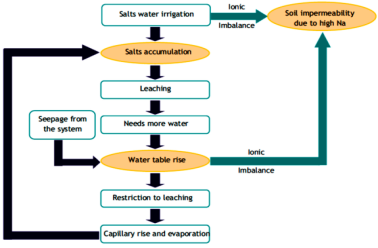
Human activities intensify soil salinity through improper irrigation using saline or poor-quality water without drainage, waterlogging, land mismanagement, deforestation, overgrazing, and intensive cultivation, reducing soil leaching capacity and exacerbating salinity. Regions such as the Rift Valley, Afar, and Somali lowlands are particularly vulnerable, where agricultural expansion without integrated soil and water management increases risks. Secondary salinity occurs when irrigation exceeds crop water use or poor drainage allows groundwater rise, a common problem in global irrigation systems
| [11] | Bekele, D., Soil Salinity and Sodicity Effects on Plants and their Adaptation Mechanism. 2021. |
| [16] | Hunde, K. K., et al., Characterization and Mapping of Soil Salinity Status at Small-Scale Irrigation Farm: The Case of Fantale Irrigation Project Sites. International Journal of Science, Technology and Society, 2024. 12(3): p. 108–119. |
[11, 16]
.
Primary salinity results from weathering of Na-, Ca-, Mg-, and K-rich rocks releasing soluble salts such as bicarbonates and carbonates, especially under arid conditions with limited leaching, poor drainage, and basin topography
| [10] | Alemayehu, H. and W. Haile, Review on Causes and Management Strategies of Salt Affected Soils in Lowlands of Ethiopia. Archives of Crop Science, 2022. 5(2): p. 151–163. |
| [11] | Bekele, D., Soil Salinity and Sodicity Effects on Plants and their Adaptation Mechanism. 2021. |
[10, 11]
. It is further intensified by land-use changes, residual salts from alluvial, lacustrine, or marine deposits, mineralized water, inefficient irrigation, and arid climate, collectively driving widespread salt-affected soils in Ethiopia
| [11] | Bekele, D., Soil Salinity and Sodicity Effects on Plants and their Adaptation Mechanism. 2021. |
[11]
.
3.3. Impacts on Agriculture and Environment
Salinization and sodicity severely reduce agricultural productivity by causing waterlogging, salt accumulation, and ion-specific toxicities from Na
+ and Cl⁻, which impair plant growth and can render land unusable
| [11] | Bekele, D., Soil Salinity and Sodicity Effects on Plants and their Adaptation Mechanism. 2021. |
[11]
. These stresses also disrupt water and nutrient uptake, degrade soil physical and chemical properties, alter vegetation cover, reduce biodiversity, and affect ecosystem functions, including climate, water, and mineral cycles. The resulting environmental, agricultural, and socio-economic impacts include lower crop yields, unstable livelihoods, reduced income, and diminished quality of life, particularly for resource-limited farmers in areas such as the middle and lower Awash Basin. Effective management strategies to sustain productivity and livelihoods include leaching with increased irrigation, gypsum amendments for sodic soils, cultivation of salt-tolerant crops, improved management of poor-quality irrigation water, and restoration of saline lands with forestry species
| [6] | Daba, A. W. and A. S. Qureshi, Review of soil salinity and sodicity challenges to crop production in the lowland irrigated areas of Ethiopia and its management strategies. Land, 2021. 10(12): p. 1377. |
| [7] | Tessema, N., et al., Soil and irrigation water salinity, and its consequences for agriculture in Ethiopia: a systematic review. Agriculture, 2022. 13(1): p. 109. |
[6, 7]
.
3.4. Impact onsoil fertility and Crop productivity
Soil fertility is a key determinant of agricultural productivity and ecosystem functioning, sustaining vegetation, natural resources, and crop production
| [1] | Worku, A., B. Bedadi, and M. Mohammed, Assessment and Mapping of Fertility Status of Salt Affected soils Amibara Area, Central Rift Valley of Ethiopia. 2015, M. Sc. Thesis, Dept. Soil Sci., School of Nature Res. Manage. and Environ. |
[1]
. Salt-affected soils, modified by excessive soluble salts, exchangeable sodium, or both, stress plants, reduce yields, and can cause total crop failure and land devaluation. In Ethiopia’s semi-arid and arid regions, salinity and sodicity are emerging challenges, especially in irrigated areas like the Middle Awash, where they have significantly reduced productivity
| [1] | Worku, A., B. Bedadi, and M. Mohammed, Assessment and Mapping of Fertility Status of Salt Affected soils Amibara Area, Central Rift Valley of Ethiopia. 2015, M. Sc. Thesis, Dept. Soil Sci., School of Nature Res. Manage. and Environ. |
| [13] | Walche, A., et al., Assessment and Characterization of Agricultural Salt‐Affected Soils around Abaya and Chamo Lakes, South Ethiopia Rift Valley. Applied and Environmental Soil Science, 2023. 2023(1): p. 3946508. |
[1, 13]
. Salinity alters soil physical properties through clay swelling and dispersion, limits water infiltration, root penetration, and seedling emergence, depleting fertility and contributing to food insecurity and poverty
| [16] | Hunde, K. K., et al., Characterization and Mapping of Soil Salinity Status at Small-Scale Irrigation Farm: The Case of Fantale Irrigation Project Sites. International Journal of Science, Technology and Society, 2024. 12(3): p. 108–119. |
[16]
.
Saline soils are generally well-structured and permeable, whereas sodic soils are poorly structured, with dispersed clays, low infiltration, surface crusting, and restricted root growth, severely limiting crop productivity. High salt concentrations negatively impact germination, growth, reproduction, and nutrient and water uptake, potentially causing crop death under marginal conditions
| [6] | Daba, A. W. and A. S. Qureshi, Review of soil salinity and sodicity challenges to crop production in the lowland irrigated areas of Ethiopia and its management strategies. Land, 2021. 10(12): p. 1377. |
| [15] | Qureshi, A., Improving agricultural productivity on salt-affected soils in Ethiopia: Farmers perceptions and proposals. African Journal of Agricultural Research, 2019. |
[6, 15]
. In Ethiopia’s irrigated lowlands, poor water management has worsened these effects; for instance, decades of cotton cultivation in the Amibara scheme and sugarcane farming at Metehara have led to farmland abandonment, reduced yields, degraded soils, and diminished livelihoods, emphasizing the need for effective soil and water management in salt-affected regions
| [6] | Daba, A. W. and A. S. Qureshi, Review of soil salinity and sodicity challenges to crop production in the lowland irrigated areas of Ethiopia and its management strategies. Land, 2021. 10(12): p. 1377. |
| [7] | Tessema, N., et al., Soil and irrigation water salinity, and its consequences for agriculture in Ethiopia: a systematic review. Agriculture, 2022. 13(1): p. 109. |
[6, 7]
.
3.5. Soil Physicochemical Properties on Salt Affected Soils
Salt-affected soils experience physical changes from swelling and dispersion of colloidal particles due to excess exchangeable Na, which reduces water infiltration, limits aeration, restricts root growth, and impairs seedling emergence (Pearson, 2004). They also suffer nutritional imbalances, as the accumulation of ions such as Na
+, HCO₃⁻, CO₃
2⁻, SiO₃
2⁻, NaCl, and Na₂SO₄ alters the solubility and availability of essential nutrients
| [1] | Worku, A., B. Bedadi, and M. Mohammed, Assessment and Mapping of Fertility Status of Salt Affected soils Amibara Area, Central Rift Valley of Ethiopia. 2015, M. Sc. Thesis, Dept. Soil Sci., School of Nature Res. Manage. and Environ. |
[1]
.
3.5.1. Effect of salinity on Soil Physical Properties
Soil physical properties texture, bulk and particle density, water content, and porosity control cultivation suitability, water and air availability, nutrient uptake, and root growth, and are strongly influenced by salinity, sodicity, and management. Texture affects water and solute movement, nutrient leaching, salt accumulation, and aeration: clay soils retain water but drain slowly, while coarser soils favor solute transport and salt crust formation, with clay-rich soils prone to Na
+ binding and coarser Fluvisols promoting salt accumulation
| [1] | Worku, A., B. Bedadi, and M. Mohammed, Assessment and Mapping of Fertility Status of Salt Affected soils Amibara Area, Central Rift Valley of Ethiopia. 2015, M. Sc. Thesis, Dept. Soil Sci., School of Nature Res. Manage. and Environ. |
[1]
. Salinity and sodicity increase bulk density through Na
+-induced dispersion, reducing permeability, water retention, and root growth, while particle density decreases under high Na
+, with saline-sodic soils showing the highest bulk density and lowest particle density
| [1] | Worku, A., B. Bedadi, and M. Mohammed, Assessment and Mapping of Fertility Status of Salt Affected soils Amibara Area, Central Rift Valley of Ethiopia. 2015, M. Sc. Thesis, Dept. Soil Sci., School of Nature Res. Manage. and Environ. |
[1]
. High Na
+ and low ECe degrade structure via clay swelling, dispersion, and aggregate slaking, reducing hydraulic conductivity, infiltration, and porosity, while intensive tillage, irrigation, and high ESP further limit water and air movement, root penetration, and crop growth
| [1] | Worku, A., B. Bedadi, and M. Mohammed, Assessment and Mapping of Fertility Status of Salt Affected soils Amibara Area, Central Rift Valley of Ethiopia. 2015, M. Sc. Thesis, Dept. Soil Sci., School of Nature Res. Manage. and Environ. |
| [8] | Worku, A. and B. Bedadi, Studies on soil physical properties of salt affected soil in Amibara area, central rift valley of Ethiopia. International Journal of Agricultural Sciences and Natural Resources, 2016. 3(2): p. 8–17. |
[1, 8]
.
Table 3.
Main effects of salt affected soil class and soil depth on some soil physical properties of Vertisols | [1] | Worku, A., B. Bedadi, and M. Mohammed, Assessment and Mapping of Fertility Status of Salt Affected soils Amibara Area, Central Rift Valley of Ethiopia. 2015, M. Sc. Thesis, Dept. Soil Sci., School of Nature Res. Manage. and Environ. |
Factor | Treatment | Clay (%) | Silt (%) | Sand (%) | STC | BD (g cm⁻³) | PD (g cm⁻³) | TP (%) |
Salt-affected soil classes | NS NSO soil | 60.72 | 30.60 | 8.68ᵃ | C | 1.46 | 2.60 | 43.84 |
| Saline soil | 56.73 | 36.85ᵃ | 6.42ᵇ | C | 1.48 | 2.57 | 42.41 |
| LSD (0.05) | NS | 5.31 | 2.01 | – | NS | NS | NS |
| SEM (±) | 2.35 | 1.98 | 0.81 | – | 0.030 | 0.019 | 1.20 |
Depth | 0–20 cm | 60.21 | 32.70 | 7.09 | C | 1.33ᵇ | 2.58 | 48.44ᵃ |
| 20–40 cm | 57.23 | 34.75 | 8.02 | C | 1.61ᵃ | 2.58 | 37.59ᵇ |
| LSD (0.05) | NS | NS | NS | – | 0.089 | NS | 3.31 |
| SEM (±) | 2.35 | 1.98 | 0.81 | – | 0.030 | 0.019 | 1.20 |
3.5.2. Effect of salinity on Soil Chemical Properties
Soil chemical fertility, governed by organic matter, total N, pH, CEC, exchangeable bases, and plant-available nutrients, strongly influences crop growth and environmental quality, with C, N, P, Mg, K, B, Ca, Zn, and CEC showing the greatest variation across land-use histories
| [1] | Worku, A., B. Bedadi, and M. Mohammed, Assessment and Mapping of Fertility Status of Salt Affected soils Amibara Area, Central Rift Valley of Ethiopia. 2015, M. Sc. Thesis, Dept. Soil Sci., School of Nature Res. Manage. and Environ. |
| [17] | Allotey, D., et al., Physico-chemical properties of three salt-affected soils in the lower Volta Basin and management strategies for their sustainable utilization. West African journal of applied ecology, 2008. 12(3): p. 23–29. |
[1,17]
. Excess salts and exchangeable sodium alter nutrient solubility and availability, causing disorders and salinity toxicity through Na
+ and Cl⁻ accumulation, while high ESP and pH in sodic soils further affect nutrient transformation and plant uptake. Nitrogen losses are high under alternating aerobic–anaerobic conditions common in sodic soils, and P or K fertilization can improve yields, though K is less effective under high salinity
| [1] | Worku, A., B. Bedadi, and M. Mohammed, Assessment and Mapping of Fertility Status of Salt Affected soils Amibara Area, Central Rift Valley of Ethiopia. 2015, M. Sc. Thesis, Dept. Soil Sci., School of Nature Res. Manage. and Environ. |
[1]
. Soil reaction (pHe) reflects acidity or alkalinity, affecting nutrient availability, toxicity, microbial activity, and root growth; alkaline sodic soils show pHe 0.5–1 unit higher than in paste or CaCl₂, often containing excess bases (Ca, Mg, K, Na), Cl⁻, SO₄
2⁻, and above pHe 8.2, carbonate and bicarbonate, with trace element deficiencies common
| [1] | Worku, A., B. Bedadi, and M. Mohammed, Assessment and Mapping of Fertility Status of Salt Affected soils Amibara Area, Central Rift Valley of Ethiopia. 2015, M. Sc. Thesis, Dept. Soil Sci., School of Nature Res. Manage. and Environ. |
[1]
. Electrical conductivity (ECe) identifies saline soils, with soluble salts from Na
+, Ca
2+, Mg
2+, Cl⁻, SO₄
2⁻, HCO₃⁻, and CO₃
2⁻ increasing osmotic stress, causing ion toxicity, disrupting nutrient balance, and reducing growth, particularly in arid and semi-arid regions with insufficient leaching
| [1] | Worku, A., B. Bedadi, and M. Mohammed, Assessment and Mapping of Fertility Status of Salt Affected soils Amibara Area, Central Rift Valley of Ethiopia. 2015, M. Sc. Thesis, Dept. Soil Sci., School of Nature Res. Manage. and Environ. |
[1]
.
Table 4.
Soil salinity status at Dire Sadi Irrigation Schemes Source | [16] | Hunde, K. K., et al., Characterization and Mapping of Soil Salinity Status at Small-Scale Irrigation Farm: The Case of Fantale Irrigation Project Sites. International Journal of Science, Technology and Society, 2024. 12(3): p. 108–119. |
Depth (cm) | ESP (%) | SAR | EC | pH | Na+ | Ca2+ | Mg2+ | CEC | Salinity Class |
Surface | 38.02ᶜ | 2.20ᵇ | 3.04ᵇ | 9.31 | 12.85ᵃ | 16.34ᵃ | 4.60ᵃ | 33.79ᵃ | Very strongly sodic |
0–30 | 53.20ᵃ | 2.72ᵃ | 2.65ᵇ | 9.20 | 11.28ᵇ | 5.77ᵈ | 4.15ᵇ | 21.20ᵇ | Very strongly sodic |
31–60 | 44.69ᵇ | 1.29ᶜ | 3.77ᵃ | 9.16 | 8.31ᶜ | 8.04ᶜ | 2.25ᶜ | 18.60ᶜ | Very strongly sodic |
61–90 | 20.74ᵈ | 0.55ᵉ | 2.24ᵇ | 9.29 | 4.03ᵈ | 11.79ᵇ | 3.61ᶜ | 19.43ᵇ | Strongly sodic |
91–120 | 19.12ᵉ | 0.96ᵈ | 0.78ᶜ | 9.30 | 7.27ᵈ | 8.00ᶜ | 2.53ᶜ | 17.80ᶜ | Strongly sodic |
Mean | 35.15 | 1.54 | 2.90 | 9.25 | 8.75 | 9.98 | 3.43 | 22.16 | Sodic soil |
CV (%) | 14.25 | 16.24 | 17.29 | 8.25 | 11.38 | 12.36 | 13.47 | 17.25 | — |
LSD (0.05) | 1.01 | 0.03 | 0.12 | 0.18 | 0.15 | 2.13 | 0.09 | 0.38 | — |
Table 5.
Main effects of salt affected soil class and soil depth on soil reaction (pHe), Organic matter, Total nitrogen, C:N ratio, Av. P and Av. K of Vertisols in the study area | [1] | Worku, A., B. Bedadi, and M. Mohammed, Assessment and Mapping of Fertility Status of Salt Affected soils Amibara Area, Central Rift Valley of Ethiopia. 2015, M. Sc. Thesis, Dept. Soil Sci., School of Nature Res. Manage. and Environ. |
Factor | Treatment | pHₑ | OM (%) | TN (%) | C: N | Available P (mg kg⁻¹) | Available K (mg kg⁻¹) |
Salt-affected soil class | NS NSO soil | 7.85ᵃ | 1.75ᵃ | 0.078 | 13.33 | 44.50ᵃ | 475.60ᵇ |
| Saline soil | 7.53ᵇ | 1.54ᵇ | 0.068 | 13.30 | 28.40ᵇ | 683.15ᵃ |
| LSD (0.05) | 0.11 | 0.13 | NS | NS | 5.11 | 106.48 |
| SEM (±) | 0.041 | 0.047 | 0.005 | 0.633 | 1.86 | 38.74 |
Depth | 0–20 cm | 7.71 | 1.79ᵃ | 0.085ᵃ | 12.47 | 41.03ᵃ | 553.95ᵃ |
| 20–40 cm | 7.66 | 1.50ᵇ | 0.061ᵇ | 14.16 | 31.86ᵇ | 586.95ᵃ |
| LSD (0.05) | NS | 0.13 | 0.015 | NS | 5.11 | NS |
| SEM (±) | 0.041 | 0.047 | 0.005 | 0.633 | 1.86 | 38.74 |
Soil chemical fertility driven by organic matter, N, P, K, CEC, exchangeable bases, pH, and salinity strongly affects crop growth, nutrient availability, and productivity, while salinity and sodicity reduce OM, N mineralization, and nutrient uptake, increase ESP, and degrade structure). In saline and sodic soils, excessive Na+, Cl⁻, and bicarbonates limit P and K availability, increase SAR with depth, and impair overall fertility, highlighting the need for targeted management.
Table 6.
Main effects of salt affected soil class and soil depth on some soil chemical properties of Vertisols in the study area | [1] | Worku, A., B. Bedadi, and M. Mohammed, Assessment and Mapping of Fertility Status of Salt Affected soils Amibara Area, Central Rift Valley of Ethiopia. 2015, M. Sc. Thesis, Dept. Soil Sci., School of Nature Res. Manage. and Environ. |
Factor | Treatment | Ca (cmol (+) kg⁻¹) | Mg | Na | K | CEC (cmol (+) kg⁻¹) | ESP (%) | PBS (%) |
Salt affected soil class | NS NSO soil | 33.01ᵇ | 2.53 | 0.98ᵇ | 1.85 | 50.12 | 1.95ᵇ | 76.55ᵇ |
| Saline soil | 39.50ᵃ | 3.67 | 1.85ᵃ | 1.55 | 47.64 | 3.88ᵃ | 97.73ᵃ |
| LSD (0.05) | 6.14 | NS | 0.39 | NS | NS | 0.62 | 5.53 |
| SEM (±) | 2.23 | 0.42 | 0.14 | 0.42 | 1.39 | 0.22 | 2.01 |
Depth | 0–20 cm | 37.97 | 3.97ᵃ | 1.94ᵃ | 1.60 | 50.36 | 3.85ᵃ | 90.30ᵃ |
| 20–40 cm | 34.53 | 2.22ᵇ | 0.89ᵇ | 1.81 | 47.40 | 1.87ᵇ | 83.22ᵇ |
| LSD (0.05) | NS | 1.15 | 0.39 | NS | NS | 0.62 | 5.53 |
| SEM (±) | 2.23 | 0.42 | 0.14 | 0.42 | 1.39 | 0.22 | 2.01 |
High soil salinity and sodicity in Ethiopia’s dry and semi-arid agro-ecologies reduce crop growth through osmotic stress, nutrient imbalance, and ion toxicity (e.g., Na
+, Cl⁻), causing yield losses of 10–70% and threatening food security and livelihoods. Excess sodium and salts degrade soil structure by swelling and dispersing colloids, increasing bulk density, reducing porosity, hydraulic conductivity, water-holding capacity, and root growth, while saline soils with Ca
2+ and Mg
2+ maintain flocculated structures with lower bulk density and higher water retention
| [8] | Worku, A. and B. Bedadi, Studies on soil physical properties of salt affected soil in Amibara area, central rift valley of Ethiopia. International Journal of Agricultural Sciences and Natural Resources, 2016. 3(2): p. 8–17. |
[8]
. These physical and chemical constraints, compounded by low rainfall and high temperatures, limit soil fertility, reduce agricultural productivity, and risk irreversible land degradation without proper soil and water management.
Soil micronutrient availability depends on organic matter, pH, and clay content, with higher Fe, Mn, Cu, and Zn in non-saline non-sodic soils due to greater OM and lower pH, while sodic soils often show deficiencies from high alkalinity, poor drainage, or prolonged wet conditions. Elevated Mo and B in sodic soils result from high pH, ESP, limited drainage, and clay content, whereas saline CaCO₃-rich soils adsorb Mo, reducing its availability; thus, salt-affected soils can increase or decrease micronutrient solubility and plant uptake
| [1] | Worku, A., B. Bedadi, and M. Mohammed, Assessment and Mapping of Fertility Status of Salt Affected soils Amibara Area, Central Rift Valley of Ethiopia. 2015, M. Sc. Thesis, Dept. Soil Sci., School of Nature Res. Manage. and Environ. |
[1]
.
3.6. Producers’ Perception and Consequences of Salinity to Rural Socio-Economic Conditions
Salinity significantly threatens rural livelihoods by reducing soil fertility, crop and forage productivity, and food security, thereby worsening poverty Understanding farmers’ perceptions and adaptive strategies is crucial for effective interventions. In Ethiopia, irrigation supports agriculture and economic growth, but salinity undermines these benefits especially in Afar, Somali, and Rift Valley regions by degrading soils, lowering crop and livestock yields, raising production costs, and prompting migration, perpetuating land degradation and economic vulnerability
| [7] | Tessema, N., et al., Soil and irrigation water salinity, and its consequences for agriculture in Ethiopia: a systematic review. Agriculture, 2022. 13(1): p. 109. |
| [15] | Qureshi, A., Improving agricultural productivity on salt-affected soils in Ethiopia: Farmers perceptions and proposals. African Journal of Agricultural Research, 2019. |
[7, 15]
. Addressing salinity is essential for sustaining productivity, protecting livelihoods, and ensuring environmental stability.
3.7. Reclamation and Management Strategies
Effective management of salt-affected soils in Ethiopia requires integrated agronomic, soil, and policy strategies. Crop rotation, salt-tolerant varieties, and organic amendments improve soil fertility, resilience, and food security. Soil management including gypsum application, leaching of salts, and improved drainage restores structure, permeability, and water infiltration while preventing waterlogging and secondary salinization. Policy support and farmer education enhance adoption of sustainable practices. Leaching removes excess salts below the root zone, with irrigation method and volume determining salt distribution; flood and sprinkler systems promote downward movement, while furrow or drip irrigation may concentrate salts
| [10] | Alemayehu, H. and W. Haile, Review on Causes and Management Strategies of Salt Affected Soils in Lowlands of Ethiopia. Archives of Crop Science, 2022. 5(2): p. 151–163. |
[10]
. Fertilizer and compost management maintains nutrient balance and soil structure under salinity stress
| [10] | Alemayehu, H. and W. Haile, Review on Causes and Management Strategies of Salt Affected Soils in Lowlands of Ethiopia. Archives of Crop Science, 2022. 5(2): p. 151–163. |
[10]
.
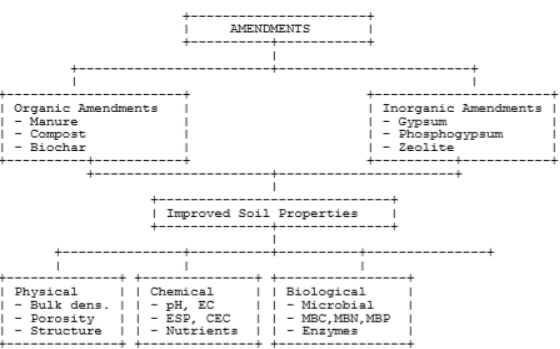
Plant selection is vital: salt-tolerant crops and halophytes mitigate salinity via exclusion, compartmentalization, extrusion, osmotic adjustment, and root placement in nonsaline layers; genetic studies in Arabidopsis highlight loci enhancing salt tolerance. Soil amendment combines physical, chemical, and biological methods to remove or replace soluble salts and exchangeable sodium, integrating organic/inorganic inputs, land and water management, and plant-microbe association. Chemical reclamation with gypsum or phosphogypsum replaces Na
+ with Ca
2+, followed by leaching, improving yields such as cotton at Melka-Sadi
| [6] | Daba, A. W. and A. S. Qureshi, Review of soil salinity and sodicity challenges to crop production in the lowland irrigated areas of Ethiopia and its management strategies. Land, 2021. 10(12): p. 1377. |
[6]
. Organic amendments from residues, manures, or waste enhance nutrients, pH buffering, bulk density, and pathogen control.
3.8. Knowledge Gaps and Future Research Directions
Despite research on salt-affected soils in Ethiopia, knowledge gaps persist, especially in remote semi-arid areas like the Somali and Afar lowlands, where limited surveys hinder accurate assessment of salinity extent and severity. Long-term monitoring in irrigated areas is also lacking, making continuous soil and water assessments essential for trend analysis and predictive modeling. Studies on integrated management combining salt-tolerant crops, organic and chemical amendments, and improved irrigation and drainage are limited, as are socioeconomic analyses of adoption barriers. Region-specific strategies supported by extension services, including sustainable irrigation, incentives for salt-tolerant crops, and land-use planning, should be developed collaboratively among communities, researchers, and government agencies. Periodic assessment and GIS-based mapping of soil fertility, including physical, chemical, and biological properties, are essential for monitoring changes, delineating fertility status, and guiding appropriate technologies
| [1] | Worku, A., B. Bedadi, and M. Mohammed, Assessment and Mapping of Fertility Status of Salt Affected soils Amibara Area, Central Rift Valley of Ethiopia. 2015, M. Sc. Thesis, Dept. Soil Sci., School of Nature Res. Manage. and Environ. |
[1]
. Reclamation should integrate chemical, biological, and agronomic methods, such as drainage, minimum tillage, mulching, organic matter addition, good-quality irrigation water, pre- and post-planting leaching, and crop selection. Sodic soils require chemical amendments like gypsum to replace Na
+, and continuous monitoring is needed to prevent further salinization
| [6] | Daba, A. W. and A. S. Qureshi, Review of soil salinity and sodicity challenges to crop production in the lowland irrigated areas of Ethiopia and its management strategies. Land, 2021. 10(12): p. 1377. |
[6]
.





 Share This Article
 Twitter
 Linked In
 Facebook
 Copy
Copy Download