Research Article | | Peer-Reviewed

Finding Bach's Compositional Characteristics in Max Reger’s Cello Suites

Received: 20 April 2026     Accepted: 3 June 2026     Published: 9 June 2026
Views:       Downloads:
Abstract

Max Reger’s Three Suites for Solo Cello, Op. 131c, occupy a significant place in the cello repertoire as among the earliest major unaccompanied cello works composed after Johann Sebastian Bach’s Six Cello Suites. Reger’s deep admiration for Bach and his extensive study of Bach’s music profoundly influenced his compositional style. This study aims to examine the extent to which Bach’s compositional characteristics are reflected in Reger’s cello suites and to identify the musical elements that demonstrate this influence. This research employs comparative musical analysis of Reger’s Three Suites for Solo Cello, Op. 131c, alongside Bach’s Six Cello Suites and Sonatas and Partitas for Solo Violin. The analysis focuses on formal structure, melodic design, rhythmic patterns, harmonic organization, and contrapuntal techniques. The findings reveal that Reger incorporated numerous features associated with Bach’s compositional style. These include the use of preludes, fugue writing, Baroque dance movements, melodic sequences, scalar passages, arpeggiated textures, and polyphonic writing. Reger’s suites also demonstrate similarities to Bach’s works in movement organization, thematic materials, and contrapuntal treatment. At the same time, Reger reinterpreted these Baroque elements through a late-Romantic musical language characterized by richer harmony and denser textures. The study concludes that Reger’s cello suites represent both a continuation and a transformation of Bach’s compositional traditions. By combining Baroque structural principles with nineteenth-century musical aesthetics, Reger created works that honor Bach’s legacy while contributing to the development of the modern solo cello repertoire.

Published in Humanities and Social Sciences (Volume 14, Issue 3)
DOI 10.11648/j.hss.20261403.15
Page(s) 232-239
Creative Commons

This is an Open Access article, distributed under the terms of the Creative Commons Attribution 4.0 International License (http://creativecommons.org/licenses/by/4.0/), which permits unrestricted use, distribution and reproduction in any medium or format, provided the original work is properly cited.

Copyright

Copyright © The Author(s), 2026. Published by Science Publishing Group

Keywords

Max Reger, J. S. Bach, Cello Suites

1. Introduction
Max Reger (1873-1916) was a German composer, organist, pianist, conductor, and academic teacher. He was known for his prolific compositions in various genres, including orchestral, choral, chamber, and organ music. He is thought of as among the most influential musicians of his time.
Max Reger’s deep connection to Johann Sebastian Bach can be clearly traced through his early education and formative musical experiences. A crucial turning point occurred in 1884, when the young Reger began studying organ and piano with Adalbert Lindner, who first introduced him to Bach’s music and guided him in exploring Bach’s organ and keyboard repertoire . Although Reger’s understanding of Bach’s style was still developing at this stage, this early exposure laid the foundation for a lifelong engagement with Bach’s works. These early educational experiences laid the groundwork for a profound and lasting engagement with Bach, whose influence would become central to Reger’s compositional identity. The following discussion will explore how this influence is manifested in Reger’s musical language and structural techniques.
2. How Did Bach’s Music Influence on Max Reger’s Compositions
Reger’s musical training continued to deepen when he later studied with Hugo Riemann in Wiesbaden, where he undertook more systematic study and acquired a comprehensive knowledge of Bach’s keyboard and organ compositions . Through this rigorous academic training, Reger not only absorbed Bach’s technical language but also began to internalize the structural and contrapuntal principles that would define his own compositional style.
Furthermore, his professional environment reinforced this influence: Reger’s growing familiarity with Bach led him away from programmatic tendencies and toward an ideal centered on “architectonic beauty” and contrapuntal clarity, values strongly associated with Bach’s music. In addition, his collaboration with figures such as Ferruccio Busoni, a noted Bach scholar and transcriber, further shaped his understanding and interpretation of Bach’s works .
These cumulative educational and professional experiences demonstrate that Reger’s admiration for Bach was not merely aesthetic but was rooted in systematic study, practical engagement, and intellectual development. As a result, Bach’s music became an essential model in Reger’s artistic formation, profoundly influencing both his compositional techniques and his broader musical outlook .
3. Reger’s Suites for Cello, Op.131c
Reger’s cello suites play an important role in the cello repertoire as they are among the only few cello suites created after Bach’s six cello suites. Reger’s cello suites hold great significance for cellists.
When compared to instruments such as the violin or piano, the cello has a shorter history and smaller repertoire. Although the cello was invented in the sixteenth century, it was recognized as an ensemble instrument and not a solo instrument until the late eighteenth century, which influenced the development of its music. Many advancements were made in sound and design in the 1700s, and many cello virtuosos wrote music for the instrument. Much of this cello music was primarily for educational purposes rather than solo performances. Additionally, the cello played an essential role in the bass sections of orchestras and ensembles.
Even though other early composers made contributions to solo repertoire for cello, Bach’s Six Suites for Solo Cello, BWV 1007-1012, represent a significant departure from his predecessors. Bach’s cello suites are unique for the period as they are an extensive collection of individual pieces that conserve various purposes. They can be used to study cello techniques, showcase the capabilities of the cello as a solo instrument while incorporating elements of the Baroque style, and can be used to highlight some of the most current trends of his day. Through his cello suites, Bach revolutionized the cello by introducing innovative techniques and opening up new possibilities. It is unclear whether he drew inspiration from earlier solo cello works, which frequently had a pedagogical purpose and sometimes featured a basso continuo . However, Bach relied exclusively on the natural capabilities of the cello to create diverse textures through the use of multiple stops and arpeggiated melodies. This resulted in a new phase of maturity for the cello that had not been seen in earlier works. Despite Bach’s cello suites representing a major step forward for the cello as a solo instrument, his cello suites did not have an immediate impact on the development of cello music and did not inspire other composers to write for the cello in a similar way. After Bach, Reger was one of the few composers who wrote his three cello suites Op. 131c, 200 years later. Before Reger’s cello suites appeared, solo cello pieces were used as etudes for teaching and technique training . After Reger composed his three cello suites, Op. 131c, some composers gradually started composing cello solo pieces, such as Zoltán Kodály, Paul Hindemith, Eugène Ysaÿe, and Benjamin Britten. These works were meant for performance. Reger composed the Three Suites for Unaccompanied Violoncello, Op. 131c in 1914, and they were premiered the following year . This was a momentous occasion, as it marked the first time in many years that the first major solo cello compositions since Bach’s six cello suites were presented. Reger’s contribution served as a catalyst for an explosion of cello works in the twentieth century, resulting in numerous new suites, sonatas, and other works being produced. Reger dedicated each of his suites to a cellist with whom he had performed in concert: Suite No.1 was dedicated to Julius Klengel; Suite No.2 to Hugo Becker; Suite No. 3 to Paul Grümmer . The exact date of these premieres remains unknown, but there is a record of a performance of one of the suites on March 18, 1916, performed by cellist Maurits Frank, just two months before Reger’s death.
4. Finding Bach’s Characteristics of Reger’s Cello Suites
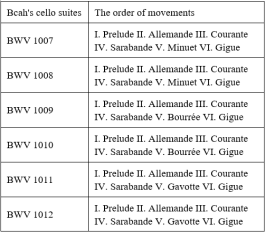
In Reger’s cello suites Op. 131c, there are some obvious characteristics that are similar to Bach’s cello suites. Bach’s cello suite is structured in the standard Baroque suite form, with movements ordered as Prelude, Allemande, Courante, Sarabande, Minuet, and Gigue. In terms of movement features, Reger combined materials from Bach’s cello suites and Bach’s six solo sonatas and partitas for violin.
The movements of Reger’s cello suite, Op. 131c, No. 1, include a Prelude, Adagio, and Fugue. He drew inspiration from Bach’s cello suite for the Prelude and Bach’s violin sonatas and partitas for the Adagio and Fugue. In Reger’s cello suite Op. 131c, No. 2, he combined the Prelude, Gavotte, and Gigue from Bach’s cello suites, and the Largo from Bach’s violin sonatas and partitas. The order of movements in Reger’s Op.131c, No. 3, is Prelude, Scherzo, and Andante con variation. The Prelude was taken from Bach’s cello suites. The Andante con variation was adapted from the Chaconne in Bach’s violin sonatas and partitas, as a Chaconne is also a type of variation. Only the Scherzo is a new element in Reger’s cello suites Op. 131c (see Figure 1, Figure 2, and Figure 3). Therefore, Reger utilized materials from the compositional structure of Bach’s cello suites and violin sonatas and partitas in his cello suites Op. 131c .
Figure 1. The movements of Bach’s cello suites.
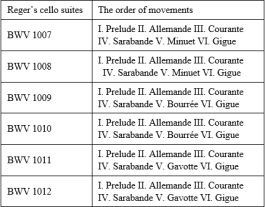
Figure 2. The movements of Bach’s violin sonatas and partitas.
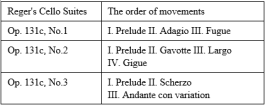
Figure 3. The movements of Reger’s cello suites.
Besides these similar musical forms, Reger’s cello suites still include many rhythmic patterns, elements of composition, melodies, and harmonies that are similar to Bach’s cello suites and violin sonatas and partitas.
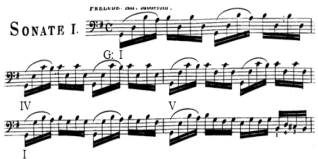
There are some obvious similar characteristics between Bach’s cello suite BWV 1007 and the first movement of Reger’s Op.131c, No.1. First, Op.131c, No.1 and BWV 1007 are both in the same key, which is G major; second, these two works used the same rhythmic pattern, which is sixteen-notes; third, Reger and Bach both used similar compositional methods, such as broken chords, scalar melodies, melodic sequences, and pedal tones. The most obvious similarities between the first movement of Reger’s Op. 131c, No.1, and the prelude of Bach’s cello suite BWV1007 are the melodies and the harmonic progression. The harmonic progression in the four measures of both preludes is the same, and the melodies of both Preludes sound similar as well.
Both Bach and Reger’s preludes begin with G major, and the harmonic progressions in the first four measures are the same: I – IV – V – I, with the first four measures all introduced with the same pedal note G. (see Figure 4, see Figure 5). However, Bach’s melodic lines are entirely based on the chord progressions, whereas Reger’s melodies still fit into the chord progressions while incorporating a more lyrical element. Reger’s melodic lines mostly feature the figurations of descending scalar motions (see Figure 6), which draw from some parts from Bach’s prelude that are also characterized by the same scalar figurations (see Figure 7).
Figure 4. J. S. Bach, Cello Suite, No1, BWV1007, Prelude, mm. 1-5.
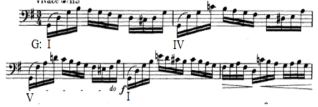
Figure 5. Max Reger, Cello Suite Op. 131c, No. 1, Prelude, mm. 1-4.

Figure 6. Max Reger, Cello Suite Op. 131c, No. 1, Prelude, mm. 3-5.
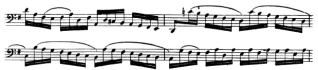
Figure 7. J. S. Bach, Cello Suite, No. 1, BWV1007, Prelude, mm. 28-31.
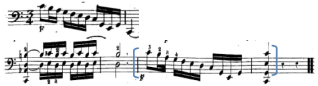
In addition, some parts of the prelude in Op. 131c, No.1 are almost the same as Bach’s prelude of BWV1009, such as measures 9 to 11 and 80 to 83 (see Figure 8) of Reger’s Prelude of Op. 131c, No.1. Reger used a compositional method of descending scale, sometimes followed by broken chords, which is similar to some parts of Bach’s Prelude of BWV 1009 (see Figure 9).
Figure 8. J. S. Bach, Cello Suite, No.3, BWV1009, Prelude, mm.1-2, mm85-88.
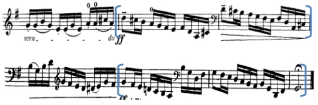
Figure 9. Max Reger, Cello Suite Op. 131c, No. 1, Prelude, mm.9-11, mm.80-83.
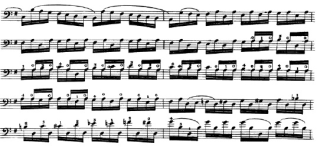
Additionally, in measures 10 to 15 (see Figure 10) of Prelude in Cello Suite Op. 131c, No. 1, Reger employed repeated notes with ascending and descending scalar motions, which are also similar to one of Bach’s compositional characteristics in the section near the end of his first Prelude (see Figure 11)
Figure 10. J. S. Bach, Cello Suite, No.1, BWV1007, Prelude, mm. 30-39.
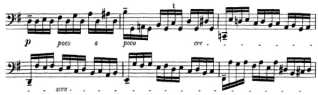
Figure 11. Max Reger, Cello Suite Op. 131c, No. 1, Prelude, mm. 10-15.
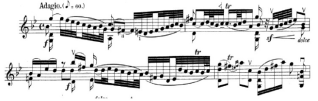
In the slow movement, it is very easy to notice that Bach and Reger both like to use a chord as the first beat at the beginning of each measure and then use the progression of scales as ornaments followed by chords to create improvisation-like effects. This characteristic can be found in both Bach’s Adagio of violin sonatas No.1, BWV 1001(see Figure 12) and Reger’s Adagio of cello suites Op. 131c, No.1 (see Figure 13, Figure 14).
Figure 12. J. S. Bach, Violin Sonata No.1 BWV 1001, Adagio, mm. 1-4.

Figure 13. Max Reger, Cello Suite Op. 131c, No. 1, Adagio, mm. 1-4.
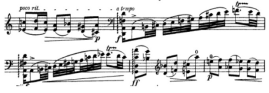
Figure 14. Max Reger, Cello Suite Op. 131c, No. 1, Adagio, mm. 13-16.
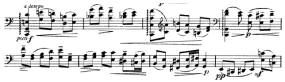
The chords followed by multiple double stops used in Reger’s Adagio of cello suite No. 1 showcase another similarity that bears a resemblance to Bach’s Sarabande of cello suites No. 6 (see Figure15, Figure 16).
Figure 15. Max Reger, Cello Suite Op. 131c, No. 1, Adagio, mm. 41-48.
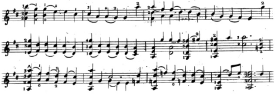
Figure 16. J. S. Bach, Cello Suite, No. 6, BWV1012, Sarabande, mm. 17-28.

Moreover, the last five measures at the coda exhibit a sequential movement that resembles the abbreviated form of the concluding sequences in Bach’s Prelude of cello suite No. 2. The use of sequences of ascending figurations followed by descending scalar lines is a common feature of Bach’s cello suites. (see Figure 17, Figure 18)
Figure 17. Max Reger, Cello Suite Op. 131c, No. 1, Adagio, mm. 58-60.
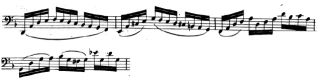
Figure 18. J. S. Bach, Cello Suite, No.2, BWV1008, Prelude, mm. 55-58.
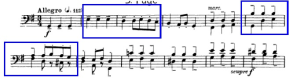
Reger’s first cello suite concludes with a quick fugue that resembles Bach’s prelude of cello suite No. 5. Reger’s fugue exemplifies his mastery of counterpoint in his fugue writing. As a result of the instrument’s limitations, Reger’s fugue is a two-voiced fugue without countersubjects and features a straightforward and lucid fugue structure. Regarding Reger’s use of rhythmic patterns in the subject, the meters and note values differ; however, the arrangement of note values remains the same, reminiscent of Bach’s use of rhythmic patterns in the subject. (see Figure 19, Figure 20).
Figure 19. Max Reger, Cello Suite Op. 131c, No. 1, Fugue, mm. 1-12.

Figure 20. J. S. Bach, Cello Suite, No. 5, BWV 1011, Prelude, mm. 27-31.
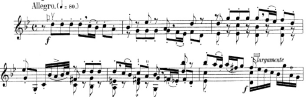
In addition, Reger’s fugue showcases another similarity to Bach’s fugue in violin sonata No. 1 by using the same compositional technique for contrapuntal texture.
Reger and Bach both utilized intricate polyphonic textures with double and multiple stops, along with shifts of voice registers, to create distinct voices. Both Bach and Reger achieve this by drawing the stems in different directions to help performers easily distinguish the two voices throughout the piece. (see Figure 21, Figure 22)
Figure 21. J. S. Bach, Violin Sonata No.1 BWV 1001, Fugue, mm. 1-6.
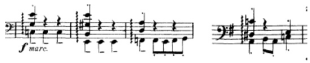
Figure 22. Max Reger, Cello Suite Op. 131c, No. 1, Fugue, mm. 38-41.

In addition, to use the different directions of stems, Reger also employed the alternation of different voice registers to create a counterpoint between voices, very similar to what Bach had done in his cello suites. For instance, in some parts of Reger’s Prelude No. 1, the contrapuntal dialogue sections feature sequences of alternation between higher and lower melodic lines (see Figure 23). This kind of compositional technique can also be found in Bach’s Gigue of his cello suite No. 3 (see Figure 24).
Figure 23. Max Reger, Cello Suite Op. 131c, No. 1, Prelude, mm. 34-37.
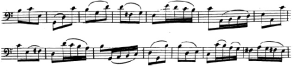
Figure 24. J. S. Bach, Cello Suite, No.3, BWV 1009, Gigue, mm. 6-19.
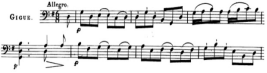
In his second suite, Reger incorporated two Baroque dance movements, specifically a Gavotte and a Gigue. Reger’s dance movements in the second suite are structured and characterized similarly to Bach’s Gavottes and Gigues, particularly in terms of the dance rhythms. Both Reger and Bach’s Gavottes showcase the similarity in their musical forms. Reger’s Gavotte is in ABA form, which corresponds to the bigger picture of ABA form in Bach’s Gavotte, featuring Gavotte I – Gavotte II – Gavotte I.
Furthermore, Reger employed the typical rhythms of Gavottes and Gigues in his second suite, which are the same as Bach’s. For instance, just like Bach used triple meters in his Gigues (see Figure 25), Reger also utilized triple meters in his Gigue (see Figure 26).
Figure 25. J. S. Bach, Cello Suite, No.1, BWV 1007, Gigue, mm. 1-7.

Figure 26. Max Reger, Cello Suite Op. 131c, No. 2, Gigue, mm. 1-5.
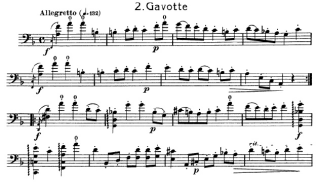
In his Gavotte, Reger emphasized the strong beats of the dance rhythms through the use of double stops and chords (see Figure 27), reminiscent of Bach’s Gavottes that feature the same characteristics (see Figure 28).
Figure 27. Max Reger, Cello Suite Op. 131c, No. 2, Gavotte, mm. 1-16.
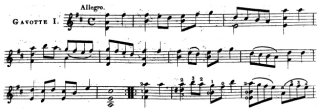
Figure 28. J.S. Bach, Cello Suite, No.6, BWV 1012, Gavotte, mm. 1-12.
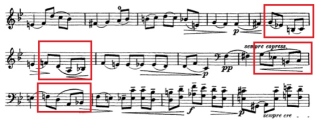
The third movement, Largo, features some melodic materials that bear a resemblance to Bach’s Sarabande from his cello suite No. 5. For example, the Largo in Reger’s second suite presents the same characteristics of slow tempo as Bach’s Sarabande. In measures 5 to 17 of Reger’s Largo (see Figure 29), the melodic elements feature the sequences of descending third intervals followed by step-wise ascending motions, which is the same as the melodic theme of Bach’s Sarabande (see Figure 30).
Figure 29. Max Reger, Cello Suite Op. 131c, No. 2, Largo, mm. 5-17.
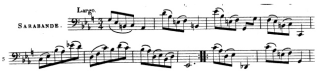
Figure 30. J.S. Bach, Cello Suite, No.5, BWV 1011, Sarabande, mm. 1-10.

Reger’s third suite reveals more advanced assimilation of Bach’s musical influence than his previous suites. However, the rhythms are frequently complex and irregular, the harmony is considerably more intricate, and the texture is denser and more robust. Nevertheless, the melodic lines often exhibit sequential patterns, where inversions are employed frequently, and the last movement is comparably more regular and rugged. Reger incorporated a Scherzo into the second movement of his third suite, in keeping with the middle movement traditions of the late eighteenth century. While the Scherzo is not directly connected to dance, it evokes a dance-like quality. The rhythmic and melodic patterns of Reger’s Scherzo resemble those found in Bach’s Courante of his cello suite No. 3, characterized by alternations between triple and duple meters. The final movement is an Andante con variazioni, comprising a simple melody followed by six variations and a coda. Although the musical form is not related to any movement of Bach’s cello suites, the motivic patterns, including arpeggios and scales, are akin to Bach’s. For instance, in measures 133 to 134 of this movement (see Figure 31), the melodic materials which feature the descending scalar motions can be found in Bach’s Prelude and Allemande of his cello suite No. 3 (see Figure 32).
Figure 31. Max Reger, Cello Suite Op. 131c, No. 3, Andante con variazioni, mm. 133-134.
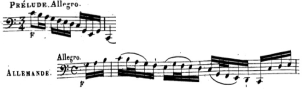
Figure 32. J.S. Bach, Cello Suite BWV 1009, Prelude, mm. 1 and Allemande, mm. 1.

To summarize, Reger’s three cello suites closely follow the overall structure of Bach’s cello suites, with each suite starting with a prelude and subsequent movements in related key. Reger incorporated Baroque-style elements, such as arpeggios, dance rhythms, and melodic sequences, and pays homage to his model by citing Bach’s melodic materials, suggesting that Reger’s cello suites were greatly influenced by Bach’s cello suites.
5. Conclusions
In conclusion, Reger’s music is regarded as having revalidated the aesthetic ideas of Bach. Reger’s performances led his audience to believe that they had heard Bach performing himself . For Reger, Bach definitely played an important role in his life and influenced his ideas of compositional style as well. This article also provides evidence of the similarities of musical materials between Reger and Bach’s cello suites.
As a composer in the 19th century, Reger combined his musical ideas of that period with the older music of Bach and demonstrated that most of his compositions and discussions of Bach had paid unabashed homage to Bach. Reger’s cello suites utilized many compositional characteristics of the Baroque period while employing contemporary harmony and texture. Thus, it is fair to say that Reger is considered “a modern Bach.”
Abbreviations

J.S. Bach

Johann Sebastian Bach

Author Contributions
Yi-Chun Chen: Conceptualization, Methodology, Formal analysis, Investigation, Writing – original draft, Writing – review & editing
Conflicts of Interest
The authors declare no conflicts of interest.
References
[1] Sadie, Stanley. The New Grove Dictionary of Music and Musician. 2nd. Macmillan Publisher Limited; 2001, pp 93.
[2] Frisch, Walter. Reger’s Bach and Historicist Modernism. 19th –Century Music. 2001-02, 25(2-3)
[3] Blom, Eric. Grove’s Dictionary of Music and Musicians. 5th. Martin Press INC; 1954, pp 92.
[4] Anderson, Christopher. Reger in Bach's Notes: On Self-Image and Authority in Max Reger's Bach Playing. The Musical Quarterly. 2004, 87(4), 708-731.
[5] Oxford Music Online, “Suites in Grove music online”. Available from:
[6] Braun, W. The Evolution of the Cello Endpin and Its Effect on Technique and Repertoire. D. M. A. Dissertation, University of Nebraska – Lincoln, 2015.
[7] Leonard, B. H. An Analysis of Max Reger's Suites for Unaccompanied Cello. M. M. Thesis, University of South Carolina, 2012.
[8] Adams, J. W. The Viola Stands Alone: The Rise in Sonatas and Suites for Unaccompanied Viola, 1915–1923. D. M. A. Dissertation, University of California, Santa Barbara, 2014.
[9] Grim, W. E. Max Reger: A Bio-Bibliography. New York: Greenwood Press; 1988, pp 23-25.
[10] The Cello Museum, “The Intersection of Homage and Originality: Max Reger’s Suites for Unaccompanied Cello”. Available from:
Cite This Article
  • APA Style

    Chen, Y. (2026). Finding Bach's Compositional Characteristics in Max Reger’s Cello Suites. Humanities and Social Sciences, 14(3), 232-239. https://doi.org/10.11648/j.hss.20261403.15

    Copy | Download

    ACS Style

    Chen, Y. Finding Bach's Compositional Characteristics in Max Reger’s Cello Suites. Humanit. Soc. Sci. 2026, 14(3), 232-239. doi: 10.11648/j.hss.20261403.15

    Copy | Download

    AMA Style

    Chen Y. Finding Bach's Compositional Characteristics in Max Reger’s Cello Suites. Humanit Soc Sci. 2026;14(3):232-239. doi: 10.11648/j.hss.20261403.15

    Copy | Download

  • @article{10.11648/j.hss.20261403.15,
      author = {Yichun Chen},
      title = {Finding Bach's Compositional Characteristics in Max Reger’s Cello Suites},
      journal = {Humanities and Social Sciences},
      volume = {14},
      number = {3},
      pages = {232-239},
      doi = {10.11648/j.hss.20261403.15},
      url = {https://doi.org/10.11648/j.hss.20261403.15},
      eprint = {https://article.sciencepublishinggroup.com/pdf/10.11648.j.hss.20261403.15},
      abstract = {Max Reger’s Three Suites for Solo Cello, Op. 131c, occupy a significant place in the cello repertoire as among the earliest major unaccompanied cello works composed after Johann Sebastian Bach’s Six Cello Suites. Reger’s deep admiration for Bach and his extensive study of Bach’s music profoundly influenced his compositional style. This study aims to examine the extent to which Bach’s compositional characteristics are reflected in Reger’s cello suites and to identify the musical elements that demonstrate this influence. This research employs comparative musical analysis of Reger’s Three Suites for Solo Cello, Op. 131c, alongside Bach’s Six Cello Suites and Sonatas and Partitas for Solo Violin. The analysis focuses on formal structure, melodic design, rhythmic patterns, harmonic organization, and contrapuntal techniques. The findings reveal that Reger incorporated numerous features associated with Bach’s compositional style. These include the use of preludes, fugue writing, Baroque dance movements, melodic sequences, scalar passages, arpeggiated textures, and polyphonic writing. Reger’s suites also demonstrate similarities to Bach’s works in movement organization, thematic materials, and contrapuntal treatment. At the same time, Reger reinterpreted these Baroque elements through a late-Romantic musical language characterized by richer harmony and denser textures. The study concludes that Reger’s cello suites represent both a continuation and a transformation of Bach’s compositional traditions. By combining Baroque structural principles with nineteenth-century musical aesthetics, Reger created works that honor Bach’s legacy while contributing to the development of the modern solo cello repertoire.},
     year = {2026}
    }
    

    Copy | Download

  • TY  - JOUR
    T1  - Finding Bach's Compositional Characteristics in Max Reger’s Cello Suites
    AU  - Yichun Chen
    Y1  - 2026/06/09
    PY  - 2026
    N1  - https://doi.org/10.11648/j.hss.20261403.15
    DO  - 10.11648/j.hss.20261403.15
    T2  - Humanities and Social Sciences
    JF  - Humanities and Social Sciences
    JO  - Humanities and Social Sciences
    SP  - 232
    EP  - 239
    PB  - Science Publishing Group
    SN  - 2330-8184
    UR  - https://doi.org/10.11648/j.hss.20261403.15
    AB  - Max Reger’s Three Suites for Solo Cello, Op. 131c, occupy a significant place in the cello repertoire as among the earliest major unaccompanied cello works composed after Johann Sebastian Bach’s Six Cello Suites. Reger’s deep admiration for Bach and his extensive study of Bach’s music profoundly influenced his compositional style. This study aims to examine the extent to which Bach’s compositional characteristics are reflected in Reger’s cello suites and to identify the musical elements that demonstrate this influence. This research employs comparative musical analysis of Reger’s Three Suites for Solo Cello, Op. 131c, alongside Bach’s Six Cello Suites and Sonatas and Partitas for Solo Violin. The analysis focuses on formal structure, melodic design, rhythmic patterns, harmonic organization, and contrapuntal techniques. The findings reveal that Reger incorporated numerous features associated with Bach’s compositional style. These include the use of preludes, fugue writing, Baroque dance movements, melodic sequences, scalar passages, arpeggiated textures, and polyphonic writing. Reger’s suites also demonstrate similarities to Bach’s works in movement organization, thematic materials, and contrapuntal treatment. At the same time, Reger reinterpreted these Baroque elements through a late-Romantic musical language characterized by richer harmony and denser textures. The study concludes that Reger’s cello suites represent both a continuation and a transformation of Bach’s compositional traditions. By combining Baroque structural principles with nineteenth-century musical aesthetics, Reger created works that honor Bach’s legacy while contributing to the development of the modern solo cello repertoire.
    VL  - 14
    IS  - 3
    ER  - 

    Copy | Download

Author Information