Research Article | | Peer-Reviewed

Equifinality of Population Dynamics in Georgia,1980-2020: Implications for Planning and Development

Received: 24 April 2026     Accepted: 4 June 2026     Published: 9 June 2026
Views:       Downloads:
Abstract

Counter-urbanization or regional decentralization since the late 1970s in the United States initiated the polarization reversal tendencies and the decentralization of population, commercial, and industrial activities to the suburbs, intermediate-sized cities, and small towns. Is the present phase of migration and settlement a myth or reality in the State of Georgia? The study analyzed the recent population movement and dynamics in Georgia using the counties and their cities as units of analysis. The study was exploratory and explanatory in nature, using descriptive statistics such as totals, ratios, averages, and tables and graphs. The research effort established the final destination of migrants from urban as well as rural areas, therefore the concept of “equifinality.” The study supports the counter-urbanization theorization, whereby the small and middle-sized cities in the orbits of large central cities of the metropolitan statistical areas (MSAs) grow at the expense of the large cities’ population decline or stagnation or modest growth.

Published in Humanities and Social Sciences (Volume 14, Issue 3)
DOI 10.11648/j.hss.20261403.16
Page(s) 240-258
Creative Commons

This is an Open Access article, distributed under the terms of the Creative Commons Attribution 4.0 International License (http://creativecommons.org/licenses/by/4.0/), which permits unrestricted use, distribution and reproduction in any medium or format, provided the original work is properly cited.

Copyright

Copyright © The Author(s), 2026. Published by Science Publishing Group

Keywords

Urbanization, Counterurbanization, Regional Decentralization, Deurbanization, Counterurbanites, Migration, Push and Pull Drivers, Equifinality

1. Introduction
Since the 1970s in United States (U.S), counter-urbanization had replaced urbanization as the dominant force shaping the nation’s settlement system. This experience is not unique to U.S but also witnessed in other Western nations. Urbanization in a sense is characterized by increasing size, density, and heterogeneity of a settlement. It implies a movement from a state of less concentration to a state of more concentration. Thus, a process of population concentration. Counter-urbanization is a process by which the populations of large cities decline or stagnate while the populations of the surrounding small and middle-sized/intermediate-sized cities and towns grow. The growth of these smaller settlements is at the expense of the large cities’ decline.
Thus, Counter-urbanization is characterized by decreasing size, density, and heterogeneity.
It is a process of population deconcentrating . The orthodox urbanization process had almost been rendered obsolete by the current counter-urbanization.
In the U.S, metropolitan areas grew less rapidly than the nation, especially in the 1980s and 1990s, and had lost population to non-metropolitan/micropolitan territories. Migration out of the large cities has been selective of particular social and economic groups; very specific subgroups have been left behind. In general, migration is an assertive mechanism, filtering and sifting the population as its members undergo socio-economic mobility. The recent volatility of population redistribution trends in the U.S continues to stimulate demographic imaginations.
Counter-urbanization or regional decentralization since the late 1970s initiated the polarization reversal tendencies and the decentralization of population, commercial, and industrial activities to the suburbs, intermediate-sized cities, and small towns. In some regions the non-metropolitan territories are at the same time losing population and decaying as farmlands shrink. Is the present phase of migration and settlement a myth or reality in the State of Georgia? This research effort lays out facts of this population dynamics and changes in the state of Georgia and speculates about the nature of the process.
2. Purpose of Study
The purpose of this study is to analyze the recent population movement and dynamics in Georgia using the counties and their cities as units of analysis. The study is exploratory and explanatory in nature, using descriptive statistics such as totals, ratios, averages, and tables and graphs. Personal interviews and secondary data were collected from different departments, organizations, and online sources. The degree of population increases or loss in different sizes of settlements in different counties and regions are to be established. The research strives to establish the final destination of migrants from urban as well as rural areas, therefore the concept of “equifinality”.
3. The Study Area
The Study Area is the State of Georgia with its Counties, Cities, and Towns. The State of Georgia is in the South-Eastern United States. According to the 2020 United States census, Georgia was the 8th most populous state with 10,713,771 in habitants. It is the 21st largest by land spanning 57,513.49 square miles (148,959.3 square kilometers of land. Georgia is divided into 159 counties and contains 535 municipalities consisting of cities, towns, consolidated city-counties, and consolidated cities. The largest municipality by population is Atlanta with population of 512,550 residents, and the smallest is Aldora with 103 residents.
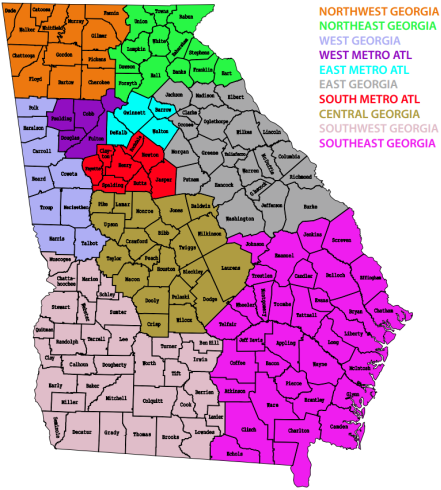
Figure 1. Map of Georgia Counties.
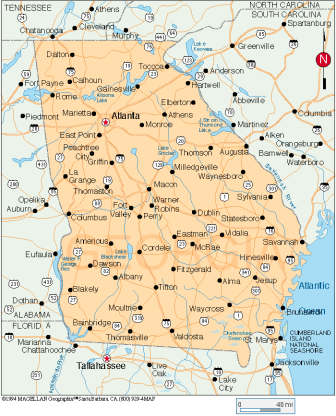
Figure 2. Map of Georgia Major Cities.
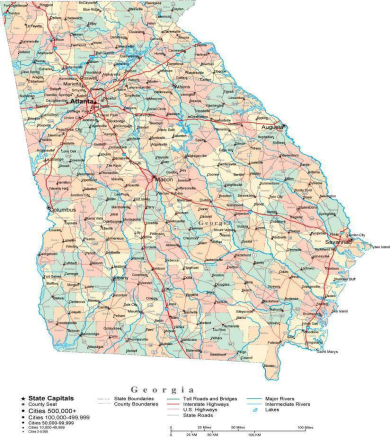
Figure 3. Map of Georgia with Cities, Interstate Highways, Roads, Rivers, and Lakes.
4. Theoretical Framework for the Study
The Urbanization reversal gained a greater traction in the United States in the 1970s, depicting a demographic trend where people move from urban areas to smaller towns and rural areas. The manifestation of this process as both a process and a movement is population deconcentrating, reversing the concentration associated with the traditional rural-to-urban migration.
The above phenomenon of urbanization reversal or counterurbanization, according to Mitchell and Bryant is a process that has a transformation effect on a settlement system or urban region from a concentrated to a more deconcentrated state. They also implied that counterurbaniztion is also a movement of migrating from places of greater to lesser population concentration . The movement impacts medium-sized cities, small towns, and rural areas contributing to their population growth, but at differentiated rates shown by statistics on internal migration of the recipient spaces.
From the inception of current phenomenon of counterurbanization, it has become a key line of inquiry in social science studies. According to Mitchell and Bryant (2020) , the study is not only occurring in the U.S but extensively documented also in many other countries and regions such as Europe, North America, Isreal, Australia, New Zealand, Africa (e.g., South Africa), Canada, Asia (e.g., China, Japan), and Greece.
During the late 20th century and early 21st century period of counterurbanization, the reshaping of social and economic structures was also happening in rural areas across U.S. The functional and morphological restructuring of rural areas were mostly due to interconnected factors of rural pathologies and the push factors, such as demographic aging and shrinking populations, job loss due to agricultural decline, small farm closures due to mechanization, and merger of farms and consolidations. Other pathologies include, especially the limited opportunities in certain high-wage or specialized sectors which discourage and constrain the highly skilled workers from relocating to rural areas. Some rural areas are not easily accessible from other regions due to their remoteness, making it virtually impossible to attract new businesses, industries, and young resourceful individuals.
Urbanization reversal or counterurbanization is not the monopoly of the U.S, it is also occurring in other advances countries, many emerging economies, and some developing countries. It happens for various reasons and has significant impacts on, and implications for middle-sized and small settlement areas. For example, it is happening in United Kingdom ; Industrialized or Global North countries ; Developing countries ; Japan ; Asia; Latin America ; Africa ; and of course, U.S .
In the U.S like in other areas or regions of the world, there are multiple interconnected factors, forces, and drivers that are associated with counterurbanization mobilities, which include Economic and Employment Drivers; Quality of Life and Environmental Factors; Infrastructure and Accessibility; Demographic and Lifestyle Shifts; Health and Safety Factors, and even Government Policies. The above counterurbanization taxonomy factors were further explained by Mitchell and Bryant (2020) as shown below :
The Economic and Employment Drivers: The rising property prices in major cities are among the most powerful forces pushing people toward rural areas where their financial assets stretch further. For example, housing affordability for the migrants in cheaper regions, rural employment growth as corporations in small and medium-sized towns create jobs reducing the need to relocate to urban areas, and cost reduction for employers who save money by hiring in rural areas thereby cutting down the higher overhead costs associated with urban offices.
Quality of Life and Environmental Factors: People are drawn to rural areas for cleaner air, lower crime, less congestion, and access to green space, and the idealized views of country life.
The Infrastructure and Accessibility Factors: Improved transportation and connectivity have made rural living more feasible by enabling easier access to urban services and employment opportunities. The high-speed internet and digital communication tools have reduced the need for physical urban presence and making remote work viable from rural locations. Higher car ownership and road development improvements allow residents to commute or access distant services easily.
The Demographic and Lifestyle Shifts: Increased wealth and changing life stages have enabled more people to pursue rural relocation during retirement or early career transitions. Second homes and early retirement have increased movement in recent years.
The Government Policy Factor: Some governments implement investments in infrastructure, including high-speed internet and transportation links, to encourage rural development and settlement. For example, in Japan it is a deliberate effort to encourage counterurbanization to tackle rural pathologies such as aging and depopulating rural areas .
Other typology versions of the multiple factors associated with population dynamics and mobilities range from economic to quality-of-life motives often linked to idyllic representation of the countryside . Thus, the concepts of “commercial counterurbanization” , “crisis-led counterurbanization”, and “lifestyle migration” .
Motivational data, according to Mitchell and Bryant (2020) distinguish at least four different types of counterurbanites, such as :
Displaced Urbanites (also called urban dropouts or distressed movers). These counterurbanites engage in default counterurbanization and favor urban residence over rural areas. They move to either adjacent or more distant rural regions, on a permanent or temporary basis, for livelihood reasons, sometimes brought about by economic crisis.
The Exurbites. They maintain urban employment but choose rural residential living spaces to enjoy their amenities. They move their primary residences to an outer ring of the urban region to facilitate a frequent commute.
The Pro-ruralites. These retirees, new rural workers, or virtual commuters engage in mainstream counterurbanization to both metropolitan-adjacent and more distance locales. They migrate for lifestyle reasons, but often maintain urban ties through social, shopping, or virtual work activity.
The Antiurbanites (also called dystopian or neorurals). They move to escape the disamenities of urban living and to immerse themselves in an alternative lifestyle. Some engage in seasonal, or ongoing natureurbanization (a type of counterurbanization), and choose a destination adjacent to a protected natural area.
The above counterurbanite typology illustrates the diverse nature of the counterurbanite cohort, and the increasing heterogeneity of many small settlement areas. In fact, the counterurbanites impact on the functional and morphological structures of the recipient places as they can introduce new businesses to meet their demands. They can also invest their externally accumulated capital (financial, social, and/or cultural) in planned or unplanned, seasonal or year-round businesses.
This study theorizes that through internal migration in the state of Georgia, large urban centers lost population to smaller centers down the settlement hierarchy. Likewise, rural areas lost population to larger centers up the settlement hierarchy due to some rural pathologies.
The question is, what are the implications for planning and development because of the above demographic changes in large cities, middle-sized cities and small towns, as well as in rural non-metropolitan areas? This study will proffer some policies and programs for regional growth and development in Georgia.
5. Discussions
The United States population increased enormously from 1980 (226,546 million) to 2020 (323,724 million) (Table 1). Likewise, the population of State of Georgia increased enormously from 1980 (5,462,982) to 2020 (10,710,017) (Tables 2 and 3). The major cities in Georgia are Atlanta, Augusta, Columbus, Savannah, Macon, Athens, Albany, and Valdosta. Some of the large cities lost population in 1980s and 1990s, such as Atlanta, Albany, Augusta, East Point, Macon, and Savannah.
Most growths are in the eight-county Metro Atlanta area, North Georgia, and Coastal Georgia (Figure 1). Metro Atlanta Counties include Fulton, DeKalb, Cobb, Gwinnett, Clayton, Douglas, Rockdale, and Henry. North Georgia Counties include Murrey, Union, White, Lumpkin, Dawson, Pickens, Cherokee, Forsyth, Hall, and Bartow. Coastal Counties include Camden, Brantly, Long, Liberty, Bryan, and Effingham. Georgia counties with large population of 50,000 or more individuals from 1990 to 2020 census years include, Bartow, Bibb, Carroll, Chatham, Cherokee, Clarke, Clayton, Cobb, Columbia, Coweta, DeKalb, Dougherty, Douglas, Fayette, Floyd, Fulton, Glynn, Gwinnett, Hall, Henry, Houston, Liberty, Lowndes, Muscogee, Richmond, Spalding, Troup, Walker, and Whitefield. (Table 4). Most of the Counties are within the orbit of Metropolitan Areas of Georgia, except Troup County.
According to Usdansky (1990) , Atlanta Constitution Staff Writer, the above three regions accounted for 72 percent of the growth across the state. Metro Atlanta more than 50 percent (56%), followed by North Georgia (11 percent), and Coastal Georgia (5 percent). The rest of the counties, especially the southern non-metropolitan/rural counties, accounted for only 28 percent during the same period. The growth of cities is mostly in the middle-sized cities of 30,000 to 80,000 inhabitants, especially from 1990 to 2020 (Tables 5 and 6). Apart from natural increase and domestic migration, growth of those middle-sized cities has been fueled by foreign born or immigrants. In 1990, the cities of 25,000 or more population with foreign born more than the Georgia state average (2.7 percent) were: Athens (5.6 percent), Atlanta (3.4 percent), Columbus (3.4 percent), East Point (3.2 percent), Marietta (5.1 percent), Roswell (6.3 percent), Smyrna (5.9 percent), and Warner Robins (3.0 percent) (Table 5). In 2020, most cities with 25,000 or more population have foreign born more or near the state average of 10.3 percent (Table 6).
Table 1. United States Population Components Change, 1980-2020.

Year

Calander Year

Rate Per 1,000 Mid-Year Population

Population as of January 1 (1,000)

Net Increase from Previous Year Total

Net Migration1 (1,000)

Net Growth Rate

Net Migration Rate

1980

226,546

1,900

724

11.1

4.2

1990

248,143

2,535

542

10.2

2.2

2000 (Projection)2

274,110

2,492

970

9.1

3.5

2010 (Projection)2

298,710

2,425

720

8.1

2.4

2020 (Projection)2

323,724

2,530

757

7.8

2.3

Source: U.S. Census Bureau . Statistical Abstract of the United States: 2000
1 International migration and movement of armed forces
2 Based on Mid-Year Series Assumptions
Table 2. Georgia Cities of 25,000 or More Population, 1980-2000.

City

Land Area 1990 (km2)

County

Total Population 1980

Total Population 1990

Total Population 2000

% Change 1980-1990

% Change 1990-2000

Albany

143.6

Dougherty

74,059

78,804

76,939

6.4

-2.4

Athens

43.0

Clarke

42,549

86,5221

100,2661

103.31

15.91

Atlanta

341.3

Fulton/DeKalb

425,022

393,929

416,474

-7.3

5.7

Augusta

50.9

Richmond

47,532

44,633

195,1822

-6.1

337.32

Columbus

560.0

Muscogee

NA3

178,683

186,291

NA

4.3

East Point

35.6

Fulton

37,486

34,595

39,595

-7.7

14.5

LaGrange

67.2

Troup

24,163

25,574

25,998

5.8

1.7

Macon

124.0

Bibb

116,903

107,365

NA4

-8.2

NA3

Marietta

52.7

Cobb

30,829

44,129

58,748

43.1

33.1

Rome

62.7

Floyd

29,609

30,425

34,980

2.4

15.0

Roswell

84.4

Fulton

23,337

47,986

79,334

105.4

65.3

Savannah

162.1

Chatham

141,378

137,812

131,510

-2.5

-4.6

Smyrna

29.5

Cobb

20,312

32,453

40,999

59.8

26.3

Valdosta

68.6

Lowndes

37,533

40,038

43,724

6.7

9.2

Warner Robins

43.2

Houston/Peach

39,879

43,861

48,804

10.0

11.3

Georgia State

15,009.5

All Counties

5,462,982

6,478,149

8,186,453

18.6

26.4

Sources: (1) Deirdre A. Gaquin and Katherine A. DeBrandt (eds.) . 2000 County and City Extra. Annual Metro, City, and County Data Book. Nineth Edition (Lanham, MD: Bernan Press).
Table D: Cities of 25,000 or More. Land Area and Population, p. 949.
(2) 2000 population data are from: Deirdre A. Gaquin and Mary Meghan Ryan (eds.) . 2021 County and City Extra. Annual Metro, City, and County Data Book, 29th Edition (Lanham, Boulder, New York, London: Bernan Press).
Table D: Cities of 25,000 or More. Land Area and Population, p. 995.
1 Unified Government. A unified city-county government combines the functions of city and county administrations. National League of Cities (December 14, 2014). Cities 101-Consolidations-National League of Cities.
2,3,4 Consolidated Government. A consolidated city-county is the “formal joining of a city (or cities) with a surrounding county government,” according to the National League of Cities.
Note:
Land area in 1990 is dry land or land partially or temporarily covered by water.
Hispanic persons may be of any race.
Table 3. Georgia Cities of 25,000 or More Population, 2000-2020.

City

County

Land Area (Miles2)

Total Population 2000

Total Population 2010

Total Population 2020

% Change 2000-2010

% Change 2010-2020

% Change 2000-2020

Albany

Dougherty

55.1

76,939

77,430

70,839

0.6

-8.5

-7.9

Alpharetta

Fulton

26.9

34,854

57,383

67,897

64.6

18.3

94.8

Athens-Clarke County

Clarke

116.3

100,266

115,370

126,391

15.1

9.6

26.1

Atlanta

Fulton/

DeKalb

135.3

416,474

427,042

512,550

2.5

20.0

23.1

Augusta-Richmond County

Richmond

302.3

195,182

200,594

197,468

2.8

0.8

1.2

Columbus

Muscogee

216.5

186,291

190,570

196,442

2.3

3.1

5.5

Dalton

Whitfield

21.1

27,912

33,104

33,368

18.6

0.8

19.5

Douglasville

Douglas

22.8

20,065

29,892

34,036

49.0

13.9

69.6

Duluth

Gwinnett

10.2

22,122

26,672

29,676

20.6

11.3

34.2

Dunwoody

DeKalb

13.0

32,808

46,428

49,326

41.5

6.2

50.4

East Point

Fulton

14.7

39,595

33,452

35,042

-15.5

4.8

-11.5

Gainesville

Hall

33.4

25,578

34,045

44,213

33.1

29.9

72.9

Hinesville

Liberty

18.3

30,392

33,309

34,085

9.6

2.3

12.2

Johns Creek

Fulton

30.8

NA

76,639

85,192

NA

11.2

NA

Kennesaw

Cobb

9.7

21,675

30,618

34,712

41.3

13.4

60.2

LaGrange

Troup

42.1

25,998

29,365

30,741

13.0

4.7

18.2

Lawrenceville

Gwinnett

13.6

22,397

27,215

30,842

21.5

13.3

37.7

Macon-Bibb County

Bibb

249.4

NA

155,844

152,732

NA

-2.0

NA

Marietta

Cobb

23.4

58,748

56,369

60,786

-4.0

7.8

3.5

Milton

Fulton

38.5

NA

32,828

40,037

NA

22.0

NA

Newnan

Coweta

19.4

16,242

32,874

42,885

102.4

30.5

164.0

Peachtree City

Fayette

25.1

31,580

34,409

36,763

9.0

6.8

16.4

Rome

Floyd

31.7

34,980

36,417

36,764

4.1

1.0

5.1

Roswell

Fulton

40.7

79,334

88,333

95,434

11.3

8.0

20.3

Sandy Springs

Fulton

37.7

85,781

93,828

109,928

9.4

17.2

28.2

Savannah

Chatham

106.8

131,510

136,919

143,632

4.1

4.9

9.2

Smyrna

Cobb

15.6

40,999

50,864

56,443

24.1

11.0

37.7

Statesboro

Bulloch

15.0

22,698

28,370

33,204

25.0

17.0

46.3

Stockbridge

Henry

13.7

9,853

26,369

30,125

167.6

14.2

205.7

Valdosta

Lowndes

36.0

43,724

54,753

56,668

25.2

3.5

29.6

Warner Robins

Houston/

Peach

37.8

48,804

69,859

76,601

43.1

9.6

57.0

Georgia State

All Counties

57,716.3

8,186,453

9,688,737

10,710,017

18.4

10.5

30.8

Source: Deirdre A. Gaquin and Mary Meghan Ryan (eds.) . 2021 County and City Extra. Annual Metro, City, and County Data Book. 29th Edition. (Lanham, Boulder, New York, London: Bernan Press), pp. 994-995.
Table D. Cities of 25,000 or More. Land Area and Population.
Table 4. Georgia Counties* with Population of 50,000 or More Individuals, 1990-2020 Census Years.

County

1990 01/04

2000 01/04

2010 01/04

2020 01/04

Bartow

55,911

76,019

100,157

108,897

Bibb

149,967

153,887

155,547

157,347

Carroll

71,422

87,268

110,527

119,151

Chatham

216,935

232,048

265,128

295,291

Cherokee

90,204

141,903

214,346

266,594

Clarke

87,594

101,489

116,714

128,670

Clayton

182,052

236,517

259,424

299,403

Cobb

447,745

607,751

688,078

766,112

Columbia

66,031

89,288

124,053

156,013

Coweta

53,853

89,215

127,317

146,163

DeKalb

545,837

665,865

691,893

764,425

Dougherty

96,311

96,065

94,565

85,793

Douglas

71,120

92,174

132,403

144,310

Fayette

62,415

91,263

106,567

119,181

Floyd

81,251

90,565

96,317

98,582

Fulton

648,951

816,006

920,581

1,066,675

Glynn

62,496

67,568

79,626

84,500

Gwinnett

352,910

588,448

805,321

957,306

Hall

95,428

139,277

179,684

202,889

Henry

58,741

119,341

203,922

240,703

Houston

89,208

110,765

139,900

163,642

Liberty

52,745

61,610

63,453

65,271

Lowndes

75,981

92,115

109,233

118,247

Muscogee

179,278

186,291

189,885

206,919

Richmond

189,719

199,775

200,549

206,603

Spalding

54,457

58,417

64,073

67,312

Troup

55,536

58,779

67,044

69,426

Walker

58,340

61,053

68,756

67,653

Whitfield

72,462

83,525

102,299

102,867

Georgia State

6,478,216

8,186,453

9,687,653

10,713,771

Source: Georgia (USA): Places in Counties—Population Statistics, Charts, and Map, Pp. 1-22.
Retrieved 01/30/2026. https://www.citypopulation.de/en/usa/places/georgia/
*All are Metropolitan Counties except Troup County
Table 5. Georgia Cities of 25,000 or More Population Characteristics by Race (Percent) in 1990.

City

Total Population 1990

Percent White

Percent Black

Percent Hispanic

Percent Indian, Eskimo, Aleut

Percent Asian and Pacific Islander

Percent Other

Percent Foreign Born

Albany

78,804

44.2

55.0

0.8

0.2

0.4

0.2

1.0

Athens

86,522

66.4

29.6

1.6

0.1

3.3

0.5

5.6

Atlanta

393,929

31.0

67.1

1.9

0.1

0.9

0.9

3.4

Augusta

44,633

43.0

56.0

0.8

0.2

0.6

0.2

1.7

Columbus

178,683

59.0

38.0

2.9

0.3

1.4

1.4

3.4

East Point

34,595

31.6

66.3

1.9

0.2

0.7

1.1

3.2

La Grange

25,574

56.7

42.3

0.6

0.1

0.8

0.1

1.6

Macon

107,365

47.1

52.2

0.6

0.1

0.4

0.1

0.8

Marietta

44,129

76

20.5

3.2

0.3

1.8

1.1

5.1

Rome

30,425

68.8

29.7

1.7

0.2

0.7

0.6

1.8

Roswell

47,986

92.2

4.9

2.7

0.1

1.8

1.1

6.3

Savannah

137,812

46.8

51.3

1.4

0.2

1.1

0.5

1.9

Smyrna

32,453

80.2

15.9

3.5

0.3

2.3

1.4

5.9

Valdosta

40,038

55.2

43.5

1.1

0.2

0.9

0.2

1.8

Warner Robins

43,861

72.7

25.0

1.8

0.3

1.4

0.6

3.0

Georgia State

6,478,149

71.0

27.0

1.7

0.2

1.2

0.7

2.7

Sources: (1) Deirdre A. Gaquin and Katherine A. DeBrandt (eds.) . 2000 County and City Extra. Annual Metro, City, and County Data Book. Nineth Edition (Lanham, MD: Bernan Press).
Table D: Cities of 25,000 or More. Land Area and Population, p. 949.
(2) 2000 population data are from: Deirdre A. Gaquin and Mary Meghan Ryan (eds.) . 2021 County and City Extra. Annual Metro, City, and County Data Book, 29th Edition (Lanham, Boulder, New York, London: Bernan Press).
Table D: Cities of 25,000 or More. Land Area and Population, p. 995.
1 Unified Government. A unified city-county government combines the functions of city and county administrations. National League of Cities (December 14, 2014). Cities 101-Consolidations-National League of Cities.
2,3,4 Consolidated Government. A consolidated city-county is the “formal joining of a city (or cities) with a surrounding county government,” according to the National League of Cities.
Note:
Land area in 1990 is dry land or land partially or temporarily covered by water.
Hispanic persons may be of any race.
Table 6. Georgia Cities of 25,000 or More Population Characteristics by Race (Percent) in 2020.

City

Total Population 2020

Percent White

Percent Black or African American

Percent Hispanic or Latino

Percent American Indian, Alaskan Native

Percent Asian1

Percent Other

Percent Foreign Born

Albany

70,839

D

D

2.4

D

D

0.0

2.0

Alpharetta

67,897

60.4

14.4

10.9

0.0

20.6

0.8

24.4

Athens-Clark County

126,391

63.1

28.0

11.0

0.0

4.3

1.4

10.2

Atlanta

512,550

42.3

49.1

4.9

0.2

5.3

0.9

8.4

Augusta-Richmond County

197,468

34.7

57.5

4.8

0.1

1.8

2.6

4.0

Columbus

196,442

42.6

46.7

7.7

0.5

2.9

3.4

6.3

Dalton

33,368

82.6

3.8

42.9

0.7

3.2

4.9

24.2

Douglasville

34,036

D

D

8.9

D

D

D

9.8

Duluth

29,676

44.3

20.4

6.7

0.0

29.7

1.6

34.5

Dunwoody

49,326

62.3

12.0

9.6

0.6

20.8

3.0

20.6

East Point

35,042

14.4

81.2

4.1

0.8

0.3

1.7

4.9

Gainesville

44,213

77.3

10.3

48.0

0.1

3.7

3.5

20.5

Hinesville

34,085

42.8

42.2

15.7

0.3

2.4

3.5

8.4

Johns Creek

85,192

61.0

11.9

8.4

0.1

21.7

3.0

27.1

Kennesaw

34,712

51.5

32.2

5.5

0.0

7.8

5.0

17.3

LaGrange

30,741

D

D

4.3

D

D

D

3.5

Lawrenceville

30,842

38.4

43.6

24.2

0.0

4.7

9.7

24.9

Macon-Bibb County

152,737

39.3

54.4

3.5

0.0

2.2

1.4

3.6

Marietta

60,786

45.4

31.4

18.2

1.7

3.0

15.0

15.0

Milton

40,037

D

D

4.5

D

D

D

15.3

Newman

42,885

D

D

7.1

D

D

D

10.4

Peachtree City

36,763

75.5

11.0

3.2

0.0

7.8

0.1

14.6

Rome

36,764

58.2

25.1

17.9

0.0

1.1

7.2

10.6

Roswell

95,434

72.0

15.0

14.3

0.4

5.7

3.7

19.3

Sandy Springs

109,928

63.6

22.4

10.3

0.0

7.9

3.8

17.7

Savannah

143,632

40.5

52.6

5.4

0.4

3.1

2.0

5.2

Smyrna

56,443

46.9

28.2

19.9

1.4

8.0

13.9

20.4

Statesboro

33,204

47.6

41.5

5.6

0.2

1.9

2.8

4.1

Stockbridge

30,125

D

D

11.8

D

D

D

9.5

Valdosta

56,668

36.4

57.3

6.0

1.3

0.7

0.0

2.6

Warner Robins

76,601

48.7

39.7

5.5

0.1

7.2

0

9.4

Georgia State

10,710,017

57.8

31.9

9.8

0.4

4.1

3.0

10.3

Source: Deirdre AQ. Gaquin and Mary Meghan Ryan (eds) . 2021 County and City Extra. Annual Metro, City, and County Data Book, 29th Edition.
Table D. Cities of 25,000 or More. Land Area and Population. (Lanham, Boulder, New York, London: Bernan Press), Pp. 994-995.
1Hawaiian Pacific Islander Population Percentage in 2020 was very Insignificant except in Peachtree City (1.8%) and Valdosta (0.7). See page 994.
6. Findings
The degree or tempo by which a settlement or central place lost population by 2020 depends on the size and location within metropolitan or nonmetropolitan areas. Fewer cities between 10,000 and 25,000 inhabitants lost population in 2020 census year. They are within the orbit of large cities (Table 7). Cities of 5,000 and 10,000 inhabitants lost more residents than the previous size levels but less than the next lower level of between 2,000 and 5,000 inhabitants. These cities are farther removed from large cities than the previous cities (Table 8). Cities of 2,000 and 5,000 inhabitants lost more residents than the previous higher levels but less than the next lower level of 1,000 to 2,000 inhabitants. These are closer to smaller rural towns. (Table 9). Cities of 1,000 to 2,000 inhabitants lost more residents than the previous higher-level settlements but less than the next lower-level inhabitants of less than 1,000. These cities are closest to the rural towns. (Table 10). Cities and towns of less than 1,000 inhabitants lost more residents than the previous higher levels. These cities are rural towns. It has the highest number of settlements that lost population in 2020 (Table 11). Out of 241 towns that had less than 1,000 inhabitants in 2020 census, 144 of them lost inhabitants.
The larger the cities or settlements the less inhabitants they lost in 2020. As the towns or settlements were getting smaller, the more they lost population in 2020. The worst cities and towns that lost population from 2010 to 2020 were less than 1,000 inhabitants. Most of the smallest settlements that lost enormous residents are in Georgia’s nonmetropolitan areas or agricultural areas and districts. Out of 241 towns that were less than 1,000 inhabitants in 2020 census, 144 of them (about 60 percent) lost population, from Fort Gaines (Clayton County) to Aldora (Lamar County).
The U.S population increased enormously from 1980 to 2020 with modest net migration rates.
The net growth rates had been high though dwindled from 11.1 percent in 1980, down to 7.8 percent in 2020 (Table 1). In absolute terms, the net increase from previous years had been high. Likewise, State of Georgia population increased enormously from 1980 through 2020, with rapid rate of change (30.8 percent) from 2000 to 2020. The percent of foreign born of 10.3 in 2020 was high when compared to only 2.7 percent in 1990. State of Georgia saw a significant increase of Blacks or African Americans, Hispanics or Latinos, and Asian Americans, from 1990 to 2020. The White percent decreased enormously during the same period.
The cities and towns populations in their categories increased during the study decades, except those that lost inhabitants. Going up the central place or settlement hierarchy from the lowest to middle, and to the highest, a smaller number of settlements lost population while a majority gained population. Most middle-level settlements gained population as they are in the umbra (immediate core) and penumbra (distant core) of the largest settlements that grew modestly.
Table 7. Georgia Cities of 10,000 to 25,000 that Lost Population in 2020.

City

County

Population 01/04/1990

Population 01/04/2000

Population 01/04/2010

Population 01/04/2020

College Park

Fulton/Clayton

21,962

20,799

14,607

13,894

Griffin

Spalding

21,837

22,919

23,643

23,478

Milledgeville

Baldwin

17,894

19,215

18,223

17,061

Cusseta-Chattahoochee County (Unified Govt.)

Chattahoochee

16,934

14,895

11,263

9,569

Americus

Sumter

16,600

17,043

17,112

16,227

Dublin

Laurens

16,411

15,943

16,172

16,074

Brunswick

Glynn

16,533

15,598

15,296

15,216

Riverdale

Clayton

11,156

13,014

15,134

15,129

Cordele

Crisp

11,149

11,530

11,170

10,241

Georgia State

All

6,478,216

8,186,453

9,687,653

10,713,771

Sources: (1) U.S. Census Bureau . 2020 Census Count by Georgia City Population. Data released by the U.S. Census Bureau, August 12, 2021. Compiled by the Legislative and Congressional Reapportionment Office.
(2) U.S. Census Bureau. Georgia (USA) : Places in Counties—Population Statistics, Charts, and Maps. Counties: Population of all counties in Georgia by Census Years https://www.citypopulation.de/en/usa/places/georgia.
Explanation: Latest available rebased population figures used. In case of significant changes, they were recalculated by using census block data.
Table 8. Georgia Cities of 5,000 to 10,000 that Lost Population in 2020.

City

County

Population 01/04/1990

Population 01/04/2000

Population 01/04/2010

Population 01/04/2020

Jesup

Wayne

9,151

9,307

10,209

9,817

Fitzgerald

Ben Hill/Irwin

9,077

9,049

9,160

9,015

Fort Valley

Peach

9,377

8,149

9,805

8,788

Lafayette

Walker

6,892

6,608

7,131

6,894

Eatonton

Putman

6,303

6,775

6,480

6,307

Barnesville

Lamar

5,258

5,995

6,827

6,123

Sandersville

Washington

6,603

6,321

5,930

5,812

Sylvester

Worth

5,982

6,154

6,189

5,629

Camilla

Mitchell

5,164

5,394

5,308

5,190

Elberton

Elbert

5,506

4,660

4,653

4,640

Summerville

Chattooga

5,014

4,631

4,532

4,422

Dawson

Terrell

5,353

5,145

4,619

4,393

Georgia State

All

6,478,216

8,186,453

9,687,653

10,713,771

Sources: (1) U.S. Census Bureau 2020 Census Count by Georgia City Population. Data released by the U.S. Census Bureau, August 12, 2021. Compiled by the Legislative and Congressional Reapportionment Office.
(2) U.S. Census Bureau. Georgia (USA) : Places in Counties—Population Statistics, Charts, and Maps. Counties: Population of all counties in Georgia by Census Years https://www.citypopulation.de/en/usa/places/georgia.
Explanation: Latest available rebased population figures used. In case of significant changes, they were recalculated by using census block data.
Table 9. Georgia Cities of 2,000 to 5,000 that Lost Population in 2020.

City

County

Population 1990

Population 2000

Population 2010

Population 2020

Cochran

Bleckley

4,585

4,418

5,153

5,052

Lyons

Toombs

4,512

4,174

4,341

4,240

Jonesboro

Clayton

3,910

4,324

4,729

4,235

Hazlehurst

Jeff Davis

4,469

3,671

4,152

4,083

Metter

Candler

3,709

3,871

4,074

4,004

Hawkinsville

Pulaski

3,746

4,340

4,589

3,980

Rossville

Walker

3,657

3,546

4,098

3,976

Hephzibah

Richmond

3,202

3,850

4,037

3,827

Washington

Wilkes

4,364

4,300

4,135

3,750

Walthourville

Liberty

2,426

4,041

4,189

3,688

Manchester

Meriwether/Tabot

4,120

4,196

4,249

3,604

Pelham

Mitchell

3,900

4,130

3,890

3,503

Alma

Bacon

3,666

3,339

3,478

3,435

Cuthbert

Randolph

3,756

3,760

3,870

3,127

Montezuma

Macon

4,497

4,070

3,499

3,058

Millen

Jenkins

3,829

3,525

3,116

2,966

Vienna

Dooly

2,730

3,040

4,008

2,940

Chickamauga

Walker

2,519

2,402

3,215

2,921

Soperton

Treutlen

2,810

2,865

3,110

2,885

Lakeland

Lanier

2,476

2,733

3,374

2,880

Sylvania

Screven

3,107

2,913

2,956

2,636

Claxton

Evans

2,508

2,324

2,746

2,606

Monticello

Jasper

2,396

2,539

2,686

2,541

Reidsville

Tattnall

2,491

2,251

2,624

2,516

Louisville

Jefferson

2,513

2,706

2,492

2,384

Webster County

Unified Govt.

Webster/Marion

2,258

2,390

2,799

2,349

Homerville

Clinch

2,697

2,901

2,464

2,337

Georgetown-Quitman County

Quitman

2,209

2,596

2,510

2,234

Trenton

Dade

2,045

1,955

2,299

2,187

Gordon

Wilkinson

2,466

2,153

2,018

1,782

Warrenton

Warren

2,217

2,098

1,934

1,745

Wadley

Jefferson

2,437

2,105

2,049

1,644

Georgia State

All

6,478,216

8,186,453

9,687,653

10,713,771

Sources: (1) U.S. Census Bureau . 2020 Census Count by Georgia City Population. Data released by the U.S. Census Bureau, August 12, 2021. Compiled by the Legislative and Congressional Reapportionment Office.
(2) U.S. Census Bureau. Georgia (USA) : Places in Counties—Population Statistics, Charts, and Maps. Counties: Population of all counties in Georgia by Census Years https://www.citypopulation.de/en/usa/places/georgia.
Explanation: Latest available rebased population figures used. In case of significant changes, they were recalculated by using census block data.
Table 10. Georgia Cities and Towns of 1,000 to 2,000 that Lost Population in 2020.

City/Town

County

Population 1990

Population 2000

Population 2010

Population 2020

Mount Vernon

Montgomery

1,925

2,080

2,361

1,978

Butler

Taylor

1,675

1,919

2,025

1,873

Pearson

Atkinson

1,714

1,820

2,109

1,822

Twin City

Emanuel

1,464

1,734

1,747

1,650

Union Point

Greene

1,774

1,648

1,625

1,603

Ellaville

Schley

1,726

1,633

1,819

1,592

Ludowici

Long

1,291

1,439

1,707

1,590

Buena Vista

Marion

1,474

1,649

2,184

1,588

Lincolnton

Lincoln

1,493

1,674

1,551

1,482

Tennille

Washington

1,631

1,587

1,532

1,501

Darien

McIntosh

1,939

2,008

1,834

1,457

Emerson

Bartow

1,383

1,368

1,465

1,444

Richland

Stewart

1,694

1,819

1,471

1,361

Sparta

Hancock

1,678

1,542

1,394

1,356

Blue Ridge

Fannin

1,678

1,542

1,394

1,356

Willacoochee

Atkinson

1,230

1,461

1,391

1,238

Edison

Calhoun

1,182

1,372

1,540

1,225

Pine Mountain

Harris/Meriwether

1,041

1,137

1,299

1,217

Lumpkin

Stewart

1,386

1,301

1,128

888

Arlington

Calhoun/Early

1,513

1,592

1,476

1,211

Boston

Thomas

1,393

1,421

1,315

1,210

Cave Spring

Floyd

1,013

970

1,200

1,183

Rochelle

Wilcox

1,510

1,453

1,175

1,163

Woodbine

Camden

1,236

1,231

1,403

1,063

Woodbury

Meriwether

1,405

1,268

966

907

Broxton

Coffee

1,219

1,388

1,189

1,049

Marshallville

Macon

1,487

1,352

1,445

1,045

Reynolds

Taylor

1,188

1,054

1,073

925

Nahunta

Brantley

1,019

1,126

1,039

1,012

Lumber City

Telfair

1,429

1,245

1,323

969

Greenville

Meriwether

1,294

1,052

880

797

Meigs

Thomas/Mitchell

1,148

1,115

1,035

928

Fort Gaines

Clay

1,248

1,108

1,112

998

Oglethorpe

Macon

1,311

1,199

1,332

1,000

Sardis

Burke

1,123

1,080

999

996

Jeffersonville

Twiggs

1,547

1,208

1,029

976

Buchanan

Haralson

1,011

982

1,115

931

Doerun

Colquitt

1,056

839

774

739

Shellman

Randolph

1,165

1,167

1,083

854

Georgia State

All

6,478,216

8,186,453

9,687,653

10,713,771

Sources: (1) U.S. Census Bureau . 2020 Census Count by Georgia City Population. Data released by the U.S. Census Bureau, August 12, 2021. Compiled by the Legislative and Congressional Reapportionment Office.
(2) U.S. Census Bureau. Georgia (USA): Places in Counties—Population Statistics, Charts, and Maps. Counties: Population of all counties in Georgia by Census Years https://www.citypopulation.de/en/usa/places/georgia.
Explanation: Latest available rebased population figures used. In case of significant changes, they were recalculated by using census block data.
Table 11. Georgia Cities and Towns (Rural Towns) of Less than 1,000 Population that Lost 70 or More People, 2010-2020.

City

County

Population 2010

Population 2020

Population Change 2010-2020

Lumpkin

Stewart

2,741

891

-1,850

Chester

Dodge

1,596

525

-1,071

Lumber City

Telfair

1,328

967

-361

Oglethorpe

Macon

1,328

995

-333

Talbotton

Talbot

970

742

-228

Shellman

Randolph

1,083

861

-222

Plains

Sumter

776

573

-203

Alto

Bank/Habersham

1,172

970

-202

Riceboro

Liberty

809

615

-194

Roberta

Crawford

1,007

813

-194

Scotland

Telfair/Wheeler

366

173

-193

Alapaha

Berrien

668

481

-187

Mountain City

Rabun

1,088

904

-184

Buchanan

Haralson

1,104

938

-166

Canon

Franklin/Hart

804

643

-161

Renolds

Taylor

1,086

926

-160

Uvalda

Montgomery

598

439

-159

Harrison

Washington

489

337

-150

Cadwell

Laurens

528

381

-147

Pinehurst

Dooly

455

309

-146

Arabi

Crisp

586

447

-139

Ray City

Berrien/Lanier

1,090

956

-134

Byromville

Dooly

546

422

-124

Lenox

Cook

873

752

-121

Adrian

Johnson/Emanuel

664

552

-112

Meigs

Thomas/Mitchell

1,035

928

-107

Aldora

Lamar

103

0

-103

Woodland

Talbot

408

305

-103

Bartow

Jefferson

286

186

-100

North High Shoals

Oconee

652

552

-100

Rhine

Dodge

394

295

-99

Luthersville

Meriwether

874

776

-98

Waverly Hall

Harris

735

638

-97

Leary

Calhoun

618

524

-94

Stillmore

Emanuel

532

439

-93

Poulan

Worth

851

760

-91

Toomsboro

Wilkinson

472

383

-89

Siloam

Greene

282

194

-88

Milan

Telfair/Dodge

700

613

-87

Eton

Murray

910

824

-86

Lilly

Dooly

213

129

-84

Greenville

Meriwether

876

794

-82

Kite

Johnson

235

165

-81

Danville

Twiggs/Wilkinson

238

165

-73

De Soto

Sumter

195

124

-71

Ellenton

Colquitt

281

210

-71

Sources: (1) U.S. Census Bureau (2021) . 2020 Census Count by Georgia City Population. Data released by the U.S. Census Bureau, August 12, 2021. Compiled by the Legislative and Congressional Reapportionment Office.
(2) U.S. Census Bureau. Georgia (USA) : Places in Counties—Population Statistics, Charts, and Maps. Counties: Population of all counties in Georgia by Census Years https://www.citypopulation.de/en/usa/places/georgia.
Explanation: Latest available rebased population figures used. In case of significant changes, they were recalculated by using census block data.
Thus, the middle-sized settlements were growing at the expense of the larger cities that were undergoing counter-urbanization and demographic shifts. The middle-sized settlements grew faster than the largest cities during the study period, indicating that the smallest settlements (towns) must have also lost their inhabitants to the nearby larger centers. Therefore, it can be confidently concluded that the small and middle-sized settlements were the final destination of Georgia’s current population movement, thus the concept of “equifinality” of the population dynamics.
7. Reasons for the Population Dynamics in Georgia Counties and Settlements
In recent years Georgia State has witnessed some of its cities decaying, most of its nonmetropolitan and farther removed rural areas deserted, while its sprawling suburbs bustling and hustling with progress and prosperity. Some large cities lost inhabitants, especially the middle- and upper-income class, in the 1980s and 1990s due to inner-city high crime and illiteracy rates, structural and environmental dilapidation, inadequate infrastructure, inadequate public services, housing crisis, declining tax base and economic base, aging population, abject poverty, high tax burden, stark inequality, and undemocratic policies, among others. Some cities such as Atlanta (Fulton County), Albany (Dougherty County), Augusta (Richmond), East Point (Fulton County), and Macon (Bibb County) witnessed population loss during the decades, and became synonymous with urban underclass, and unemployed Blacks and other minorities. Some of the large cities grew in the last two decades due to: consolidated government (Athens-Clarke) and unified government (Augusta-Richmond), strong market and corporate headquarters, logistics, tech, entertainments and services (Atlanta), military and government jobs (Columbus), and ports services, logistics, and tourism (Savannah).
Georgia’s bustling and growing middle-sized cities are largely within the orbits of large cities and the urban counties.
The growth of the Middle-sized cities since the last three decades has been the attraction of businesses and residents, college town, strong job market, manufacturing infrastructure, employment, adequate housing and living costs, economic diversity, demographic diversity, high quality of life, safety, high performing schools, central economic hub of the county, rural-suburban identity, healthcare hub, and young labor force, among others.
Exemplary cities: College town (Kennesaw, Cobb), Military (Columbus, Muscogee; Hinesville, Liberty; Warner Robins, Houston/Peach); manufacturing (Statesboro, Bulloch; LaGrange, Troup; Dalton, Whitefield; Douglasville, Douglas), rural-suburban identity (Milton, Fulton), healthcare hub (Rome, Floyd; Gainesville, Hall), demographic diversity (Lawrenceville, Gwinnett; Marrietta, Cobb; Gainesville, Hall; Sandy Springs, Fulton; Duluth, Gwinnett; Kennesaw, Cobb), Technology (Roswell, Fulton; Alpharetta, Fulton), Housing (Newnan, Coweta; Peachtree City, Fayette), safety and quality of life (Peachtree City, Fayette; Newnan, Coweta), quality school (Johns Creek, Fulton; Duluth, Gwinnett), economic hub of the region/county (Dunwoody, DeKalb; Valdosta, Lowndes), and youthful population and workforce (Lawrenceville, Gwinnett; Smyrna, Cobb; Valdosta, Lowndes; Warner Robins, Houston/Peach).
Majority of Georgia’s rural counties and towns lost inhabitants during the study period. They gained ghost towns and the portrait is unequivocally troublesome. The primary drivers of small rural population decrease include collapse of agriculture and textile industries that left for abroad for cheap labor, mechanization of agriculture and consolidation of farmlands and operations that do not need many labor force. That is, small family farms gave way to large-scale automated operations. The demand for local labor undoubtedly vanished; aging demographics and the consequent “natural decrease” as large portion of residents move into retirement, younger generations relocating to larger central places/cities for employment opportunities, lack of private sector enterprises and employments, thus the lack of major new industrial “pull factor.” Other drivers include monoculture agricultural economy that lacked diversification with its devastating attrition over time; agriculture and the associated high poverty level; extreme demographic aging trend of rural communities and the associated natural decrease (deaths outnumbering births). The rural towns lack working-age population needed to attract new businesses, thus leaving the enclaves “shrinking in place” over time. Some of the farmlands are isolated from major transportation systems and corridors that struggle to attract new residents, e.g., Lumber city (Telfair County; Plains, Sumter County). A few of the rural towns experienced growth due to economic diversification that includes manufacturing, e.g., Alto (Habersham/Bank County).
7. Policy Implications for Planning and Regional Development
The primary task of this paper is to place small and middle-sized cities in the context of regional development in the State of Georgia. The paper further emphasizes the role of small and middle-sized settlements in enhancing off-farm enterprises which are crucial in establishing state commercial and industrial base. The settlements should be significant nodes for employment generation, industrialization, and the creation of backward and forward linkages between urban centers and agricultural centers in the rural areas. The relationship between small and middle-sized centers and the agricultural rural areas should be symbiotic.
Small urban centers should be the central places where agricultural commodities are collected, exchanged, and redistributed. They should be centers where farmers sell their surpluses.
On the other hand, the agricultural rural areas should provide demand for farm inputs and consumer products produced and sold in the urban centers.
To stem the out migration from rural areas, there should be appropriate government policies to diversify the economic base of the rural areas, especially establishing manufacturing industries for adequate job creation and higher incomes.
Good farming environment and enhanced remunerations as well as better treatment of farm workers should be necessary to retain farm workers from migrating to nearby urban centers for better job opportunities.
There should be a deliberate effort to bring the wealthy and middle-class back to the city. They left the cities with their businesses and employments, making it even harder for the poor and unemployed to find a way out of their socioeconomic predicaments. The urban flight and loss of businesses led to the decline of tax base and economic base, as well as central city department stores closing due to the inability to compete with newer suburban malls. There should be deliberate government policies to reduce violent crime and vandalism in the central cities to entice those who left them to come back. Racial discrimination and segregation of minorities should be reduced, and lack of their participation in the supposedly democratic decision-making process in the central-city public policies should be enhanced.
The small and middle-sized cities orbiting the large cities should, as a matter of industrial policy, be made home to major corporations to enable people commute to work within the suburbia without clogging the central cities. Thus, the small and middle-sized cities should become living places, rather than adjuncts or subordinates to the larger cities. They should become more self-sufficient. The policy recommendation should focus on making the conditions in rural areas, suburban centers, and central cities of metropolitan statistical areas (MSAs) better to encourage inhabitants from leaving in the first place, as well as even making the migrants go back to their origins.
8. Conclusions
Counter-urbanization or regional decentralization since the late 1970s in the United States initiated the polarization reversal tendencies and the decentralization of population, commercial, and industrial activities to the suburbs, intermediate-sized cities, and small towns. Is the present phase of migration and settlement a myth or reality in the State of Georgia? The study analyzed the recent population movement and dynamics in Georgia using the counties and their cities as units of analysis. The study was exploratory and explanatory in nature, using descriptive statistics such as totals, ratios, averages, and tables and graphs. The research effort established the final destination of migrants from urban as well as rural areas, therefore the concept of “equifinality.”
The study supports the counter-urbanization theorization, whereby the small and middle-sized cities in the orbits of large central cities of the metropolitan statistical areas (MSAs) grow at the expense of the large cities’ population decline or stagnation or modest growth.
The findings of the study include, (i) the population of most Georgia’s largest cities behaved like a pendulum, by declining in 1980s and 1990s but had grown modestly from 2000 decade; (ii) the population of the middle-sized cities grew enormously and consistently during the study period; (iii) the population of nonmetropolitan rural towns declined enormously and consistently during the study period; (iv) the new immigrant population or foreign born contributed enormously to the increased population of the middle-sized cities violating the usual stepwise population movement of first moving into the central cities and then to the suburbs after gaining financial stability and momentum; and (v) the population of Georgia also grew enormously and consistently during the study period. One can confidently conclude that the destination of the lost populations in large cities and rural towns are the small and middle-sized cities and towns, which capture most of them. The policy response includes, formulating appropriate planning policies and strategies capable of determining the viability and survival of central cities; capable of influencing the future of suburbia and exurbs; and capable of determining the survival of the de-urbanized rural counties. For example, government policies should include implementing investment in infrastructure, including high-speed internet and transportation links all over the regions (both urban and rural) to encourage rural industrialization, development, and settlement. This policy should be seen as a deliberate effort to encourage counterurbanization to tackle rural pathologies, especially rural decay and shrinkage.
Funding
This Research Project was supported by the Morehouse Research Development Grant (MRDG), AY2025-2026
Abbreviations

MSA

Metropolitan Statistical Area

Conflicts of Interest
The author declares no conflicts of interest.
References
[1] Aka, Ebenezer O. (1991). “The Functions of Intermediate-Sized Cities in Innovation Diffusion and National Socio-Economic Development in Developing Countries”. African Urban Quarterly, Volume 6, Number 3 and 4, August and November 1991, pp. 175-184.
[2] Anastasiou, E., and Duquenne, M. (2020). “Determinants and Spatial Patterns of Counterurbanization in Times or Crisis: Evidence from Greece”. Population Review, 59 (2), 85-110.
[3] Argent, N., and Plummer, P. (2022). “Counter-Urbanization in Pre-pandemic Times: Disentangling the Influences of Amenity and Disamenity”. Australian Geographer.
[4] Benson, M., and O’Reilly, K. (2009). “Migration and the Search for a Better Way of Life: A Critical Exploration of Lifestyle Migration”. The Sociological Review, 57 (4), 608-625.
[5] Berry, Brian J. L. (1976). “The Counterurbanization Process: Urban America Since 1970”. Urbanization and Counterurbanization, edited by Brian Berry. Urban Affairs Annual Review, Vol. 11, 1976, pp. 17-30.
[6] Berry, B. (1976). Urbanization and Counterurbanization. (Beverly Hill: Sage Publications).
[7] Boyle, P., Halfacree, K., and Robinson, V. (1998). Exploring Contemporary Migration (Harlow: Longman).
[8] Bosworth, G., and Bat Finke, H. (2020). “Commercial Counterurbanization: A Driving Force in Rural Economic Development”. Environment and Planning: Economy and Space, 53 (3), 654-674.
[9] Brunce, M. (1994). The Countryside Ideal (London: Routledge).
[10] Champion, T., and Brown, D. L. (2012). “Migration and Urban-Rural Population Redistribution in the UK and US”, in M. Shucksmith, D. L., Brown, S. Shortall, J. Vergunst, and M. E. Warner (eds), Rural Transformations and Rural Policies in the US and UK (pp. 39-57). (New York: Routledge).
[11] Crankshaw, O., and Borel-Saladin, J. (2019). “Causes of Urbanisation and Counterurbanization in Zambia: Natural Population Increase or Migration”? Urban Studies, 56 (10), 2005-2020.
[12] Deirdre, A. Gaquin and Katherine A. DeBrandt (eds) (2000). 2000 County and City Extra. Annual Metro, City, and County Data Book. Nineth Edition. (Lanham, MD: Bernan Press)
[13] Deirdre, A. Gaquin and Mary Meghan Ryan (eds.) (2021). 2021 County and City Extra. Annual Metro, City, and County Data Book, 29th Edition (Lanham, Boulder, New York, London: Bernan Press)
[14] Dilley, Luke, Menelaos Gkartzios, and Tokumi Odagiri (2022). “Developing Counterurbanisation: Making Sense of Rural Mobility and Governance in Japan”. Habitat International, 125 (2022), 102595.
[15] Elshof, H., Haartsen, T., van Wissen, L. J. G., and Mulder, C. H. (2017). “The Influence of Village Attractiveness on Flows of Movers in a Declining Rural Region”. Journal of Rural Studies, 56, 39-52.
[16] Geyer, N. P., and Geyer, H. S. (2017). “Counterurbanisation: South Africa in Wider Context”. Environment and Planning, 49 (7), 1575-1593.
[17] Garcia-Ayllon, S. (2016). “Rapid Development as a Factor of Imbalances in Urban Growth of Cities in Latin America: A Perspective Based on Territorial Indicators”. Habitat International, 58, 127-142.
[18] Gkartzios, M. (2013). “Leaving Athens: Narratives of Counterurbanisation in Times of Crisis”, Journal of Rural Studies, 32, 158-167.
[19] Gunnerud Berg, N. (2020). “Geographies of Wellbeing and Place Attachment: Revisiting Urban-Rural Migrants”. Journal of Rural Studies, 78, 438-444.
[20] Halfacree, K. (2001). “Constructing the Object: Taxonomic Practices, ‘Counterurbanisation’ and Positioning Marginal Rural Settlement”. International Journal of Population Geography, 7, 395-411.
[21] Jain, M., and Korzhenevych, A. (2019). “Counter-urbanisation as the Growth of Small Towns: Is the Capital Region of India Prepared”? Tijdschrift voor Economische en Sociale Geografie, 110 (2), 156-172.
[22] Karsten, L. (2020). “Counterurbanisation: Why Settled Families Move Out of the City Again”. Journal of Housing and the Built Environment, 35, 429-442.
[23] Mitchell, C. J. A. (2004). “Making Sense of Counterurbanization”. Journal of Rural Studies, 20 (1), 15-34.
[24] Mitchell, Clare J. A. and Christopher R. Bryant (2020). “Counterurbanization”, in International Encyclopedia of Human Geography (Second Edition), pp. 433-438.
[25] Mitchell, Clare J. A., and Christopher R. Bryant (2020). “Counterurbanization-- An Overview”. ScienceDirect Topics. International Encyclopedia of Human Geography (Second Edition), pp. 1-10.
[26] Remoundou, K., Gkartzios, M., and Garrod, G. (2016). “Conceptualizing Mobility in Times of Crisis: Towards Crisis-Led Counterurbanization”? Regional Studies, 50 (10), 1663-1674.
[27] U.S Census Bureau, (2000). Statistical Abstract of the United States.
[28] U.S Census Bureau (2021). 2020 Census Count by Georgia City Population. Data was released by the U.S Census Bureau, August 12, 2021. Compiled by the Legislative and Congressional Reappointment Office.
[29] U.S Census Bureau. Georgia (USA) Places in Counties-Population Statistics, Charts, and Maps. Counties: Population of Counties in Georgia by Census Year., pp. 1-22. Retrieved 01/30/2026.
[30] Usdansky, Margaret L. (1990). “Census Reflects Suburban Boom. Georgia Cities, Rural Areas Suffer”. Atlanta Constitution, Wednesday, August 29, 1990. Section A1. Margaret L. Usdansky is a Staff Writer.
Cite This Article
  • APA Style

    Aka, E. (2026). Equifinality of Population Dynamics in Georgia,1980-2020: Implications for Planning and Development. Humanities and Social Sciences, 14(3), 240-258. https://doi.org/10.11648/j.hss.20261403.16

    Copy | Download

    ACS Style

    Aka, E. Equifinality of Population Dynamics in Georgia,1980-2020: Implications for Planning and Development. Humanit. Soc. Sci. 2026, 14(3), 240-258. doi: 10.11648/j.hss.20261403.16

    Copy | Download

    AMA Style

    Aka E. Equifinality of Population Dynamics in Georgia,1980-2020: Implications for Planning and Development. Humanit Soc Sci. 2026;14(3):240-258. doi: 10.11648/j.hss.20261403.16

    Copy | Download

  • @article{10.11648/j.hss.20261403.16,
      author = {Ebenezer Aka},
      title = {Equifinality of Population Dynamics in Georgia,1980-2020: Implications for Planning and Development},
      journal = {Humanities and Social Sciences},
      volume = {14},
      number = {3},
      pages = {240-258},
      doi = {10.11648/j.hss.20261403.16},
      url = {https://doi.org/10.11648/j.hss.20261403.16},
      eprint = {https://article.sciencepublishinggroup.com/pdf/10.11648.j.hss.20261403.16},
      abstract = {Counter-urbanization or regional decentralization since the late 1970s in the United States initiated the polarization reversal tendencies and the decentralization of population, commercial, and industrial activities to the suburbs, intermediate-sized cities, and small towns. Is the present phase of migration and settlement a myth or reality in the State of Georgia? The study analyzed the recent population movement and dynamics in Georgia using the counties and their cities as units of analysis. The study was exploratory and explanatory in nature, using descriptive statistics such as totals, ratios, averages, and tables and graphs. The research effort established the final destination of migrants from urban as well as rural areas, therefore the concept of “equifinality.” The study supports the counter-urbanization theorization, whereby the small and middle-sized cities in the orbits of large central cities of the metropolitan statistical areas (MSAs) grow at the expense of the large cities’ population decline or stagnation or modest growth.},
     year = {2026}
    }
    

    Copy | Download

  • TY  - JOUR
    T1  - Equifinality of Population Dynamics in Georgia,1980-2020: Implications for Planning and Development
    AU  - Ebenezer Aka
    Y1  - 2026/06/09
    PY  - 2026
    N1  - https://doi.org/10.11648/j.hss.20261403.16
    DO  - 10.11648/j.hss.20261403.16
    T2  - Humanities and Social Sciences
    JF  - Humanities and Social Sciences
    JO  - Humanities and Social Sciences
    SP  - 240
    EP  - 258
    PB  - Science Publishing Group
    SN  - 2330-8184
    UR  - https://doi.org/10.11648/j.hss.20261403.16
    AB  - Counter-urbanization or regional decentralization since the late 1970s in the United States initiated the polarization reversal tendencies and the decentralization of population, commercial, and industrial activities to the suburbs, intermediate-sized cities, and small towns. Is the present phase of migration and settlement a myth or reality in the State of Georgia? The study analyzed the recent population movement and dynamics in Georgia using the counties and their cities as units of analysis. The study was exploratory and explanatory in nature, using descriptive statistics such as totals, ratios, averages, and tables and graphs. The research effort established the final destination of migrants from urban as well as rural areas, therefore the concept of “equifinality.” The study supports the counter-urbanization theorization, whereby the small and middle-sized cities in the orbits of large central cities of the metropolitan statistical areas (MSAs) grow at the expense of the large cities’ population decline or stagnation or modest growth.
    VL  - 14
    IS  - 3
    ER  - 

    Copy | Download

Author Information
  • Department of Political Science, Morehouse College, Atlanta, USA