Abstract
China’s rapid social and economic transformation over the past few decades has brought remarkable prosperity, yet it has also exposed prominent social and corporate management problems, among which the correlation between employees’ mental health and corporate management practices has become a heated topic. The serial suicide incidents at Foxconn, a leading global electronics foundry, stand as a typical case reflecting this issue. Foxconn’s core workforce consists of the new generation of migrant workers, who are generally perceived to have weak pressure resilience and fragile personalities, making it difficult for them to adapt to the company’s militarized management model. Within less than a year, 18 Foxconn workers attempted suicide by jumping off buildings, arousing widespread public concern worldwide. Unlike previous studies that focused on corporate efficiency and value creation from the enterprise’s perspective, this paper analyzes the specific details of the 18 suicide cases and the self-report of a survivor, centering on workers’ emotional health. It verifies that flaws in Foxconn’s management practices are the core cause of the suicide incidents. From the perspectives of scientific management, dormitory management, and human resource management, the paper further explores how each management practice erodes employees’ emotional health and leads to the tragic outcomes. Finally, based on existing research and the analysis of this study, practical and targeted suggestions are proposed to prevent the recurrence of similar tragedies, with the aim of providing references for corporate management optimization and the protection of employees’ mental health.
|
Published in
|
Humanities and Social Sciences (Volume 14, Issue 3)
|
|
DOI
|
10.11648/j.hss.20261403.17
|
|
Page(s)
|
259-271 |
|
Creative Commons
|

This is an Open Access article, distributed under the terms of the Creative Commons Attribution 4.0 International License (http://creativecommons.org/licenses/by/4.0/), which permits unrestricted use, distribution and reproduction in any medium or format, provided the original work is properly cited.
|
|
Copyright
|
Copyright © The Author(s), 2026. Published by Science Publishing Group
|
Keywords
Mental Health, Management Practices, Foxconn, New Generation of Migrant Workers, Serial Suicides
1. Introduction
1.1. Research Background
Since the implementation of the reform and opening-up policy in 1978 under the guidance of Deng Xiaoping, China has transformed its economy from a slow Soviet-style centrally planned system to a socialist market economy
| [1] | GOODALL K, WARNER M. Enterprise Reform, Labor–Management Relations, and Human Resource Management in a Multinational Context: Empirical Evidence from Sino—Foreign Joint Ventures [J]. International Studies of Management & Organization, 1999, 29(3): 21–36.
https://doi.org/10.1080/00208825.1999.11656767 |
[1]
. Over the past two decades, China’s export trade volume has increased by more than 50 times, with the ratio of import and export trade to GDP rising year by year
| [2] | LIU Z. The Growth of China’s Trade Volume and the Upgrading of Local Industries-Based on the Global Value Chain Governance Perspective [J]. Academic Monthly, 2007, 2: 80–6. |
[2]
, and its industrial development has advanced rapidly, gradually earning China the title of the "world factory"
| [2] | LIU Z. The Growth of China’s Trade Volume and the Upgrading of Local Industries-Based on the Global Value Chain Governance Perspective [J]. Academic Monthly, 2007, 2: 80–6. |
| [3] | SHEN J. Factors affecting international staffing in Chinese multinationals (MNEs) [J]. The International Journal of Human Resource Management, 2006, 17(2): 295–315.
https://doi.org/10.1080/09585190500404754 |
[2, 3]
. As China’s comprehensive strength improves, more enterprises have embarked on the path of internationalization. However, according to the smile curve of the Global Value Chain (GVC), China remains at the low end of the GVC, mainly engaged in foundry and processing
| [4] | CHILD J. Changes in the structure and prediction of earnings in Chinese state enterprises during the economic reform [J]. International Journal of Human Resource Management, 1995, 6(1): 1–30. https://doi.org/10.1080/09585199500000005 |
[4]
.
Despite becoming the world’s third-largest trading power after the United States and Germany, this economic growth has not equally improved the living standards of all social groups. Many workers in large manufacturing enterprises are under extreme work pressure, which leads to severe emotional distress and even extreme behaviors such as suicide
| [5] | GEREFFI G. International trade and industrial upgrading in the apparel commodity chain [J]. Journal of international economics, 1999, 48(1): 37–70.
https://doi.org/10.1016/S0022-1996(98)00075-0 |
| [6] | LIU Z, ZHANG J. From integration into GVC to construction of NVC: strategic thinking for Chinese industrial upgrading [J]. Academic Monthly, 2009, 41(9): 59–68. |
[5, 6]
. The serial suicide incidents at Foxconn Technology Group are a typical manifestation of this problem.
Founded in Taiwan as a subsidiary of Hon Hai Precision Group, Foxconn has developed into one of the world’s largest electronics manufacturing enterprises, with approximately 1.4 million employees worldwide, over 900,000 of whom are in mainland China
| [7] | ANDRIJASEVIC R, SACCHETTO D. Made in the EU: Foxconn in the Czech Republic [J]. WorkingUSA, 2014, 17(3): 391–415. |
[7]
. Relying on its low-cost strategy and mature management experience, Foxconn has become China’s largest foundry enterprise and has to a certain extent solved the employment problem of the new generation of migrant workers in China
. However, starting from March 2010, 18 new generation migrant workers at Foxconn attempted suicide by jumping off buildings, resulting in 14 deaths and only 4 survivors
This incident sparked global attention, with many scholars pointing out that the extreme pressure faced by employees in the workplace is a key contributing factor. Andrijasevic and Sacchetto
| [7] | ANDRIJASEVIC R, SACCHETTO D. Made in the EU: Foxconn in the Czech Republic [J]. WorkingUSA, 2014, 17(3): 391–415. |
[7]
further found that despite reaping huge profits in the globalized economy, Foxconn pays its front-line workers extremely low wages, which are even insufficient to support their families, as reported by the British Daily Mail.
1.2. Aims and Objectives
Foxconn’s management model is based on Taylor’s scientific management principles, which scholars Andrijasevic, Drahokoupil and Sacchetto
| [10] | ANDRIJASEVIC R, DRAHOKOUPIL J, SACCHETTO D. Flexible workforces and low profit margins: electronics assembly between Europe and China [M]. ETUI, 2016. |
[10]
referred to as the "bloody Taylor system". Most existing studies on the Foxconn incident focus on its management model itself, while few systematically analyze the factors affecting workers’ emotional health from the perspective of employees’ mental state
| [10] | ANDRIJASEVIC R, DRAHOKOUPIL J, SACCHETTO D. Flexible workforces and low profit margins: electronics assembly between Europe and China [M]. ETUI, 2016. |
[10]
. This dissertation aims to fill this research gap, taking Foxconn’s management practices in mainland China as a case study to explore the intrinsic relationship between corporate management practices and employees’ mental health.
The core research questions of this paper are:
1. From the perspective of the interaction between management practices and mental health, what are the root causes of the serial suicide incidents among Foxconn employees?
2. How can corporate management practices be optimized to effectively improve employees’ emotional health and prevent similar tragedies?
1.3. Structure
This dissertation consists of six themed chapters, with a clear and logical research framework. The introduction chapter clarifies the research background, research questions and research significance, laying the foundation for the full text. The literature review chapter combs the theoretical research on the relationship between mental health and management practices, and in-depth analyzes Foxconn’s specific management practices and the living and working experiences of its employees, providing a theoretical basis for subsequent empirical analysis. The methodology chapter introduces the research approach, research design, data collection and analysis methods, as well as ethical considerations of this study. The findings chapter conducts a detailed analysis of the Foxconn suicide incidents, exploring the individual and social factors leading to the tragedies, with a focus on the impact of management practices on employees’ mental health. The discussion chapter evaluates Foxconn’s post-incident remedial measures and proposes targeted optimization suggestions for its management practices. Finally, the conclusion chapter summarizes the main research findings, points out the research limitations and prospects for future research.
2. Literature Review
This chapter aims to explore the intrinsic relationship between psychological well-being and corporate management practices, focusing on two core issues: how Foxconn’s management practices damage employees’ emotional health and even lead to extreme suicidal behaviors; and how Foxconn can adjust its management methods to improve employees’ mental health and avoid the recurrence of suicide incidents. By sorting out existing research, this chapter lays a theoretical foundation for the analysis of the Foxconn incident, and clarifies the research perspective and innovation of this paper. The chapter is structured as follows: first, it combs the theoretical research on the relationship between mental health and management practices; then, it analyzes Foxconn’s specific management practices in mainland China; finally, it summarizes the subjective experience of Foxconn employees on these management practices based on existing interview studies.
2.1. The Connection Between Mental Health and Management Practices
Klitzman, House, Israel and Mero
| [11] | KLITZMAN S, HOUSE J S, ISRAEL B A, et al. Work stress, nonwork stress, and health [J]. Journal of behavioral medicine, 1990, 13(3): 221–43. https://doi.org/10.1007/BF00844929 |
[11]
pointed out that people’s emotional state is mainly affected by the work environment, and although non-work stress has a slightly stronger correlation with health, work stress and non-work stress are both independently associated with mental health. This means that work pressure is an important factor affecting people’s mental health and cannot be ignored.
A large number of studies have confirmed that workers’ emotional health is closely related to working conditions. Klitzman, House, Israel and Mero
| [11] | KLITZMAN S, HOUSE J S, ISRAEL B A, et al. Work stress, nonwork stress, and health [J]. Journal of behavioral medicine, 1990, 13(3): 221–43. https://doi.org/10.1007/BF00844929 |
[11]
further noted that work stress, including work requirements, interpersonal relationships in the workplace and the physical working environment, can significantly affect workers’ emotions
| [12] | FRANKENHAEUSER M, GARDELL B. Underload and overload in working life: Outline of a multidisciplinary approach [J]. Journal of Human Stress, 1976, 2(3): 35–46. |
[12]
. Long-term work stress not only causes psychological distress but also may lead to life-threatening physical diseases such as hypertension
| [13] | CAPLAN R D. Job demands and worker health: Main effects and occupational differences [M]. US Department of Health, Education, and Welfare, Public Health Service…, 1975. |
[13]
. Based on this study, it investigated the 12-month prevalence of depression and anxiety through the "Comprehensive International Diagnostic Interview", found that work stress is associated with mental illnesses in both men and women
| [14] | VIRTANEN M, HONKONEN T, KIVIMäKI M, et al. Work stress, mental health and antidepressant medication findings from the Health 2000 Study [J]. Journal of affective disorders, 2007, 98(3): 189–97. https://doi.org/10.1016/j.jad.2006.03.019 |
[14]
. Although this study is limited to a single country and has certain regional limitations, its rigorous research design and in-depth analysis ensure the authority of its conclusions.
Foxconn’s militarized management model is a typical example of corporate management practices that exacerbate workers’ work pressure and damage their mental health
. This chapter combs and analyzes existing research on Foxconn’s management practices in mainland China, explores the impact of these practices on employees’ emotions, and provides a theoretical basis for the subsequent analysis of the causes of the Foxconn serial suicide incidents and the formulation of preventive measures.
2.2. Foxconn’s Management Practices in Mainland China
Founded in 1974, Foxconn Technology Group has developed from a small factory with only 100 employees into a Fortune Global 500 enterprise, with most of its employees concentrated in mainland China
| [7] | ANDRIJASEVIC R, SACCHETTO D. Made in the EU: Foxconn in the Czech Republic [J]. WorkingUSA, 2014, 17(3): 391–415. |
[7]
. Its high-quality and high-standard production has made it a leader in the global electronics foundry industry
| [15] | STURGEON T J, KAWAKAMI M. Global value chains in the electronics industry: characteristics, crisis, and upgrading opportunities for firms from developing countries [J]. International Journal of Technological Learning, Innovation and Development, 2011, 4(1-3): 120–47.
https://doi.org/10.1504/IJTLID.2011.041902 |
[15]
. With the development of economic globalization, Foxconn has expanded its production layout to the Czech Republic, Hungary, Turkey and other countries, and has adopted a consistent militarized management model in all its overseas factories
| [7] | ANDRIJASEVIC R, SACCHETTO D. Made in the EU: Foxconn in the Czech Republic [J]. WorkingUSA, 2014, 17(3): 391–415. |
[7]
.
Since 2010, as the world’s largest professional electronics manufacturer, Foxconn has experienced 18 suicide incidents
| [16] | MENG F W. Research on Foxconn’s human resource management system and methods[J]. Business Economy, 2017, (3): 118-120. |
[16]
. Meanwhile, the emergence of terms such as "sweatshop", "voluntary overtime agreement" and "non-suicide agreement" has exposed the flaws in Foxconn’s management model and its neglect of employees’ dignity and human rights
| [17] | ANNER M. Abandoned? The impact of Covid-19 on workers and businesses at the bottom of global garment supply chains [J]. Center for Global Workers’ Rights, 2020, 27. |
[17]
, arousing widespread international criticism. Critics point out that Foxconn’s Asian factories deprive workers of their dignity at work. Psychologists who participated in the on-site investigation of Shenzhen Foxconn noted that the employees who committed suicide had pre-existing psychological and emotional distress, and that the serial suicides were related to mental illnesses such as depression
. Some scholars also believe that there is an imitative tendency in these suicide incidents, but the core question is why employees imitate suicidal behaviors rather than positive working attitudes
| [18] | NIEDERKROTENTHALER T, VORACEK M, HERBERTH A, et al. Role of media reports in completed and prevented suicide: Werther v. Papageno effects [J]. The British Journal of Psychiatry, 2010, 197(3): 234–43.
https://doi.org/10.1192/bjp.bp.109.074633 |
[18]
.
However, Pun, Chan and Selden
| [19] | PUN N, CHAN J, SELDEN M. Apple, Foxconn, and China’s Workers [J]. Sociology and Social Justice, 2018: 151. |
[19]
pointed out that suicide behavior is not simply caused by individual physical and mental health problems, and Foxconn’s militarized management is the prerequisite for these individual psychological factors to trigger extreme behaviors
| [20] | YEUNG J H Y, ZHU V C Y, CHEN D D. Foxconn and the Serial Suicide Crisis [M]. NeilsonJournals Publishing, 2014. |
[20]
. The Foxconn suicide incidents are the result of a combination of multiple factors, and this paper focuses on exploring how Foxconn’s management practices push workers into despair and lead to suicidal behaviors. The following section analyzes Foxconn’s militarized management model from four aspects: scientific management, dormitory management, work management and human resource and wage management.
2.2.1. Scientific Management
Taylor first proposed the principles of scientific management at the end of the 19th century, whose core is to standardize work operations and improve enterprise production efficiency
| [21] | TAYLOR F W. Scientific management [M]. Routledge, 2004. |
[21]
. The core goal of scientific management is to "improve the output of each unit of labor" through various measures, thereby enhancing the overall social labor productivity
| [22] | TAYLOR F W. The principles of scientific management [M]. NuVision Publications, LLC, 1911. |
[22]
. In The Principles of Scientific Management, Taylor systematically expounded four core components of scientific management: establishing a scientific work system, scientifically selecting workers, training and developing workers, and establishing a long-term cooperative relationship between managers and workers
| [21] | TAYLOR F W. Scientific management [M]. Routledge, 2004. |
[21]
. The core principles of scientific management, such as work quota, piece-rate wage system, specialized planning layer, functional foreman system and exception principle, are all fully reflected in Foxconn’s management practices
| [10] | ANDRIJASEVIC R, DRAHOKOUPIL J, SACCHETTO D. Flexible workforces and low profit margins: electronics assembly between Europe and China [M]. ETUI, 2016. |
[10]
.
Foxconn’s application of scientific management is highly distinctive
. Its standardized assembly lines, integrated management mechanisms and strict hierarchical system all embody the core requirements of scientific management for standardized operations
| [24] | LI G, ZHANG S W, LIU S Y. Lessons and challenges from Foxconn’s rapid growth [J]. China Electronic Commerce, 2008, (11): 92-96. |
[24]
. However, as a modern labor-intensive manufacturing enterprise, Foxconn’s application of scientific management is accompanied by labor alienation and the suppression and distortion of employees’ human nature under high pressure
| [25] | SMITH C, PUN N. The dormitory labour regime in China as a site for control and resistance [J]. The international journal of human resource management, 2006, 17(8): 1456–70. |
[25]
. In production management, Foxconn adheres to the hypothesis of the "rational economic man", pursuing high efficiency and low-cost control, and emphasizing standardized and modular production
| [26] | WILLIAMSON O E. The economic institutions of capitalism [J]. The political economy reader: Markets as institutions, 2008, 27. |
| [27] | STURGEON T J. Modular production networks: a new American model of industrial organization [J]. Industrial and corporate change, 2002, 11(3): 451–96.
https://doi.org/10.1093/icc/11.3.451 |
[26, 27]
. In human resource and wage management, Foxconn strictly controls labor costs, recruiting employees in accordance with the local minimum wage standard
.
In essence, Foxconn’s scientific management takes maximizing profits with the lowest cost as its core goal. Under this management system, workers gradually lose their human dignity and are alienated into "production machines". The labor-capital relationship is severely unbalanced in favor of capital, causing collective psychological trauma to workers. The serial suicide incidents of young workers can be regarded as a silent resistance to this inhumane management system.
2.2.2. Dormitory Management
Foxconn has a highly mature dormitory management system in mainland China
| [28] | CHENG P Y, PAN Y, SHEN C, et al. Trapped in Foxconn: Investigating the quasi-militarized factory regime[J]. Youth Studies, 2011, (5): 60-74. |
[28]
, which includes room allocation and daily living rules, aiming to maintain dormitory order
| [7] | ANDRIJASEVIC R, SACCHETTO D. Made in the EU: Foxconn in the Czech Republic [J]. WorkingUSA, 2014, 17(3): 391–415. |
[7]
. Most Foxconn workers are migrant workers, who cannot afford the high living costs in cities due to low wages and the household registration system. They have to accept Foxconn’s dormitory labor system to reduce living expenses and remit money to their families
| [8] | CHAN J, PUN N, SELDEN M. The politics of global production: A pple, F oxconn and C hina's new working class [J]. New technology, work and employment, 2013, 28(2): 100–15. https://doi.org/10.1111/j.1468-005X.2012.00296.x |
| [25] | SMITH C, PUN N. The dormitory labour regime in China as a site for control and resistance [J]. The international journal of human resource management, 2006, 17(8): 1456–70. |
[8, 25]
. Foxconn uses factory dormitories to accommodate migrant workers, turning the living area into an extension of the workshop and enabling corporate management power to infiltrate into employees’ private lives, mainly through random allocation mechanisms.
Both workshop work groups and dormitory roommates are randomly assigned, and fellow villagers and colleagues are deliberately scattered in different dormitories, cutting off employees’ pre-existing social connections
| [8] | CHAN J, PUN N, SELDEN M. The politics of global production: A pple, F oxconn and C hina's new working class [J]. New technology, work and employment, 2013, 28(2): 100–15. https://doi.org/10.1111/j.1468-005X.2012.00296.x |
| [25] | SMITH C, PUN N. The dormitory labour regime in China as a site for control and resistance [J]. The international journal of human resource management, 2006, 17(8): 1456–70. |
[8, 25]
. This system helps Foxconn maintain low labor costs and high production efficiency, but it also has three obvious negative impacts. First, Foxconn implements a strict access control system, prohibiting workers from receiving relatives and friends, and restricting behaviors such as drinking and arguing, which cuts off workers’ contact with the outside world and makes them in a state of "atomization"
| [7] | ANDRIJASEVIC R, SACCHETTO D. Made in the EU: Foxconn in the Czech Republic [J]. WorkingUSA, 2014, 17(3): 391–415. |
[7]
. Although this ensures that workers are always in a work-ready state, it also leads to the accumulation of psychological problems, which may trigger extreme behaviors when they cannot be resolved. Second, the strict dormitory management system fully controls workers’ daily lives
| [28] | CHENG P Y, PAN Y, SHEN C, et al. Trapped in Foxconn: Investigating the quasi-militarized factory regime[J]. Youth Studies, 2011, (5): 60-74. |
[28]
, with a series of strict rules such as no drinking, no smoking, no use of high-power electrical appliances, no cooking, no staying out for more than three days, and no posting posters
| [8] | CHAN J, PUN N, SELDEN M. The politics of global production: A pple, F oxconn and C hina's new working class [J]. New technology, work and employment, 2013, 28(2): 100–15. https://doi.org/10.1111/j.1468-005X.2012.00296.x |
| [25] | SMITH C, PUN N. The dormitory labour regime in China as a site for control and resistance [J]. The international journal of human resource management, 2006, 17(8): 1456–70. |
[8, 25]
. Long-term living under such rules makes workers feel a strong sense of powerlessness and lack of belonging, and lose their personal freedom. Third, Foxconn implements a strict security and warden system, where security guards and wardens have absolute authority over workers and often manage them through verbal abuse, corporal punishment and even physical assault
| [8] | CHAN J, PUN N, SELDEN M. The politics of global production: A pple, F oxconn and C hina's new working class [J]. New technology, work and employment, 2013, 28(2): 100–15. https://doi.org/10.1111/j.1468-005X.2012.00296.x |
| [25] | SMITH C, PUN N. The dormitory labour regime in China as a site for control and resistance [J]. The international journal of human resource management, 2006, 17(8): 1456–70. |
[8, 25]
. Due to the volatility of production demand, dormitory managers can suspend workers at any time, which means Foxconn does not have to worry about labor shortages
| [7] | ANDRIJASEVIC R, SACCHETTO D. Made in the EU: Foxconn in the Czech Republic [J]. WorkingUSA, 2014, 17(3): 391–415. |
[7]
. This management method not only fully squeezes workers’ surplus value but also causes severe psychological harm to them.
2.2.3. Work Management
Foxconn’s work management is characterized by long working hours, short rest time and extremely high production targets. The Industrial Engineering (IE) department calculates the time required for each work process in seconds and formulates workers’ workload accordingly. For example, on a production line in Foxconn’s Longhua Park, each operation of assembly line workers is limited to 2 seconds, and workers need to complete 18,000 to 20,000 operations every day. The production quota is continuously increased until it reaches the limit of workers’ productivity.
Foxconn adopts an assembly line production model, where each employee is only responsible for a single process or action
| [29] | BRAVERMAN H. Labor and monopoly capital: The degradation of work in the twentieth century [M]. nyu Press, 1998. |
[29]
. For example, workers responsible for polishing the edges of Apple 4S phone cases only need to repeat the polishing action for semi-finished products coming off the assembly line. The same is true for other production processes. With the strong market demand for products, work standardization has been solidified. The only reason why workers have not been replaced by machines is that human labor is more efficient or cheaper in these processes
| [30] | ACEMOGLU D, RESTREPO P. Artificial intelligence, automation, and work [M]. The economics of artificial intelligence: An agenda. University of Chicago Press. 2018: 197–236. |
[30]
.
This work management model helps Foxconn save management costs and ensure high productivity, which is its core competitive advantage. However, while bringing huge economic benefits, it also has obvious drawbacks. The overly detailed labor division leads to monotonous and tedious work, and most front-line workers are the post-80s and post-90s generations. Using militarized management to stimulate work enthusiasm is likely to trigger social problems
| [29] | BRAVERMAN H. Labor and monopoly capital: The degradation of work in the twentieth century [M]. nyu Press, 1998. |
[29]
. For both contract and permanent workers, long-term work in such an environment will inevitably lead to severe psychological pressure, which is an important cause of the serial suicide incidents at Foxconn.
2.2.4. Human Resource and Wage Management
In human resource and wage management, Foxconn’s core goal is to minimize costs, recruiting employees and paying wages in strict accordance with the local minimum wage standard
| [28] | CHENG P Y, PAN Y, SHEN C, et al. Trapped in Foxconn: Investigating the quasi-militarized factory regime[J]. Youth Studies, 2011, (5): 60-74. |
[28]
. Foxconn’s human resource management is rough and rigid: employees are assigned to fixed positions during recruitment, and if they find the position unsuitable and want to transfer, the human resources department will not provide any support. The only way for employees to change positions is to resign and reapply for recruitment
| [31] | ANDRIJASEVIC R, SACCHETTO D, PUN N. One firm, two countries, one workplace model? The case of Foxconn’s internationalisation [J]. The Economic and Labour Relations Review, 2020, 31(2): 262–78.
https://doi.org/10.1177/1035304620911149 |
[31]
. As a foundry enterprise, Foxconn believes that controlling labor costs is the most effective way to reduce production costs and increase profits
| [32] | ANDRIJASEVIC R, SACCHETTO D. ‘Disappearing workers’: Foxconn in Europe and the changing role of temporary work agencies [J]. Work, employment and society, 2017, 31(1): 54–70.
https://doi.org/10.1177/0950017015624389 |
[32]
.
Foxconn’s human resource management has gone through multiple stages, all of which are based on the Taylor system and ignore employees’ spiritual needs
. Employee evaluation is purely based on work performance, focusing on piece counting and timekeeping, and requiring employees to work continuously at their posts. The core logic is "more work, more pay"—workers who process more parts and work longer hours can get higher wages
| [19] | PUN N, CHAN J, SELDEN M. Apple, Foxconn, and China’s Workers [J]. Sociology and Social Justice, 2018: 151. |
[19]
. A workshop team leader is responsible for a large number of employees, but they only focus on production tasks and ignore employees’ emotional and psychological needs. According to Foxconn’s regulations, employees who are absent from work for three days without reason will be automatically dismissed, and the company never investigates the real reasons for their absence
| [33] | SELDEN M, CHAN J, NGAI P. The politics of global production: Apple, Foxconn and China's new working class [J]. Asia-Pacific Journal, 2013, 11(32): e1. |
[33]
.
In addition, Foxconn has obvious regional discrimination in human resource management. As a Taiwanese enterprise, its middle and senior managers from Taiwan are called "Taiwanese staff", who enjoy high salaries, housing and car subsidies, and even company stock options
| [34] | LI Q. The compensation and incentive model of Foxconn Group[J]. China Human Resources Development, 2007, (2): 68-71. |
[34]
. In contrast, mainland managers who create the same performance for the company receive much lower treatment and have no right to hold company stocks. With the improvement of workers’ work proficiency, the company continuously increases production quotas. Over time, employees not only cannot get extra overtime pay but even face wage deductions for failing to complete the quotas
| [34] | LI Q. The compensation and incentive model of Foxconn Group[J]. China Human Resources Development, 2007, (2): 68-71. |
[34]
, which makes it difficult for workers to maintain a healthy mental state.
2.3. Foxconn’s Employees: The New Generation of Migrant Workers
2.3.1. Definition of the New Generation of Migrant Workers
While the lack of humanized management is the main corporate factor leading to the Foxconn suicide incidents, the characteristics of the employees themselves are also an unignorable factor—all the employees who attempted suicide are the new generation of migrant workers
. The new generation of migrant workers refers to those born after 1980, aged between 16 and 30, who went out to work in the mid-to-late 1990s, mainly engaged in the secondary and tertiary industries, but still hold rural household registration. With a total population of over 100 million, they have gradually become the main body of migrant workers and an important part of China’s contemporary industrial workers.
Compared with the first generation of migrant workers who went out to work only for survival, the new generation of migrant workers have higher expectations for life: they hope to improve their quality of life, change their lifestyle and pursue a better life while meeting their basic living needs. They have a higher education level than the older generation, but there is still a big gap compared with urban residents, leading to a lack of competitiveness in the job market and forcing them to engage in low-end jobs that urban residents are unwilling to take. In addition, they advocate equality, have a strong awareness of rights protection, are unwilling to be mediocre, and have a more independent personality.
2.3.2. The Working and Living Experience of Foxconn’s Employees
Foxconn has a typical pyramid-shaped management hierarchy: senior leaders formulate corporate development strategies and profit targets, middle managers are responsible for implementation and task delegation, and front-line production workers are under strict multi-level supervision, including assistant production line leaders, production line leaders, team leaders and supervisors. There is no effective communication mechanism between employees, and Foxconn does not provide long-term career planning for front-line employees
. Focused on reducing labor costs, Foxconn only considers how to increase production through overtime work, ignoring employees’ emotional identification with the company and their spiritual needs
| [35] | HIRSCHMAN A O. Exit, voice, and loyalty: Responses to decline in firms, organizations, and states [M]. Harvard university press, 1972. |
[35]
.
To obtain higher wages, employees have to sign overtime agreements and work overtime day and night, which brings huge mental pressure and leads to an extremely high turnover rate at Foxconn
| [14] | VIRTANEN M, HONKONEN T, KIVIMäKI M, et al. Work stress, mental health and antidepressant medication findings from the Health 2000 Study [J]. Journal of affective disorders, 2007, 98(3): 189–97. https://doi.org/10.1016/j.jad.2006.03.019 |
[14]
. The overly detailed labor division and lack of promotion channels make employees lose their work motivation. Long working hours and heavy workloads leave employees with no personal leisure time, and their daily activities are limited to the "canteen-dormitory-workshop" triangle
| [14] | VIRTANEN M, HONKONEN T, KIVIMäKI M, et al. Work stress, mental health and antidepressant medication findings from the Health 2000 Study [J]. Journal of affective disorders, 2007, 98(3): 189–97. https://doi.org/10.1016/j.jad.2006.03.019 |
[14]
. The high turnover rate also makes it difficult for dormitory roommates to establish close relationships—they come from different departments and barely communicate with each other, leading to a strong sense of loneliness among front-line workers. In addition, there is a serious lack of effective communication between employees and middle managers
| [25] | SMITH C, PUN N. The dormitory labour regime in China as a site for control and resistance [J]. The international journal of human resource management, 2006, 17(8): 1456–70. |
[25]
.
The night shift system not only damages workers’ physical health but also severs their connection with their families. Foxconn workers usually work when their family members rest and sleep when their family members work or study, making it impossible for them to spend time with their families
| [10] | ANDRIJASEVIC R, DRAHOKOUPIL J, SACCHETTO D. Flexible workforces and low profit margins: electronics assembly between Europe and China [M]. ETUI, 2016. |
[10]
. The dormitory labor system makes Foxconn’s work schedule ignore workers’ family life needs, forcing workers to sacrifice family time to meet production demands. A 2013 survey of 685 workers at Shenzhen and Wuhan Foxconn found that 61.1% of workers believed that "night shifts are extremely tiring and difficult to adapt to"
| [28] | CHENG P Y, PAN Y, SHEN C, et al. Trapped in Foxconn: Investigating the quasi-militarized factory regime[J]. Youth Studies, 2011, (5): 60-74. |
[28]
. The rough management methods of security guards and wardens have also caused widespread dissatisfaction and resentment among workers
.
Faced with heavy workloads, high work requirements, low wages and all-round supervision, workers are under huge psychological pressure, but they have to continue working for this meager income to support their families
| [32] | ANDRIJASEVIC R, SACCHETTO D. ‘Disappearing workers’: Foxconn in Europe and the changing role of temporary work agencies [J]. Work, employment and society, 2017, 31(1): 54–70.
https://doi.org/10.1177/0950017015624389 |
[32]
. Long-term militarized management causes severe damage to workers’ mental health, and eventually leads to mental breakdown and extreme suicidal behaviors.
2.4. Summary
In summary, Foxconn has achieved brilliant economic results by pursuing high production efficiency and maintaining a strong cost advantage, but all of this is based on ignoring workers’ emotional health and fully squeezing their surplus value. This chapter analyzes Foxconn’s management practices from four aspects and combines the working and living experiences of its employees to verify that Foxconn’s management practices are the main cause of the serial suicide incidents, as they severely damage employees’ emotional health and push them into despair.
Based on this, the following chapters will take the 18 Foxconn serial suicide incidents as the research background, use public information and academic research results (such as case facts and reporter interviews) to analyze how management factors affect workers and lead to tragedies, evaluate Foxconn’s post-incident remedial measures, and put forward reasonable optimization suggestions to minimize the recurrence of similar tragedies.
3. Methodology
3.1. Research Approach
Different from quantitative research that focuses on data statistical analysis, qualitative research explores core theoretical issues from the perspectives of ontology and epistemology, and forms a set of systematic research methods and detection methods in the research process
| [36] | LINCOLN Y S. Naturalistic inquiry [M]. sage, 1985. |
[36]
. This paper adopts a qualitative research approach, which is an explanatory research method that requires researchers to focus on the continuous real experiences of research participants and define the strategic, ethical and personal boundaries of the research process.
Qualitative research is exploratory rather than predictive—many research problems will only emerge in the research process, so researchers may need to adjust and refine research questions to deepen their understanding of the research object. Essentially, qualitative research is explanatory, requiring researchers to interpret research data through describing individuals or environments, analyzing data by themes or categories, and finally summarizing theoretical implications.
This paper uses qualitative research to analyze the Foxconn serial suicide incidents, exploring the causes of employee suicides and the optimization paths of corporate management practices. This requires in-depth and long-term investigation and analysis in the interactive relationship between researchers and research objects to obtain a comprehensive and in-depth understanding of the problem. Based on the research on the relationship between management practices and employees’ emotions, this paper confirms that management practices are the most important factor affecting employees’ mental health, and focuses on exploring which specific management practices of Foxconn have led to employees’ suicidal behaviors. Taking the 18 Foxconn suicide incidents as a case study, this paper first combs the existing research results of scholars to form a comprehensive understanding of Foxconn’s management practices, then analyzes the management practices that affect employees’ emotions through the tragedy itself and employees’ subjective experiences, and finally combines existing research and Foxconn’s remedial measures to put forward systematic and reasonable optimization suggestions.
The study of the Foxconn incident also needs to be based on Marxist theory, and the literature analysis method has irreplaceable advantages in this process. Therefore, this paper also adopts a descriptive research method, which helps to screen out the true and effective information from the numerous and complicated relevant materials and ensure the objectivity and authenticity of the research.
3.2. Research Design
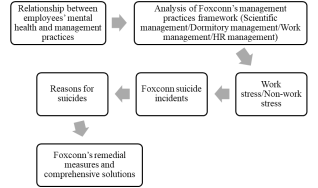
Based on existing scholars’ research on work stress and employees’ emotions, this paper confirms that work stress is closely related to employees’ emotional state (as shown in
Figure 1). Work stress mainly comes from corporate management practices, so it can be inferred that corporate management models have a significant impact on employees’ emotional health (mental health).
Taking the Foxconn serial suicide incidents as a case study, this paper first analyzes the overall environment of China’s manufacturing labor market, then explores the factors affecting Foxconn employees’ emotions, including management factors and other social factors, and finds that management factors play a dominant role. On this basis, the paper constructs an analytical framework of Foxconn’s management practices, providing a theoretical framework for analyzing the impact of each management practice on workers’ mental health.
Existing literature on the impact of Foxconn’s management practices on workers’ emotions is scarce. After the suicide incidents, Foxconn’s management only attributed the reasons to employees’ personal emotional problems, without reflecting on the flaws in its own management practices. Based on this reality, this paper focuses on exploring how Foxconn’s management practices affect employees’ emotions and push them to give up their lives, which is the innovation of this paper.
The research steps are as follows: first, understand the challenges faced by the new generation of migrant workers under Foxconn’s management model through the self-report of a suicide survivor (Tian Yu) interviewed by Chan
| [37] | CHAN J. A Suicide Survivor: the life of a Chinese migrant worker at Foxconn [J]. Asia-Pacific Journal, 2013, 11(31): e1. |
[37]
. Second, conduct a separate analysis of the 18 suicide incidents that occurred at Foxconn from 2010 to 2018, focusing on the work status of the suicidal employees and the psychological process from their initial enthusiasm for work to their final despair. Third, further analyze the impact of different management practices on employees’ emotional health. Finally, based on the above analysis results, combine Foxconn’s post-incident countermeasures and professional research results to critically analyze how to avoid the recurrence of similar incidents and put forward reasonable suggestions.
Figure 1. Research Framework.
3.3. Data Collection
As a descriptive qualitative analysis, the data collection of this paper mainly relies on academic resources and public credible information, including:
1. Academic resources: Books and academic databases of the University of Bristol, Google Scholar, Howie, Wanfang Database and Weipu Database (the latter three are important platforms for Chinese academic literature, with high credibility of published materials);
2. Video resources: Video platforms such as YouTube, which provide visual materials for understanding Foxconn’s management model and qualitative research methods;
3. Public information: Official reports, media interviews and case data of the Foxconn suicide incidents, which provide first-hand materials for the analysis of the case.
3.4. Data Analysis
The data analysis of this paper follows the following steps: first, list and sort out the specific personal information of the 18 suicidal employees to form a basic understanding of the case; second, verify the flaws in Foxconn’s management practices through the self-report of the suicide survivor (Tian Yu); third, analyze the impact of four management practices (scientific management, work management, dormitory management and human resource management) on the suicidal employees based on the analytical framework in the literature review; fourth, compare and summarize the similarities and differences of the suicidal employees from the perspective of their living and working environments, confirming that Foxconn’s management practices have a severe negative impact on employees’ mental health and identifying the specific problems of Foxconn’s management; fifth, evaluate the effectiveness of Foxconn’s post-incident remedial measures and point out their limitations; finally, combine the above analysis to put forward a series of targeted remedial measures and optimization suggestions, aiming to prevent the recurrence of the Foxconn tragedy and restore employees’ emotional health. These suggestions are not only applicable to Foxconn but also to other manufacturing enterprises with similar working environments and a large number of new generation migrant workers, hoping to arouse the attention of Chinese enterprises to employees’ emotional health, help create a better working environment for migrant workers, and promote the healthy development of enterprises and the national economy.
All the documents and data used in this paper are publicly published and available on Google Scholar and other academic platforms, and the employee interview information is also publicly released with high credibility. As a research on a relatively recent topic, most of the selected references are within the past ten years, and some are even within the past two years, ensuring the timeliness of the research on the current situation. In addition, most of the authors of the selected references are PhDs or researchers from well-known universities at home and abroad (such as Chen Jenny, Chen Chris and Ngai PUN from top Chinese universities), which reflects the authority of the research data to a certain extent.
It should be noted that the research data of this paper has certain limitations: the analysis of employees’ subjective experiences mainly relies on the self-report of a single suicide survivor (Tian Yu), which has certain subjectivity. However, this is the most comprehensive and complete survivor self-report available at present, and combined with the direct research results of many other scholars on Foxconn’s management practices, the research conclusions of this paper still have high credibility.
3.5. Ethical Consideration
In the entire research process, this paper only uses publicly available information, including employee interview materials obtained by previous scholars through formal procedures, without disclosing any trade secrets of Foxconn. At the same time, the author strictly abides by academic ethics, does not mix personal emotions into the research and discussion process, and maintains an objective and neutral research attitude throughout the paper to ensure the authenticity and objectivity of the research results.
4. Findings of Analysis
4.1. An Overview of the Foxconn Serial Suicide Incidents
Multiple websites and academic documents have confirmed that 18 Foxconn employees attempted suicide by jumping off buildings from 2010 to 2018
| [37] | CHAN J. A Suicide Survivor: the life of a Chinese migrant worker at Foxconn [J]. Asia-Pacific Journal, 2013, 11(31): e1. |
[37]
. The following table lists the basic information of these suicide incidents (
Table 1). Combined with the self-report of Foxconn suicide survivor Tian Yu
| [37] | CHAN J. A Suicide Survivor: the life of a Chinese migrant worker at Foxconn [J]. Asia-Pacific Journal, 2013, 11(31): e1. |
[37]
, this paper analyzes the living and working conditions of the suicidal employees and explores the core factors leading to their extreme behaviors.
Table 1. Basic Information of Foxconn Serial Suicide Incidents (2010-2018).
Date | Location and Identification | Age |
2010/01/23 | Foxconn Huanan Plant, Ma | 19 |
2010/03/11 | Foxconn Shenzhen Plant, Li | 20 |
2010/03/17 | Foxconn Shenzhen Plant, Yu | 17 |
2010/03/29 | Foxconn Shenzhen Plant, Male | 23 |
2010/04/06 | Foxconn Shenzhen Plant, Rao | 18 |
2010/05/06 | Foxconn Shenzhen Plant, Lu | 24 |
2010/05/11 | Foxconn Shenzhen Plant, Zhu | 24 |
2010/05/14 | Foxconn Shenzhen Plant, Liang | 21 |
2010/05/21 | Foxconn Shenzhen Plant, Hu | 21 |
2010/05/25 | Foxconn Shenzhen Plant, Li | 19 |
2010/05/26 | Foxconn Shenzhen Plant, He | 23 |
2010/05/27 | Foxconn Shenzhen Plant, Chen | 20 |
2010/11/05 | Foxconn Shenzhen Plant, Wang | 23 |
2011/11/23 | Foxconn Taiyuan Plant, Male | 21 |
2011/05/26 | Foxconn Chengdu Plant, Male | 20 |
2013/05/11 | Foxconn Chongqing Plant, Male | Unknown |
2016/08/18 | Foxconn Henan Plant, Male | 31 |
2018/01/06 | Foxconn Zhengzhou Plant, Unknown | Unknown |
Due to Foxconn’s confidentiality system and the protection of personal privacy, the age and specific personal information of some suicidal employees have not been disclosed, but this does not affect the overall research conclusions of this paper.
4.2. Reasons for the Foxconn Serial Suicide Incidents
Suicide behavior is not caused by a single factor but by a combination of multiple factors
| [38] | DURKHEIM É. Étude de sociologie [J]. Alcan, Paris, 1897. |
[38]
. In Suicide: A Study in Sociology, Durkheim pointed out that suicide should not be regarded as an isolated individual event, but as a social phenomenon that needs to be analyzed as a whole in a specific social context and time period. This "whole" is not a simple sum of individual suicide events but a new specific social fact with its own inherent laws.
Ngai and Chan
also pointed out that the Foxconn suicide incidents are not only related to employees’ personal mental illnesses but also mainly determined by social factors. The young employees who committed suicide can be regarded as resisting the inhumane management system in an extreme way. This section first analyzes the individual psychological factors of the suicidal employees, then focuses on the social factors—especially the impact of Foxconn’s management practices on employees’ emotions, and finally combines Foxconn’s post-incident solutions and scholars’ research results to put forward comprehensive and complete optimization suggestions for corporate management.
Observation shows that although individual psychological problems have a certain impact on the 18 suicide incidents, the core question is why employees in different living and working environments all choose the same extreme suicide method to express their despair about work. As social individuals with social connections, if they were not under huge work pressure and facing an almost inhumane management model, there would not be so many consecutive suicide incidents. Therefore, Foxconn’s management practices are the core factor leading to employees’ suicide.
4.2.1. Individual Psychological Factors and Imitative Behavior
Chan, Pun and Selden
pointed out that after the Foxconn serial suicide incidents, the mainstream view is that Foxconn has complete facilities, the highest wages among similar factories, and all management measures are in line with national laws, so the responsibility should be attributed to the young workers’ weak pressure resilience. Investigations have confirmed that Foxconn does provide workers with basic living conditions such as food, clothing, housing and transportation, and has raised wages to a certain extent, but the actual wages are still only at the local minimum level. At the same time, the strict dormitory labor system deprives workers of an independent and free social living space, making the dormitory a continuation of factory control over workers
| [25] | SMITH C, PUN N. The dormitory labour regime in China as a site for control and resistance [J]. The international journal of human resource management, 2006, 17(8): 1456–70. |
[25]
.
First, from the perspective of age, the 14 employees who attempted suicide in 2010 were all under 24 years old, and most were under 20 years old—they are typical new generation migrant workers. Compared with the older generation of migrant workers, they are generally regarded as having weak pressure resilience and fragile personalities
| [39] | NGAI P, HUILIN L. Unfinished proletarianization: self, anger, and class action among the second generation of peasant-workers in present-day China [J]. Modern China, 2010, 36(5): 493–519. https://doi.org/10.1177/0097700410375649 |
[39]
. The new generation of migrant workers have higher expectations for life and work, and when the cruel reality is far from their dreams, it will cause severe psychological imbalance
| [39] | NGAI P, HUILIN L. Unfinished proletarianization: self, anger, and class action among the second generation of peasant-workers in present-day China [J]. Modern China, 2010, 36(5): 493–519. https://doi.org/10.1177/0097700410375649 |
[39]
.
Many people regard suicide as a purely personal behavior determined by individual psychological factors, which is also the view of the psychological team that participated in the on-site investigation of Shenzhen Foxconn. They believe that the serial suicides are positively related to employees’ personal emotional and mental illnesses such as depression. This view is consistent with the opinion of many psychiatrists cited by Durkheim, who believe that suicide is only a result of personal mental illness. However, Durkheim found through the comparative analysis of cross-regional and gender suicide data that there is no fixed and inevitable relationship between mental illness and suicide: 1. The country with the highest prevalence of mental health problems has the lowest suicide rate; 2. Among mental hospital inpatients, the number of women is slightly higher than that of men, but the male suicide rate is about four times that of women; 3. In all countries, the suicide rate increases with age, while the high incidence of mental disorders is in young and middle-aged people
| [40] | KESSLER R C, ANGERMEYER M, ANTHONY J C, et al. Lifetime prevalence and age-of-onset distributions of mental disorders in the World Health Organization's World Mental Health Survey Initiative [J]. World psychiatry, 2007, 6(3): 168. https://doi.org/10.1002/j.2051-5545.2007.tb00193.x |
[40]
. This shows that psychological factors are only one of the potential inducements of suicide, and this inducement does not necessarily lead to extreme behaviors. Under different social environments, mental deviations may lead to different behaviors, and suicide is only one of the possibilities. This means that individual psychological factors are not the decisive cause of the Foxconn suicide incidents.
In addition, many people believe that the consecutive suicide incidents in Foxconn’s various production areas are related to "imitative behavior", that is, suicidal behavior produces a "contagion effect" among employees with similar experiences. However, Durkheim believed that imitation is a purely psychological phenomenon that only occurs between people without social connections. When analyzing mass suicide incidents, he took the serial suicides in military camps as an example, pointing out that soldiers’ suicidal behaviors are not simple imitation, but the result of a common collective social psychology. This view is highly consistent with the nature of the Foxconn "serial jump" incident: the employees’ suicidal behaviors are not simple psychological imitation and contagion, but originate from highly similar emotional experiences caused by the same social environment and living experience. The imitative behavior only makes this negative emotional state more obvious, and the real root cause of suicide is the social environment—including the national economic transformation and the enterprise’s inhumane management model.
4.2.2. The Impact of Foxconn’s Management Practices on Employees
Through 43 interviews with Foxconn employees (including the suicide survivor Tian Yu), Chan
| [37] | CHAN J. A Suicide Survivor: the life of a Chinese migrant worker at Foxconn [J]. Asia-Pacific Journal, 2013, 11(31): e1. |
[37]
found that although individual psychological problems are one of the factors leading to employees’ suicide, the negative experiences of Foxconn employees in assembly line work and dormitory life are the more critical core factors. The following first briefly introduces the suicide survivor Tian Yu, then analyzes the psychological harm caused by different management practices to employees, and further explores the core factors affecting the Foxconn suicide incidents.
Chan
| [37] | CHAN J. A Suicide Survivor: the life of a Chinese migrant worker at Foxconn [J]. Asia-Pacific Journal, 2013, 11(31): e1. |
[37]
first met Tian Yu in July 2010 at Longhua People’s Hospital in Shenzhen, where she was recovering from injuries caused by the suicide attempt. Like most new generation migrant workers, Tian Yu left her hometown and came to the unfamiliar city of Shenzhen to pursue her life dreams, but finally chose extreme behavior under the pressure of Foxconn’s management model.
(i). The Impact of Scientific Management
Foxconn’s scientific management requires all employees to repeat a single and tedious job every day, with strict rules such as no napping at work and only allowing bathroom breaks with someone to take over the post
. These dehumanizing regulations keep workers in a state of extreme tension at work. As the main body of Foxconn’s workforce, the new generation of migrant workers yearn for urban life, but the reality is that they are busy with long hours of repetitive and boring work every day.
Empirical studies have shown that Foxconn workers often face long working hours, limited rest time, and high levels of production pressure, which pose significant risks to both physical and mental health
| [8] | CHAN J, PUN N, SELDEN M. The politics of global production: A pple, F oxconn and C hina's new working class [J]. New technology, work and employment, 2013, 28(2): 100–15. https://doi.org/10.1111/j.1468-005X.2012.00296.x |
| [25] | SMITH C, PUN N. The dormitory labour regime in China as a site for control and resistance [J]. The international journal of human resource management, 2006, 17(8): 1456–70. |
[8, 25]
. Such working conditions fall far short of the World Health Organization’s definition of health as “a state of complete physical, mental and social well-being”, suggesting a serious infringement on workers’ right to health.
According to employee interviews, workers generally have no time to leave the factory due to work pressure, and can only relax by playing mobile phones in the dormitory or going to Internet cafes (the most common entertainment venue around Foxconn) to chat or play online games
| [25] | SMITH C, PUN N. The dormitory labour regime in China as a site for control and resistance [J]. The international journal of human resource management, 2006, 17(8): 1456–70. |
[25]
. The factory has a small amount of fitness equipment, which can only relieve workers’ pressure in a short time. Under long-term high pressure, the huge gap between workers’ life expectations and reality causes severe emotional tension, which may lead to mental depression and other psychological problems.
Tian Yu’s work experience is a typical reflection of Foxconn’s scientific management: she got up at 6: 30 every morning, started work at 7: 40, had lunch at 11: 00, worked overtime until 7: 40 p.m. after dinner, and had to attend mandatory unpaid meetings every day, listening to the same disciplinary speeches repeatedly
| [37] | CHAN J. A Suicide Survivor: the life of a Chinese migrant worker at Foxconn [J]. Asia-Pacific Journal, 2013, 11(31): e1. |
[37]
. She said she had no choice but to work overtime, and had to ask for permission to leave her seat at work, otherwise she would be fined
| [37] | CHAN J. A Suicide Survivor: the life of a Chinese migrant worker at Foxconn [J]. Asia-Pacific Journal, 2013, 11(31): e1. |
[37]
. A 17-year-old female office worker interviewed by Chan
| [37] | CHAN J. A Suicide Survivor: the life of a Chinese migrant worker at Foxconn [J]. Asia-Pacific Journal, 2013, 11(31): e1. |
[37]
pointed out that she had to switch between day and night shifts every month, which was extremely hard—especially for female workers during menstruation, the shift system caused severe physical and psychological discomfort. Workers must swipe their employee ID cards at the beginning and end of work, and the assembly line runs 24 hours a day with bright lights in the workshop
| [37] | CHAN J. A Suicide Survivor: the life of a Chinese migrant worker at Foxconn [J]. Asia-Pacific Journal, 2013, 11(31): e1. |
[37]
.
Foxconn strictly implements the principle of "no rest during work", and workers who work more than 10 hours a day are inevitably in a state of mental breakdown and resistance. These negative emotions continue to accumulate in workers like air in a plastic bag—when the pressure exceeds the limit, the bag will "explode". The harsh work requirements and bad working environment make workers physically and mentally exhausted, and under Foxconn’s hierarchical management model, workers have no right to speak. Finally, they have to choose suicide in despair to resist this unreasonable management system.
(ii). The Impact of Dormitory Management
Foxconn’s militarized dormitory management has a profound impact on workers’ thinking and cognition, which is an important factor leading to the tragedy
. The dormitory is the core of Foxconn’s strategy to maintain a stable labor force and manage mobile migrant workers
| [7] | ANDRIJASEVIC R, SACCHETTO D. Made in the EU: Foxconn in the Czech Republic [J]. WorkingUSA, 2014, 17(3): 391–415. |
[7]
. Foxconn implements strict regional management and door card systems in dormitories, prohibiting workers from visiting other dormitories, which interferes with employees’ social network construction and hinders communication and interaction between workers. In such a lonely and streamlined living space, workers lose their personal and social lives, which minimizes the risk of workers forming a united force, but also leads to severe psychological loneliness.
It is even common for couples working in the same factory to only meet two or three times a month because of different shifts (day shift and night shift). According to Tian Yu’s memory, due to Foxconn’s shift system, her dormitory roommates had different work and rest times, making it impossible for them to rest together or have normal social interactions, and she barely communicated with her roommates even after living together for a long time
| [37] | CHAN J. A Suicide Survivor: the life of a Chinese migrant worker at Foxconn [J]. Asia-Pacific Journal, 2013, 11(31): e1. |
[37]
.
The random dormitory allocation system destroys the possibility of workers establishing close friendships and increases their sense of personal loneliness. Tian Yu lived with 7 other girls in a randomly allocated dormitory, and they remained strangers even after living together for a long time
| [37] | CHAN J. A Suicide Survivor: the life of a Chinese migrant worker at Foxconn [J]. Asia-Pacific Journal, 2013, 11(31): e1. |
[37]
. Tian Yu’s father said that Tian Yu had difficulty understanding the local dialect when she first came to Shenzhen, so she could only communicate with her original friends online—but the virtual communication was not timely, and most of her troubles and negative emotions were buried in her heart alone, eventually leading to despair and suicide
.
Workers have the need to communicate, to share their troubles, and to vent their anger, but these needs cannot be met in Foxconn’s dormitory environment, let alone spiritual communication. Foxconn’s dormitory management realizes the macro-control of employees’ working hours, and the dormitory labor system ensures a sufficient labor supply, but 75% of Foxconn workers report an average of only four rest days per month
| [25] | SMITH C, PUN N. The dormitory labour regime in China as a site for control and resistance [J]. The international journal of human resource management, 2006, 17(8): 1456–70. |
[25]
, which directly violates the relevant rest regulations in China’s Labor Law
| [41] | LOCKE R M. The promise and limits of private power: Promoting labor standards in a global economy [M]. Cambridge University Press, 2013. |
[41]
and infringes on workers’ right to leisure. For workers, the right to leisure is a basic labor right, and adequate rest is the basic guarantee of physical and mental health.
This dormitory management model has caused a high degree of labor alienation, squeezing workers’ right to leisure to the greatest extent, and this squeeze even extends to all aspects of workers’ lives, bringing multiple physical and psychological pressures to them
| [37] | CHAN J. A Suicide Survivor: the life of a Chinese migrant worker at Foxconn [J]. Asia-Pacific Journal, 2013, 11(31): e1. |
[37]
. As a disadvantaged group in the labor-capital relationship, workers have no ability to resist, and over time, ending their lives becomes their only way to resist.
(iii). The Impact of Human Resource Management
Most of the new generation migrant workers are only children, who have a relatively good living environment since childhood and a more free personality, and may not adapt to high-intensity work for a short time—but this is only a superficial reason. The more critical internal reason is the serious flaws in Foxconn’s human resource management system. Foxconn’s management model is based on the military experience of its chairman Terry Gou, and the company insists on the principle of absolute obedience from top to bottom
| [37] | CHAN J. A Suicide Survivor: the life of a Chinese migrant worker at Foxconn [J]. Asia-Pacific Journal, 2013, 11(31): e1. |
[37]
.
First, to obtain high profits, Foxconn must strictly control production costs, among which labor cost control is the key. Foxconn recruits employees and pays wages in strict accordance with the local minimum wage standard, and even relocated its factories from Shenzhen to Henan to save labor costs after the local government raised the minimum wage standard in Shenzhen
. Tian Yu recalled that after working for a month, all other employees received their salary bank cards except her. She ran back and forth to the human resources department many times, only to find that her salary card was left in another Foxconn factory. After several twists and turns, she still did not receive her salary for nearly a month
. At that time, her mobile phone was broken, the living expenses given by her father were almost used up, and she was under huge work pressure—these problems finally pushed her to choose suicide
| [37] | CHAN J. A Suicide Survivor: the life of a Chinese migrant worker at Foxconn [J]. Asia-Pacific Journal, 2013, 11(31): e1. |
[37]
.
Second, Foxconn rarely considers employees’ spiritual needs. The workshop is in a state of compulsive silence all day except for the noise of machines, and colleagues rarely chat with each other even during breaks. The company even prohibits talking in the workshop, and production line leaders often blame employees even if they have not made any mistakes. Tian Yu saw a female colleague who was forced to stand for several hours and publicly humiliated many times for a small work mistake
| [37] | CHAN J. A Suicide Survivor: the life of a Chinese migrant worker at Foxconn [J]. Asia-Pacific Journal, 2013, 11(31): e1. |
[37]
. A young team leader interviewed by Relying on its low-cost strategy and mature management experience, Foxconn has become China’s largest foundry enterprise (Li, 2019) and has to a certain extent solved the employment problem of the new generation of migrant workers in China Chan
| [37] | CHAN J. A Suicide Survivor: the life of a Chinese migrant worker at Foxconn [J]. Asia-Pacific Journal, 2013, 11(31): e1. |
[37]
pointed out that team leaders have to abuse the workers under their supervision to complete production tasks—if they care too much about workers’ feelings, they will not be able to meet the production quotas. For female workers, public humiliation for small mistakes will cause a strong sense of shame and embarrassment, and the long-term accumulation of these negative emotions will eventually lead to extreme behaviors.
4.3. Summary
As Durkheim
| [38] | DURKHEIM É. Étude de sociologie [J]. Alcan, Paris, 1897. |
[38]
pointed out, no single factor can cause suicide behavior. The new generation of migrant workers are quick to accept new things, courageous and innovative, but they are also prone to impulsiveness, lack independent opinions when facing problems, and have an obvious herd mentality. This group is not good at dealing with negative emotions and tends to adopt extreme methods to solve problems.
Foxconn’s militarized management system inherits the army’s cost awareness: the army only invests in personnel with training prospects to obtain higher returns, and Foxconn also takes "the least investment for the highest profits" as the core concept of its militarized management. In every detail of management, Foxconn implies that employees should abandon a "luxurious" life and devote themselves to low-cost work. The company advocates competition and believes that competition is the most effective way to enhance corporate capabilities, and competition depends on cost advantages. Foxconn believes that the contemporary market has entered an era of meager profits, and cost control is the key to corporate survival.
Foxconn’s management practices can coordinate the actions of more than 800,000 employees to achieve production goals, which is its outstanding advantage. The company requires employees to establish cost awareness in both production and life, and unifying individual cost awareness is conducive to the company’s overall cost control. The main ways to reduce costs are the overtime system and dormitory management: although the company does not force workers to work overtime, the ingenious system design makes workers "voluntarily" scramble for overtime work—because without overtime, their wages are far from enough to support their lives. On the surface, workers work overtime to earn more money for themselves, but in fact, it is the company’s way to cultivate workers’ cost awareness. The overtime system ensures the factory’s 24-hour production, allows workers to obtain more overtime pay in a short time, and also achieves the company’s goal of low cost and high efficiency. Foxconn does not force workers to work overtime, but lets them "choose" it voluntarily; just as it does not force workers to accept cost control, but gives them the illusion of free choice. Foxconn likens its cost reduction method to "wringing water out of a dry towel".
Foxconn has achieved remarkable results in instilling cost awareness into employees, but when product prices continue to decline, the company’s only solution is to further reduce labor costs—which has become a common practice in the company. At Foxconn, cost saving has become a habit, a mindset and a conscious behavior of employees. However, the long-term emphasis on cost control and frequent overtime work have caused huge negative impacts on workers’ physical and mental health. Although Foxconn has achieved its original profit goals through these management practices, the serious flaws in its management have led to workers’ despair and suicidal behaviors, which need to be fundamentally improved.
5. Discussion
5.1. Limitations of Remedial Measures and Root Cause Analysis
Following the series of employee suicide incidents, Foxconn’s remedial interventions, including non-suicide agreements, dormitory barbed wire installations, and basic employee hotlines, were all superficial, passive responses that failed to address the core crisis. These measures did not target the root of the problem but instead shifted responsibility to individual workers and suppressed extreme behaviors rather than eliminating their psychological triggers. The non-suicide agreement exacerbated employees’ sense of powerlessness, while physical barriers only prevented impulsive acts without resolving long-term work stress, emotional isolation, and unfair management. The employee hotline lacked professional counseling teams and follow-up mechanisms, rendering it a symbolic gesture with no practical mental health support effect.
The fundamental root cause lies in Foxconn’s persistent militarized and Taylorist management logic, which prioritizes extreme production efficiency and cost control over employee well-being. The enterprise treated frontline workers as replaceable production tools rather than independent individuals, ignoring the evolving demands of the new generation of migrant workers, who seek respect, social connection, and personal development beyond basic wages. This rigid management model, coupled with mandatory overtime, monotonous assembly line work, strict dormitory control, and unfair wage and promotion systems, led to chronic psychological alienation, anxiety, and hopelessness among employees, ultimately triggering extreme tragedies.
5.2. Targeted Optimization Strategies
To resolve the mental health crisis and improve labor management, systematic reforms must replace superficial fixes, focusing on a people-oriented framework rather than efficiency-first logic. First, overhaul core management concepts to embed employee welfare and mental health into corporate development goals, and train grassroots managers to eliminate harsh and demeaning management practices. Second, standardize working hours in strict compliance with labor laws, abolish implicit mandatory overtime, set reasonable production quotas, and implement job rotation to reduce work monotony and physical fatigue.
Third, reform the dormitory management system to restore employees’ private space and social rights, relax overly strict access and living rules, optimize dormitory allocation, and build public leisure spaces to break social isolation. Fourth, improve the wage and promotion system to ensure fairness, raise basic wages beyond the local minimum standard, establish transparent internal promotion channels, and eliminate wage discrimination based on regional or identity differences. Fifth, build a professional mental health support system, including universal mental health education, free one-on-one counseling, and early warning mechanisms for high-risk employees, connecting with professional medical institutions for severe cases.
5.3. Social and Industrial Implications
The Foxconn incident is not an isolated corporate crisis but a microcosm of the structural conflicts facing China’s labor-intensive manufacturing industry. It exposes the mismatch between traditional extensive management models and the psychological and rights demands of the new generation of industrial workers. For the manufacturing sector, this incident signals the end of the low-cost, high-intensity labor exploitation model; sustainable industrial development requires a shift to humanized management, as employee well-being directly impacts corporate stability and long-term competitiveness.
For regulatory authorities, it necessitates strengthened labor law enforcement, stricter supervision of overtime, wage payment, and workplace treatment, and the construction of a social mental health service network for migrant workers. For society, it calls for greater attention to the mental health of industrial workers, breaking discriminatory perceptions, and building a supportive social atmosphere that respects labor and protects workers’ legitimate rights.
5.4. Reference to International Advanced Management Experience
International leading manufacturing enterprises, such as Japanese and European-American industrial firms, have adopted people-centric management models that prioritize employee participation, work-life balance, and comprehensive welfare. These enterprises view employees as core assets, investing in professional training, mental health support, and fair career development, avoiding over-reliance on high-intensity manual labor. In contrast, Foxconn’s traditional model lags significantly in humanized management. Domestic manufacturing firms should adapt international best practices to local conditions, gradually phasing out rigid management, improving labor conditions, and balancing efficiency with employee rights, rather than blindly imitating foreign models.
6. Conclusion
This study analyzes the negative impact of Foxconn’s rigid, efficiency-oriented management model on frontline employees’ mental health, evaluates the ineffectiveness of its post-incident superficial remedial measures, and identifies the core root cause as the enterprise’s disregard for workers’ psychological needs and basic rights. The research confirms that labor-intensive manufacturing enterprises cannot sustain long-term development by sacrificing employee well-being, and humanized management is an inevitable choice for industrial upgrading and labor rights protection.
The reforms proposed—shifting management concepts, standardizing labor systems, optimizing living conditions, building professional mental health support, and ensuring fair treatment—are not only applicable to Foxconn but also provide reference for similar manufacturing enterprises. The Foxconn incident serves as a critical warning for the entire manufacturing industry: as the labor force structure and social demands evolve, enterprises must abandon outdated Taylorist and militarized management, balance economic benefits with social responsibility, and protect the physical and mental health of workers.
Ultimately, the healthy development of the manufacturing industry relies on the joint efforts of enterprises, government regulators, and society. Enterprises must take the lead in implementing humanized reforms, the government should strengthen supervision and policy guidance, and society should pay attention to the rights and interests of industrial workers. Only through multi-party collaboration can the recurrence of similar labor tragedies be avoided, and high-quality, sustainable development of the manufacturing industry be achieved.
Author Contributions
Luyao Jiao: Writing-original draft, Investigation
Jie Fan: Methodology
Yimeng Han: Writing – review & editing
Yuwei Liu: Writing – review & editing
Conflicts of Interest
The authors declare no conflicts of interest.
References
| [1] |
GOODALL K, WARNER M. Enterprise Reform, Labor–Management Relations, and Human Resource Management in a Multinational Context: Empirical Evidence from Sino—Foreign Joint Ventures [J]. International Studies of Management & Organization, 1999, 29(3): 21–36.
https://doi.org/10.1080/00208825.1999.11656767
|
| [2] |
LIU Z. The Growth of China’s Trade Volume and the Upgrading of Local Industries-Based on the Global Value Chain Governance Perspective [J]. Academic Monthly, 2007, 2: 80–6.
|
| [3] |
SHEN J. Factors affecting international staffing in Chinese multinationals (MNEs) [J]. The International Journal of Human Resource Management, 2006, 17(2): 295–315.
https://doi.org/10.1080/09585190500404754
|
| [4] |
CHILD J. Changes in the structure and prediction of earnings in Chinese state enterprises during the economic reform [J]. International Journal of Human Resource Management, 1995, 6(1): 1–30.
https://doi.org/10.1080/09585199500000005
|
| [5] |
GEREFFI G. International trade and industrial upgrading in the apparel commodity chain [J]. Journal of international economics, 1999, 48(1): 37–70.
https://doi.org/10.1016/S0022-1996(98)00075-0
|
| [6] |
LIU Z, ZHANG J. From integration into GVC to construction of NVC: strategic thinking for Chinese industrial upgrading [J]. Academic Monthly, 2009, 41(9): 59–68.
|
| [7] |
ANDRIJASEVIC R, SACCHETTO D. Made in the EU: Foxconn in the Czech Republic [J]. WorkingUSA, 2014, 17(3): 391–415.
|
| [8] |
CHAN J, PUN N, SELDEN M. The politics of global production: A pple, F oxconn and C hina's new working class [J]. New technology, work and employment, 2013, 28(2): 100–15.
https://doi.org/10.1111/j.1468-005X.2012.00296.x
|
| [9] |
WATERS S. Workplace suicide and states of denial: The France Télécom and Foxconn cases compared [J]. TripleC, 2017, 15(1): 191.
https://doi.org/10.31269/triplec.v15i1.829
|
| [10] |
ANDRIJASEVIC R, DRAHOKOUPIL J, SACCHETTO D. Flexible workforces and low profit margins: electronics assembly between Europe and China [M]. ETUI, 2016.
|
| [11] |
KLITZMAN S, HOUSE J S, ISRAEL B A, et al. Work stress, nonwork stress, and health [J]. Journal of behavioral medicine, 1990, 13(3): 221–43.
https://doi.org/10.1007/BF00844929
|
| [12] |
FRANKENHAEUSER M, GARDELL B. Underload and overload in working life: Outline of a multidisciplinary approach [J]. Journal of Human Stress, 1976, 2(3): 35–46.
|
| [13] |
CAPLAN R D. Job demands and worker health: Main effects and occupational differences [M]. US Department of Health, Education, and Welfare, Public Health Service…, 1975.
|
| [14] |
VIRTANEN M, HONKONEN T, KIVIMäKI M, et al. Work stress, mental health and antidepressant medication findings from the Health 2000 Study [J]. Journal of affective disorders, 2007, 98(3): 189–97.
https://doi.org/10.1016/j.jad.2006.03.019
|
| [15] |
STURGEON T J, KAWAKAMI M. Global value chains in the electronics industry: characteristics, crisis, and upgrading opportunities for firms from developing countries [J]. International Journal of Technological Learning, Innovation and Development, 2011, 4(1-3): 120–47.
https://doi.org/10.1504/IJTLID.2011.041902
|
| [16] |
MENG F W. Research on Foxconn’s human resource management system and methods[J]. Business Economy, 2017, (3): 118-120.
|
| [17] |
ANNER M. Abandoned? The impact of Covid-19 on workers and businesses at the bottom of global garment supply chains [J]. Center for Global Workers’ Rights, 2020, 27.
|
| [18] |
NIEDERKROTENTHALER T, VORACEK M, HERBERTH A, et al. Role of media reports in completed and prevented suicide: Werther v. Papageno effects [J]. The British Journal of Psychiatry, 2010, 197(3): 234–43.
https://doi.org/10.1192/bjp.bp.109.074633
|
| [19] |
PUN N, CHAN J, SELDEN M. Apple, Foxconn, and China’s Workers [J]. Sociology and Social Justice, 2018: 151.
|
| [20] |
YEUNG J H Y, ZHU V C Y, CHEN D D. Foxconn and the Serial Suicide Crisis [M]. NeilsonJournals Publishing, 2014.
|
| [21] |
TAYLOR F W. Scientific management [M]. Routledge, 2004.
|
| [22] |
TAYLOR F W. The principles of scientific management [M]. NuVision Publications, LLC, 1911.
|
| [23] |
NGAI P, CHAN J. Global capital, the state, and Chinese workers: the Foxconn experience [J]. Modern China, 2012, 38(4): 383–410.
https://doi.org/10.1177/0097700412447166
|
| [24] |
LI G, ZHANG S W, LIU S Y. Lessons and challenges from Foxconn’s rapid growth [J]. China Electronic Commerce, 2008, (11): 92-96.
|
| [25] |
SMITH C, PUN N. The dormitory labour regime in China as a site for control and resistance [J]. The international journal of human resource management, 2006, 17(8): 1456–70.
|
| [26] |
WILLIAMSON O E. The economic institutions of capitalism [J]. The political economy reader: Markets as institutions, 2008, 27.
|
| [27] |
STURGEON T J. Modular production networks: a new American model of industrial organization [J]. Industrial and corporate change, 2002, 11(3): 451–96.
https://doi.org/10.1093/icc/11.3.451
|
| [28] |
CHENG P Y, PAN Y, SHEN C, et al. Trapped in Foxconn: Investigating the quasi-militarized factory regime[J]. Youth Studies, 2011, (5): 60-74.
|
| [29] |
BRAVERMAN H. Labor and monopoly capital: The degradation of work in the twentieth century [M]. nyu Press, 1998.
|
| [30] |
ACEMOGLU D, RESTREPO P. Artificial intelligence, automation, and work [M]. The economics of artificial intelligence: An agenda. University of Chicago Press. 2018: 197–236.
|
| [31] |
ANDRIJASEVIC R, SACCHETTO D, PUN N. One firm, two countries, one workplace model? The case of Foxconn’s internationalisation [J]. The Economic and Labour Relations Review, 2020, 31(2): 262–78.
https://doi.org/10.1177/1035304620911149
|
| [32] |
ANDRIJASEVIC R, SACCHETTO D. ‘Disappearing workers’: Foxconn in Europe and the changing role of temporary work agencies [J]. Work, employment and society, 2017, 31(1): 54–70.
https://doi.org/10.1177/0950017015624389
|
| [33] |
SELDEN M, CHAN J, NGAI P. The politics of global production: Apple, Foxconn and China's new working class [J]. Asia-Pacific Journal, 2013, 11(32): e1.
|
| [34] |
LI Q. The compensation and incentive model of Foxconn Group[J]. China Human Resources Development, 2007, (2): 68-71.
|
| [35] |
HIRSCHMAN A O. Exit, voice, and loyalty: Responses to decline in firms, organizations, and states [M]. Harvard university press, 1972.
|
| [36] |
LINCOLN Y S. Naturalistic inquiry [M]. sage, 1985.
|
| [37] |
CHAN J. A Suicide Survivor: the life of a Chinese migrant worker at Foxconn [J]. Asia-Pacific Journal, 2013, 11(31): e1.
|
| [38] |
DURKHEIM É. Étude de sociologie [J]. Alcan, Paris, 1897.
|
| [39] |
NGAI P, HUILIN L. Unfinished proletarianization: self, anger, and class action among the second generation of peasant-workers in present-day China [J]. Modern China, 2010, 36(5): 493–519.
https://doi.org/10.1177/0097700410375649
|
| [40] |
KESSLER R C, ANGERMEYER M, ANTHONY J C, et al. Lifetime prevalence and age-of-onset distributions of mental disorders in the World Health Organization's World Mental Health Survey Initiative [J]. World psychiatry, 2007, 6(3): 168.
https://doi.org/10.1002/j.2051-5545.2007.tb00193.x
|
| [41] |
LOCKE R M. The promise and limits of private power: Promoting labor standards in a global economy [M]. Cambridge University Press, 2013.
|
Cite This Article
-
APA Style
Jiao, L., Fan, J., Han, Y., Liu, Y. (2026). The Relationship Between Mental Health and Management Practices: A Case Study of Serial Suicides in Foxconn China. Humanities and Social Sciences, 14(3), 259-271. https://doi.org/10.11648/j.hss.20261403.17
 Copy
|
Copy
|
 Download
ACS Style
Jiao, L.; Fan, J.; Han, Y.; Liu, Y. The Relationship Between Mental Health and Management Practices: A Case Study of Serial Suicides in Foxconn China. Humanit. Soc. Sci. 2026, 14(3), 259-271. doi: 10.11648/j.hss.20261403.17
Copy
|
Download
AMA Style
Jiao L, Fan J, Han Y, Liu Y. The Relationship Between Mental Health and Management Practices: A Case Study of Serial Suicides in Foxconn China. Humanit Soc Sci. 2026;14(3):259-271. doi: 10.11648/j.hss.20261403.17
Copy
|
Download
-
@article{10.11648/j.hss.20261403.17,
  author = {Luyao Jiao and Jie Fan and Yimeng Han and Yuwei Liu},
  title = {The Relationship Between Mental Health and Management Practices: A Case Study of Serial Suicides in Foxconn China},
  journal = {Humanities and Social Sciences},
  volume = {14},
  number = {3},
  pages = {259-271},
  doi = {10.11648/j.hss.20261403.17},
  url = {https://doi.org/10.11648/j.hss.20261403.17},
  eprint = {https://article.sciencepublishinggroup.com/pdf/10.11648.j.hss.20261403.17},
  abstract = {China’s rapid social and economic transformation over the past few decades has brought remarkable prosperity, yet it has also exposed prominent social and corporate management problems, among which the correlation between employees’ mental health and corporate management practices has become a heated topic. The serial suicide incidents at Foxconn, a leading global electronics foundry, stand as a typical case reflecting this issue. Foxconn’s core workforce consists of the new generation of migrant workers, who are generally perceived to have weak pressure resilience and fragile personalities, making it difficult for them to adapt to the company’s militarized management model. Within less than a year, 18 Foxconn workers attempted suicide by jumping off buildings, arousing widespread public concern worldwide. Unlike previous studies that focused on corporate efficiency and value creation from the enterprise’s perspective, this paper analyzes the specific details of the 18 suicide cases and the self-report of a survivor, centering on workers’ emotional health. It verifies that flaws in Foxconn’s management practices are the core cause of the suicide incidents. From the perspectives of scientific management, dormitory management, and human resource management, the paper further explores how each management practice erodes employees’ emotional health and leads to the tragic outcomes. Finally, based on existing research and the analysis of this study, practical and targeted suggestions are proposed to prevent the recurrence of similar tragedies, with the aim of providing references for corporate management optimization and the protection of employees’ mental health.},
 year = {2026}
}
Copy
|
Download
-
TY  - JOUR
T1  - The Relationship Between Mental Health and Management Practices: A Case Study of Serial Suicides in Foxconn China
AU  - Luyao Jiao
AU  - Jie Fan
AU  - Yimeng Han
AU  - Yuwei Liu
Y1  - 2026/06/09
PY  - 2026
N1  - https://doi.org/10.11648/j.hss.20261403.17
DO  - 10.11648/j.hss.20261403.17
T2  - Humanities and Social Sciences
JF  - Humanities and Social Sciences
JO  - Humanities and Social Sciences
SP  - 259
EP  - 271
PB  - Science Publishing Group
SN  - 2330-8184
UR  - https://doi.org/10.11648/j.hss.20261403.17
AB  - China’s rapid social and economic transformation over the past few decades has brought remarkable prosperity, yet it has also exposed prominent social and corporate management problems, among which the correlation between employees’ mental health and corporate management practices has become a heated topic. The serial suicide incidents at Foxconn, a leading global electronics foundry, stand as a typical case reflecting this issue. Foxconn’s core workforce consists of the new generation of migrant workers, who are generally perceived to have weak pressure resilience and fragile personalities, making it difficult for them to adapt to the company’s militarized management model. Within less than a year, 18 Foxconn workers attempted suicide by jumping off buildings, arousing widespread public concern worldwide. Unlike previous studies that focused on corporate efficiency and value creation from the enterprise’s perspective, this paper analyzes the specific details of the 18 suicide cases and the self-report of a survivor, centering on workers’ emotional health. It verifies that flaws in Foxconn’s management practices are the core cause of the suicide incidents. From the perspectives of scientific management, dormitory management, and human resource management, the paper further explores how each management practice erodes employees’ emotional health and leads to the tragic outcomes. Finally, based on existing research and the analysis of this study, practical and targeted suggestions are proposed to prevent the recurrence of similar tragedies, with the aim of providing references for corporate management optimization and the protection of employees’ mental health.
VL  - 14
IS  - 3
ER  -
Copy
|
Download





 Share This Article
 Twitter
 Linked In
 Facebook