Research/Technical Note | | Peer-Reviewed

Effect of Board Thickness on Physico-mechanical Properties of Bio-polymer Tiles Reinforced with Shea Nutshell Dust and Enhanced with Kaolinite

Received: 2 March 2025     Accepted: 13 March 2025     Published: 20 January 2026
Views:       Downloads:
Abstract

This study investigates the production and mechanical properties of bio-plastic tiles using a composite mixture of Shea Nut Shell (SNS), high-density polyethylene (HDPE), and clay. The mixtures were extruded and compressed into bio-plastic tiles of two different sizes: (19 × 9 × 2.5) cm and (19 × 9 × 5.0) cm. To assess the influence of particle size and composition on tile properties, SNS was processed into 1 mm and 2 mm geometrical sizes and combined in four different weight-to-weight proportions: 90/10/100, 80/20/100, 70/30/100, and 60/40/100 (SNS/clay/plastic). The study examined the effects of particle size and composition ratio on key physical and mechanical properties, including density, flexural strength, flexural modulus, compression strength, and impact bending resistance. Additionally, the influence of tile thickness and inter-structural material arrangement on mechanical performance was analyzed using a factorial experimental design. The results showed density values ranging from 2.95g/cm3 to 4.07g/cm3, with variations in flexural strength, flexural modulus, impact bending, and compression across different compositions. Structural analysis revealed that the 90/10/100 ratio exhibited superior bonding cohesion and compatibility, leading to enhanced mechanical properties. The findings indicate that the investigated factors significantly influenced the performance of bio-plastic tiles. The mechanical values obtained in this study align with standard requirements for construction materials, suggesting that these tiles are suitable for use in pavement pathways with both low and high load-bearing capacities.

Published in World Journal of Materials Science and Technology (Volume 3, Issue 1)
DOI 10.11648/j.wjmst.20260301.13
Page(s) 13-23
Creative Commons

This is an Open Access article, distributed under the terms of the Creative Commons Attribution 4.0 International License (http://creativecommons.org/licenses/by/4.0/), which permits unrestricted use, distribution and reproduction in any medium or format, provided the original work is properly cited.

Copyright

Copyright © The Author(s), 2026. Published by Science Publishing Group

Keywords

Shea Nut Shell, Bio-plastic, Tiles, Flexural Strength, Flexural Modulus

1. Introduction
Rapid economic growth and urbanization have led to increased well-being globally but also increased resource use and environmental pollution . Nigeria, the ninth-highest country with unmanaged plastic residue, accounted for 2.7% of discarded plastic waste globally . Factors contributing to this include inefficient solid waste management, insufficient power generation, and lack of advanced waste management technology systems, other activities like food processing, fruits, and seed processing also contribute to environmental disturbances. Nigeria is the world's largest exporter of shea nuts and butter . The Vitallera paradoxa (Shea trees) is known to produce bio-residue, which can also be used to establish a bio-economy that can helps to mitigate climate change, integrate soil nutrients, and improve agro-ecology practices in Africa's Shea zone . Shea butter development is acknowledged as a vital agro-based business, which has contributed to a decrease in food security a potential for revenue generation, and a decrease in poverty level especially in any country . Due to the increase demand for Shea butter (Figure 1), the Shea butter production witnessed tremendously growth that led to high volume of Shea nut shells being discarded as waste . Shea trees in Africa produce bio-waste, including Shea nut shell (SNS), which can be used to establish a bio-economy . SNS is an agro-based by-product from the combustion of Shea nut shells during Shea butter preparation, once dried the shell becomes agricultural waste. SNS is produced by shelling, the most difficult aspect of Shea butter production, but is not automated in many African countries like Nigeria due to its time-consuming and high waste generation . Previous study shows that the shea Nut shells are also used as boiler fuels in Africa, while some use it as landfills to generate methane like any other rotting plant matter . However, when the nut is adequately and properly removed from the fruit and dried, it becomes agricultural waste .
The depletion of natural resources and environmental concerns have led to a growing interest in environmentally friendly materials, research on agricultural waste management aims to address economic and environmental issues related to waste disposal . Large amounts of agricultural waste are generated annually, which can be used as secondary raw materials for value-added products in the circular economy, and the use of agricultural waste to create biopolymer-based composites for lightweight applications, combining natural reinforcements . Agricultural wastes offer sustainable biomass for engineering composites, biofuels, and other bio based materials, enhancing the utilization of waste lignocellulose components in integrated bio refineries . In addition to being employed in textile dyeing wastewater treatment using batch sorption methods with activated carbon, shea nut shells are a commercially valuable adsorbent for industrial dyestuffs, exhibiting high dye removal rates . The chemical test that was done on the shea-nut shell found that it exhibited pozzolanic qualities, meaning that shea-nut shell Ash (SSA) may be used in masonry and the manufacturing of sandcrete blocks in place of some of the cement used in mortar production during construction work .
Environmental biotechnology (OBD-Plus microorganisms Patent) is being applied to the conversion of Shea cake waste to bio-fertilizer in order to promote soil conversation and the Shea tree's domestication . Shea (Vitellaria paradoxa) nut shells (SNS) were also employed as raw materials to create an activated carbon-based catalyst via chemical activation with potassium hydroxide (KOH) . According to studies Dejean, et al., , these shells have a high potassium content (up to 25% in the ash) and create high-quality activated carbons that are mechanically stable and have a high porosity. The addition of Shea Nut Shell (SNS) to plastic as composites will be an effective way to minimize huge waste generated after production and limit the effect to air pollution caused during burning and landfills . The use of SNS as raw material for the production of composite tiles will further enhanced effective management of the material as waste. Both waste materials (SNS and plastic) can serve as potential raw materials for other valuable product that could improve the socio-economic development of the country and also helps to mitigate the effect on climate change.
Due to limited information on use of SNS for the production of composite or polymer composite, this study therefore seek to investigate the mechanical properties of polymer composite tiles made from recycled polyethylene and reinforce with SNS fibre, while the inter-structural arrangement of the fibre to fibre in the matrix was also examined.
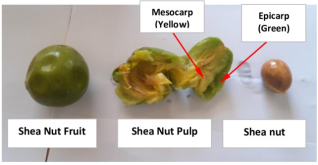
Source: Abdul-Mumeen et al., .

Download: Download full-size image

Figure 1. Shea nut fruit, pulp and the nut (seed).
2. Materials
2.1. Materials Collection
SNS material was collected from the Shea stockpile site located at Tede community in Atisbo local Government. Atisbo is found in the north western area of Oyo State, Nigeria, of about 175 km from Ibadan, the State capital. The town of Tede has the population 110,792 at the 2006 census with an area mass of 2,997 km2, it’s located within the latitude of 8° 26´ 5´´ N and longitude of 3° 19´58´´ E. The used polyethylene water bags was collected from dumping yard of DFRIN package water factory, located inside Forestry Research Institute of Nigeria (FRIN). The kaolinite as enhancement was adopted and collected for the Soil Section, Department of Sustainable Forest Management, FRIN, Ibadan, Oyo State, Nigeria.
2.2. Materials Preparation and Samples Production
The used polyethylene water package bags were milled into particles at Temperature range of 100-120°C using agglomerator machine of model L-0489 avaliable at the Department of Forest Products Development and Utilization, FRIN. The particles was screened using a wire mesh sieve of dimensional size of 1.0 mm. The kaolinite was oven-dried at 103°C for 48 hours to achieve moisture content at 2%, milled into powder using pulverizer and screened using wire mesh sieve of size 1.0 mm. The SNS waste was oven-dried at 103°C and also milled into particles using pulverizer. The particles was thoroughly screened with wire sieves to obtained two geometric particle sizes of 1.00 mm as (fine) and 2.00 mm (coarse).
The materials were mixed at a proportional ratio of 90/10/100, 80/20/100, 70/30/100, 60/40/100, 50/50/100, 40/60/100, 30/70/100, 20/80/100, and 10/90/100 (SNS/clay/plastic) weight to weight basis. The mixture of these particles was fed into the single screw extruder at controlled temperature of 95 ± 5°C to obtain thoroughly compounded molten product. The ejected compounded molten material was fed into a rectangular mould of size (19 x 9 x 2.5) cm and (19 x 9 x 5.0) cm and compressed using hydraulic cold press of 20 ton for 20 minutes to be firm and solidify after cooling. The final products of biopolymer tiles were prepared for laboratory test specimen sizes in accordance with American Standard for Testing Materials (D570, D790 and D 638) for determination of dimensional properties tests, flexural properties, compression and density.
2.3. Properties Determination
Dimensional stability and density
In accordance to ASTM D 792, the changes in board weight after submerged in water soak test exposure at two different temperatures (26°C and 65°C); and was determined by using the formula stated in equation (1), this test was done within the stipulated periods of 168 hours. Meanwhile the board density was determined by using the formula stated in equation (2) which is in accordance with ASTM D638-90.
Weight loss (%)=W1- W2W1 x 100.(1)
Where W1 = Oven-dried weight of sample before the water soak test (g) and W2 = Oven-dried weight of sample after the soak test (g).
Density gcm3=WaVa(2)
Where Wa = Air dried weight (g); Va = Air dried volume (cm3).
2.4. Mechanical Properties
2.4.1. Flexural Test
The flexural strength and modulus (modulus of rupture and modulus of elasticity) of specimens with dimensions of 17.8 cm × 5.1 cm was done in accordance with ASTM D790. Each specimen was subjected to three-point bending tests in Universal Testing Machine of model WDW- 5000 of 858 load frame with 50 kN load cell, span of 100 mm and at a crosshead speed of 2.8 mm/min.
2.4.2. Impact Bending
Board specimen of (15.4 x 15.4) cm was subjected to series of hammer blows using an impact testing machine in accordance with ASTM D805/ D1037 - 2006. The samples were freely held along all four corners, and a hemisphere of a 22.5 kg hammer was used to strike the core of the specimen. The rod was drops at a height of 1.3 cm, and continues to rise by 1.3 cm increments until breakage occurred, and the data obtained were used to calculate impact bending using the equation below:
J=WL
Where: J = Toughness (work per specimen) (Nm), W = weight of the pendulum (kg) and L = Distance from the centre of the supporting axis to the centre of gravity of the pendulum (m).
2.5. Morphological Analysis
The fractural surfaces of the biopolymer tiles were examined using Scanning Electron Microscopy model JEOL JSM-7600F operated at 15 kV. An appropriate size of the sample was rigidly mounted in the specimen chamber called hub. The samples were coated with gold palladium of electrically conducting material using low vacuum sputter coating. The specimen was placed in a relative high-pressure chamber where the working distance is short and the electron optical column is differentially pumped to keep vacuum adequately low at the electron gun. The high-pressure region around the sample in the SEM neutralizes charge and provides an amplification of the secondary electron signal. Low-voltage SEM gives high primary electron brightness and small spot size even at low accelerating potentials. The micrographs were produced at magnification limit of 800, 900 and 1000x.
2.6. Experimental Design
The study was laid out in a 2 by 2 by 8 factorial experiments in Completely Randomized Design. The samples were subjected to three treatment factors which are board thickness, geometric particle size of SNS and proportional ratio each variable was replicated five times for all the tests to minimize experimental errors in the data obtained. The data obtained were subjected to one way analysis of variance (ANOVA) and separation of means was done using Duncan Multiple Ranged Test (DMRT) in order to determine the level of significance among and between the variables.
3. Results and Discussion
3.1. Mechanical Properties
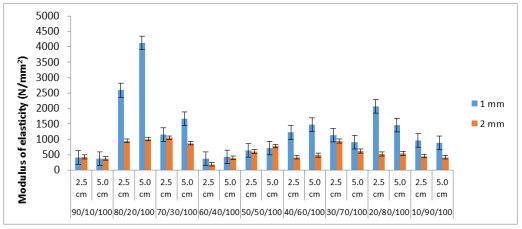
The study examined the modulus of elasticity of tiles produced from different particle sizes and mixing proportions of SNS waste, clay, and plastic. The mean values ranged from 380.75 N/mm2 to 4120.24 N/mm2, with differences observed based on particle size and composition. The relationship between MOE and variables was illustrated in Figure 2, with tiles produced from 1 mm particles being more rigid than those made from 2 mm particles. As SNS content decreased from 90% to 40%, tiles of thickness size 5.0 cm were more rigid than those of thickness size 2.5 cm. However, tiles made from SNS/Sand/Polymer at a ratio of 80/20/100 at a thickness size of 5.0 cm had the highest MOE and were the most rigid. Tiles made from 1 mm particles had higher modulus values than those made from 2 mm particles. Additionally, tiles with 80% SNS content at a thickness of 5.0 cm had the highest modulus, indicating greater rigidity. The analysis of variance in Table 1 shows that molecule size and blending extent significantly influence the modulus of flexibility (MOE) of tiles and showed that all main factors, except board thickness, were significant, with interactions between certain factors also being significant. However, it agrees with Njoku , who previously described how small particles have a larger modulus of flexibility than massive particles. The results suggested that increasing the surface area of particles led to increased strength, consistent with previous studies with the addition of cassava peel starch to bioplastics was found to decrease Young's modulus, likely due to the amorphous phase formed by starch-branched amylopectin chains. Comparing the Young modulus values of the bioplastics to plastic standards, the bioplastics were significantly more rigid Syuhada, , found that increasing cassava strip starch decreases bioplastics MOE due to decreased firmness due to starch expansion. Amylopectin binds and direct affixes cause a decrease in bio-plastic solidity. This aligns with Agustin and Padmawijaya, , that understanding that stiffness of bioplastics are influenced by the formation of crystalline phases by linear chains. Chitosan-cassava peel starch bioplastics, with two linear chains, exhibited higher rigidity compared to polymer-based materials.
3.2. Modulus of Rupture (MOR)
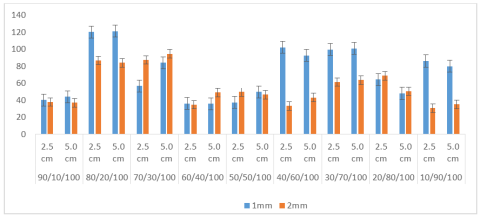
The strength of walkway tiles made from solid residue materials (SNS residues) was measured using a range of values from 35.55 N/mm2 to 120.27 N/mm2. The modulus of rupture (MOR) values were 72.09 N/mm2 and 55.12 N/mm2, respectively. The strength of tiles with particle sizes 1 mm and 2 mm were found to be stronger. Tiles 5 cm thick had higher strength and lower MOR in 20/80/100 and 10/90/100 mixing proportion tiles, respectively. The more SNS, the higher the MOR, this were found to be in the same range with Liu et al. that found cellulose positively influences stress transfer and mechanical strength of polymer composites. The presence of lignin increases the interfacial compatibility of plastic materials, but lignin itself has certain rigidity. The analysis of variance presented in Table 1, shows that particle size and mixing proportion were significant in the MOR of the tiles produced. But the board thickness, interactions between board thickness and particle size, particle size and mixing proportion were not significantly different, as well as interactions between particle sizes, mixing proportion, and board thickness, as shown in Table 1 and as revealed in Figure 3. However, it agrees with Al Jabril, et al., who earlier defined the result that was demonstrated the strength of MOR increases. By increasing the surface area of particle though, the mixing ratio was significant on particle size as shown in Figure 3 it was observed that there was no significant difference for tiles 2.5 cm and 5 cm thick at 80/20/100 mixing proportions.
3.3. Impact Bending
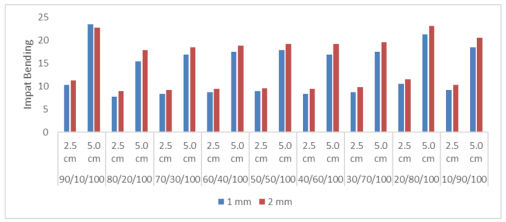
The study examined the impact bending strength and flexural strength of walkway tiles ranging from 7.72 to 23.49 J/m. The relationship between and among the variable factors as illustrated in Figure 4, shows that the impact bending strength of the produced tiles increases consistently from tiles with particle sizes 1 mm and 2 mm; and thickness of 2.5 cm and 5.0 cm respectively. While, it was observed that produced walkway tiles at 90/10/100 mixing ratio was find to be most resistance to shock (Impact bending) than others as shown in Figure 4. Analysis of variance as presented in Table 1., the result shows that all the factors includes main and interaction were significantly different at 5% level of probability. This implies that all the factors such as particle sizes, mixing proportions and tiles thickness significantly influenced the shock resistance (impact bending strength) of the tiles. The outcome of result in Duncan Multiple Range Test at 5% level of probability shows that walkway tiles at particle sizes 2 mm and thickness 5.0 cm were found to be the outstanding tiles for shock resistance as presented in Table 1. The IB mean values increased from 10-40% and decreased from 50-60%, with the highest value being 80% of SNS. The study found that walkway tiles with a 90/10/100 mixing ratio were more shock-resistant, this is in accordance with Andrew et al., that the impact properties of composite materials are directly related to its overall toughness, which is highly influenced by the interfacial bond strength, the matrix and fibre properties. The increased flexural strength of hybrid composites with glass fibre loading was mainly due to shearing resistance. The study also found that impact bending decreased with a reduction in clay, reaching a point, and increased with higher proportions of clay, suggesting that clay increased the composite's binding ability and resistance to distortion under pressure. The trend observed in this present studies however, indicates that impact bending decreased with reduction in clay, reached a point and increased with higher proportions of clay implying that clay increased binding ability of the composite and therefore its resistance to distortion under pressure which is in consonance with established literature. This implies that all the factors such as particle sizes, mixing proportions and tiles thickness significantly influenced the shock resistance (impact bending strength) of the tiles.
Figure 2. Effect of production variables on the modulus of elasticity of tiles made from SNS.
Figure 3. Effect of production variables on the modulus of rupture on tiles produced from SNS residue.
Figure 4. Effect of production variables on Impact bending strength on walkway tiles made from SNS fibre residue.
Table 1. Analysis of variance for physical and mechanical properties of biopolymer tiles.

Properties

Flexural modulus

Flexural strength

Impact bending

Source of variance

f-value

Sig.

f-value

Sig.

f-value

Sig.

Particle size

55.660

0.00*

56.696

0.00*

41957.019

0.00*

Mixing proportion

20.849

0.00*

40.929

0.00*

26911.216

0.00*

Board thickness

3.620

0.06ns

0.434

0.51 ns

2459197.287

0.00*

PS*MP

12.024

0.00*

18.133

0.00*

733.566

0.00*

PS*BT

0.045

0.83ns

0.001

0.98 ns

2613.137

0.00*

MP*BT

2.149

0.04*

1.773

0.09 ns

4446.987

0.00*

PS*MP*BT

3.183

0.00*

0.954

0.48 ns

631.313

0.00*

3.4. Physical Properties
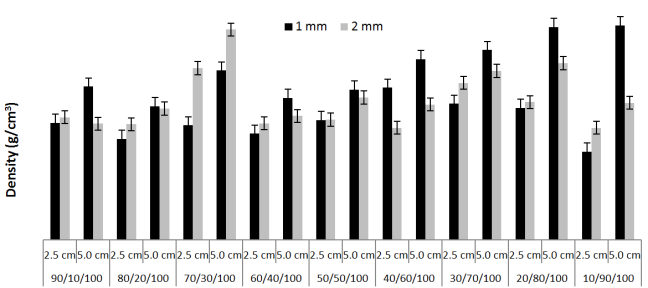
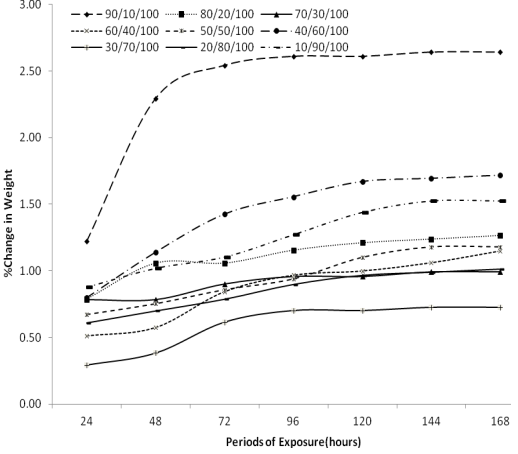
The density of the produced tiles was determined based on the mass of the material per unit volume. For tiles made from 1 mm and 2 mm particle sizes, the mean values obtained were 3.55g/cm3 and 3.41g/cm3 at different mixing proportions. The densities obtained were 3.11g/cm3, 2.95g/cm3, 4.07g/cm3, 2.99g/cm3, 3.25g/cm3, 3.98g/cm3, 4.03g/cm3, and 3.37g/cm3 for 90/10/100, 80/20/100, 70/30/100, 60/40/100, 50/50/100, 40/60/100, 20/80/100, and 10/90/100 (SNS/clay/plastic), respectively. This density obtained at different thickness levels were 3.03g/cm3 and 3.92g/cm3 as shown in Figure 5. From the Figure 6, particle size 1 mm had higher value than 2.5 cm, these observations were noticed for all samples and also follows the same trend in particle sizes 2 mm. Differences in density between the 1 mm and 2 mm could be attributed to the size of the composites. It is common knowledge that fine grained soils weigh higher compared to coarse soils, and this is because the finer the particulate size the more grains are present per unit size. The study found that the density of the tiles ranged from 2.47g/cm3 to 5.24g/cm3, with variations based on factors such as particle size, mixing proportion, and thickness. Tiles made from particle sizes of 1 mm and 2 mm had mean densities of 3.55g/cm3 and 3.41g/cm3 respectively. The mixing proportions also influenced density, with values ranging from 2.95g/cm3 to 4.07g/cm3. The study observed that tiles with a particle size of 1 mm generally had higher densities than those with a size of 2 mm. The analysis in Table 2 shows that all factors had a significant effect on tile density, with particle size and mixing proportion playing important roles. Tiles with a particle size of 1 mm and a thickness of 5.0 cm were found to have the highest density values. The properties of plastics used in tile production were also noted to impact density, with factors such as molecular structure and composition influencing the material's density. The study also analysed the weight changes of tiles after 24 hours of water immersion and oven drying at 26 ± 2°C. The weight changes varied according to the particle sizes, mixing proportions, and thickness sizes. Tiles made from SNS/clay/plastic of 80/20/100 had the least weight change values, suggesting they resist water intake. Tiles made from SNS waste exposed to heat conditions at 65 ± 2°C had the highest weight changes. Water hydroxylation of bioplastics is attributed to the composites' affinity to water. Cassava bioplastic films have higher absorption rates compared to hydrolyzed potato and corn bioplastic films due to their limited water absorption. The study in Table 2, shows that 80/20/100 SNS/clay/plastic had higher resistance to water intake compared to other proportions, resulting in the least weight change after oven drying. This could be due to poor affinity for water and the size of granules, which impedes the affinity of clay particles. For weight changes at wet conditions for 24 hours it shows that all the main factors, two and three-factor interaction, had a significant influence on weight changes of the products at 24 hours of water exposure. The study suggests that all factors considered in tile production have an influence on weight changes at 24 hours of water exposure. The study examined the weight change values of tiles made of particle sizes 1 mm and 2 mm at a thickness of 2.5 cm, made from SNS/clay/plastic at various levels. The total weight changes after exposure to drying conditions at 26°C for 1 week were 136.1% and 96.99%, respectively. The walkway tile of 1 mm composition had the highest mean value of weight changes (5.63%), while 30/70/100 had the lowest (0.84%). The weight changes varied among tiles at different drying exposure periods, with tiles of 80/20/100 having the highest variation and weight changes from 120 hours to 168 hours. The particle size of 2 mm at a thickness of 2.5 cm of 90/10/100 had the highest mean value of 2.38%, while 40/60/100 had the lowest mean value of 0.85%. There was little variation among tiles 90/10/100, 80/20/100, and 50/50/50. The results of the study validated the position of Oberti, & Paciello, , who found that bio-plastic tiles desorb moisture at varying rates depending on the proportions of components used in their manufacture. Rhodes also observed the behavior of bioplastics made from starchy constituents after being subjected to wetting and drying at varying temperatures to desorb moisture and be deformed in shape.
Figure 5. Effect of variable factors on physical properties of bio-plastic tiles.
Figure 6. Weight performance of 2 mm particle sizes of 5 cm thick tiles made SNS after long term water exposure.
Table 2. Results of follow-up tests conducted for physical and mechanical properties.

Main factors

Levels

Mechanical properties

Density (g/cm3)

Weight changes (%)

Modulus (MOE) N/mm2

Strength (MOR) N/mm2

Impact bending (J/m)

26°C

65°C

Particle-size (mm)

1

1278.01a

72.09a

13.71a

3.55a

0.73a

1.30b

2

672.30b

55.12b

14.98b

3.41b

0.67a

1.46a

Mixing proportion (SNS/clay/plastic)

90/10/100

399.23d

39.69d

16.97a

3.11de

0.95a

2.03a

80/20/100

2169.24a

102.98a

12.52h

2.95f

1.19a

1.86ab

70/30/100

1186.94b

80.58b

13.24g

4.07a

0.72bc

1.42ab

60/40/100

349.28d

38.76d

13.68e

2.99ef

0.65bc

1.40ab

50/50/100

686.78cd

45.76d

13.91d

3.25cd

0.77bc

1.42ab

40/60/100

902.98bc

67.67c

13.50f

3.55b

0.64bc

1.29bc

30/70/100

1152.52b

81.33b

13.93d

3.98a

0.46c

0.97c

20/80/100

1247.11b

57.85c

16.69b

4.03a

0.48c

0.89c

10/90/100

682.33cd

57.87c

14.69c

3.37c

0.45c

1.14

Tiles thickness (cm)

2.5

897.93b

62.86a

9.49b

3.03b

0.78b

1.67

5.0

1052.39a

64.35a

19.21a

3.92a

0.63a

1.09

Values with the same alphabet along the columns are not significantly different at α0.05
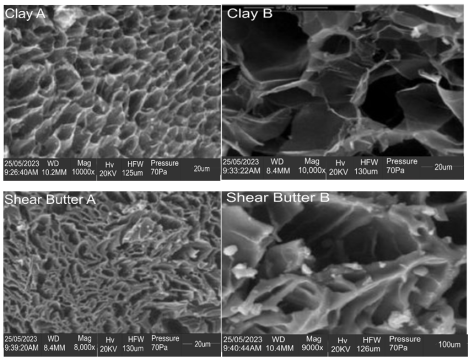
Figure 7. SEM images of Bio-plastic tiles, made from Shea Nut Shell residue (a) Clay (2) Clay (3) SNS (4) SNS.
The following mainly summarize the different types of different raw materials for the preparation of the performance Bio-plastic tiles, made from Shea Nut Shell residue. Through the retrospective analysis of the various kinds of adhesive and the microstructure of the research, found that different molar concentration of alkali and acid solution, liquid-to-binder, curing temperature and time to the preparation of the geopolymers with different property has been found.
4. Conclusion
Pollution, global warming, and natural calamities currently beset our environment. Too much carbon dioxide, plastics, and papers that take years to degrade are some of the culprits . Many studies have been attempted to ease the misery, identify alternative solutions to pollution, particularly water and land pollution, which have a significant impact on our ecosystem. These researches aim at minimizing the waste generated from SNS and bio-plastics to enable our environment to become healthier again. It was discovered that waste (SNS) can be used to produce value added product like bio-plastic tiles. The outcome of the production and evaluation was successful, all the factors used in this study has significant influenced on the properties of bio-plastic tiles. It was discovered that bio-plastic tiles made from lower particle sizes of 1 mm were better in strength and modulus than the 2 mm. based on the finding from the study, bio-plastic tiles of 20/80/100 and 70/30/100 are stronger, stiffer and better torsion than the other. The outcome of the percentage (%) weight changes, were found to be better especially in compositions of 30/70/100 and 20/80/100 because the values obtained from this composites falls below 1.00(<1.00), while other composite can still be useful because there were found to be lower than other conventional composites made from cement, phenol and urea formehydride. The production also helps to reduce the environmental problems created by the plastics and Shea nut Shell waste in the society, the seeds/nuts waste from forest fruits can still be use for value added products. This study revealed that Shea nut Shell waste from the forest fruits nuts/seeds could be further processed to produce value like bio-plastics composites. Factors such as particle size for fibres should be considered. Also materials such as clay and other reinforces should be tested for production of bioplastic tiles and awareness campaign on maintenance of shea nut waste should be extended to shea nut processor to conserve this valuable agroforestry product waste. The study suggests that Shea Nut Shell residue from forest fruits, nuts, and seeds can be processed into bio-plastic composites. The research emphasizes the importance of considering particle size for fibres and testing materials like clay for bioplastic tiles. It also suggests that processors should be educated on residue preservation and serve as a reference for low-cost bio-plastic tile production.
Abbreviations

ASTM

American Society for Testing and Materials

°C

Degrees Celsius

FTIR

Fourier Transform Infrared Spectroscopy

HDPE

High-Density Polyethylene

ISO

International Organization for Standardization

kN

Kilonewton

LDPE

Low-Density Polyethylene

MOE

Modulus of Elasticity

MOR

Modulus of Rupture

PET

Polyethylene Terephthalate

PLA

Polylactic Acid

PP

Polypropylene

PVC

Polyvinyl Chloride

SEM

Scanning Electron Microscopy

SNS

Shea Nuts Shell

TGA

Thermogravimetric Analysis

UV

Ultraviolet

wt.%

Weight Percentage

XRD

X-ray Diffraction

Author Contributions
Oyewumi Racheal Omolade is the sole author. The author read and approved the final manuscript.
Conflicts of Interest
The author declares no conflicts of interest.
References
[1] Abdul-Mumeen, Iddrisu, Didia Beauty and Abdulai Adam. Shea butter extraction technologies: Current status and future perspective. African Journal of Biochemistry Research, Article Number - BC101F860142 (2019), Vol. 13(2), pp. 9-22,
[2] Abi, C. B. E.,. Effect of boro gypsum on brick properties, Construction and Building Materials. (2014) 59, 195–203.
[3] Agustin, Yuana elly and Padmawijaya K. S. Effect of glycerol and zinc oxide addition on antibacterial activity of biodegradable bioplastics from chitosan-kepok banana peel starch, IOP Conference Series Materials Science and Engineering, (2017). 223(1): 012046
[4] Ajala, O. E., Aberuagba, F., Odetoye, T. E., and Ajala, A. M. Biodiesel: sustainable energy replacement to petroleum‐based diesel fuel–a review. Chem Bio Eng Reviews, (2015). 2(3), 145-156.
[5] Akinpelu Kamoru Babayemi. Performance Evaluation of Palm Kernel Shell Adsorbents for the Removal of Phosphorus from Residuewater" Advances in Chemical Engineering and Science, (2017). Vol. 7 No. 2,
[6] Al-Jabri K. S., A. W. Hago, R. Taha, A. S. Alnuaimi and A. H. Al-Saidy. “Strength and Insulating Properties of Building Blocks Made from Residue Materials”, Journal of Materials in Civil Engineering, (2009) Vol. 21, No. 5, page no: 191–197.
[7] Amola, L., Kamgaing, T., Tchuifon, D. Atemkeng, C. and Anagho, S. Activated Carbons Based on Shea Nut Shells (Vitellaria paradoxa): Optimization of Preparation by Chemical Means Using Response Surface Methodology and Physicochemical Characterization. Journal of Materials Science and Chemical Engineering, (2020). 8, 53-72.
[8] Andrew, J. J., Srinivasan, S. M., Arockiarajan, A., and Dhakal, H. N. Parameters influencing the impact response of fiber-reinforced polymer matrix composite materials: A critical review. Composite Structures, (2019). 224, 111007.
[9] Dehghani, M. H., Omrani, G. A., & Karri, R. R. Solid residue—sources, toxicity, and their consequences to human health. In Soft computing techniques in solid residue and residue water management (2021). pp. 205-213.
[10] Dejean, A., Ouédraogo, I. W., Mouras, S., Valette, J., and Blin, J. (2017). Shea nut shell based catalysts for the production of ethanolic biodiesel. Energy for Sustainable Development, 40, 103-111.
[11] Gupta, N., Mahur, B. K., Izrayeel, A. M. D., Ahuja, A., and Rastogi, V. K. (2022). Biomass conversion of agricultural waste residues for different applications: a comprehensive review. Environmental Science and Pollution Research, 29(49), 73622-73647.
[12] Itodo, A. U., Itodo, H. U., and Gafar, M. K. Evaluation of Dyestuff removal by Shea Nut (Vitellaria paradoxa) shells. Journal of Applied Sciences and Environmental Management, (2010). 14(4).
[13] Ivanov A. T. Production and applications of crude polyhydroxyalkanoate-containing bioplastis from the organic fraction of municipal solid residue, International journal of Environmental Science and Technology, (2015). Vol 12(2) p. 725-738.
[14] Izathul Shafina Sidek, Sarifah Fauziah Syed Draman, Siti Rozaimah Sheikh Abdullah, and Nornizar Anuar. Current development on bioplastics and its future prospects: an introductory review, Vol 1 (2019) 03-08
[15] Liu, R., Peng, Y., Cao, J., and Chen, Y. Comparison on properties of lignocellulosic flour/polymer composites by using wood, cellulose, and lignin flours as fillers. Compos. Sci. Technol. (2014). 103, 1–7.
[16] Moore S (2008) The role of Vitellaria Paradoxa in poverty reduction and food security in the Upper East region of Ghana Earth & Environment 3: 209-245
[17] Mujtaba, M., Fraceto, L. F., Fazeli, M., Mukherjee, S., Savassa, S. M., de Medeiros, G. A. and Vilaplana, F. Lignocellulosic biomass from agricultural waste to the circular economy: a review with focus on biofuels, bio composites and bioplastics. Journal of Cleaner Production, (2023), 402, 136815.
[18] Njoku R E, Okon A E, and Ikpaki T C. Effects of Variation of Particle Size and Weight Fraction on the Tensile Strength and Modulus of Periwinkle Shell Reinforced Polyester Composite, Nigerian Journal of Technology. (2011) Vol 30, pp 87–93
[19] Oberti, I., & Paciello, A. Bioplastic as a substitute for plastic in construction industry. Encyclopedia, (2022), 2(3), 1408-1420.
[20] Otaiku A. A. Shea Cake Residue Conversion to Biopesticide: Environmental protection of Diseases and Pest of the Shea Tree Seeds of Change, Global Shea Alliance (GSA) (2017) Conference, Cotonou, Benin
[21] Oyewumi, Racheal. O. Techno-economic analysis of bio-plastic tiles made with shea nuts shell and clay, a dissertation submitted to the department of social and environmental forestry, faculty of renewable natural resources, university of Ibadan. In partial fulfilment of the requirements for the award of degree of Master of Science (forest economics and governance), University of Ibadan, Nigeria. (2021).
[22] Patrick Felicity, O. Investigation into the use of Shea-nut shell as a lightweight aggregate, unpunished National Diploma project, Civil Engineering Department, Federal Polytechnic Bida, Niger State. Nigeria Research Inventy: International Journal of Engineering and Science Vol. 6, Issue 6 (July 2016), PP 21-27: 2319-6483.
[23] Phiri, R., Rangappa, S. M., Siengchin, S., Oladijo, O. P., & Dhakal, H. N. Development of sustainable biopolymer-based composites for lightweight applications from agricultural waste biomass: A review. Advanced Industrial and Engineering Polymer Research. (2023).
[24] Quainoo, A. K., Konadu, A., & Kumi, M. The potential of shea nut shells in phytoremediation of heavy metals in contaminated soil using lettuce (Lactuca sativa) as a test crop. (2015).
[25] Rhodes, C. J. Solving the plastic problem: From cradle to grave, to reincarnation. Science Progress, Volume: 102 issue: 3, page(s): 218-248, (2019).
[26] Senyo Kwame. "Preliminary insight into cloud computing adoption in a developing country", Journal of Enterprise Information Management, (2016). Vol. 29 Issues, 4 pp. 505 - 524
[27] Stringer, L. C., Fraser, E. D., Harris, D., Lyon, C., Pereira, L., Ward, C. F., & Simelton, E. Adaptation and development pathways for different types of farmers. Environmental Science & Policy, 104, 174-189. (2020).
[28] Syuhada M., Sintia A. S. and Endaruji S. The Effect of Cassava Peel Starch Addition to Bioplastic Biodegradation Based on Chitosan on Soil and River Water Media Biology, Medicine, & Natural Product Chemistry (2020). ISSN 2089-6514 (paper) 9: 1. 7-13
[29] Tsado, T. Y., Yewa, M., Yaman, S., and Yewa, F. Effect of sheanut shell ash as a partial replacement of ordinary Portland cement in mortar. International J. of Engineering Science Invention, (2014). 3, 1-5.
[30] World Bank. Global economic prospects 2005: Trade, regionalism, and development. (2020),
[31] Yidana, S. M. The hydro chemical framework of surface water basins in southern Ghana. Environmental geology, (2009). 57, 789-796.
[32] Yusuf-Salihu, B. O., Lateef, A., & Azeez, L. Phytochemical profiling of wastes from the processing of shea butter (Vitellaria paradoxa) and pharmacological potentials within the paradigm of circular bioeconomy: Emphasizing antioxidant and antidiabetic applications. Cleaner and Circular Bioeconomy, (2024). 9, 100107.
Cite This Article
  • APA Style

    Omolade, O. R. (2026). Effect of Board Thickness on Physico-mechanical Properties of Bio-polymer Tiles Reinforced with Shea Nutshell Dust and Enhanced with Kaolinite. World Journal of Materials Science and Technology, 3(1), 13-23. https://doi.org/10.11648/j.wjmst.20260301.13

    Copy | Download

    ACS Style

    Omolade, O. R. Effect of Board Thickness on Physico-mechanical Properties of Bio-polymer Tiles Reinforced with Shea Nutshell Dust and Enhanced with Kaolinite. World J. Mater. Sci. Technol. 2026, 3(1), 13-23. doi: 10.11648/j.wjmst.20260301.13

    Copy | Download

    AMA Style

    Omolade OR. Effect of Board Thickness on Physico-mechanical Properties of Bio-polymer Tiles Reinforced with Shea Nutshell Dust and Enhanced with Kaolinite. World J Mater Sci Technol. 2026;3(1):13-23. doi: 10.11648/j.wjmst.20260301.13

    Copy | Download

  • @article{10.11648/j.wjmst.20260301.13,
      author = {Oyewumi Racheal Omolade},
      title = {Effect of Board Thickness on Physico-mechanical Properties of Bio-polymer Tiles Reinforced with Shea Nutshell Dust and Enhanced with Kaolinite},
      journal = {World Journal of Materials Science and Technology},
      volume = {3},
      number = {1},
      pages = {13-23},
      doi = {10.11648/j.wjmst.20260301.13},
      url = {https://doi.org/10.11648/j.wjmst.20260301.13},
      eprint = {https://article.sciencepublishinggroup.com/pdf/10.11648.j.wjmst.20260301.13},
      abstract = {This study investigates the production and mechanical properties of bio-plastic tiles using a composite mixture of Shea Nut Shell (SNS), high-density polyethylene (HDPE), and clay. The mixtures were extruded and compressed into bio-plastic tiles of two different sizes: (19 × 9 × 2.5) cm and (19 × 9 × 5.0) cm. To assess the influence of particle size and composition on tile properties, SNS was processed into 1 mm and 2 mm geometrical sizes and combined in four different weight-to-weight proportions: 90/10/100, 80/20/100, 70/30/100, and 60/40/100 (SNS/clay/plastic). The study examined the effects of particle size and composition ratio on key physical and mechanical properties, including density, flexural strength, flexural modulus, compression strength, and impact bending resistance. Additionally, the influence of tile thickness and inter-structural material arrangement on mechanical performance was analyzed using a factorial experimental design. The results showed density values ranging from 2.95g/cm3 to 4.07g/cm3, with variations in flexural strength, flexural modulus, impact bending, and compression across different compositions. Structural analysis revealed that the 90/10/100 ratio exhibited superior bonding cohesion and compatibility, leading to enhanced mechanical properties. The findings indicate that the investigated factors significantly influenced the performance of bio-plastic tiles. The mechanical values obtained in this study align with standard requirements for construction materials, suggesting that these tiles are suitable for use in pavement pathways with both low and high load-bearing capacities.},
     year = {2026}
    }
    

    Copy | Download

  • TY  - JOUR
    T1  - Effect of Board Thickness on Physico-mechanical Properties of Bio-polymer Tiles Reinforced with Shea Nutshell Dust and Enhanced with Kaolinite
    AU  - Oyewumi Racheal Omolade
    Y1  - 2026/01/20
    PY  - 2026
    N1  - https://doi.org/10.11648/j.wjmst.20260301.13
    DO  - 10.11648/j.wjmst.20260301.13
    T2  - World Journal of Materials Science and Technology
    JF  - World Journal of Materials Science and Technology
    JO  - World Journal of Materials Science and Technology
    SP  - 13
    EP  - 23
    PB  - Science Publishing Group
    SN  - 3070-1546
    UR  - https://doi.org/10.11648/j.wjmst.20260301.13
    AB  - This study investigates the production and mechanical properties of bio-plastic tiles using a composite mixture of Shea Nut Shell (SNS), high-density polyethylene (HDPE), and clay. The mixtures were extruded and compressed into bio-plastic tiles of two different sizes: (19 × 9 × 2.5) cm and (19 × 9 × 5.0) cm. To assess the influence of particle size and composition on tile properties, SNS was processed into 1 mm and 2 mm geometrical sizes and combined in four different weight-to-weight proportions: 90/10/100, 80/20/100, 70/30/100, and 60/40/100 (SNS/clay/plastic). The study examined the effects of particle size and composition ratio on key physical and mechanical properties, including density, flexural strength, flexural modulus, compression strength, and impact bending resistance. Additionally, the influence of tile thickness and inter-structural material arrangement on mechanical performance was analyzed using a factorial experimental design. The results showed density values ranging from 2.95g/cm3 to 4.07g/cm3, with variations in flexural strength, flexural modulus, impact bending, and compression across different compositions. Structural analysis revealed that the 90/10/100 ratio exhibited superior bonding cohesion and compatibility, leading to enhanced mechanical properties. The findings indicate that the investigated factors significantly influenced the performance of bio-plastic tiles. The mechanical values obtained in this study align with standard requirements for construction materials, suggesting that these tiles are suitable for use in pavement pathways with both low and high load-bearing capacities.
    VL  - 3
    IS  - 1
    ER  - 

    Copy | Download

Author Information
  • Department of Forest Products Development and Utilization, Forestry Research Institute of Nigeria, Ibadan, Nigeria;Department of Forest Production and Products, University of Ibadan, Ibadan, Nigeria
  • Abstract
  • Keywords
  • Document Sections

    1. 1. Introduction
    2. 2. Materials
    3. 3. Results and Discussion
    4. 4. Conclusion
    Show Full Outline
  • Abbreviations
  • Author Contributions
  • Conflicts of Interest
  • References
  • Cite This Article
  • Author Information