
Optimizing bioplastics from renewable resources is crucial for addressing global plastic pollution. This is done to address the waste problem that has severely disrupted the environment because it cannot degrade in the soil for hundreds of years. This research, based on taro starch and other polymer materials, is expected to address the impact of plastic waste in the future. The purpose of this study was to determine the effect of the ratio of bioplastic materials and the type of plasticizer and to determine the best treatment and its characteristics. This taro starch-based bioplastic research was combined with carrageenan and glucomannan at ratios of 25:75 and 50:50 (total material 6 grams) and with 3 types of plasticizers: castor oil, stearic acid, and egg white, each 1 gram. The observed bioplastic variables included mechanical properties, including tensile strength, elongation, and elasticity, as well as biodegradability, and functional group analysis for the best treatment. The results showed that the treatment of bioplastic material ratio and plasticizer type showed an effect on the variables of tensile strength, elongation at break, elongation and did not affect biodegradation. The best bioplastic was formulated with a ratio of taro starch and carrageenan of 25:75 and 1% castor oil with characteristics of tensile strength of 18.33 MPa; elongation of 4.96%, and complete biodegradation in 6 days. Although it did not meet the SNI (Indonesian Standart National) mechanical property standards, this composite showed potential as an environmentally friendly packaging material. Further optimization of plasticizer concentration and crosslinking strategy is recommended to improve its performance.
| Published in | World Journal of Materials Science and Technology (Volume 3, Issue 1) |
| DOI | 10.11648/j.wjmst.20260301.14 |
| Page(s) | 24-33 |
| Creative Commons |
This is an Open Access article, distributed under the terms of the Creative Commons Attribution 4.0 International License (http://creativecommons.org/licenses/by/4.0/), which permits unrestricted use, distribution and reproduction in any medium or format, provided the original work is properly cited. |
| Copyright |
Copyright © The Author(s), 2026. Published by Science Publishing Group |
Biodegradable, Bioplastics, Composite, Mechanical Properties, Thermoplastics
Treatment | Plasticiser (1g) | |||
|---|---|---|---|---|
Taro starch composite with | Ratio | Castor Oil (P1) | Stearic Acid (P2) | Egg Whites (P3) |
Glucomanan (G) | 25:75 (R1) | GR1P1 | GR1P2 | GR1P3 |
Glucomanan (G) | 50:50 (R2) | GR2P1 | GR2P2 | GR2P3 |
Caragenan (K) | R1 | KR1P1 | KR1P2 | KR1P3 |
Caragenan (K) | R2 | KR2P1 | KR2P2 | KR2P3 |
Treatment | Plasticizer (%) | ||
|---|---|---|---|
P1 (castor oil) | P2 (stearic acid) | P3 (egg white) | |
GR1 (25:75) | 14,69±0,17 b | 9,71±0,66 e | 9,88±0,49 de |
GR2 (50:50) | 11,67±0,37 cd | 8,18±0,84 ef | 6,46±0,18 fg |
KR1 (25:75) | 18,33±0,24 a | 6,77±0,37 fg | 5,94±0,56 g |
KR2 (50:50) | 12,34±0,07 c | 5,24±0,99 g | 4,88±0,48 g |
Treatment | Plasticizer (%) | ||
|---|---|---|---|
P1 (castor oil) | P2 (stearic acid) | P3 (egg white) | |
GR1 | 6,43±1,01 abc | 4,29±0,00 bc | 5,63±1,99 abc |
GR2 | 5,36±2,53 abc | 5,00±1,01 abc | 9,29±1,01 a |
KR1 | 4,96±0,95 bc | 4,29±0,00 c | 6,43±1,01 ab |
KR2 | 3,93±0,51 c | 8,57±0,00 a | 5,00±1,01 abc |
Treatment | Plasticizer (%) | ||
|---|---|---|---|
P1 | P2 | P3 | |
GR1 | 231,20±33,65 abc | 226,52±15,46 abcd | 156,33±29,71 bcd |
GR2 | 145,05±30,99 bcd | 165,32±16,60 bcd | 70,14±9,62 d |
KR1 | 344,78±23,20 a | 157,85±8,75 bcd | 92,83±5,89 cd |
KR2 | 316,49±38,91 ab | 61,17±11,51 d | 98,67±10,29 cd |
Treatment | Plasticizer (%) | ||
|---|---|---|---|
P1 | P2 | P3 | |
GR1 | 6 | 6 | 7 |
GR2 | 7 | 7 | 6 |
KR1 | 7 | 7 | 6 |
KR2 | 6 | 7 | 7 |
SNI | Indonesian Standart National |
MPa | Mega Pascal |
PVA | Polivynil Alcohol |
G | Glucomanan |
K | Caragenan |
P | Plasticizer |
R1 | Ratio 25:75 |
R2 | Ratio 50:50 |
P1 | Plasticizer castor oil |
P2 | Plasticizer stearic acid |
P3 | Plasticizer egg white |
ASTM | American Standart Testing and Material |
FTIR | Fourier Transform Infrared |
| [1] | Atere, J. O., O. Ogunmodede, and D. F. Adewumi. 2024. Investigating Functional Properties of Rice-Based Bioplastics. Pages 1–15. |
| [2] | Badan Standarisasi Nasional. 2016. Kriteria ekolabel - Bagian 7: Kategori produk tas belanja plastik dan bioplastik mudah terurai (SNI 7188.7: 2016). Page Badan Standardisasi Nasional. |
| [3] | Bidari, R., A. A. Abdillah, R. Alfredo, B. Ponce, and A. L. Charles. 2023. Characterization of Biodegradable Films Made from Taro Peel. |
| [4] | Botha, E., T. Chuene, D. Mathobisa, and K. Harding. 2024. Production and Biodegradation Testing of Bioplastics. Pages 66–72 Production and Biodegradation Testing of Bioplastics. |
| [5] | Botlhoko, O. J., R. C. Mphahlele, R. Lekalakala, and S. Muniyasamy. 2024. Blending Techniques for Preparing Cost-minimized Bioplastics and Biocomposites. Biodegradable Polymers, Blends and Biocomposites: 179–198. |
| [6] | Chaudhary, S., M. Kour, and R. Kumar. 2024. Bioplastic films from starch of Colocasia esculenta and its waste: A smart template for sensing applications. International Journal of Biological Macromolecules 281. |
| [7] | Dewi, N. K. A., A. Hartiati, and B. A. Harsojuwono. 2018. The Effect of Temperature and Acid Type on Hydrolysis of Taro Yam Starch (Colocasia Esculenta L. Schott) to The Characteristics of Glucose. Jurnal Rekayasa Dan Manajemen Agroindustri 6: 307. |
| [8] | Fitriani, R. O., A. Hartiati, and L. Suhendra. 2018. Characteristics Of Liquid Sugar Made From Yam Gadung (Dioscorea hispida D.) In Variation Of Acid Types And Concentration. Jurnal Rekayasa Dan Manajemen Agroindustri 6: 203. |
| [9] | Gibson, R. F. 1994. Principles of Composite Material Mechanics. Page Principles of Composite Material Mechanics. |
| [10] | Harnis, R., and Y. Darni. 2011. Penentuan Kondisi Optimum Konsentrasi Plasticizer pada Sintesa Plastik Biodegradable Berbahan Dasar Pati Sorgum. Seminar Nasional Sains dan Teknologi-II. |
| [11] | Hartiati, A., B. A. Harsojuwono, H. Suryanto, and I. W. Arnata. 2021. Synthesis of starch-carrageenan bio-thermoplastic composites on the type and concentration of thermoplastic forming materials as packaging materials. IOP Conference Series: Earth and Environmental Science 913. |
| [12] | Hartiati, A., and I.. M. Tuningrat. 2020. Influence of Type and Concentration of Acids on Hydrolisis Starch of “Taro Tuber” Into Sugar Liquid. Agroindustrial Journal 6: 419. |
| [13] | Jahangiri, F., A. K. Mohanty, and M. Misra. 2024. Sustainable biodegradable coatings for food packaging: challenges and opportunities. Green Chemistry 26: 4934–4974. |
| [14] | Javaid, H., M. Khan, K. Mustafa, and S. Musaddiq. 2022. Biodegradable Plastics as a Solution to the Challenging Situation of Plastic Waste Management. Pages 1–22 Handbook of Biodegradable Materials. |
| [15] | Kedir, W. M., A. K. Geletu, and G. S. Weldegirum. 2024. Spider web-reinforced chitosan/starch biopolymer for active biodegradable food packaging. Applied Food Research 4: 100526. |
| [16] | Lounis, F. M., F. Benhacine, and A. S. Hadj-Hamou. 2024. Improving water barrier properties of starch based bioplastics by lignocellulosic biomass addition: Synthesis, characterization and antibacterial properties. International Journal of Biological Macromolecules 283. |
| [17] | Mamauod, M. I., M. H. A. Hassan, and S. N. L. Mamauod. 2024. The Effect Of Glycerol Concentration On Starch-Based Bioplastics Derived From Banana Peels (Musa Acuminata). Malaysian Journal of Analytical Sciences 28: 1003–1011. |
| [18] | Mayuri, T., R. N. Shukla, and J. Balaji. 2023. Biobased Food Packaging Materials: Sustainable Alternative to Conventional Petrochemical Packaging Materials: A Review. Asian Journal of Dairy and Food Research 42: 137–143. |
| [19] | Muiruri, J. K., J. C. C. Yeo, H. Run, T. T. Lin, X. Hou, V. Raveenkumar, B. Y. Jian, W. Thitsartarn, C. He, and Z. Li. 2024. Plant oil fillers toughened poly (3-hydroxybutyrate) green biocomposites. European Polymer Journal 210. |
| [20] | Permana, K. D. A., A. Hartiati, and B. Admadi. 2017. The Effect of Sodium Chloride (NaCl) Solution Concentration as a Soaking Agent on the Quality Characteristics of Taro Starch (Calocasia esculenta L. Schott). Jurnal Rekayasa dan Manajemen Agroindustri 5: 60–70. |
| [21] | Rahmatullah, R. W. Putri, E. Nurisman, Yandriyani, A. Al Hadi, and M. A. Raihan. 2023. Manufacturing Biodegradable Bioplastics from A Mixture of Starch and Kapok Fibers with Variations of Chitosan and Glycerol. Agroindustrial Technology Journal 02: 91–97. |
| [22] | Rastiyati, N. L. D., A. Hartiati, and B. Admadi. 2016. The Effect Of Nacl Concentration And Water To Ingredient Ratio On The Quality Characteristics Of Gadung Potato Starch (Dioscorea Hispida Dennst). J. Rekayasa Dan Manajemen Agroindustri 4: 116 – 125. |
| [23] | Sanyang, M. L., S. M. Sapuan, M. Jawaid, M. R. Ishak, and J. Sahari. 2015. Effect of plasticizer type and concentration on tensile, thermal and barrier properties of biodegradable films based on sugar palm (Arenga pinnata) starch. Polymers 7: 1106–1124. |
| [24] | Saputra, F., A. Hartiati, B. H. Admadi, M. Jurusan Teknologi Industri Pertanian, F. Teknologi Pertanian, and D. Jurusan Teknologi Industri Pertanian. 2016. Quality Characteristics Of Taro Starch (Colocasia Esculenta) In The Comparison Of Water With Taro Crushed And Sodium Concentration. Maret 4: 62–71. |
| [25] | Saputri, C. A., F. A. Julyatmojo, Harmiansyah, M. Febrina, M. Mahardika, and S. Maulana. 2024. Characteristics of bioplastics prepared from cassava starch reinforced with banana bunch cellulose at various concentrations. IOP Conference Series: Earth and Environmental Science 1309. |
| [26] | Saray, I. J., A. G. Fuentes, and L. Casinillo. 2023. Taro (Colocasia esculenta) and sea grapes (Caulerpa lentillifera) as potential materials for making bioplastic. EDUCATUM Journal of Science, Mathematics and Technology 10: 47–57. |
| [27] | Shafqat, A., N. Al-zaqri, A. Tahir, and A. Alsalme. 2021. Saudi Journal of Biological Sciences Synthesis and characterization of starch based bioplatics using varying plant-based ingredients, plasticizers and natural fillers. Saudi Journal of Biological Sciences 28: 1739–1749. |
| [28] | Sharma, S., T. Ghosh, N. Mulchandani, and V. Katiyar. 2024. Biodegradable Synthetic Poly (Lactic Acid) (PLA) for Food Packaging Application. Page Agro-Waste Derived Biopolymers and Biocomposites: Innovations and Sustainability in Food Packaging. |
| [29] | Sultan, A., H. Sultan, W. Shahzad, A. Kareem, A. Liaqat, Z. Ashraf, A. Shahid, A. Rauf, S. Saeed, T. Mehmood, M. Zahra, A. Soto-Bubert, and R. Acevedo. 2024. Comparative analysis of physical and mechanical properties of starch based bioplastic derived from the pulp and peel of potatoes. Journal of the Indian Chemical Society 101. |
| [30] | Suparwan, K. G. I., A. Hartiati, and L. Suhendra. 2021. The Effect of Filler Type and Concentration on The Characteristic Bioplastic Composites of Gadung Tuber Starch-Carrageenan. Jurnal Rekayasa Dan Manajemen Agroindustri 9: 312. |
| [31] | Tiozon, R. J. N., A. P. Bonto, and N. Sreenivasulu. 2021. Enhancing the functional properties of rice starch through biopolymer blending for industrial applications: A review. International Journal of Biological Macromolecules 192: 100–117. |
| [32] | Sundari, U. Y., A. Sandriya, E. D. P. Setyowati, O. Andanu and F. Fiardilla. 2024. Karakterisasi Fisik Film Berbasis Polivinil Alkohol (PVA) dengan Penambahan Nanoclay Sebagai Filler. Jurnal Penelitian UPR:Kaharati 4: 8-15. |
| [33] | Wang, Z. L., and Z. C. Kang. 1996. FUNCTIONAL AND SMART MATERIALS -Structural evolution and structure analysis. |
| [34] | Yulianti, N. L., B. A. Harsojuwono, I. B. P. Gunadnya, and I. W. Arnata. 2024. Optimization of Cellulose Nanofibers and Castor Oil in the Synthesis of Starch-carrageenan-polyvinyl Alcohol Bio-thermoplastic Film. Pakistan Journal of Analytical and Environmental Chemistry 25: 31–48. |
| [35] | Averous, L. 2004. Biodegradable multiphase system based on plasticized starch: A review, J. Macromol. Sci. 44(3): 231-274. |
| [36] | Khan, S., S. Nadir, Z. U. Shah, A. A. Shah, S. C. Karunathna, J. Xu, A. Khan, S. Munir and F. Hasan. 2017. Biodegradation of polyester polyurethane by Aspergillus tubingensis. Environmental Pollution. 225: 469-480. |
| [37] |
Nayiroh, N. 2013. Teknolologi Material Komposit.
http://nurun.lecturer.uin-malang.ac.id/wp-content/uploads/sites/7/2013/03/Material-Komposit.pdf Accessed June 25, 2025 |
APA Style
Hartiati, A., Widaningsih, D., Harsojuwono, B. A., Arnata, I. W., Antares, A. (2026). Enhancing Mechanical Biodegradable Bioplastic Performance of Taro Starch Composites with Castor Oil, Stearic Acid, and Egg White. World Journal of Materials Science and Technology, 3(1), 24-33. https://doi.org/10.11648/j.wjmst.20260301.14
ACS Style
Hartiati, A.; Widaningsih, D.; Harsojuwono, B. A.; Arnata, I. W.; Antares, A. Enhancing Mechanical Biodegradable Bioplastic Performance of Taro Starch Composites with Castor Oil, Stearic Acid, and Egg White. World J. Mater. Sci. Technol. 2026, 3(1), 24-33. doi: 10.11648/j.wjmst.20260301.14
AMA Style
Hartiati A, Widaningsih D, Harsojuwono BA, Arnata IW, Antares A. Enhancing Mechanical Biodegradable Bioplastic Performance of Taro Starch Composites with Castor Oil, Stearic Acid, and Egg White. World J Mater Sci Technol. 2026;3(1):24-33. doi: 10.11648/j.wjmst.20260301.14
@article{10.11648/j.wjmst.20260301.14,
  author = {Amna Hartiati and Dwi Widaningsih and Bambang Admadi Harsojuwono and I Wayan Arnata and Ardhinata Antares},
  title = {Enhancing Mechanical Biodegradable Bioplastic Performance of Taro Starch Composites with Castor Oil, Stearic Acid, and Egg White},
  journal = {World Journal of Materials Science and Technology},
  volume = {3},
  number = {1},
  pages = {24-33},
  doi = {10.11648/j.wjmst.20260301.14},
  url = {https://doi.org/10.11648/j.wjmst.20260301.14},
  eprint = {https://article.sciencepublishinggroup.com/pdf/10.11648.j.wjmst.20260301.14},
  abstract = {Optimizing bioplastics from renewable resources is crucial for addressing global plastic pollution. This is done to address the waste problem that has severely disrupted the environment because it cannot degrade in the soil for hundreds of years. This research, based on taro starch and other polymer materials, is expected to address the impact of plastic waste in the future. The purpose of this study was to determine the effect of the ratio of bioplastic materials and the type of plasticizer and to determine the best treatment and its characteristics. This taro starch-based bioplastic research was combined with carrageenan and glucomannan at ratios of 25:75 and 50:50 (total material 6 grams) and with 3 types of plasticizers: castor oil, stearic acid, and egg white, each 1 gram. The observed bioplastic variables included mechanical properties, including tensile strength, elongation, and elasticity, as well as biodegradability, and functional group analysis for the best treatment. The results showed that the treatment of bioplastic material ratio and plasticizer type showed an effect on the variables of tensile strength, elongation at break, elongation and did not affect biodegradation. The best bioplastic was formulated with a ratio of taro starch and carrageenan of 25:75 and 1% castor oil with characteristics of tensile strength of 18.33 MPa; elongation of 4.96%, and complete biodegradation in 6 days. Although it did not meet the SNI (Indonesian Standart National) mechanical property standards, this composite showed potential as an environmentally friendly packaging material. Further optimization of plasticizer concentration and crosslinking strategy is recommended to improve its performance.},
 year = {2026}
}
TY  - JOUR
T1  - Enhancing Mechanical Biodegradable Bioplastic Performance of Taro Starch Composites with Castor Oil, Stearic Acid, and Egg White
AU  - Amna Hartiati
AU  - Dwi Widaningsih
AU  - Bambang Admadi Harsojuwono
AU  - I Wayan Arnata
AU  - Ardhinata Antares
Y1  - 2026/01/20
PY  - 2026
N1  - https://doi.org/10.11648/j.wjmst.20260301.14
DO  - 10.11648/j.wjmst.20260301.14
T2  - World Journal of Materials Science and Technology
JF  - World Journal of Materials Science and Technology
JO  - World Journal of Materials Science and Technology
SP  - 24
EP  - 33
PB  - Science Publishing Group
SN  - 3070-1546
UR  - https://doi.org/10.11648/j.wjmst.20260301.14
AB  - Optimizing bioplastics from renewable resources is crucial for addressing global plastic pollution. This is done to address the waste problem that has severely disrupted the environment because it cannot degrade in the soil for hundreds of years. This research, based on taro starch and other polymer materials, is expected to address the impact of plastic waste in the future. The purpose of this study was to determine the effect of the ratio of bioplastic materials and the type of plasticizer and to determine the best treatment and its characteristics. This taro starch-based bioplastic research was combined with carrageenan and glucomannan at ratios of 25:75 and 50:50 (total material 6 grams) and with 3 types of plasticizers: castor oil, stearic acid, and egg white, each 1 gram. The observed bioplastic variables included mechanical properties, including tensile strength, elongation, and elasticity, as well as biodegradability, and functional group analysis for the best treatment. The results showed that the treatment of bioplastic material ratio and plasticizer type showed an effect on the variables of tensile strength, elongation at break, elongation and did not affect biodegradation. The best bioplastic was formulated with a ratio of taro starch and carrageenan of 25:75 and 1% castor oil with characteristics of tensile strength of 18.33 MPa; elongation of 4.96%, and complete biodegradation in 6 days. Although it did not meet the SNI (Indonesian Standart National) mechanical property standards, this composite showed potential as an environmentally friendly packaging material. Further optimization of plasticizer concentration and crosslinking strategy is recommended to improve its performance.
VL  - 3
IS  - 1
ER  -
Faculty of Agricultural Technology, Udayana University, Bali, Indonesia
Biography: Amna Hartiati is a lecturer in the Agricultural Industrial Technology Study Program Faculty of Agricultural Technology, Udayana University, Bali, Indonesia. She graduated with a doctorate in polymer technology in 2021. She has been a lecturer since 1989 and currently works as a researcher in the field of bioplastics and edible coatings.
Faculty of Agriculture, Udayana University, Bali, Indonesia
Faculty of Agricultural Technology, Udayana University, Bali, Indonesia
Faculty of Agricultural Technology, Udayana University, Bali, Indonesia
Faculty of Technology, Institute of Technology and Health Bali, Bali, Indonesia
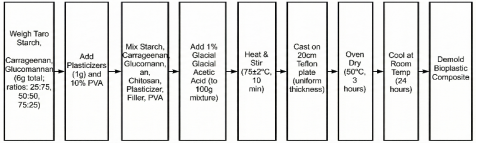
Figure 1. Flowchart of the bioplastic composite synthesis process.
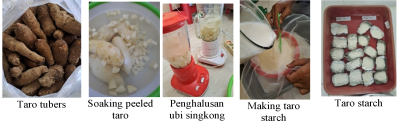
Figure 2. The process of making taro starch.
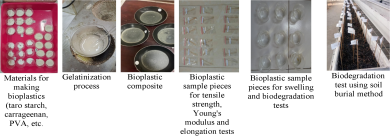
Figure 3. Preparation for testing such as tensile strength, elongation at break, elongation, swelling and biodegradation.
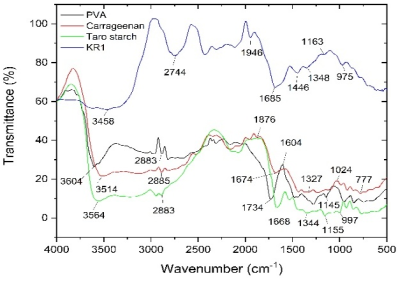
Figure 4. Wave number spectra of taro starch, carrageenan, starch-carrageenan bioplastic composite with castor oil and the best taro starch-carrageenan bioplastic composite.

Information



 Share This Article
 Twitter
 Linked In
 Facebook
 Copy
Copy Download